Diocese, displaced

A major aspect of the violence in South Sudan has been the huge internal displacement of people. The traditional definition of a refugee is someone who seeks safety across an international border. These people are refugees, but in their own country.
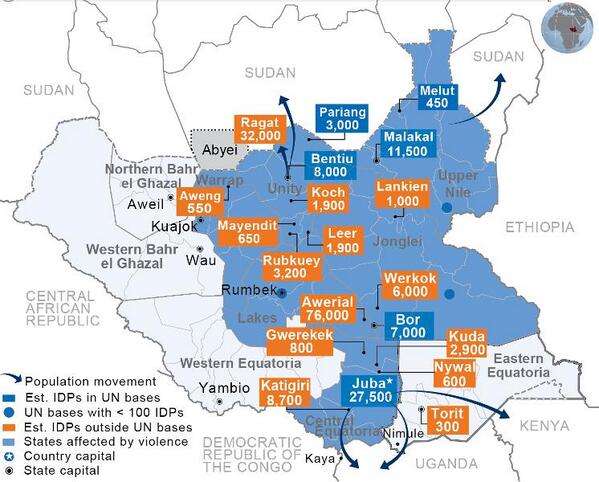
UN map

This week, I have been trying to find out more about the largest number on that map, the 76,000 in Awerial, which is an area of the Diocese of Yirol. As the map shows, Awerial is not far from Bor but the Nile River separates the two. That being said, there is a long history of links between the communities across the river—for trade, for grazing cattle, and to flee violence.

After the 1991 “Bor Massacre,” for instance, a huge number of people did exactly what they’ve done in the last few weeks: flee to Awerial and points west, some as far as Western Equatoria. Others resettled permanently: there is still a large Dinka community in Nimule.

I have had no luck in getting through to people in Awerial itself—phone links seem pretty bad—but I have managed to talk to others in South Sudan who have. It seems a fair guess that among those 76,000 are a goodly number of members of the Diocese of Bor. At least one archdeacon from Bor as well as one rural dean from the diocese are currently displaced to Awerial. Given the strength of the Anglican church in Bor, there are likely many others as well.

Some international media have managed to report from Awerial (the New York Times, the BBC) but it has become clear in my phone calls that we should not think this map tells the whole story. There are many people who have fled to rural communities or into the largely uninhabited grazing areas. These people are even further from the limited relief available in Awerial.

I have written before about how displacement has been a huge shaping factor in the South Sudanese church. Part of the experience of displacement for many South Sudanese, as I noted, is the feeling of isolation and disconnection from the rest of the church, both in South Sudan and around the world. Seventy-six thousand people does not approach the scale of the displacement in 1991—then, it was estimated that seventy percent of the east bank Dinka population was killed or displaced—but it is a lot of people for a part of the world that is rural and remote. I hope we are soon able to learn more about what is going on there and what it means to be the church in this situation.

UPDATE: I just came across this 46-second audio clip describing the conditions these 76,000 displaced people are dealing with in Awerial.
On scholarship and the priesthood

In any given week, I spend a lot of time thinking about Christianity in Sudan and South Sudan. It is, more or less, my job. I’m a doctoral student and my research concerns precisely these topics.

In most weeks, my focus on this research is a quiet affair. Sure, I talk with friends and colleagues about what I am uncovering, think about how it connects to other questions in the field of African and world Christianity, and ponder what the implications are for mission and evangelism in the western world, but for the most part it is just me, my books, and interview transcripts from my oral history fieldwork trips.

In the past two weeks, however, this has all changed rather dramatically. South Sudan has become enveloped in a disastrous spiral of violence. Personally, I have found these developments deeply distressing and have spent a fair bit of time calling friends and contacts in South Sudan simply because I have a great deal of love and affection for them and want to know how they are.

But I have also had a professional reaction to all of this. “Hey,” I thought when this all began, “I know something about this. And I think that what I know could help Christians and others around the world begin to understand the deep complexity of what is happening in South Sudan.” So I’ve been posting material on this blog. Some posts have been historical in nature. Others have reported on my phone calls with friends and tried to provide context to what is going on.

To tell you the truth, I had no particular strategy in mind when I began posting things. I just knew I had information I wanted to get out there and writing is a default response for an aspiring academic. But I gradually began to notice something. People were reading it. They were contacting me to thank me for the background and the context. Aid organizations have asked me to send them what I know. International reporters have been in touch to ask for my contacts in South Sudan. It has been an effort just to stay on top of the e-mail I’m receiving (though don’t let that stop you writing).

For me, my scholarship and my ordination as an Anglican/Episcopal priest are inextricably linked. The Latin word for priest—pontifex—means literally bridge-builder and the idea has a deep resonance for me. As a priest and a Christian, I believe I am to help develop relationships between people and God and between people and one another. I dig deeply into the history of the church in Sudan and South Sudan because I think there is information there that will help all of us be linked more deeply to our sisters and brothers in Christ there. I hope my research also helps build links in the other direction as well.

Sometimes the connection between my research and that bridge-building is not immediately obvious. I can go whole weeks (months, even!) wondering just why I thought it was a good idea to start this degree. But then something like this explodes and the connections become obvious—and painful—once again.

I am not the first to write about this, bit it is worth noting that the Episcopal Church has not historically been a place that is congenial to this connection between scholarship and priesthood. The church, it sometimes seems, prefers to put its emphasis on the new, the trendy, and the novel. History is for boring old fuddy-duddies. Except, of course, as these last weeks have shown, it’s not. People in the church really care about this stuff. My Inbox is testimony to that fact.

The thing about scholarship, of course, is you never know just what is going to be important so you have to support lots of it. But history has a way of rearing its head in unexpected ways. The Episcopal Church is currently debating liturgical changes around same-sex blessings. Surely there is something to be gained from studying the extensive history of acrimonious liturgical revision in Anglican history to see what insights might apply to our current day? But where is the next generation of liturgical scholars in the Episcopal Church? This is one example of many that could be cited.

As we look back on 2013, perhaps one of the most interesting developments in the church is the emergence of the Scholar-Priest Initiative to address precisely these concerns. Scholarship (at a doctoral level or otherwise) and ordained vocations (priestly or otherwise) are intimately inter-related. That’s what the last few weeks have demonstrated yet again for me.

Upending “the slow and laborious task of years”

As I have been reading about South Sudan’s violence over the last few weeks, I have thought often of this quotation attributed to Winston Churchill:

To build may have to be the slow and laborious task of years. To destroy can be the thoughtless act of a single day.

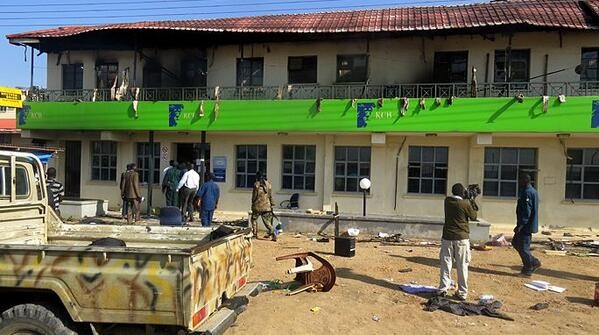
The fate of the town of Bor exemplifies this. Bor had a difficult history during Sudan’s long civil war. But since the 2005 Comprehensive Peace Agreement, Bor has been trying to emerge from this past. When I was there in April, there was a good-sized market and several new buildings that were under construction, including at least two banks. Most significantly of all, I kept meeting young people who had been forced to flee the area during the civil war, been educated abroad, and were now returning, eager to go to work in their new country in which they took great pride. Bor and Jonglei state in general remained a very poor, deeply underdeveloped place but these, I thought, were signs of a very modest, incipient “peace dividend”—the “slow and laborious” building of a new country.

Even before the recapture of Bor by the “White Army” in recent days, I had been hearing reports of the wholesale destruction of the market. Then I saw online this picture of one of Bor’s banks:

00c5c34ee88a2a9f3c9f36f1bcf8e0cd72b7fd54af6a126cfc145e3452fd0bc4

Most significant of all, however, has been the human cost. A friend of mine in Bor recently sent me this brief, devastating message:

I am Traumatized.

My Mam and sister are in Toich {Swamps area} hiding from Nuer fighters. She is over seventy in age. I have no way to help her. May God protect her life.

Secondly, My family is in Nairobi. They will have no help from me this month and on. Now I do not know what will happened to them from Landlord and where to get food. The only hope is that God is the provider.

This friend is one of those who was educated abroad and returned to Jonglei after the peace deal. He is capable, committed, and wants to see a successful South Sudan. Like many other people, he has left his family abroad where the schools are better but has been sending his salary back to them to care for them. Meanwhile, he has also been reconnecting with his family in his rural village and seeing how he can support them. These are exactly the kinds of things that need to happen if South Sudan is to be a success. But now—as this message makes clear—all that has been upended by the “thoughtless act” of the recent violence. He won’t be paid a salary. He can’t contact his family.

I have little doubt that if peace were to return to Bor and Jonglei, the “slow and laborious” work of building the new country would continue. The bank, I am sure, will one day re-open. The market will be re-built. But if you were my friend, you have to ask yourself, “Why bother? Why not just move back abroad, find a job, and live with my family there?” Yet it is precisely these people the country needs if it is to be a success.

Perhaps the most depressing thing I have read appeared in an article in this morning’s New York Times. Referring to an eventual peace deal between Salva Kiir and Riak Machar, Jok Madut Jok said:

The two men will eventually sit down, resolve their issues, laugh for the cameras, and the thousands of civilians who have died will not be accounted for. No one will be responsible for their deaths.

Responsibility. I recognize that in my friend—though sadly not in his leaders.