Who teaches us?

My time at Yale Divinity School is coming to an end. As I’ve been thinking back over it these past few days, I decided to do a little math. The results may only be of interest to me but here’s what I came up with.

In my time at YDS, I’ve taken 22 courses. (You need 24 to graduate. I did a semester abroad, which I’m not counting here.)

Of those 22, 18 were taught or co-taught by male faculty. Seven were taught or co-taught by female faculty. That means only four courses I took were taught solely by a woman.

Nine were taught by ordained faculty members (and one has been ordained since), though I’ve learned that different faculty wear their ordination differently. For some, it barely seems to register in their consciousness.

Four of those 22 courses were taught by non-white faculty, all of whom were male. (And three of those courses, oddly, were taken in the same semester.)

I can’t figure the age breakdown, though I’d guess my faculty have ranged in age from a few years older than me to close to or past retirement.

So what to make of these figures? I don’t think I steered deliberately in any one direction. Many of the courses I’ve taken were required and many of those are taught by white, male faculty.

One thing for sure is that whom we are taught by shapes who we become. The faculty I’ve had courses with are the ones to whom I turn most readily for advice and input on my life and career. How should I feel about the fact that the majority of courses I took were taught by people who are like me? And how will that shape what I do in the future?

Do you think this breakdown is reflective of something specific to Yale or is it generalizable across seminaries?

In any event, interesting questions to reflect on as I prepare to leave this place. Maybe at some point—when I’m really procrastinating—I’ll look back through old syllabi and figure out the breakdown of the books I was assigned to read.
WHMP Interview: “Moving, funny, and edifying”

My interview on WHMP yesterday is now a podcast. The link is here. The interview starts at about 18:00 and ends about 15 minutes later. They call it “moving, funny, and edifying.” I have my doubts but listen and see what you think.

One of my answers surprised me. It was the one on the big lesson I take away from my time in South Africa. I said it was learning about my own helplessness. It just sort of came out but I think it’s right. There’s something to be said for confronting—again and again—one’s own inability to change the world on one’s own. It teaches us something about who we are and our inherent limitations. But it doesn’t end there. It’s only once you’ve realized your own helplessness that you can truly realize God’s never-ending and abundant grace.

Read the book if you want to hear more: it’s called Grace at the Garbage Dump for a reason.

“Episcopal” worship

Every Wednesday night this year, I’ve been involved in the team at Berkeley Divinity School at Yale that has put together the weekly Eucharist for the community. We’ve done all kinds of stuff—historic prayer books, no prayer books, prayer books from around the world, Eucharistic prayers where we—gasp!—change the words (and, for instance, replace all male imagery with female imagery). Each service, we believe, is authentically Anglican or Episcopal and yet there has been wide variety between them.

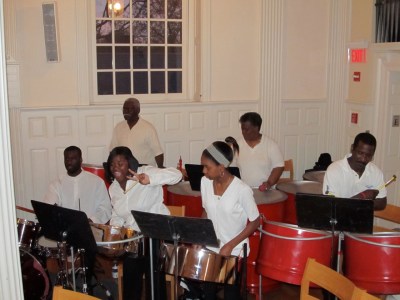
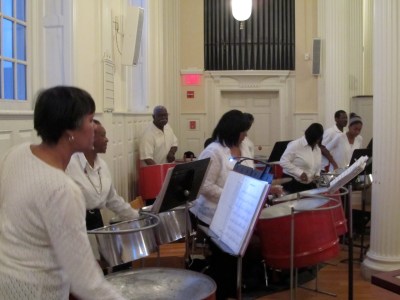
Last night was our mega-mondo, supa-spectacular, everything-AND-the-kitchen-sink, blow-em-out, LAST and FINAL community Eucharist of the year. (I’m working on patenting that phrase, by the way.) It lived up to its billing. We had Anglican chant, a beautiful choral anthem, a major organ prelude, a french horn, and—to top it all off—the steel band from St. Luke’s Episcopal Church in New Haven.

All I can say about their performance is that it is a really good thing the chapel doors have good hinges. Otherwise, they would have been totally blown off by the sheer quality of the music. (You can hear some sample clips here but nothing compares to the real thing, especially in a place with acoustics as good as our chapel’s.)

And it all raises a really interesting question: worship is supposed to be a unifying feature for Anglicans. But what makes worship Anglican or Episcopal? And how can we tell when we see it?

(And another question: how much does the music used in a service have to have a certain “unity” to it? Based on last night, hardly any at all!)

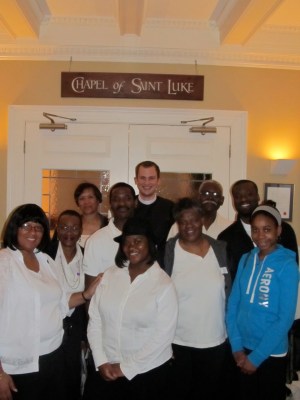
St. Luke’s is the wonderful church I’ve been a part of during my time in New Haven and it was wonderful to have them at Berkeley where we have our own chapel dedicated to Luke.

Isn’t it great…

…when you have a book signing and it’s standing room only?

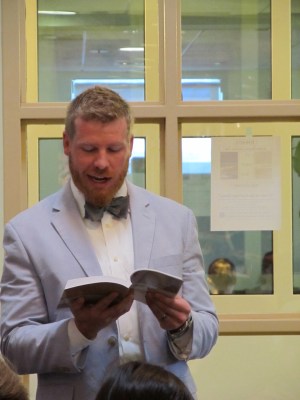
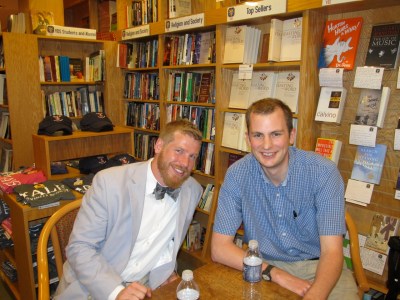
That’s what Stephen Register and I had today at the Student Book Supply at Yale Divinity School. Each of us read from our books—his is Meantime: The Aesthetics of Soldiering, mine is Grace at the Garbage Dump: Making Sense of Mission in the Twenty-First Century—and then started signing… and just kept on going. We sold out the stock the store had on hand (fortunately I had some extra copies handy, which had sold out by the end of the day. They will be re-stocked in the morning if you still haven’t got your copy.). I was especially grateful so many people came out at such a busy time of the semester.

It was a particularly sweet moment since both Stephen and I were in the same spiritual writing course last spring. Now, here we were signing books together. (That’s Stephen on the left; I wish I looked that good in seersucker.) That course, incidentally, was taught by Lauren Winner, who also has a new book out this spring: Still: Notes on a Mid-Faith Crisis. (We read it in draft form in class and it is excellent.)

And the really encouraging thing is that there were ten other people in that class, all of whom are exceptional writers working on fascinating projects. I hope that today’s is not the last book signing to come out of that class!

I’ll next be signing and selling books at the Global Episcopal Mission Network’s annual conference in Ivoryton, Connecticut on Friday, May 4. I’ll also be selling books in Hendersonville, North Carolina as part of African Medical Mission’s fundraising weekend, May 5 and 6. (Details of events beyond that weekend are here.)

Want to set up an event? Let’s talk: jessezink [at] gmail [dot] com.

A Spirituality of Mission

Tell me if this sounds familiar.

You’re off “helping the poor” somewhere—soup kitchen, homeless shelter, outdoor church ministry, wherever. This is great. You’re participating in “mission,” which has become the buzziest buzzword in the church in recent years.

But the focus has become the actual task at hand: making the sandwiches to feed the people at the outdoor church, cutting the carrots to make the soup. Somehow, the focus on the people you were supposed to be working with has been lost, subsumed beneath the never-ending mountain of need you’re encountering.

I know this feeling well—extremely well, as a matter of fact. When I was a missionary in South Africa, it was easy to let the tasks at hand overwhelm the reality that what mattered was building relationships with the people in the community where I worked. Since I’ve been back in the U.S., I’ve seen these same dynamics at play, like the time I helped a group make sandwiches for an outdoor church and then, when we arrived, watched as our group, myself included, handed out the sandwiches with utmost efficiency—and nary a word spoken to any of the people attending the church. Watching the situation I thought to myself, “Hmmm… something’s missing here.”

Mission is not a cost-free enterprise. It’s not something that we can fit into a little box—Sunday afternoon, 2 to 4, mission—and then go on with the rest of our life. It’s about an approach to life, one that demands that we engage with those who are different than us, whether they are just down the street or halfway across the world. It’s what Jesus did when he chatted with the woman at the well. It is, ultimately, what God in Christ did in the moment of the Incarnation, coming to we who were “far off” and engaging with us. Difference exists in this world (and we are ever more aware of it as our world is drawn closer and closer together). Mission is what happens when we encounter it in a Christ-like way.

And it’s all kind of scary and unsettling. It’s much nicer to have all the answers—to know exactly how many sandwiches we need or how many gallons of soup—than to have none but strike up a conversation and see where it leads. But if we want the Gospel to unsettle the world, it must first unsettle us.

One thing that is missing, then, from the church’s conversation about mission is what might be called a “spirituality of mission.” I owe this phrase to the work of Gustavo Gutierrez, who has written of the need for a “spirituality of liberation” to go along with his theology of liberation. His question is how to get people who are poor and oppressed to see that liberation can begin with them, in spite of the years of oppression.

How do we become the people who can overcome our fear and reach out to those who are different than us? We do that by cultivating our relationship with God in Christ, the one whose most frequent teaching was “fear not,” and who modeled exactly what the fearlessness looks like and exactly where it can lead.

What gives you the spiritual resources to continue to engage in God’s mission in the world?

Two Great Books, One Great Place

I’ll be reading from and signing copies of my new book, Grace at the Garbage Dump, at the Yale Divinity School bookstore on Tuesday, April 17, at 12:30pm.

What makes this a particularly special event is that it is a joint event with my friend and fellow author, Stephen Register. Stephen’s new book is Meantime: The Aesthetics of Soldiering, and is about his journey from military service in Iraq to Yale Divinity School. Stephen and I were in the same writing group and have read each other’s work in draft form. So it’s a delight to see his work published—his writing is vivid and honest, and gives those of us who haven’t served an honest window into the life of a soldier. It is well worth the read, particularly as the country begins to grapple with the sheer number of returning veterans in our midst.

Tuesday, April 17, 12:30pm, Yale Divinity School bookstore, 409 Prospect St. Free pizza while it lasts!

Episcopal / Anglican Slogans

Last semester in class, we made a list of slogans, phrases, ideas, objects, etc. that we’ve heard in conversation about or relating to the Episcopal Church, Anglicanism, or any part thereof. Here’s a partial list:

  • the three-legged stool (that is, Scripture, Tradition, and Reason)
  • lex orandi, lex credendi—the way we worship shapes/determines/is what we believe
  • a logo that features a shield with obscure heraldry
  • “no outcasts”
  • Via Media, or Middle Way
  • “The Episcopal Church Welcomes You” (to what?)
  • Dispersed Authority
  • The Four-Fold Anglican Shape: formed by Scripture, shaped by worship, ordered for Communion and directed by God’s mission (this is the most recent, I’d say)
We can debate some of these later, especially whether their current interpretations and usages match up with the original usage, whether the authors meant for them to have such defining weight (in the case of dispersed authority, definitely not), and whether they are even consistent. What struck me as we did the list is that you could make a similar list of slogans related to Episcopalians/Anglicans and mission:
  • Mutual Responsibility and Interdependence in the Body of Christ (1963 document from Toronto Anglican Congress)
  • Partners in Mission
  • Decade of Evangelism (the 1990s, as set by bishops at Lambeth 1988)
  • Millennium Development Goals
  • Five Marks of Mission

(Indeed, the word “mission” itself could almost be added to this list, given the reckless abandon with which it has been used in recent years.)

I don’t find many of these particularly helpful. I can never remember the Five Marks of Mission, mainly because they don’t really grab me. I think the Millennium Development Goals promote a shopping-list mentality among churches that prize dollars and cents over relationships. The Decade of Evangelism is very well-remembered in the non-western Anglican Communion (an archdeacon in Nigeria last summer told me, “The Decade of Evangelism saved the Church in Nigeria”) but I rarely hear anyone in the U.S. talk about it.

The thing of it is, despite our wonderful slogans we still seem to have difficulty articulating what the Episcopal Church is and is for (though we seem to have no problem articulating what it is not). And, we lack a clear sense of what mission is, which results in something like the Sauls’ resolution’s very thin idea of mission.

There is much to find depressing in all this but two stand out. First, these slogans replace genuine theological engagement with inconsistent and confusing sound-bites. Second, they betray the assumption that we all know what we’re talking about when we say something so we don’t need to bother figuring out what it means. This is never a good assumption to make.

As far as mission goes, there’s a third disappointment: all of these are focused outward. This is, obviously, quite good. But I’d hope that we remember that in order for us to be a missional church, we need first to be transformed by the love of God in Christ to become missional Christians. Mission is our response to God’s grace—but we need to receive that grace before we can respond.

What are your favourite slogans that I’ve left out?

UPDATE: Welcome to all who are clicking over here from Episcopal Cafe. If you like this post, you might like some others I’ve written about mission lately: the spirituality of mission or how our understanding of mission shapes our budgetary decisions.

House of Commons Report Calls for More Support for Episcopal Church of Sudan

From time to time on this blog, I go on about how in many parts of the world, it is the church that is the main organization in society able to deliver goods and services to the people. I’ve found this to be true, for instance, in South Sudan where the weak government struggles to make its presence felt while the church is in every last village and community.

The church isn’t perfect but at least it’s there and provides a basic sort of social infrastructure. It was a view best summarized for me by a Sudanese priest who told me last summer: “We are the church. We are always on the ground!” Unfortunately, as I’ve noted before, western media seem incapable of understanding what a different role the church plays in a non-western context.

There’s a new report from the British Parliament’s International Development Committee that reaches this same conclusion and calls for its own Department for International Development to be more intentional about partnering with the church.

This is particularly true on education, say the report’s authors:

When allocating funds for its development projects, DFID should as far as possible seek to strengthen and complement the limited internal capacity that already exists within South Sudan. We have some concerns that DFID’s decision to fund the United Nations rather than the Episcopal Church of Sudan to deliver its school construction programme misses an opportunity to do so.

The same is true for the important work of peace-building and reconciliation that is going on in South Sudan. The report highlights the role people like Archbishop Daniel Deng Bul of the Episcopal Church of Sudan have played in negotiating peace in some very difficult situations:

It will clearly take time to build the capacity of the GRSS, army and police to take on primary responsibility for peacekeeping and mediation. In the meantime, DFID must not disregard the constructive role that the Sudan Council of Churches can play in this area.

Reports like these are easily lost in the swirl of government paperwork and I don’t expect any major changes in policy. And it’s worth noting that the report has a bleak outlook on the immediate future in the world’s newest nation—that is probably the major take-away here. Still, it’s nice when the government can start pointing out what has long been obvious to all involved, and maybe begin to shape policy in new directions.

“Moral Realism” about Christian service

In his column today, David Brooks encourages those in my generation committed to service around the world to develop a sense of “moral realism” by reading novels by folks like Hammett and Chandler:

There’s only so much good you can do unless you are willing to confront corruption, venality and disorder head-on….

A noir hero is a moral realist. He assumes that everybody is dappled with virtue and vice, especially himself. He makes no social-class distinction and only provisional moral distinctions between the private eyes like himself and the criminals he pursues. The assumption in a Hammett book is that the good guy has a spotty past, does spotty things and that the private eye and the criminal are two sides to the same personality.

Christians say something similar, only we use words like sin, grace, and forgiveness. Christians know that “corruption, venality, and disorder” begin at home, within ourselves. The point that I make in my new book, Grace at the Garbage Dump, about my years as a missionary in South Africa, dovetails neatly with what Brooks has to say: we can be committed to changing the world all we want, but unless we are also committed to changing ourselves then we will get nowhere.

When I first showed up for work in a shantytown community in South Africa, I was committed to making the world a better place, “solving” the problems of global poverty and poor health. Naturally, with an attitude like this, I fell immediately and repeatedly flat on my face. It wasn’t until I began to realize that my attitude towards and outlook on the world and my work needed to change. I had to be willing to confront my fears head-on, instead of burying them in a welter of emotions about world change. I had to be willing to build an actual relationship with someone who seemed markedly different to me and whom I wanted to treat not as a person but as an object whose problems needed to be solved.

Historically, the Christian tradition has seen baptism as the moment when we are received, forgiven, and transformed by God in Christ. We remember this moment each time we celebrate the Eucharist. In my Episcopal Church, however, baptism is now seen as a moment of “commissioning” to join in God’s work in the world. This is right, more or less, except I get the sense we’re sometimes leaving off the part about the personal transformation and focused solely on the world’s transformation. When we do that, we end up eliding a huge part of the Christian tradition and becoming more or less like the folks Brooks is writing about.

The world needs to change, true. But change begins at home.

Demographics is Destiny – Evangelicalism and Anglicanism

Last night, our community service at Berkeley Divinity School was in the style of Anglican evangelical worship—think Holy Trinity Brompton or Holy Trinity Cambridge: praise band, a Eucharistic prayer I wrote which only quoted the writings of St. Paul, the whole works.

The idea behind the service was to challenge our understandings of what constitutes distinctively “Anglican” worship. Evangelical churches may worship in ways other than those set out by the prayer book but still consider themselves Anglican. (I experienced something of this when I was studying in England a while back.) There was some, predictable, grumbling about the service. Evangelicalism, for a variety of reasons, has historically been weak in the American church so it can seem particularly foreign to us.

By chance—and this is the kind of thing that happens when you go to a place like Yale/Berkeley—we had with us last evening principals of two English theological colleges, Martin Seeley of Westcott House and George Kovoor of Trinity Bristol. (Rev. Kovoor is also the international general secretary of the Evangelical Fellowship of the Anglican Communion, which, I think, raised the stakes for our praise band a bit. They rose to them. Of all the guests to have on all of the nights, this was pretty ironic.)

Westcott is a moderately Anglo-Catholic place where I once spent a term. It has maybe 70 to 80 students training for ordination. I was chatting with Rev. Kovoor after the service and learned Trinity Bristol has 160 students training for ordination in the Church of England. Now, these are not the only training colleges in the Church of England, but these numbers should, I hope, give pause to those of us who sometimes are eager to dismiss evangelicalism as not truly Anglican (as if we can somehow get to decide that). If demographics is destiny, it seems like the evangelical wing of the church is certainly in a good position.

And, if one purpose of our seminary training is about learning about the breadth of the church and preparing for the future church, then a single evening of evangelical worship seems like a very good thing.

Our senior student preacher, Josh, put his sermon on YouTube