Grace at the Garbage Dump Published!

Cascade Press has published Grace at the Garbage Dump: Making Sense of Mission in the Twenty-First Century by the Rev. Jesse Zink. The book is a theological memoir and reflection on the importance of mission drawn from Jesse’s years as a Young Adult Service Corps missionary of the Episcopal Church in Mthatha, South Africa.

The book is being widely praised. Brian McLaren says Jesse Zink is “talented as a writer, honest as a Christian thinker, and smart as an activist—exactly the kind of voice we need.” The bishop of Connecticut, Ian Douglas, says “I can think of no more exciting study of Christian mission than Jesse’s book. It is a welcome resource to the many people who are looking for a meaningful and contemporary presentation of what God is up to in the world today.” Read more about what people are saying.

Here’s the text on the back of the book.

Like many young people in his generation, Jesse Zink had long been eager to work overseas and make the world a better place. As a missionary working in a shantytown community in South Africa, he found all that and much more—in demanding, unexpected, and surprising ways.

Grace at the Garbage Dumptakes readers with Jesse through his years in South Africa: struggling with AIDS patients to get life-saving drugs, coaching women through a micro-credit program, and teaching preschool students to sing (and dance) to “Johnny B. Goode.” It’s a story that leads us to a deeper understanding of our world and is at once hopeful and uplifting while also being credible and serious.

The headlines are dominated by disaster and despair but young people remain passionate about service to the least among us. Grace at the Garbage Dump is an invigorating call to respond to the difficulties of our time with an active and engaged faith. Whether you end up at the local soup kitchen or halfway around the world, you’ll be challenged to seek God’s grace in even the most adverse circumstances.

The best and cheapest way to get a copy of the book is directly from the publisher.

How “mission” shapes budget

Here’s an example about how the Episcopal Church’s failure to have a conversation about what we mean by mission produces contested and confusing budgetary decisions.

The budget proposed for the next three years in the Episcopal Church adds close to $700,000 for the Office of Government Relations, to be focused on anti-poverty advocacy. Great! All Christians can get behind anti-poverty advocacy, right?

Except that it comes at the expense of other programs. More than a million dollars cut from funding the work of the Anglican Communion Office. Close to three million cut from the budget for youth programs.

The first thing to note is that these are policy decision being made without, to my knowledge, policy debates being had. I used to be a reporter and covered lots of budget debates in lots of organizations. One realization I always came away with is that how a group spends—and doesn’t spend—its money reflects its values.

The closest Episcopalians have come to a conversation about budgetary priorities is the constant repetition in the church of the word “mission” without any clarity as to what that word means. And since, as we’ve seen, one influential document defined our mission as simply being what Jesus says in Luke 4, spending more money on anti-poverty programs makes a lot of sense; “good news to the poor” and all that. (Of course, in the rest of the Gospel of Luke, Jesus spends precious little time with people we would identify as “the poor,” raising questions about how to interpret this passage. But that’s an exegetical conversation for another time.)

What if we defined mission a bit differently? This is not the place to lay out a full-blown missiology but what if we said that God’s mission is the restoration of right relationship between humans and between humans and God? (Our catechism says something very similar.) What if we saw relationships as being at the centre of our role in God’s mission? What if we thought that in the Incarnation, God in Christ takes relationship to a whole new level, crossing the barrier between divine and human and engaging with those who are different in a credible, costly, and vulnerable way?

In short, what if we said that mission is about building meaningful relationships with those who are different than us as we work towards that glorious day when there will be “a great multitude that no one could count, from every nation, from all tribes and peoples and languages, standing before the throne and before the Lamb, robed in white, with palm branches in their hands. They cried out in a loud voice, saying, ‘Salvation belongs to our God who is seated on the throne, and to the Lamb!’” (Rev. 7:9-10) Although in our polarized and fractured world we demonize and mock those who are different than us, the witness of Scripture is that, at the end, all of us who are different will be united in one. We might as well start working towards that, and, in the process, follow the example of Christ who engaged with difference in a way no one had ever seen before or since. It would be a powerful, counter-cultural model to the world around us if the church could be an incubator of heterogeneity rather than a mere simulacrum of the world’s drive towards homogeneity.

If we said all this, we might have different priorities. We’d spend our money on a place like the Anglican Communion Office so it can continue its important work of bringing together different people from different backgrounds and different parts of the world to find common ground in projects like Continuing Indaba and the Bible in the Life of the Church. We’d make sure that the Episcopal Youth Event stays in business so young people from different backgrounds can engage in meaningful, Christ-centred interaction in a way they get almost nowhere else.

But we might not increase funding for the Episcopal Public Policy Network, making the painful decision that in a time of limited funds, policy advocacy is not part of the church’s unique charism.

You might disagree with these ideas (and you’ll note undoing EPPN’s additional funding doesn’t produce enough to fund EYE and the ACO) or you might have different ideas for moving money around in the budget. Terrific! What I wanted to illustrate in this post is the impact of not talking seriously about mission. My hope is that the church can begin to have a conversation about its budget—and the future of the church—that grapples with the missiological issues at stake.

If we’re going to place “mission” at the centre of everything, could we at least start talking about it?

How? or Why? And what’s the mission?

A friend who has read Diana Butler Bass’s latest book told me the other day about a point Bass makes repeatedly. Basically, as I understand it, Bass argues that the church has been too busy asking how questions that it no longer asks why questions.

I haven’t read the book but the insight struck me as true. We ask ourselves how we are “doing” church but we don’t talk about why we are bothering with it. Ashes To Go, an exciting idea that takes the imposition of ashes out of the church on Ash Wednesday, is still basically a how conversation. How do we impose ashes, not why are we bothering with this liturgy? What does Ash Wednesday mean in this day and age? (Why and what questions are closely related.) Perhaps, we think, the answer to the why questions are obvious but few things with Christianity ever are.

These questions are particularly pressing in the Episcopal Church as we prepare for a General Convention this summer that will be asked to make decisions about restructuring and pass a budget that deals with the painful reality of substantially diminished income.  Both these questions—restructuring and budget—are how questions. How do we be a church and spend our money in light of the realities of church life in 2012?

The answer that has been given to the underlying why questions is, simply, “mission.” We are told we must be structured for mission and we must spend our money on mission. But what is mission? Why is it important? This conversation does not appear, to my knowledge, to have been had. And it is a particularly important conversation to have because mission is in danger of becoming a buzzword, meaning different things to different people and so losing its force in dialogue.

To take one example, the Chief Operating Officer of the Episcopal Church, Stacy Sauls, last year proposed a resolution calling for a special convention on church structure. It reads, in part: “The Special Commission shall be charged with presenting a plan to the Church for reforming its structures, governance, administration, and staff to facilitate this Church’s faithful engagement in Christ’s mission to proclaim good news to the poor, release to the captives, recovery of sight to the blind, freedom to the oppressed, and the acceptable year of the Lord (Lk. 4:18) in a way that maximizes the resources available for that mission at all levels of this Church.”

The text thus claims to answer the why mission? question. It does so in a way that is faithful to scripture by pointing to Jesus’ “inaugural address” in the Gospel of Luke. (We should note, of course, that Jesus is here quoting the prophet Isaiah. There is little thought given in this resolution to what Jesus “adds” to this Isaianic mission, though of course he must add something or the Gospel would no longer be good news but good olds.)

But is Luke 4 the only way to think about mission? Hardly.

What about when Jesus says, “I have come that they may have life and have it more abundantly”? (John 10:10) Or when Jesus is asked what to do to perform the works of God and he replies, “This is the work of God, that you believe in him whom he has sent”? (John 6:29) What about when Abraham is told that if he follows God’s commands to get up and go, “in you all the families of the earth shall be blessed” (Genesis 12:3), a promise repeated in Genesis? What about Jesus pre-resurrection commands to “to proclaim the kingdom of God and to heal” (Luke 9:2) and post-resurrection commands to, famously, “Go therefore and make disciples of all nations, baptizing them in the name of the Father and of the Son and of the Holy Spirit, and teaching them to obey everything that I have commanded you”? (Matthew 28:19-20) There’s a whole whack of Pauline passages to consider as well, of course.

None of these are contradictory and all form a piece of the mission to which we are called as followers of God in Christ. Nor is God’s mission necessarily something best learned by pointing to individual passages. Rather, I’d have us consider the entire witness of the people of God as recorded in the Bible. But these few verses certainly complicate the picture of mission put forth in the Sauls resolution.

The recently-released budget for the next three years of Episcopal Church spending points up exactly why we need to be having a conversation on what we mean by mission. While the narrative to go with the budget mentions mission in its first paragraph, there is almost no explanation as to what the budget drafters think the word means. The result is that the conversation about the budget has been almost entirely about how questions, not why ones. Every decision in the budget is one rich with missional implications—cutting funding for youth events but increasing it for policy advocacy is a missional decision, for instance—and I want to talk about the what and the why before talking about the how.

Here is a non-exhaustive list of questions I’d like to think about in the run-up to General Convention

  • What is the mission to which we are called as followers of God in Christ?
  • What does the church have to offer the world in this generation?
  • Why is the Christian witness significant/important/meaningful in this time and place?
  • Why does the Episcopal Church exist? What is the unique offering that Episcopal followers of God in Christ can make to the world?

I have some thoughts on all these questions and hope to get around to sharing some of them. For now, though, I hope we can change our budget and structure conversation away from one that pits Episcopalians against one other in a scarce fight for money and power and towards one that starts asking what and why before asking how.


“Get up and go”

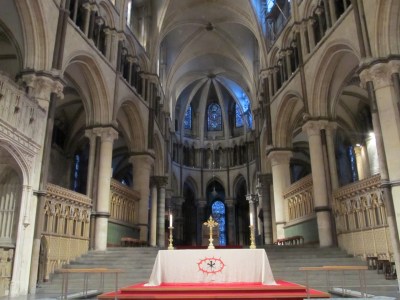
I’ve just returned from pilgrimage to Canterbury Cathedral in England, the “mother church” of the Church of England and the Anglican Communion.

There is much that is moving about Canterbury—the site of Thomas Beckett’s murder, the throne of St. Augustine, the lively and vibrant congregational life that makes this cathedral no different than a country parish on Sunday mornings, the fabulous choir that leads Evensong every day.

But what I found memorable was the visit—in the rain—to St. Augustine’s Abbey a short way from the cathedral. Augustine was sent by Pope Gregory in the late sixth century to evangelize the Anglo-Saxons. Augustine set off but got cold feet and turned around in France. When he returned to Rome, Gregory sent him off again—this is immortalized in stained glass in Lambeth Palace that has Gregory pointing and saying to Augustine, “Go!”—and Augustine eventually showed up in what is now Kent.

There, he met Queen Bertha, who was from the Continent and already Christian. Together, the two of them set about evangelizing the area, eventually converting Bertha’s husband, Ethelbert. And so Christianity was reintroduced to this part of the world.

The ruins, from the cathedral tower.

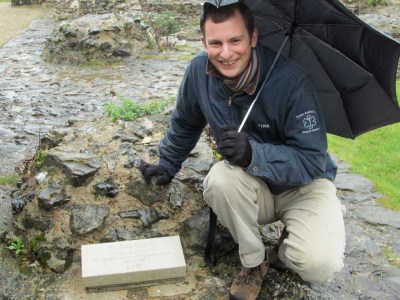
Augustine is buried in the abbey and his grave is a pile of stones. Our group thought about what it says about Anglicanism that our notional founder is buried in such modest style. The contrast with, say, St. Peter’s Basilica in Rome, is stark.

For a long time, the abbey in Canterbury was a major centre of religious life. But then the Reformation came along and Henry VIII shuttered the monasteries. The abbey was put to a number of purposes but eventually abandoned and left to fall further into ruins.

In the nineteenth century, this began to change. A missionary college was built near the ruins and the ruins were preserved. Thus, at the same site at which Augustine arrived after being told to “Go!”, scores of British missionaries were trained to go out into all the world, spreading the Gospel, and laying the foundation for our contemporary Anglican Communion.

For all that we get squeamish these days when we recollect the mission past, when I was standing in the ruins of St. Augustine’s Abbey last week, the word “Go!” was sounding in my head like a gong. Movement—across barriers and boundaries of language, culture, race, class, sex, identity, and so on and so forth—is at the heart of our Christian faith and the abbey ruins reminded me powerfully of it.

The signboards at the ruin call the abbey an “early foothold of Christianity in England.” We know, of course, that Christianity is on the wane across Britain. I wondered if in the future there will be more such ruins, and if this former abbey, once a harbinger of what Christianity would look like in the British Isles, is now a harbinger of the shape of Christianity in generations in come.

We returned to the cathedral for Evensong that day and the lesson was from Genesis 12. God said to Abram, “Get up and go to the land that I am showing you.”

The Commemoration of Stephen F. Bayne, Jr., January 18

On many days of the church year, Episcopalians commemorate figures from the past who are models and exemplars of holy living and Gospel witness. These people range from Ignatius of Antioch (Oct. 17) to Jonathan Daniels (Aug. 14) and everyone in between. There’s a big new revision of this list called Holy Women, Holy Men that is the result of years of hard work.

But there are many figures who are not in HWHM who deserve to be remembered. For me, one of those figures is Stephen Fielding Bayne, Jr. I’ve written a commemoration in the style of Holy Women, Holy Men and encourage you, if you are able, to use it in your worship life. Bayne died on the same day as St. Peter so you might want to commemorate him (as we do with others), the day before or the day after.

The commemoration is below. Who else do you think deserves to be commemorated?

Stephen F. Bayne, Jr.
Bishop 1974

Psalm 133, Romans 12:1-8, John 20:19-23

Collect
Gracious God, whose Son prayed that his followers might be one, we remember in thanksgiving this day your servant Stephen Bayne; inspire in your global church the same passion for unity which shaped his ministry; deepen our relationships in a spirit of mutual responsibility and interdependence, and empower us to be servants of your reconciling Gospel; through the same Christ our Lord who with you and the Holy Spirit lives and reigns, one God, for ever and ever. Amen.

Preface
for Pentecost

Biography
Stephen Fielding Bayne, Jr. was the first executive officer of the Anglican Communion, helping Anglicans around the world understand why their worldwide Communion was important in the challenging post-war years.

Bayne was born in New York City on May 21, 1908. After studying at Amherst College and The General Theological Seminary, he was ordained a priest in 1933 at the Cathedral of St. John the Divine. He served parishes in St. Louis and western Massachusetts, and as chaplain at Columbia University and to the navy during World War II. In December 1946, without informing him he was a candidate, the Diocese of Olympia elected Bayne their bishop. During his episcopacy, he presided over a growing diocese and remained an active scholar, contributing a volume on Christian ethics to the Church’s Teaching Series and writing several other books.

At the 1958 Lambeth Conference, Bayne chaired the committee on “The Family in Contemporary Society” and distinguished himself for the way he navigated difficult issues of sexuality. Bishops at the conference approved the idea of a creation of an “executive officer” for the growing Anglican Communion. Archbishop Geoffrey Fisher invited Bayne to fill the position. Bayne accepted and began work in January 1960. The Anglican Communion was at a crossroads. The demise of the British Empire, the growing ecumenical movement, and a sense that the world was changing challenged Anglicans to determine what it is that held them together.

Bayne’s tenure was marked by his unrelenting travel, on average 150,000 miles a year, to provinces of the church all over the world. It was said of him that “Bishops come and go but not as much as Bishop Bayne.” Declaring the need to make “a frontal attack on provincial and national narrowness,” he emphasized the importance of relationships among Anglicans and developed many new communication instruments—including the Anglican Cycle of Prayer—to facilitate this. Everywhere he went, he emphasized the mission of God, urging Anglicans to figure out what God was already doing in their midst and then join in that task.

The apex of his time as executive officer was the 1963 Anglican Congress in Toronto. There, delegates approved a document drafted primarily by Bayne titled “Mutual Responsibility and Interdependence in the Body of Christ.” MRI called for new patterns of being Anglican marked by “the birth of entirely new relationships” and declared “our unity in Christ…is the most profound bond among us, in all our political and racial and cultural diversity.” MRI—and Bayne—was widely hailed as a break with an outdated Anglican past, even appearing on the front page of The New York Times.

Bayne stepped down as executive officer in 1964. He narrowly lost the election for presiding bishop that year but still accepted a position at the Episcopal Church Center in New York. As a bishop, he chaired the heresy investigation of Bishop Pike. In 1970, he returned to General Seminary as professor and later dean. He died on January 18, 1974.

(Photo from An American Apostle: The Life of Stephen Fielding Bayne, Jr. by John Booty.)

World AIDS Day at Yale Divinity School

I spoke at our service commemorating World AIDS Day today in Marquand Chapel at Yale Divinity School.

Here’s what I said:

My friend Pakama lives in a place called Itipini, a shantytown community built on the landfill of small city in South Africa, the country with more HIV-positive people than any other in the world. I worked in a clinic in Itipini and when Pakama first came there three years ago, she was weak, gaunt, and emaciated. Her collar bones poked through her shirt. She had AIDS and tuberculosis.


I helped her navigate the complex health system, looking for the right combination of drugs to treat her diseases. I knew anti-retroviral therapy for AIDS was incredibly effective but I wasn’t sure Pakama was healthy enough to make it through the system in time. She lost the energy to walk and I had to lift her in and out of the car and carry her to appointments. She lay in bed in her shack the rest of the day. Each morning, as I drove to Itipini, I mentally prepared myself to hear the news that she had died the night before. In those weeks of traveling through the health care system with Pakama, her brother and aunt, both of whom were HIV-positive, died of the disease. I didn’t have much hope Pakama would be different.


It took a long time and a lot of work but she got started on ARVs. There was no sudden shift, however. She was still weak and thin – but alive. There were other patients to look after and  I saw less of Pakama. Then, I was away for a few weeks. When I returned, the first thing I did was seek her out. 


I found her in front of her shack washing clothes. She smiled broadly to see me again and asked how I was.


“I’m fine,” I said. “But I want to know how you are. Can you walk?”


“Yes,” she replied. She was supporting herself just fine while washing the clothes but I needed to see for myself. 


“Show me,” I said. 


She gave me a look that said, “What does he think? Of course I can walk by myself.” But she humoured me. Without struggle or undue effort, she casually walked down one side of the shack and back to the door and then turned to look to see if I was satisfied. I was. She was like a whole new person.


When I worked in South Africa, friends at home often asked me if there was hope in the face of the HIV/AIDS pandemic. On that glorious day when I saw Pakama stroll back and forth in front of her shack, I knew the answer is definitively yes. I saw Pakama again this past summer when I went to visit Itipini. Her weight has nearly doubled and she has a small fruit stand in town that enables her to pay school fees for her children.


But as I read the news last week about the craven decision by the international community to effectively kill the Global Fund to Fight HIV/AIDS and Tuberculosis, I wonder about Pakama’s supply and whether next year on this day I’ll still be able to point to her as a story of hope.

It’s worth noting that the clinic I worked at in South Africa was church-related and church-funded. Across Africa, churches are on the front lines of the HIV/AIDS epidemic. The funding cuts to the Global Fund seem to be an excellent opportunity for the church – in Africa, in the United States, in Europe, working together – to seize its prophetic role and work to overturn the decision.

What you should really read, though, is former UN Envoy Stephen Lewis’ statement on the gutting of the Global Fund, which I heard him deliver on Monday of this week in New Haven. I’d post an excerpt except the whole thing is incredible.

Shoulder-to-shoulder

Here’s the kind of story that rarely gets told in conversations about Anglican unity, though I suspect it’s more common than we might think.

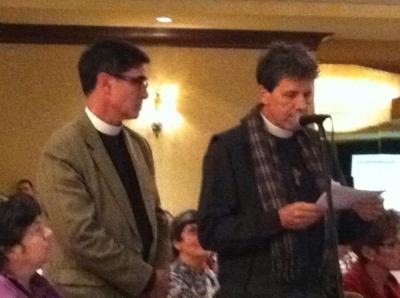
This is a picture of two priests – Len (right) and Rob – in my diocese, Western Massachusetts, at our diocesan convention last weekend. Both are rectors of good-sized churches and well-known around the diocese.

I didn’t know either particularly well but before last weekend. But I knew enough to know they’d probably be on opposite sides of any conversation about sexuality-related issues. Len is the more conservative, Rob the more liberal.

There were two resolutions up for debate at convention, both related to encouraging the blessing of same-gender marriages in the diocese. Several people got up to speak on the resolution, some in favour, others against, all with varying degrees of articulateness and emotion. It was a fine display of the kind of church democracy that is foundational to the governance of the Episcopal Church: a bunch of people, in a hotel ballroom, on a Saturday afternoon, trying to discern what God is calling the church to do.

I noticed Len and Rob standing by the same microphone waiting their turn to speak. It struck me as odd that they would wait together when there was another microphone with a much shorter line.

Len spoke first. He recalled how he had testified at General Convention 2003 against Gene Robinson’s election as bishop of New Hampshire. He mentioned that because the one thing he remembered most of all was how there seemed to develop a de facto split in those waiting to testify. Those in favour at one microphone, those against at another. At our convention, Len said, he wanted to stand shoulder-to-shoulder (almost literally) with his friend and brother in Christ Rob to show that although they disagreed on the issues in the resolution, it was not going to be an issue that would impede their sharing of Christian unity.

Len went on to explain why he disagreed with the resolution and would vote against it. Then he stepped aside and Rob stepped up. He explained how much he respected, admired, and cared for Len and how they disagreed on the issues under consideration. But nothing, he said, would take away from his respect for Len and his belief that they were equally members of the body of Christ. (I’m paraphrasing from memory here as I wasn’t taking notes.) Then Rob explained why he supported the resolution and would vote for it. Then they both sat down.

I have a whole stock of stories about the church in Nigeria, Sudan, South Africa, Uganda, Ecuador, China, and numerous other places that I tell to Americans about how committed and eager Anglicans in other parts of the world are to share in God’s gift of unity to the worldwide body of Christ. Len and Rob have given me a story I will take with me when I travel again.

Both resolutions, it should be noted, passed. But delegates, mindful of the global reality of the church, also passed a third resolution, that read as follows:

RESOLVED that the 110th Convention of the Diocese of Western Massachusetts affirm its commitment to Christ’s missional prayer “that all may be one…so that the world may believe” (John 17:21); and be it further

RESOLVED that the 110th Convention of the Diocese of Western Massachusetts declare its belief that the church can be an instrument of unity and reconciliation in a fracturing world; and affirm its earnest commitment to deepen our relationships across the Anglican Communion both by seeking to explain to our sister and brother Anglicans around the world our response to the Gospel of Jesus Christ in our context and by committing to listen and learn from them, all in a spirit of Christ-like humility, vulnerability, and gentleness.

Yes, there are disagreements and we should talk about them, explore them, and question them. But they need not divide.

And yet we persist in thinking otherwise.

Small Steps

I’ve spent the last week in Mthatha, South Africa, my former home, visiting the people I used to work with at the Itipini Community Project. There were far too many people to catch up with in far too short of a time. Two years is a long time and people have changed – as I have, presumably.

For me, it was a lesson in small steps and little victories. Many people I once knew are now dead, most from AIDS. There were several stories of tragic deaths too young. Nomantombi was a delightful young woman who died in June this year. Sipho and Pamela were a married couple who died with six months of each other, leaving behind several children, including two daughters whom I helped into high school. Those two daughters are still going to school, even as they planned funerals for their parents. Though these deaths were tragic, they were not exactly surprising. It was clear when I left two years ago that some people were not long for this world.

More surprising were the people who lived. A handful of the HIV-positive people I knew well and worked closely with to help get them on anti-retrovirals are now thriving. Pakama, one woman I invested lots of energy in, even as her family was dying of AIDS around her, is still alive. Whereas I could once carry her around the hospital in my arms, she is now – there’s no other way to put this – fat. Three years ago when I was visiting her every day, she bottomed out at 47kg. She now weighs 82.5kg. I had a great time sitting with her on this visit and listening to her talk about these last three years. For every Pakama, there are three or four Siphos or Pamelas. But that one Pakama matters a lot.

The same is true for the high school students I used to know. Many have done one or more of the following things: dropped out, had a(nother) child, or tested positive for HIV. (Two hit the trifecta and did all three.) One dropped out because her mother got quite sick and she had to take care of her. Others struggled with the English-language education and the lack of resources.

But there are a few who have stuck with it and two passed the high-stakes graduation exam and got a high-school diploma. This puts them in rarefied company in Itipini. I can’t imagine more than a half-dozen people in the entire community have diplomas, if that. Those two are now in college. Looking at the students still in school, there are probably three more who have a really good shot at passing the test. Of those three, one, Khayakazi, a daughter of Pamela and Sipho, will be a trend-setter if she passes. (You can read more of her story from two years ago here.)

Five years ago she had a child. She took two years off then came to me and asked for help going back to school. She has stuck with it – even as her son has started first grade and her parents have died. If she passes, she will be the first young woman to our knowledge to have a child, stop school, and go back and finish. Buoyed by her progress, I was walking around Itipini this last week talking to all the young woman I know who’ve dropped out of high school and making sure they know it’s possible to go back.

So a few steps forward, many more steps back. That seems to be how things work.

See “Cities” and Exciting Bishops

The penultimate diocese on my summer tour is Nzara, one of seven Anglican dioceses in South Sudan’s Western Equatoria State. This is the bishop, Samuel Peni. (I like a bishop who can untuck his shirt on a hot afternoon.)

The diocese here is coming up to its second anniversary and has made huge strides in that time. It’s built diocesan offices and a great conference center. It has a house for its bishop. And just yesterday, it opened a really impressive clinic and medical center – well-stocked, well-trained staff, good facilities. Nzara is a little bit older than Aweil and points the direction for a place like Aweil. If Nzara can make this much progress in such a short while, Aweil can surely find a new house for its bishop.

Nzara is an interesting case in South Sudan. For much of the civil war, this part of Western Equatoria was in SPLA control so Nzara didn’t suffer as grievously as other places – like Aweil – did. However, in the last few years this part of Western Equatoria has been devastated by the Lord’s Resistance Army, a rebel army that began in northern Uganda but is now migrating around central Africa, leaving chaos in its wake. Thousands of people in Western Equatoria have been displaced from rural areas to the cities and towns, where they have been for a few years now. That has resulted in the closure of a huge number of churches in rural areas of the dioceses. Ezo, the diocese to the west of Nzara, has been particularly hard-hit by the LRA.

My time in Nzara has given me a chance to reflect on two developments in the church in Sudan. The first is the rapid growth of dioceses in the Sudanese Episcopal church. There are now 31 dioceses I think, with more on the way. (The province doesn’t create them at random, though. Many of the senior clergy in Nzara have told me about the lengthy process they had to go through so Nzara could split from Yambio and become its own diocese.) Traditionally, a diocese is centred on one city, the see city. Practically speaking, the see city gives the diocese an economic base so it has parishioners who have enough money to give to the church to help the church function. But there aren’t that many true cities in South Sudan. (The country only has a population of eight or nine million after all.)

Nzara is a county capital but to call it a city – or even a town – is a bit of stretch. It has no bank, no gas station, no Internet access, and a market that only meets three days a week. For the diocese to do any of its business – like paying the people building the clinic – someone has to drive to Yambio, the state capital, 25 minutes away. (Twenty-five minutes isn’t that bad. Ezo is even farther.) Gas costs $2/liter. Things are beginning to change – there’s a rumour Nzara will be getting a bank – but there’s no doubt the location puts a huge crimp in the diocese’s activities.

But this is how it must be. There are so many Episcopalians in Sudan, the church needs to create dioceses so bishops are reasonably close to their people. As the church continues to grow – and more dioceses are in the offing – there are going to be more see “cities” like Nzara. I myself come from a relatively rural diocese and we make things work so it’s not impossible. But it’s worth noting this is a challenge of church growth in South Sudan.

The other development to note in the Sudanese church is the bishops. He has a lot of help but the man leading the charge in Nzara is Bishop Samuel. He’s part of a cohort of new, young, energetic, and educated bishops in the church, who work incredibly hard. Their formative years came during the war and they are now determined to lead their people into a full and just peace. It is impossible to meet people like Bishop Samuel – or any of these other bishops – and not be hopeful and excited about what the future holds for the church in South Sudan.

The “African Church”

I try not to use the word “Africa” – ever. The continent of Africa is a huge and varied place that an undifferentiated and imprecise term doesn’t seem to be of much use.

Yet I have often heard reference to the “African church,” as in, “The African church believes x” or “The African church doesn’t like y.” Yet as I have traveled around “Africa” – this summer and on other visits – I never fail to be impressed with the diversity within this allegedly monolithic entity.

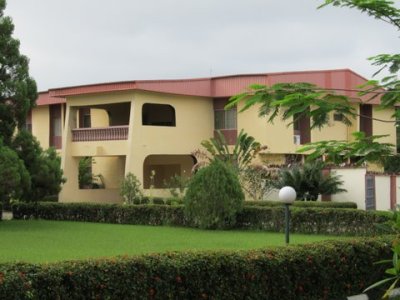
For instance, here is the bishop’s house in Owerri, Nigeria, where I was in June.

And here is the bishop’s house in Aweil, South Sudan, where I was last week.

What you can’t see is that the house in Owerri is part of a large compound with nicely-tended gardens. The bishop in Owerri has three sitting rooms (he needs them all to entertain his many visitors) and they are air-conditioned. In Aweil, that little building has two rooms – with dirt/sand floors – that serve as housing not only for the bishop but also the diocesan school principal and his family. The building also serves as the bishop’s office. In Owerri, the bishop has two offices in two different buildings, at least one of which is larger than the entire building in Aweil.

Here are some women after church on a Sunday in Owerri.

And here are some parishioners in Aweil.

What you can’t tell from the pictures is that the women in Owerri speak great English and smell great. That might be because they have running water in their homes (a few even have hot water) and cook over propane or electric stoves. In Aweil, those women speak Dinka and Arabic and – there’s no other way to put this – have a certain odour about them, which I have often come across in people who are not able to bathe all that often and cook all their meals over smokey fires. Perhaps that’s because they have to carry all their water in buckets from a well.

As I sat in Aweil last week, I couldn’t help but pine for my air-conditioned bedroom in Owerri with a tub with hot water and a sink with taps in it. Instead, I had my umpteenth bucket bath – I’m developing an odour not unlike those women – in the grass hut outside and immediately got my feet all sandy when I walked back into the bishop’s house and crawled into my bed crammed against a wall. (Great thing about bathing outside, though, is you get to look at the stars while you wash – or, in one memorable case, watch an amazing thunder storm roll in across the plain.)

These are two little visual examples of the differences between a place like Owerri and Aweil. There are a huge number of others, of course. Owerri has countless programs, construction projects, and events going on. Aweil can barely provide enough wafers for monthly communion in its cathedral. There are at least twenty church schools in Owerri and many are quite good. The school in Aweil is in huts with flimsy grass walls. Life in Owerri is more similar to life in an American diocese than it is to life in Aweil.

And just as there is programmatic and financial diversity within the “African church,” there is also theological, philosophical, liturgical, and ideological diversity as well. Nigeria and Sudan were both evangelized by the Church Missionary Society but have developed on quite separate paths. There is quite a lot of difference between a Sunday morning in Aweil and a Sunday morning in Owerri.

So how can we speak of the “African church”? Maybe instead of speaking about it so much, we should start spending more time visiting it.