Thabo Makgoba on qualifications for next archbishop of Canterbury

Thabo Makgoba, the archbishop of Cape Town, has given an interview in which he speaks about, inter alia, the ongoing selection process for the next archbishop of Canterbury. His point of departure was the recent Anglicans Ablaze gathering in Johannesburg:

Makgoba said the Anglicans Ablaze conference reflected “a synergy of positive energies within our church” with people of contrary worship and theological positions coming together.

“We should bring whatever challenges we have into this milieu and grow together as Anglicans. 


Makgoba said that despite the diversity among Anglicans, certain “fundamentals” such as “breaking bread together”, kept the church together.


Commenting on the appointment of a successor to Archbishop of Canterbury Rowan Williams, Makgoba said the global church faced major issues including new human identities and degradation of the environment, which required ongoing strong leadership.
Being Archbishop of Canterbury was “an impossible job. If you really believe that you are only a conduit for the grace and love of God, it is do-able.


“I hope that whomever becomes archbishop will take up where (Archbishop Williams) ended, inject theological strength into our debate, yet know that there are no easy answers. 


“As an archbishop (the next incumbent) needs to create an enabling environment for people to really live what it means to be an Anglican in the beauty of our diversity.”


Gathering momentum for a Thabo Makgoba candidacy

When Rowan Williams announced his resignation in March, I argued that the Crown Nominations Commission needed to look beyond the usual crop of suspects and consider the many talented African bishops in the Communion as possibilities.

Filling Rowan Williams’ shoes was never going to be easy—any successor will have to stack up to one of the greatest theological minds of the generation. Going for an outside-the-box appointment—first Archbishop of Canterbury from outside England since Augustine?—lays to rest those possible comparisons and frees the successor to be fully himself (or herself, but that won’t happen—yet—to the see of Canterbury).

Then in June, I expanded on this argument in a piece in Religion Dispatches:

It is in this context that the attention of the Anglican Communion has again turned to Canterbury. The bishop’s chair there will soon be vacant, even as Rowan Williams takes full advantage of the months preceding his December retirement. And while speculation as to his successor runs hot, most observers place their bets on current occupants of English sees. That would be a mistake. As the Anglican Communion continues its growth in the non-Western world, I believe its nominal leader must reflect that change: it is time for an African Archbishop of Canterbury.

(I should note that this piece was heavily edited before it was published and, as it appears now, contains several sentences and paragraphs I did not write. But I did write the one I just quoted.)

Since I first made these arguments, I believe the case for Thabo Makgoba has only strengthened. He has distinguished himself in his response to the Lonmin mine shooting in August. He continues to faithfully lead his diverse church. One of his dioceses (Swaziland) recently elected Africa’s first female bishop. I suspect he will consecrate her. Wouldn’t it be grand if he came to Canterbury and—finally, at last!—did the same thing in England?

The Crown Nominations Commission, meanwhile, appears to have deadlocked at its meeting last week. There is no British bishop who is sufficiently satisfactory, it seems.

So I repeat my plea to the CNC: turn your gaze outside of the Church of England! Look to the hundreds of other bishops around the world who could ably fulfill this role.

(As far as I can tell, the archbishop of Canterbury has to be a citizen of the Commonwealth, not necessarily an English citizen—e.g. Rowan Wiliams. All the candidates I have suggested so far meet this criterion.)

There’s a gathering Twitter campaign to suggest possible alternatives for the CNC to consider, using the hashtag #alternativearchbishops. It mostly appears to be facetious at the moment. Let’s open up this process in any way we can! Start throwing out your suggestions and maybe, just maybe, someone will see them.

Seeds of hope in war-torn lands

In my experience, church-goers in the North Atlantic world struggle to come to grips with the expansive role the church plays in other parts of the world. The church in Sudan, for instance, teaches its seminary students agricultural skills so they can be extension agents when they return to their home villages. In the absence of effective central government, the church comes to play an outsize role—a fact that is almost always overlooked in other parts of the world.

I was thinking about that while reading Tim Butcher’s Blood River: A Journey to Africa’s Broken Heart. The book is excellent reporting on his journey from eastern Congo, down the Congo River to the Atlantic Ocean, retracing the steps of H.M. Stanley, the first European to make the journey.

To say the Congo has a difficult history is a profound understatement. What Butcher finds is a country in regress, less developed, urban, and safe than fifty years earlier when the colonialists left.

What struck me throughout the book, however, was the way in which Butcher kept coming across the church. When all other organs of society and culture seemed to be absent, Butcher still found friendly priests and bishops who hosted him and sent him on his way. He didn’t find many foreigners in Congo. But those he did find—and who weren’t working for the UN—were related to the church: missionary priests from the U.S. and Brazil, a missionary teacher from England. Unlike the UN types, these priests and missionaries were willing to leave their compounds and engage with the people around them.

The missionary from England tells Butcher:

The war has had one major effect in that there are only two real ways left for Congolese people to get on. Before, there was at least a system of schools to go to paid for by the state, a transport system so that people could reach other parts of the country, a health system so that if you were ill you could stand a chance of recovery. But today all of that has gone, so that you only have two real options—you join a church, the only organization that provides an education, a way for someone to develop, or you join one of the militias and profit from the war.

It’s a depressing view, this, but it also has the seeds of hope. I am reminded of John, my Sudanese friend who said to me last year before our visit to Abyei, “We are the church. We are always on the ground!” Or it reminds me of a General Synod address Rowan Williams gave last year about his visit to Congo and Kenya.

Although Butcher’s book makes for disturbing reading, I found in it the seeds of hope, that even in the most war-torn parts of the world, the church remained. And if the church remains, hope remains.

“So, Lord, please keep things broadly the same / Frankly, revival would drive me insane”

The Archbishop of the Church in Wales, Barry Morgan, last weekend addressed the Church’s Governing Body about the recent review the church commissioned to review its structure.

The actual review—which came out in July—is more detailed than the Archbishop’s speech. I looked at the review in July and had several thoughts on it then so I won’t write about it again.

But I did want to post the poem that the Archbishop ends with:

Lord, won’t ya keep things broadly the same

Frankly, revival would drive me insane

I’m busy, I’m tired so I’ll ask you again

Lord, won’t ya keep things broadly the same.


Lord, keep us from the unknown

I know that I’m damaged, but I’ll leave it alone

I’m busy, I’m tired and I’m injury prone

But Lord, please keep us from the unknown.


Lord, won’t ya keep us quite uninspired

At least, please wait till we’re all retired

I’m busy, I’m tired, to be quite so fired

So Lord, please keep us quite uninspired.


When we said ‘Lord, have your way

and change us so we follow’

Can’t you see it was irony

That’s now gone rather hollow.


So, Lord, please keep things broadly the same

Frankly, revival would drive me insane

I’m busy, I’m tired, so I’ll ask you again

Lord, please keep things broadly the same.

And then the Archbishop says:

And Jesus’ response to that is quite simple: “If you would be my followers, that just isn’t possible”.

Amen.

“Anglocostalism” in Nigeria and Obstacles to Anglican Unity

One of the most important developments in the world church in the last few decades has been the rise of neo-Pentecostalism, sometimes called the “Born Again” church. These denominations, particularly prevalent in Africa, are marked by their concern with spiritual healing, the preaching of the prosperity gospel, fixation on a world of good and evil forces, and much else.

What is perhaps less remarked upon is the way in which these neo-Pentecostal churches have influenced the historic mission denominations, including the various provinces of the Anglican Communion. This is one of the main things I learned on my travels in the church in Nigeria last summer. (The observations prompted the post, “What is Peter Akinola Afraid Of?”)

The Journal of Anglican Studies has just published my article, “‘Anglocostalism’ in Nigeria: Neo-Pentecostalism and Obstacles to Anglican Unity,” which takes a close look at how what it means to be Anglican is changing in Nigeria.

Here’s the article’s abstract:

In the last several decades, the religious landscape in Nigeria has been transformed by the rise of neo-Pentecostal or ‘new generation’ churches. These churches teach a gospel of prosperity, advance an oppositional view of the world, focus on a supernatural arena of spiritual forces, accord a unique weight to the Bible, and practice a charismatic worship style. One result of the presence of these churches has been to change the face of Anglicanism in Nigeria. Concerned about the possibility of diminished influence and prestige, the Church of Nigeria (Anglican Communion) has responded to neo-Pentecostal churches by adopting more of its rivals’ beliefs and practices. This paper argues that this changing environment explains, in part, Nigerian opposition to efforts at global Anglican unity and argues that it is impossible to address the future of the Anglican Communion without first understanding the on-the-ground religious context in Nigeria.

It’s an academic article, which means it’s a bit longer than a regular blog post, but I hope you’ll have a read through. Already, in the few weeks since the article went online, I’ve been pleased with the e-mail conversations this article has generated with people in the Nigerian church. I’d be happy to expand those conversations to folks elsewhere.

As I have travelled in the world church, I’m repeatedly reminded of just how little we know about each other around the world. This article—and others like it, still in the pipeline—are efforts to help increase that sense of mutual understanding.

Anglican Communion awareness increasing?

The Episcopal News Service has a lengthy article today that follows up a lot of the questions raised at General Convention about the Church’s huge cuts to funding for the Anglican Communion Office. It also makes some grand claims about the nature of the Anglican Communion nine years after the election of Gene Robinson as bishop of New Hampshire.

Here’s the article’s lede:

The world’s 80 million Anglicans are much more aware today than they were 10 years ago that they belong to a global communion, a realization that has led to a flourishing of international relationships between the Episcopal Church and other provinces, dioceses and individuals.

Although the article claims to be concerned with Anglicans all over the world, the only evidence it musters is in the Episcopal Church. This is a hallmark of one of the most depressing of all American characteristics, namely the willingness to generalize from quite particular experience. To write an article like this merely reinforces what many people around the world already think: Americans are self-centred, solipsistic, and parochial.

The thing is, our brother and sister Anglicans around the world have known and cared about the Anglican Communion for a lot longer than many Americans have. When I traveled in the church in Nigeria (where 1 in 4 of those 80 million Anglicans live) last summer, one of the aspects of the church that was most noticeable to me was the way Nigerian Anglicans cared about being part of the Communion. The official name of the church is Church of Nigeria (Anglican Communion). When you leaf through a diocesan newsletter, there’s plenty of material about other Anglicans around the world. In a remote diocese in South Sudan a few years back, I was asked what I thought about Rowan Williams’ decision to deny Katharine Jefferts Schori her mitre on a visit to England. In a remote Bible college in a China, I was once asked about the Anglican Communion. It’s the Americans who have woken up and smelled the Anglican Communion coffee in the last decade. The rest of the world, at least, was already aware.

My sense of the last decade is that the American church, particularly its liberal wing, has been rushing to catch up with the rest of the world in terms of understanding itself as part of a global Communion. For a variety of reasons—including prioritizing domestic concerns, feeling unsure about how to relate to newly-independent churches, and so forth—the Episcopal Church began a fairly large retreat from its global commitments in the late 1960s all the way through the 1990s. This, in many ways, set the stage for the “crisis” of the last decade.

In 1963, Anglican lay people, priests, and bishops from around the world got together for an Anglican Congress in Toronto. One of the speakers was a man named Howard Johnson, who, a few years prior, had completed a two-year tour of every province in the Anglican Communion. At the Congress, he had this to say:

We Anglicans stumbled into universality – prodded, I believe, by Providence. But our consciousness of ourselves has not yet caught up with the reality of ourselves. In actuality we are a multiracial, multilingual, multicultural body, but in awareness we are still parochial and provincial.

My sense is that Johnson’s observation is still largely correct. It is true, however, that the election and ordination of Gene Robinson means that Episcopalians now know more than they used to about the Anglican Communion whether they like it or not. But has that had the positive impacts the article claims? On that question, I think, the jury is still out.

Lessons from the Church in Wales

The meeting was notable for the number of contributions from members with a common message: “The Church cannot go on doing the same things in the same way; some things need to change and we are open to – and indeed encourage – that possibility.

Sound like a familiar sentiment? But rather than being from the just-concluded General Convention of the Episcopal Church, the sentence is how the new Review of the Church in Wales begins. The Welsh church commissioned the report two years ago and it was released earlier this week.

On the assumption that the Episcopal Church—which just created a super-committee to consider restructuring—has something to learn from our Welsh sisters and brothers, I had a look through the report.

The report spends a lot of time calling for larger Ministry Areas—something like deaneries, though it is careful not to call them that—in which the lead pastors would be both ordained and lay. “A radical change of perspective is needed,” the authors write, “from parish to a much larger area, and from a single priest, to a team with different gifts.” (p. 8) I think the report is to be commended for so highlighting the role of lay people in ministry. The call to move to the larger Ministry Areas is a sign of the straits the church is in that it feels it can’t keep the close connection to communities the parish system gives it.

Given the recent focus of this blog, the report’s commentary on ordination training was interesting, particularly the way in which it upholds residential training as a part of such training, even if combined with non-residential portions (p. 14). The report also acknowledges the increased need for non-stipendiary clergy (p. 17). We call them “bivocational” clergy in the U.S. but the idea is the same. Clergy need to start thinking about income sources independent of the church. The report suggests the church in a few years think about moving from six dioceses to three (p. 19). Since you need to have four dioceses to stay a province of the Anglican Communion, I’m not quite sure what that would mean for the Church in Wales status but that doesn’t seem to have been considered by the authors. (Perhaps Wales could get around that by having some missionary areas?)

The most interesting aspect of the report is its identification of a problem in the culture of the Church in Wales: “namely the respect in which the office of Bishop is held in the Church in Wales and the authority which he wields by virtue of his office.” The authors write:

A number of people have said to us that the Church in Wales is still characterised by a culture of deference and dependence. This is a model of leadership that is carried over into the parishes, where so often the complaint has been that it is all about the clergy, that there is a culture of “Father knows best”. What this means in practice is that people look to the Bishops and clergy to take initiatives and it has been suggested to us that nothing much happens without this. (p. 6)

I’d say there’s an element of this in the American church as well, though less than there used to be, perhaps, and less so than there is in Wales. Moreover, I think many bishops in both Wales and the U.S. would be happy to give up some of this authority if only we’d take it from them. I hope that this Review, as well as whatever process the Episcopal super-committee goes through, can start a conversation on what we expect of bishops and how we remain true to our Anglican tradition while remaining able to relate to the challenges of our time.

One thing that is clear, however, is that no structural change can change this cultural situation the Review identifies. And so what I think this report reveals most fundamentally is that we can tinker—even quite dramatically—with the structure of the church but it all means nothing if the people in the church don’t change as well. It’s one thing to (unanimously) establish a committee to investigate church structure (and sing it into being). It’s quite another to look in the mirror and ask how—independent of any structural concerns—each member of the church can become a more missional follower of God in Christ.

And that, I think, is the ultimate disappointment of this Review. It doesn’t go far enough. Perhaps that’s what you get when your committee is composed of three well-connected church personages. I get the sense that the report’s authors simply decided to shrink and combine the church’s functions in response to its diminished financial position. The Review does a good job at the beginning and the end of identifying what the purpose of church is —”to proclaim the Gospel and draw people into the life of Christ” (p. 37)—but sometimes I struggle to see how that goal is connected to some of its recommendations.

The annex of this Review is fascinating: a summary of all the other structure reports in the last generation in the Church in Wales. And yet here is the church, again calling for review and reform. Will this report end up on a similar list at some point in the future? It might, if we put all our energy into changing structure and none into changing the disciples we are forming.

The Episcopal Church: The Diocese of Texas of the Anglican Communion

Without much surprise, the Episcopal Church’s General Convention today passed its budget for the next three years. And, as presented on Tuesday, the budget sharply cuts funding for the church’s connection to the Anglican Communion.

While I find the decision disappointing—as I have noted here and here—it was not surprising. What was heartening was that the cuts to funding the Anglican Communion Office were so notably criticized on the floor of the House of Deputies. (I missed the budget debate in the House of Bishops.) I heard one delegate make the point I have made before, namely that how can we expect dioceses to give the full asking to the churchwide budget, when the church doesn’t give the full asking to the Anglican Communion Office?

I’ve heard a couple of figures on this but it seems like the Episcopal Church is currently giving between a third and a half of the asking to the ACO. That puts the church in Diocese of Texas territory: wealthy, well-resourced (comparatively) but unwilling to share any of those resources with the other institutions of the church to which it belongs. There’s been a lot of talk at Convention about the hierarchical nature of the church: as far as General Convention is concerned, the hierarchy stops with it. You give us your money, it says to the dioceses, but we’ll keep it for ourselves. Can you blame other dioceses for saying the same thing to the church?

When we start squabbling over resources like this—pointing out how much some dioceses give but not others, arguing over apportionments, etc.—it’s a sure sign of an institution in decline. If we can no longer meet our commitments, something needs to change. I, for one, am hopeful that the new structure super-committee that has been created by this Convention can discern ways for the church to remain a full, active, and engaged member of the one, holy, catholic, and apostolic church around the world to which we belong.

The body of Christ on July 9

There are a lot of things that happen at a General Convention beyond the business of passing legislation: movie screenings, talks, networking, and, oh yeah, worship.

In celebration of the first anniversary of the independence of South Sudan, there was a Eucharist on Monday evening for those connected to the work of the Episcopal Church of Sudan. It was a terrific service: lots of great singing led by the Sudanese there, support from some of the many bishops in the Episcopal Church who have Sudanese congregations in their diocese, an honest acknowledgement of the pain and suffering that has happened and remains ongoing, and much else.

There is lots packed into a General Convention so the service didn’t begin until 9:30pm. As wonderful as it was, I have to say I was a bit weary during the first part of the service. That changed during the passing of the peace when the three bishops in the service took a liturgical liberty to tell the congregation about their relationship.

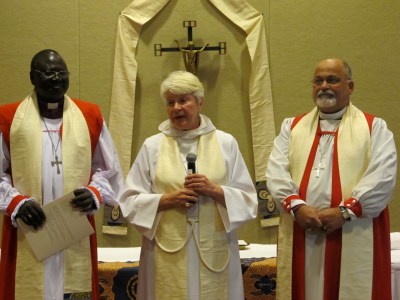
From left to right, that’s Ruben Akurdit, of Bor, Sudan; Cate Waynick of Indianapolis, Indiana; and Mauricio Andrade of Brasilia, Brazil. Together, they have a three-way companion diocese relationship. Last year, Cate and Mauricio were in Bor together. (Three-way companion relationships are increasingly common. We recently saw the fruit of another relationship in this letter to Rowan Williams from several bishops.)

In their comments, the three bishops stressed how they see in one another the body of Christ: difference (of race, background, culture, sex, etc.) but commonality in worshipping the same God in Christ.

I was completely awake by the time they had finished their short remarks. Then, in the Eucharistic prayer, each said the words of institution (the “take eat” part of the liturgy) in their own language. It is not often that a Eucharistic prayer I have heard so often and know so well can surprise and move me but it did on Monday night.

The act of celebrating the Eucharist in multiple languages with people from multiple backgrounds seemed to me to be so central to what the good news of the body of Christ is all about. And it’s yet one more reason I have hope about the future of the church and its role in God’s mission in the world.

Memo to bishops-elect

The General Convention of the Episcopal Church will vote in the next day or two to confirm  several new bishops who have been elected in the last four months. No doubt, these bishops will take office full of plans for their tenure and ready to implement them. As they do, I— presumptuously—have a thought for them.

The definition of the ministry of a bishop in the Episcopal catechism includes, “to act in Christ’s name for the reconciliation of the world and the building up of the Church.” Bishops are symbols of unity in the worldwide church, representing the universal to the local and the local to the universal.

My thought for the new bishops is that they be sure to use their time as bishop to establish solid companion diocese relationships. This is not, in itself, that surprising an idea. Many dioceses already have such relationships.

What I want to urge the new bishops to do, however, is to build relationships in unlikely places. As I found out in my travels last summer at this time, there are several dioceses in the church in Nigeria that are eager for American companions. (See my posts here and here for more on this.) I heard time and again how interested people in those dioceses were in establishing relationships that moved the Anglican Communion beyond the divisive rhetoric of the last decade or more. Without ignoring the differences of opinion, these people still wanted to establish companion relationships. And yet, no matter how hard they tried, the Nigerians I met were turned away. “Sorry,” they were told. “Our churches can’t be in relationship.”

These bishops-elect have an incredible opportunity to change the discourse in the Anglican Communion from one of fracture to one of unity. (I’ve written before about the importance of companion diocese relationships.) Just imagine what a companion relationship between an American diocese and a Nigerian one could mean for the Anglican Communion.

I imagine that being a bishop can be pretty overwhelming. I imagine it can be pretty easy to end up focused solely on the pressing concerns of the diocese. My hope for the new bishops—and all bishops—is that they’ll remember to work for the reconciliation of the world.

The church—and the world—needs it.