On many days of the church year, Episcopalians commemorate figures from the past who are models and exemplars of holy living and Gospel witness. These people range from Ignatius of Antioch (Oct. 17) to Jonathan Daniels (Aug. 14) and everyone in between. There’s a big new revision of this list called Holy Women, Holy Men that is the result of years of hard work.
But there are many figures who are not in HWHM who deserve to be remembered. For me, one of those figures is Stephen Fielding Bayne, Jr. I’ve written a commemoration in the style of Holy Women, Holy Men and encourage you, if you are able, to use it in your worship life. Bayne died on the same day as St. Peter so you might want to commemorate him (as we do with others), the day before or the day after.
The commemoration is below. Who else do you think deserves to be commemorated?
Stephen F. Bayne, Jr.
Bishop 1974
Psalm 133, Romans 12:1-8, John 20:19-23
Collect
Gracious God, whose Son prayed that his followers might be one, we remember in thanksgiving this day your servant Stephen Bayne; inspire in your global church the same passion for unity which shaped his ministry; deepen our relationships in a spirit of mutual responsibility and interdependence, and empower us to be servants of your reconciling Gospel; through the same Christ our Lord who with you and the Holy Spirit lives and reigns, one God, for ever and ever. Amen.
Preface
for Pentecost
Biography
 Stephen Fielding Bayne, Jr. was the first executive officer of the Anglican Communion, helping Anglicans around the world understand why their worldwide Communion was important in the challenging post-war years.
Bayne was born in New York City on May 21, 1908. After studying at Amherst College and The General Theological Seminary, he was ordained a priest in 1933 at the Cathedral of St. John the Divine. He served parishes in St. Louis and western Massachusetts, and as chaplain at Columbia University and to the navy during World War II. In December 1946, without informing him he was a candidate, the Diocese of Olympia elected Bayne their bishop. During his episcopacy, he presided over a growing diocese and remained an active scholar, contributing a volume on Christian ethics to the Church’s Teaching Series and writing several other books.
At the 1958 Lambeth Conference, Bayne chaired the committee on “The Family in Contemporary Society” and distinguished himself for the way he navigated difficult issues of sexuality. Bishops at the conference approved the idea of a creation of an “executive officer” for the growing Anglican Communion. Archbishop Geoffrey Fisher invited Bayne to fill the position. Bayne accepted and began work in January 1960. The Anglican Communion was at a crossroads. The demise of the British Empire, the growing ecumenical movement, and a sense that the world was changing challenged Anglicans to determine what it is that held them together.
Bayne’s tenure was marked by his unrelenting travel, on average 150,000 miles a year, to provinces of the church all over the world. It was said of him that “Bishops come and go but not as much as Bishop Bayne.” Declaring the need to make “a frontal attack on provincial and national narrowness,” he emphasized the importance of relationships among Anglicans and developed many new communication instruments—including the Anglican Cycle of Prayer—to facilitate this. Everywhere he went, he emphasized the mission of God, urging Anglicans to figure out what God was already doing in their midst and then join in that task.
The apex of his time as executive officer was the 1963 Anglican Congress in Toronto. There, delegates approved a document drafted primarily by Bayne titled “Mutual Responsibility and Interdependence in the Body of Christ.” MRI called for new patterns of being Anglican marked by “the birth of entirely new relationships” and declared “our unity in Christ…is the most profound bond among us, in all our political and racial and cultural diversity.” MRI—and Bayne—was widely hailed as a break with an outdated Anglican past, even appearing on the front page of The New York Times.
Bayne stepped down as executive officer in 1964. He narrowly lost the election for presiding bishop that year but still accepted a position at the Episcopal Church Center in New York. As a bishop, he chaired the heresy investigation of Bishop Pike. In 1970, he returned to General Seminary as professor and later dean. He died on January 18, 1974.
(Photo from An American Apostle: The Life of Stephen Fielding Bayne, Jr. by John Booty.)

 I recommend Thabo Makgoba, archbishop of Cape Town and primate of the Anglican Church of Southern Africa. He’s educated, outspoken on important issues, young(ish), and has been called “the Denzel Washington of the Anglican Communion.”
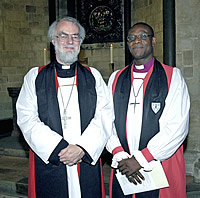 If not Archbishop Thabo, how about Josiah Idowu-Fearon, bishop of Kaduna in Nigeria? He’s super-educated, an expert on Islam, and has shown his independence from the Nigerian church hierarchy by, inter alia, calling for primates not boycott a Primates Council meeting. Not sure how old he is, though. (Wikipedia says he’s about 63.)
 Jesse Zink