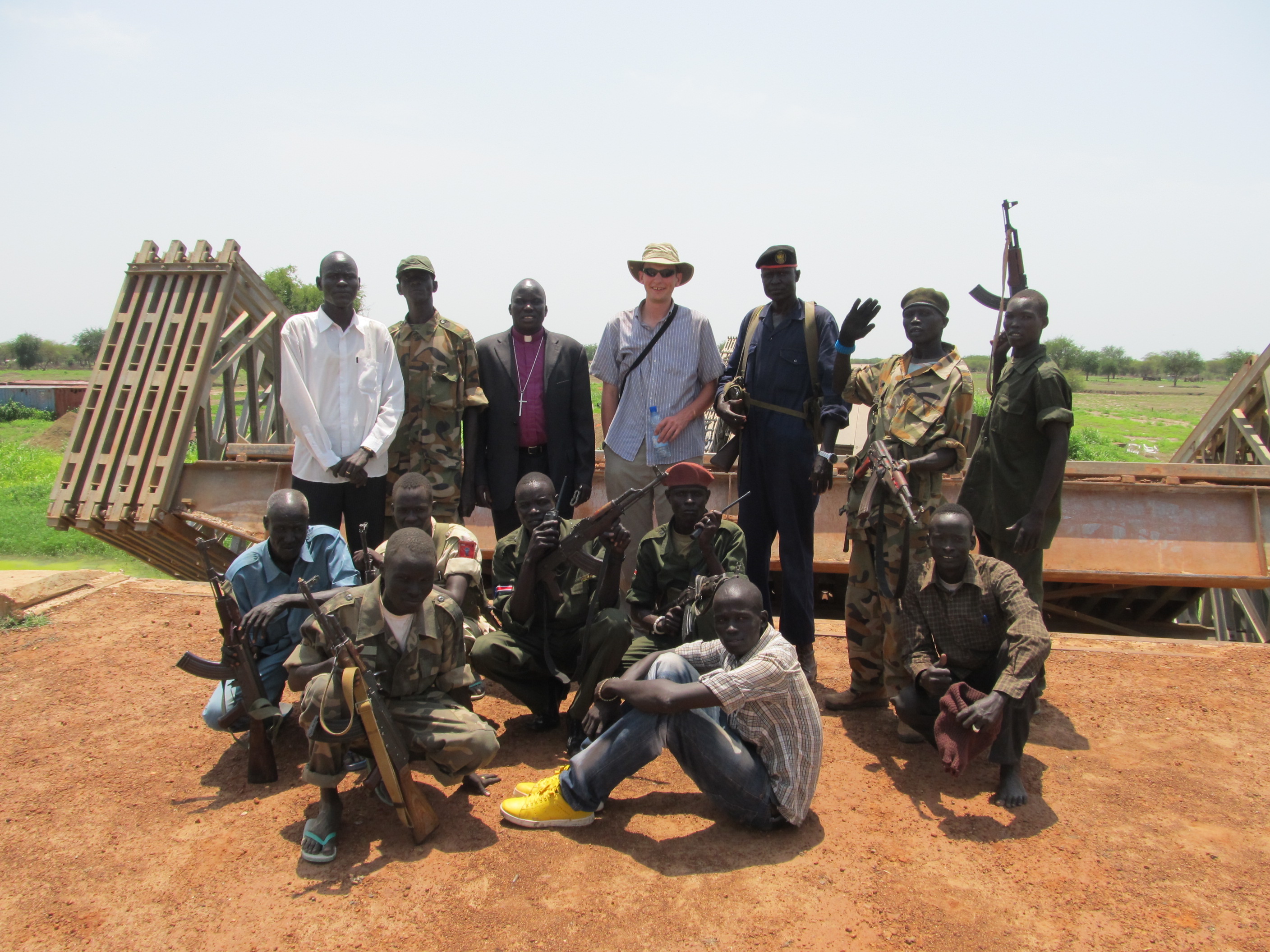
“moving, eloquent and theologically grounded”: first Backpacking review

The book hasn’t even been shipped yet, but the first review of Backpacking through the Anglican Communion: A Search for Unity is hot off the press—or “press,” I should say, since it’s online, though none the less thorough, thoughtful, and complete for that.

You can read it online at the Episcopal Digital Network, but here are a few excerpts:

Zink is a great storyteller. His writing is clear, engaging and accessible, and you are drawn into the lives of the people he met – from huge, wealthy, almost-mega-churches in Nigeria to a tiny church in the Andes of Ecuador and a diocesan cathedral in Sudan made of cinder block with three plastic chairs, total, in the nave….

The book is an excellent means, especially for Anglicans from the wealthy part of the world, to understand the very difficult economic and social contexts of global Anglicanism – especially in Africa. We learn about the challenges posed by Pentecostalism, along with the way poverty and war shapes the issues that a church finds important. This book would be excellent in a study group on global Anglicanism. Indeed, each chapter can stand alone, and the book could be used in a variety of Christian education contexts….

The last chapter is Zink’s moving, eloquent and theologically grounded plea for Anglican unity. He doesn’t have a lot of optimism, and I’d have to agree that our track record of late hasn’t been good. Nonetheless, his case for finding a way to be together and do God’s work in spite of differences of opinion is desperately needed, and I agree with his assessment that Anglicans, of all people, should be able to do this.

I don’t know about optimism, but I definitely have hope for the future of the Anglican Communion—it is hope that is at the core of this book.

Read the whole review and then go order the book for yourself (Cokesbury, Amazon, .ca, .co.uk, or your local bookstore with this information).

Minority Report: Anglican Communion edition

Some years ago, Tom Cruise starred in a movie called Minority Report. The plot revolves around three human “pre-cogs” who can tell when a murder is about to happen. Cruise and company swoop in, arrest the murderer before he or she can commit his crime, and save the day. Things begin to unravel when—to give away the ending—it turns out that three pre-cogs are not always in unanimous agreement but that the dissenting, minority reports are suppressed.

The phrase “minority report” has been stuck in my head lately—but in the context of the church in 2013, not Tom Cruise in 2054. A clear majority of Anglicans are female—yet three weeks worth of reporting in The Church Times about the GAFCON II conference in Nairobi quoted precisely one woman and allotted her one word: an unnamed Ugandan priest was to said have voted “No” on the final communique.

This is not to pick on either GAFCON or The Church Times. The four Anglican Instruments of Communion—the Archbishop of Canterbury, the Primates Meetings, the Lambeth Conference, and the Anglican Consultative Council—are all dominated by men. (In part, this is because they are dominated by bishops, who tend to be male.) The people who are the primary drivers about debates about global Anglican futures tend to be male as well.

Anglicans have been led to believe that there are two sides in debates about our future: the liberals and the conservatives, each presenting unified and diametrically opposing views. But just as Cruise et al. had to learn that the unanimity of their pre-cogs was not what it seemed, so too Anglicans have to learn that we are dealing with more diversity than we may have imagined. Part of the purpose of my writing a book about the Anglican Communion that tries to move beyond bishops and describe life at the grassroots level in different parts of the world was to demonstrate that the loudest voices in the Communion are rarely the most representative—no matter how strenuously they claim they are.

All of this is to say something obvious: the church has a long way to go before we start reflecting the reality of the body of Christ in which we are joined.

This is not to say that the wounds of the Anglican Communion would be healed if we put women in charge. As I show in Backpacking through the Anglican Communion, my experience does not show that women somehow believe in unity and reconciliation in a way that men do not. But it is to say that the model of communion that has been put forth in the last several years has been one that has privileged a handful of voices and disregarded (suppressed?) a huge number of others.

So when we read reports foretelling the death of the Anglican Communion that are authored solely by men, we should label those minority reports—for that is precisely what they are.

“I’m not dead yet.” -The Anglican Communion

I have been staying up late several nights this week finishing the proofs of my new book about the Anglican Communion. It is a book that argues that not only is unity in a world communion possible, it is a vital part of that communion’s witness to the world.

Then I woke up this morning to read that Andrew Brown (“England’s most sanctimonious atheist,” in the words of one Church Times letter to the editor) thinks the Anglican Communion is dead.

Wow. Poor timing on my behalf.

But then I started reading the article and wondered just what grounds Brown had for making his case.

We might notice that his article commits more or less all the errors I outlined in a previous post about writing about the Anglican Communion—he doesn’t travel anywhere, he relies mostly on bishops and men as sources, etc., etc.

He writes, for instance of the Church of Nigeria, that it doesn’t matter how “many Anglicans there are there and however sincerely they seem to hate gay people.” I read that and I think, “Has he ever actually been to Nigeria? Are we talking about the same church?” Were people who write about the Anglican Communion to start moving from behind their computers and instead spend their time and money visiting with Anglicans, I think the story they would find is different. Instead, everyone sits comfortably in their prejudices and certainties and shows little desire to change that situation.

On the other hand, perhaps the Anglican Communion is dead. Perhaps the days when our understanding of the Communion was constituted almost solely by what bishops and other men had to say are coming to an end. Perhaps we can now start listening to the voices of the young, the female, the non-ordained and see that they are hardly in lockstep agreement with what their bishops have to say.

The core of my faith is the belief that death is not the end. Maybe we can pray that the death of our current forms of relationship will lead to a resurrection in newness and fullness of life.

Maybe.

But it’s going to take a willingness to move beyond the same old ways of doing business.

The end is (not) nigh…

There’s been a spate of articles in the secular press recently, keyed to a conference at Wycliffe College in Toronto marking the 50th anniversary of “Mutual Responsibility and Interdependence in the Body of Christ.” (They’re a month late, but who wants to go to a conference in August anyway?)

If the only thing you knew about the Anglican Communion was what you read in these articles, you could be forgiven for thinking the end of the Communion is nigh.

It’s not.

That’s the message I have heard time and time again as I travel around the world church. (I’m writing this post in South Sudan, as a matter of fact, where I have been spending the last month with the church here.) But articles such as these propagate a narrative of disunity that has largely gone unchallenged.

Let’s look at what these articles have in common:

  • They quote mostly bishops. Fair enough, I suppose, since bishops are leaders in the church. In my experience, however, bishops are far from the most interesting (or representative) people in the church.
  • Relatedly, they quote mostly men. Most bishops are men. Of the Anglicans who speak English (and thus can be interviewed by reporters who speak only English), a larger percentage are men. But this neglects the viewpoints of the majority of Anglicans who happen to be women.
  • They quote people who can travel. Articles like these are written by reporters who don’t leave the comfort of their home. They let the subjects come to them: attend a conference, interview a few people on the sidelines, go back to the office, and write it all up. What about people who can’t afford plane tickets, whose visa applications are rejected, or who are too busy in ministry to travel? When I was a reporter, I wrote several stories like this. I rarely found that they did more than scratch the surface.
  • They call reporting “analysis”. (Like this one) If we’re going to analyze a topic, it seems that something more than merely quoting other people is necessary. For instance, the conference at Wycliffe featured a line-up of speakers of a decidedly conservative tilt. That fact is barely mentioned in the news coverage.

My new book, Backpacking through the Anglican Communion: A Search for Unity is born of precisely these frustrations. As I have traveled around the world, working and visiting and listening and praying with my fellow Anglicans, I have found stories that fundamentally challenge the narrative of disunity that is propounded in articles such as these. I have found these stories precisely by going past the bishops, men, and English-speakers who dominate stories such as these.

This is not to say that what these male bishops have to say is necessarily wrong. There’s truth in their comments, of course, but it is, at best, partial truth. Nor is it to say the Anglican Communion is in a perfectly unified body. Like other parts of the body of Christ, it has its own dysfunctions, idiosyncrasies, and broken bits that create a unique set of challenges.

But if we’re serious about being a worldwide family of churches, we need to start with an honest appraisal of the situation. Articles like these do nothing to help with that.

Backpacking through the Anglican Communion will be published in January 2014.

Backpacking Through the Anglican Communion: A Search for Unity

Exciting news! It’s time to raise the curtain on Book #2!

IMG_1594My next book, Backpacking Through the Anglican Communion: A Search for Unity, draws on the tens of thousands of miles I’ve travelled in recent years to show what Anglican life is like at the grassroots level around the world—in places as diverse as Nigeria, Ecuador, England, and China. Some of those travels first appeared in partial form on this blog; many of them did not.

More than a simple travelogue, the book also challenges the dominant narrative of disunity that so colours debates about the future of global Anglicanism. I show how the loudest voices in the Anglican Communion are rarely as representative as they think. In fact, when conversations about divisive issues—sexuality, Biblical interpretation, authority—are undertaken in a spirit of mutuality and vulnerability, they deepen—and not fracture—relationship.

IMG_3661IMG_2946Finally, the book is an argument that unity actually matters and that in our globalizing and fracturing world, Anglicans have an incredible opportunity to witness to the world—an opportunity we are singularly failing to grasp at this moment in time.

Backpacking Through the Anglican Communion: look for it in early 2014 from the Church Publishing family. And if you live outside the U.S. and want it published where you live, let me know so we can start talking about it now. Contact details are here.