A lesson from history for South Carolina

When was this man’s predecessor consecrated? And why does it matter?

Last autumn, the diocese of South Carolina left the Episcopal Church. A primary justification for this departure was that South Carolina was created as a diocese in 1785, before it acceded to the constitution and canons of the Episcopal Church in 1790. The departure, therefore, was a mere return to its pre-accession status. The implicit claim here is that a diocese only needs itself to be a church—with a bishop, the sacraments, the Bible, and the creeds, they’ve got all they need. Mark Lawrence, the bishop of the diocese, has pointed to the Chicago-Lambeth Quadrilateral as evidence of this claim.

I have an article in the current edition of The Living Church that challenges this line of thinking. And I challenge that line of thinking by pointing to an historical fact: the first bishop of South Carolina, Robert Smith, was not consecrated until 1795—and at a General Convention. In other words, for nearly ten years, including the five before it acceded to the Episcopal Church’s constitution, South Carolina was without a bishop. By the standards its current leaders are now using to justify their departure, that makes it at best a proto-diocese.

(We should note that in the early years of the Episcopal Church—despite the name—several dioceses went long stretches without bishops, for a variety of reasons. South Carolina was not unique in this regard.)

This historical fact is the grounds for the larger claim of the article, namely that provinces—groupings of dioceses—matter to Anglicanism: we need them so that we can ensure our bishops are properly chosen and consecrated. The fact that Bishop Smith was consecrated at a General Convention demonstrates this. Moreover, I argue that this larger sense of belonging is actually part of the good news of the church. But read the article for the rest of the argument.

The Living Church editors also solicited two responses to my piece, which take different views. You can read one here. (UPDATE: The second response essay has also been posted.)

History matters, if only as a corrective to the self-justifying arguments that are so common in the church today. Would that we had more people in the church studying it.

The Power of Establishment

On Monday, I did something I rarely do: I read The Daily Mail, one of England’s leading newspapers (by sales). It’s a tabloid that makes it money by plastering screaming (and arguably distorting) headlines across its pages.

I read the paper because a) it was in a waiting-room I was in and b) the front-page headline was about Justin Welby, archbishop of Canterbury, and a letter he (and about 40 other bishops) signed opposing the government’s proposed changes to welfare. The article (and the accompanying op-ed column) was not positive about the archbishop’s move. Welby himself thoughtfully responded on his blog.

Leaving aside the merits of the dispute (which, as a non-voter in this country, I don’t entirely understand but on the surface it seems Welby et al. have a point), let’s talk about the media coverage. England is supposed to be an ever-increasingly secularized country, with fewer and fewer people attending church and fewer and fewer people believing in God. So why all the attention for a letter the archbishop signed?

For me, it’s a reminder of the power of Establishment: no matter what people might think about religion in England, the Church of England still has a privileged role. When its leaders speak, they get attention. Not always, and not as much as they would like, I am sure, but attention nonetheless. As I read about this debate, I am reminded of bishops in some African countries I’ve visited, whose public utterances are closely watched. When I was in Nigeria, bishops (of a number of different denominations) regularly featured in news reports. Ditto for South Sudan.

At the same time as this flare-up over the bishops’ poverty letter in England, the American House of Bishops released a letter about gun violence. Also this week, some faith leaders—including Episcopalians—have spoken out against the proposed Republican budget. I will be stunned if any of these statements makes the cover of any major newspaper in the United States, or is even mentioned. That’s not how the media market works in the United States. Katharine Jefferts Schori and American Episcopal bishops are not media figures in the way English bishops are. (A few have succeeded in getting into the news cycle with statements about same-sex marriage, but these are exceptions that prove the rule.)

All of which is to say what I’ve said many times on this blog in one way or another: context matters. Anglicans around the world minister in a huge variety of contexts that shapes their actions and statements. We do well to remember that.

Recommended reading for the structure committee

The Episcopal Church has a new committee charged with re-designing the church’s structure. Many other American denominations are making or have made similar moves lately, part of a push towards a more “missional” focus for the church. While I have some concern that the Episcopal committee is, at 24 members, too large as to be unwieldy, I look forward to hearing their recommendations in a few years time.

Since it’ll likely be a little while until they meet formally, they have some time do some holiday reading. Here’s a preliminary list of books I hope the committee members are familiar with:

  • Roland Allen, Missionary Methods: St. Paul’s or Ours? First published in 1912, this book from an Anglican missionary in China upended missionary orthodoxies of the day and remains as relevant and enduring a challenge to the church of our time as it was to his. (I wrote more about Allen’s relevance a while back.)
  • Vincent Donovan, Christianity RediscoveredDonovan was a Catholic missionary among the Maasai and his book represents an attempt—half a century later—to put Allen’s teaching into practice. It’s an incredible reflection that forces the reader to think seriously about what the core of the church is, what the message is that the church has to offer, and how all of that works out in messy, real-world ways.
  • David Bosch, Transforming Mission: Paradigm Shifts in Theology of Mission. Just re-issued for its 20-year anniversary, this is the single best book I ever read in seminary. David Bosch, a South African who was killed shortly after this was published, takes the reader through the Biblical basis for mission and the history of different mission paradigms, before laying out a multi-part understanding of what the mission is to which the church is called. Incredible reading.
  • Christopher Wright, The Mission of God: Unlocking the Bible’s Grand Narrative. Wright takes the reader through the whole sweep of the Bible, demonstrating how mission is the key theme of the writings that form the ground for our faith. It’s another thick book, but it’s also one will make you look at the Bible in a new way and, if nothing else, give you great material for your next Bible study or sermon.
  • One I haven’t been able to read—but would like to—is Life-Widening Mission: Global Anglican Perspectives, a series of essays from young Anglicans around the world.

What would you recommend? These are all books about mission, in one way or another. Any suggestions for books about organizational change, management theory, etc.? Leave suggestions in the comments.

Merry Christmas to all, and to all a good read!

The hierarchical nature of the church and the good news of Jesus Christ

Nine years ago, when Gene Robinson was elected bishop of New Hampshire, conservative Episcopalians—not to mention Anglicans elsewhere in the world—were adamant that the Presiding Bishop at the time, Frank Griswold, “do something” to prevent New Hampshire from going ahead with the consecration. Bishop Griswold replied that, as the election and confirmation process had proceeded as to canon, there was nothing he could do.

This dispute was, inter alia, a dispute about the hierarchical nature of the church. The conservatives argued there was some level of authority above New Hampshire that could reverse the diocese’s decision. There was—the General Convention, which approved Robinson’s election—but beyond that, Bishop Griswold looked at the canons of the church and said he had no higher powers to “do something.”

Fast forward to the past few months and the debate over the departure of the diocese of South Carolina from the church. Many of those same conservatives are upholding the decision by South Carolina to withdraw from the Episcopal Church. The argument is that the basic building block of the church is the diocese and a diocese has no intrinsic need to be a part of anything larger. This is why the diocese of South Carolina has declared itself to be, essentially, a free-floating ecclesial entity. (This raises questions I thought about in this post.) The liberal Episcopalians who oppose the departure say that, in fact, the church is hierarchical in nature and a diocese isn’t a diocese without reference to some larger entity, in this case The Episcopal Church, a province of the Anglican Communion.

(I am using the words “liberal” and “conservative” here with reckless abandon and as shorthand for larger and more complex positions.)

Debates over the governance structure of a church can appear to be among the most naval-gazing topics of all, fodder for lunch-time debates at seminary, General Convention sub-committees, and not much else. But as this example shows, the polity of The Episcopal Church—and, in particular, its hierarchical nature—is currently under intense scrutiny. Not only is there the South Carolina example, there is the case of the several active and retired bishops who are under investigation because they filed a brief saying that the church was not hierarchical. The House of Bishops weighed in on the nature of the church at General Convention in the summer.

Rather than being so much naval-gazing, I think the questions raised by these debates actually have something to do with the good news the church has to proclaim. So, if you’ll bear with me, I’m going to think about hierarchy in the church, and then think about why or if it matters how hierarchical the church is.

The basic question comes down to something like this: how far up does the hierarchy of the church go? Everyone accepts the need for a bishop in a diocese. But do those bishops and those dioceses have to be part of some larger organization, like the Episcopal Church? And do those larger organizations have to be part of something larger, like the Anglican Communion? What does it mean to “be part” of something larger? What opportunities and constraints come with this?

The first thing to say is that there is a lot of hypocriscy on this issue. We’ve already seen some of this at work in the South Carolina instance. But that’s far from the only example. For instance, it is widely acknowledged that many priests and some bishops practice a kind of “open communion” in which people who are not baptized are invited to receive communion. This is in direct violation of the canons of the Episcopal Church. The teaching that baptism precedes communion was upheld by General Convention this summer. Yet it seems unlikely that anyone’s practice has changed as a result. The hierarchy of the church says one thing; clerics ignore it. Discipline for canonical violations is fine, seems to be the message, just so long as it is not for us.

Here’s another example: some of the same people who say South Carolina has to be part of something larger assert with equal vehemence that hierarchy stops at the water’s edge. That is to say, there is no hierarchy above the provincial level in the Anglican Communion. Anglicans from elsewhere in the world better not start interfering with the church. Conservatives, of course, have been happy to appeal to varying levels of hierarchy beyond The Episcopal Church in search of support for their views.

The prevailing situation, then, on the hierarchical nature of the church seems to be a hermeneutic of self-justification. This results in a condemnation of the other side and an exoneration of oneself. In a situation like this, how is one to proceed?

We might start by noting that hierarchy dates to the early church. Very quickly in the development of the church (when there were a lot more bishops, each overseeing a smaller area than they do now), a handful of cities—Rome, Antioch, Alexandria, Constantiople, and Jerusalem—came to exercise a kind of authority over Christians in other places. These were the metropolitan sees, which is why you sometimes hear a senior bishop referred to as a metropolitan. He (or she) has authority over other bishops in his (or her) area. Hierarchy has been a part of the ordering of the church catholic from an early date.

(Importantly, of course, the presiding bishop of The Episcopal Church is not a metropolitan. He or she—as Bishop Griswold demonstrated—has no canonical authority over other bishops. But the idea of a local church belonging to something greater than itself is pretty old.)

Appeals to tradition, however, are hardly sufficient, especially when I am sure people more learned than me could quickly add complexity to my short sketch of the early church. Conversely, we might note that the claim advanced by many South Carolina supporters that a diocese is the basic building-block of the church has an intrinsic merit. Anglicans have traditionally affirmed four items as the ground for ecumenical reunion: a belief in Holy Scriptures, the creeds as a sufficient statement of faith, the dominical sacraments, and the “historic episcopate locally adapted.” This is known as the Chicago-Lambeth Quadrilateral. Clearly, those four elements of what it means to be a church are present in a single diocese. Why the need for hierarchical structures at all?

I answered that question in a previous post: a single diocese cannot perpetuate its episcopate. You need three bishops to make one bishop. That’s why groups of dioceses get together as provinces to set rules for how those three bishops will get together to do just that.

So it’s clear that hierarchy is a) part of the history of the church, b) necessary for the church as Episcopalians and Anglicans understand it, and c) a subject on which self-serving interpretations can quickly come to dominate. In a situation like this, it’s very easy to get drawn into naval-gazing.

But let’s not! There’s good news here but this post has gone on long enough. Stay tuned for the next post.

A self-declared, free-floating ecclesial entity

A majority of Episcopalians in South Carolina yesterday affirmed the diocese’s decision to withdraw from the structures of the Episcopal Church. This is not a surprising decision, though, if you’ve read previous posts here, you’ll know I find it a disappointing one.

The bishop, Mark Lawrence, says that the diocese is now, “an extra-provincial diocese within the larger Anglican Communion.” There are some formal extra-provincial dioceses in the Anglican Communion (the two dioceses in Sri Lanka, for instance) but South Carolina is not one of them. They are now a self-declared, free-floating ecclesial entity.

So here’s my question: what happens when Bishop Lawrence retires/resigns/is no longer bishop? How will the diocese replace him?

The reason the church has metropolitical structures–a hierarchy, that is–is for precisely this purpose. It takes three bishops to make one bishop. So you put groups of dioceses together–we call them “provinces” in the Anglican Communion–and they set rules for how they determine when three (or more) bishops will get together and make a new bishop.
That’s one reason why, incidentally, there have to be a minimum of four dioceses to form a province. A vacancy in one diocese does not harm the province’s ability to sustain its episcopacy.

South Carolina’s decision to be an independent ecclesial entity does not provide a path for the future of the diocese as it is now. Mark Lawrence cannot be bishop for ever. It’s hard to see how this decision can be sustainable in the long run.

While this may seem to be a quibbling point, it’s tied into a larger question about the hierarchical nature of the church, which has been simmering in the Episcopal Church lately. That question is, in turn, tied into a larger question about what the good news of Jesus Christ is. I’ll address that in a later post but for now it’s worth ruminating on what future this new entity in South Carolina sees for itself.

Religious discourse in an age of “I have no need of you.”

I came across this Facebook spoof the other day:

(And that’s only part of it: you can see the rest of it here.)

This spoof is funny—and depressing—because it is true. Particularly as the American election enters its final weeks, it seems my Facebook feed has become dominated by such threads. And it’s not only on Facebook. More and more, people in this country seem to believe that things would be best if the other party just disappeared. Everyone is saying—effectively—”I have no need of you.”

The trouble is that sometimes discourse in the church mirrors a little too closely discourse in society. In this regard, I am reminded of San Diego Bishop James Mathes’ article in the Daily Episcopalian a few days ago. In it, he reflects on what a Christian commitment to discourse—especially at such a polarizing time, politically—might mean:

It begins with a commitment to discourse, especially with those with whom we differ. It continues with great care with the words that we use and the judgments that we make about others. Our common conversation about things of importance should be imbued with prayer. It requires more questions of inquiry than assertions of our own position—positions we should hold gently.

In all of this, the blogosphere is presently problematic. Read, react, respond is the norm. I wonder what would happen if we read, meditated and pondered, asked only questions of inquiry for a few days, and only then positively expressed our place in the conversation. Blogging could quickly take on the character of discourse and transformation.

And here is my dream: that our larger society would take note of how Episcopalians discuss the hard questions—how we speak with care and listen in deep, searching ways. As they observe us, they would see who we are as the body of Christ and how we treat each one another. As they see us, they will want to know more about the one whom we follow. I yearn for that kind of church: quintessentially Anglican and truly inclusive.

Although Bishop Mathes’ article drew quite a lot of critical reaction, I think he’s on to something. The way Christians talk to one another—and to others—can be part of the church’s counter-cultural witness. Rather than taking a posture of hostility to those who espouse different views, I think Christians are called to take a posture of relatedness.

Two reasons immediately spring to mind:

  • The other person in the conversation is made in the image of God. Surely, this is worth something. Rather than looking to tear that person down, perhaps we might concentrate on looking for the image of God in them. This can be awfully hard to do.
  • It is basic New Testament theology that we need one another to be whole. “I have no need of you” is precisely the thing we cannot say to one another, as Paul teaches in I Cor. 12. It is relatively easy to say this to people who have traditionally been excluded or whom we agree with. It is quite another thing—though no less important—to say that to those we cannot seem to find any common ground with. But that exactly the challenge the Gospel lays before us.

These can be challenging tasks. For instance, a posture of hostility towards Adolf Hitler seems quite justified. There has to be a genuineness from all involved in the conversation for this to work.

Still, I don’t think I’m the only person who is tired with the state of political discourse in this country. If it is not depressingly predictable, it is utterly vapid. I share Bishop Mathes’ hope that people could look to the church—Episcopal or otherwise—and say, “Look at them. They disagree on some issues but that does not take way from their commitment to discourse with one another and a sharing of a common life.”

I hope for a church where issues matter and are openly debated but not at the expense of the relationships we share by virtue of our one baptism in the one body of Christ. In this context, it’s worth remembering that Jesus’ prayer in John 17 is a missional prayer: “that they all may be one…so that the world may believe.”

It may be a lot to hope for. But I think there’s deep evangelical potential in it.

Flexibility and change in the Episcopal Church: The Commemoration of William Reed Huntington

In the debate over a potential covenant for the Anglican Communion, you might see mentioned from time to time the idea that Anglicans already have a covenant of sorts: the so-called Chicago-Lambeth Quadrilateral of 1886/1888. You can read all about it in your Book of Common Prayer (p. 876) but it has four elements:

  • Old and New Testaments as containing all things necessary for salvation;
  • The creeds as a sufficient statement of the faith;
  • Dominical sacraments (baptism and Eucharist) rightly administered;
  • Historic episcopate locally adapted.

The man behind the Quadrilateral was William Reed Huntington, whom the Episcopal Church commemorates today. Huntington was a parish priest, long-time deputy to General Convention, and advocate for ecumenical reunion in the United States. In fact, it was his desire to see the church united that led to the Quadrilateral. These were the elements Episcopalians had to see in another church to be reunited with them. The Quadrilateral remains a factor today, explaining why the Episcopal Church can be in full communion with the Evangelical Lutheran Church in America but not, say, the Presbyterians, who have a much different understanding of the ministry of the episcope. (Huntington was also a priest for many years in Worcester, Massachusetts. Although the Diocese of Western Massachusetts didn’t exist then, it’s more proof that it may be a small diocese but still one that punches above its weight.)

Efforts to use the Quadrilateral as the basis for intra-Anglican unity are a category mistake. The Quadrilateral is about ecumenical relations. And there’s good reason for this. If we say that the Quadrilateral is essentially a proto-Anglican Covenant, then we’re saying that our relations with the Anglican Church of Southern Africa or the Anglican Church of Canada are no different than our relationship with the ELCA or the Moravians. We may sometimes feel that way but the whole idea of the Anglican Communion, as I interpret it, is that those churches that have a historic relationship have some sort of special relationship that is distinct from that shared with other members of the one, holy, catholic, and apostolic church.

Now you may think, as I largely do, that the proposed Anglican Covenant is unnecessary. But don’t say that Anglicans already have a covenant. Huntington had something entirely else in mind when he was devising the Quadrilateral.

Sometimes the Quadrilateral is seen as a bit too firm and an obstacle to reunion, particularly the part about bishops. But what I like about Huntington was his advocacy for  flexibility and change in other parts of the church’s life to facilitate ecumenical reunion. He thought, for instance, the church could be a bit more open to liturgical change. To this end, he spent a lot of time on prayer book revision.

Huntington’s commemoration, then, poses several questions to the church in this time of change: what do we think is worth preserving about our church? What can we more readily compromise on?

Church structure reform: now the work really begins

For decades, Alaskan politicians have been looking for a way to develop the state’s natural gas resources on the North Slope. In 2007, the state legislature passed a piece of legislation called AGIA (the Alaska Gasline Inducement Act) that, it was believed, would at last lead to the building of the gas pipeline to transport the gas to market.

I can’t remember if I was in the legislative gallery at the time or not (I think not) but I do remember the palpable sense of excitement and enthusiasm that surrounded AGIA. Of the 60 lawmakers in the House and Senate, exactly one voted in opposition.

I’ve been thinking about AGIA in the wake of the General Convention’s unanimous approval of a resolution that creates a committee to overhaul the structure of the church. There is that same sense of excitement and enthusiasm that I remember from AGIA. People want change and they are pinning their hopes on this committee to bring it.

So perhaps it is time for a dose of reality: the way ahead for this super committee is hugely difficult. Committee members (whomever they may end up being) have a huge amount of work to do. They have to learn the ins and outs of the current governance structure to figure out what to change or whether and how to start over. It surely makes sense that committee members also explore how other denominations govern themselves. They’ll need to think and dream about what is needed from a national church structure in the twenty-first century. And they have to do all this (and much more) in just under two years, with uncertain staff support and while all of them have jobs and lives elsewhere that are competing for their attention.

At the same time, the hundreds of deputies who passed this resolution will be headed home. The enthusiasm will naturally dissipate as they re-engage with the work of ministry in their local contexts. When actual changes begin to be proposed, there will no doubt be stout opposition from defenders of the status quo. This could be difficult to overcome if people are no longer paying close attention.

Moreover, we can’t “save” the church simply by changing its structure. We need church members who are continually open to the transforming work of God in Christ upon them, people who are agents of God’s mission in the world, people open to following in the sacrificial way of Christ. If we don’t have that—and we don’t take our focus off it—the work of the super-committee will be moot.

All of this is to say that the resolution passed by this General Convention is not the end of anything: it is the beginning of what I hope is a process that transforms the church. While leadership of that process is about to be passed to a super-committee, the process itself  needs the continued care, support, and guidance of the whole church. That’s why a group like Acts 8 is so interesting. At their meeting last night, they talked about ways to spread this passion for church reform to all levels of the church.

All that enthusiasm for AGIA? It soon passed. Before too many months, those who had voted for it were running for office against it. Mutual recrimination followed. Alaska is no closer to a natural gas pipeline than it was before AGIA passed.

Let’s make sure the same thing doesn’t happen with this resolution. Let’s stay interested and engaged in this process, in the hope that the holy way of doing business so clearly exemplified by this Convention can be carried into the important work of the next three years.

The Episcopal Church: The Diocese of Texas of the Anglican Communion

Without much surprise, the Episcopal Church’s General Convention today passed its budget for the next three years. And, as presented on Tuesday, the budget sharply cuts funding for the church’s connection to the Anglican Communion.

While I find the decision disappointing—as I have noted here and here—it was not surprising. What was heartening was that the cuts to funding the Anglican Communion Office were so notably criticized on the floor of the House of Deputies. (I missed the budget debate in the House of Bishops.) I heard one delegate make the point I have made before, namely that how can we expect dioceses to give the full asking to the churchwide budget, when the church doesn’t give the full asking to the Anglican Communion Office?

I’ve heard a couple of figures on this but it seems like the Episcopal Church is currently giving between a third and a half of the asking to the ACO. That puts the church in Diocese of Texas territory: wealthy, well-resourced (comparatively) but unwilling to share any of those resources with the other institutions of the church to which it belongs. There’s been a lot of talk at Convention about the hierarchical nature of the church: as far as General Convention is concerned, the hierarchy stops with it. You give us your money, it says to the dioceses, but we’ll keep it for ourselves. Can you blame other dioceses for saying the same thing to the church?

When we start squabbling over resources like this—pointing out how much some dioceses give but not others, arguing over apportionments, etc.—it’s a sure sign of an institution in decline. If we can no longer meet our commitments, something needs to change. I, for one, am hopeful that the new structure super-committee that has been created by this Convention can discern ways for the church to remain a full, active, and engaged member of the one, holy, catholic, and apostolic church around the world to which we belong.

The body of Christ on July 9

There are a lot of things that happen at a General Convention beyond the business of passing legislation: movie screenings, talks, networking, and, oh yeah, worship.

In celebration of the first anniversary of the independence of South Sudan, there was a Eucharist on Monday evening for those connected to the work of the Episcopal Church of Sudan. It was a terrific service: lots of great singing led by the Sudanese there, support from some of the many bishops in the Episcopal Church who have Sudanese congregations in their diocese, an honest acknowledgement of the pain and suffering that has happened and remains ongoing, and much else.

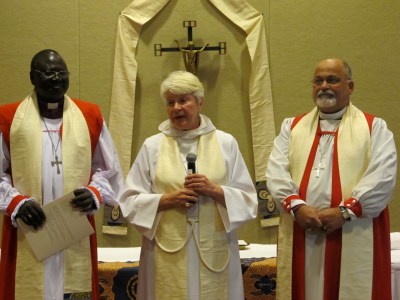
There is lots packed into a General Convention so the service didn’t begin until 9:30pm. As wonderful as it was, I have to say I was a bit weary during the first part of the service. That changed during the passing of the peace when the three bishops in the service took a liturgical liberty to tell the congregation about their relationship.

From left to right, that’s Ruben Akurdit, of Bor, Sudan; Cate Waynick of Indianapolis, Indiana; and Mauricio Andrade of Brasilia, Brazil. Together, they have a three-way companion diocese relationship. Last year, Cate and Mauricio were in Bor together. (Three-way companion relationships are increasingly common. We recently saw the fruit of another relationship in this letter to Rowan Williams from several bishops.)

In their comments, the three bishops stressed how they see in one another the body of Christ: difference (of race, background, culture, sex, etc.) but commonality in worshipping the same God in Christ.

I was completely awake by the time they had finished their short remarks. Then, in the Eucharistic prayer, each said the words of institution (the “take eat” part of the liturgy) in their own language. It is not often that a Eucharistic prayer I have heard so often and know so well can surprise and move me but it did on Monday night.

The act of celebrating the Eucharist in multiple languages with people from multiple backgrounds seemed to me to be so central to what the good news of the body of Christ is all about. And it’s yet one more reason I have hope about the future of the church and its role in God’s mission in the world.