Dislocated Liturgy

In her new book, Still: Notes on a Mid-Faith Crisis, Lauren Winner has a section on “dislocated exegesis.” That’s the practice of reading a familiar Bible passage in an unfamiliar context, say, in front of an immigration detention facility.

I thought of that when I read this post from my fellow seminarians at Nashotah House in Wisconsin. It seems a bunch of them put on cassocks, left behind the confines of their seminary, and went and chanted the Great Litany and Compline.

My friend Nathaniel, who wrote that post, calls it one of the most profound liturgical moments of his seminary training:

I was deeply impacted by the juxtaposition of the rhythm of liturgy with the pulse of the city.  Indeed, we might call it a “secular liturgy.”  The ebb and flow of quotidian humanity passed before us: buying and selling, eating dinner, parking, going from point A to point B and back again, waiting for a rendezvous, panhandling.  I was overwhelmed with the sense of how God delights in his creation, and how he yearns to bless, and to transform, and to open all of these to being Eucharistic.  He longs for these liturgies to be transparent to his work and to his love in the world; to turn all of these banal experiences into sacrifices of thanksgiving through union with Christ.

Slowing down, being still and silent in that place, and listening to the Spirit, I suddenly had a sense of the presence and the nearness of God.  I have never experienced this in a city before.  I have always experienced cities as being somewhat cold and godless, full of noise and distraction.  And yet, standing in silence, hearing all the noises of the traffic, and distant conversations, and doors opening and closing, I experienced a beautiful cacophony that is no different than anywhere else where human hearts beat, and that God is no further there than in the monastery secluded in the deepest wood or emptiest desert hermitage.

Liturgy is one of the great strengths of the Anglican tradition. How else could this idea be adapted in your context?

The distinctiveness of the Episcopal Church

Samuel Seabury asked a question on Twitter recently:

(Isn’t Twitter wonderful? Dead Episcopal bishops tweeting. Seabury’s old foe William White is online as well.)

I think Seabury asks a good question here. If I remember my history correctly, at the time the Episcopal Church was being born, there were no other churches in the new United States of America that had bishops. Congregationalists, Methodists, Quakers all stressed local governance.

In this context, naming the church “Episcopal” is something a bold move. “Look at us,” it says, “we have bishops and we are connected to the historic, true church. We are distinctive.”

So as the Episcopal Church once again struggles to find its way in a changing world, I wonder if asking Seabury’s question again is helpful: in the current religious marketplace, what makes the Episcopal Church distinctive?

Relatedly, is highlighting our distinctiveness the way to go? Or should we be stressing what we have in common, not only with other Christians but with all folks everywhere?

Beyond “open communion”

As if the current raft of controversies isn’t enough, the Episcopal Church is moving towards open debate about the relationship between the Eucharist and baptism. The other weekend, I attended a gathering in the Diocese of Connecticut on this issue.

What struck me at the gathering was not so much the arguments about the issue at hand (which I’m not going to rehash here, although I do find that this article has a helpful new take on old questions) but that each speaker acknowledged in one way or another that the questions raised by this debate go much deeper than the relationship between the Eucharist and baptism.

I think this is right. This conversation is bubbling up in the church at this particular time not so much because of a sudden, pressing need to re-evaluate the church’s historic teachings on baptism and the Eucharist but because it is a useful proxy issue for countless other conversations the church needs to be having.

As I see it, the debate about baptism and the Eucharist is also about the following (and this is a non-exhaustive list):

  • What is the church’s relationship with the culture in which we find ourselves? One way of asking this is to wonder about the relationship between the claim to “radical hospitality” and “anything goes” nature of our world.
  • People are wounded. The way the world works exacts a huge cost on people. I think of this anytime I hear people preach a theological anthropology that stresses the goodness of people—we are all “magnificent creations of the divine” as I heard recently. Rather than stressing the way in which Jesus brings about change in our lives, the church is in a position of preaching that we are all really just OK and we can all be “radically included.” We preach that because so much of the world says otherwise.
  • Relatedly, what do we do not want in church? As one of the speakers at the event said, “If you ran a church that was ‘radically inclusive,’ you’d probably be in jail.” How do we say “no” in the church?
  • I have a hard time imagining that we would be having this debate if church attendance was growing. In this light, proposals for open communion can look like a desperate attempt to get people to stay in church, out of fear that if we tell them they need to be baptized first they’ll never come back. How do we avoid approaching ministry from a position of fear about church decline?
  • Do we value theological coherence in the church? If we do, I have a hard time seeing how we can square the baptismal ecclesiology that has been so prevalent recently with open communion. I suspect we don’t value coherence so much as we value “bums in pews”… and we’re willing to do anything we can to get them there. What would an ecclesiology that takes no account of church size look like?
  • How is our liturgy related to our witness to the world? Do we have to have Eucharist at virtually every service (“Eucharistic inflation” as I’ve heard it called)?

Whatever the outcome of the various resolutions that are pending on this question, it seems unlikely that there will be much change in practice. Those who do now give communion to those who are not baptized will likely not change. If the canons are changed, it seems unlikely that congregations supporting the traditional teaching of the church will change either.

But what could change is that the church could have a larger conversation about some of these larger questions. Rather than getting lost in a welter of confusion over a question that really isn’t going to change much, maybe we could start addressing some of the serious underlying issues.

What other questions does this issue raise for you? And what else would you like to see the church discuss?

Remembering St. Peter’s, Ellicott City

For the last few days, I have been processing the news of the shooting at St. Peter’s, Ellicott City, a church I have visited and preached at on more than one occasion. The shooting resulted in the death of Mary-Marguerite Kohn, a priest I remember well. The church’s administrative assistant Brenda Brewington was also killed.

I was invited to St. Peter’s because the congregation has long supported African Medical Mission, the organization I worked for when I lived in South Africa. In fact, AMM’s Jenny McConnachie was at St. Peter’s just a few weeks back. As the stories about the shooting have made clear, St. Peter’s is a congregation that was committed to ministry with all kinds of people from all walks of life. (It seems the shooter was a homeless man who had been served by the St. Peter’s food pantry.) It’s in the nature of a church that was founded to minister to mill workers in Ellicott City.

Over the weekend, I had a look back at one of the sermons I’ve preached at St. Peter’s. The text was the rich man and the eye of the needle. I noted this paragraph:

We’ve seen how wealth can help us build walls around ourselves. We’ve seen that Jesus is calling us to make ourselves a little more open and a little more vulnerable to the world around us. The phrase I want to use to describe this is the same phrase that we use to describe what Jesus did – incarnation. Reconciliation begins when we choose to go to a new place in the world and simply exist. God used God’s immense power to choose to exist in an entirely new way, among humans. We have wealth and power and we must use it to exist in a new space. Sometimes that new space means getting up and moving from North America to a shantytown in South Africa. But sometimes going to that new space means simply exploring a different part of the town you’ve lived in your entire life. Sometimes going to that new space simply means going down to the end of the pew after the service and talking to the person you’ve never met before. God’s mission of reconciliation requires of us an incarnational ministry. That means we have to simply be in a new and different way and in a new and different place. It is both a reassuringly simple and monumentally difficult task but it is at the centre of our Christian calling.

In reading about the shooting, I’ve been struck by just how much emphasis Mary-Marguerite put on exactly this kind of incarnational ministry. St. Peter’s didn’t need me to tell them about this; they just needed to look at their co-rector.

I’ve written and preached about vulnerability frequently. (The Incarnation is the central idea in my new book.) But I never had anything like this in mind, perhaps one reason I’ve found these deaths so shocking. In my Good Friday sermon this year, I preached about daily crucifixions that are all around us. These three deaths are one example of exactly that.

St. Peter’s other co-rector, Kirk Kubicek, preached a beautiful sermon last Sunday that just about sums it up:

It is their commitment to serving their brothers and sisters whoever they might be, and believe me if you spend any time in our office you eventually see every kind of brother and sister there is, that sent them home to the heart of Love. We will never know why, but we do know they and the man they were serving are with the God who says, You are my Beloved – with you I am well pleased….

And I still see two women who were and continue to be exemplars to us of what it means to abide with Christ – what it means to be known by Christ.

In truth, right now they are where they have always been – in the heart of God’s everlasting love.

Mary-Marguerite’s funeral gets underway in just a few minutes in Baltimore.

How do we argue in the church?

I once met an Orthodox woman who was flabbergasted to hear that in some parts of the Episcopal Church, Mary is not venerated. “I know there can be different practices on the Eucharist and other things,” she said, “but I just don’t see how you can be a Christian and not venerate the Virgin Mary!”

I thought of that woman the other night when I had a conversation with a very good friend of mine about communion with the unbaptized. This is the practice of sharing communion with all who come to the rail, regardless of whether they are baptized or not.

My friend, who opposes changing the practice, said, “I can’t see the point of having a conversation with someone who disagrees with me on this subject. It just seems so obvious what the answer is.”

My friend also supports the full inclusion of gays and lesbians in the church. I pointed out to him that his comment is more or less what has been said by those who oppose changing the church’s teachings on homosexuality.

Everyone draws the line in a different place. Mary. Homosexuality. Communion. We all (and I include myself here) have issues on which we are unyielding and absolutely convinced of our own rightness.

We’ve had a decade or more of trench warfare in the Episcopal Church on sexuality (which continues). It has conditioned us to think of a major liberal / conservative divide in the church. What is interesting about the communion debate is the way in which it complicates this divide, as my friend demonstrates. This actually fills me with hope.

I hope that in this conversation about communion we will learn again how to disagree with one another. I hope we learn that the liberal / conservative understanding of the church is not set in stone and, in fact, doesn’t do a very good job of capturing its full diversity. I hope we can learn that Christian unity is not about ensuring that everyone believes and does the same thing. Rather, Christian unity is about recognizing a pattern of faithful living in another person, a pattern of living that shows that one’s life has been transformed by Christ.

It is very easy in any debate—sexuality, communion, Mary—for the stakes to escalate quickly and for anathemas to start being thrown around with reckless abandon. (It has always been so in church history.) What if, in this conversation about communion, we could start by focusing on our patterns of faithful living and pursue ways of building these ties? What would it be like for people who disagree on communion to come together for prayer, instead of debate? As much as I am filled with hope, I fear that Tom Ferguson is right and the communion question will quickly become one which “will just become another flashpoint as we organize ourselves into our little mini-communities, desperately trying to find the people who are like us, and, hence, the true Episcopalians.”

I’m not saying that conversation on this topic, and many others, is not necessary. But it’s striking how quickly we think debate can be the only thing we need to do in the church when, in fact, it’s a small part of what it means to be a Christian wrestling with a difficult topic.

The way in which the church argues can be a key part of our counter-cultural witness to the world. Maybe on the communion question we can begin to get it right.

Episcopal / Anglican Slogans

Last semester in class, we made a list of slogans, phrases, ideas, objects, etc. that we’ve heard in conversation about or relating to the Episcopal Church, Anglicanism, or any part thereof. Here’s a partial list:

  • the three-legged stool (that is, Scripture, Tradition, and Reason)
  • lex orandi, lex credendi—the way we worship shapes/determines/is what we believe
  • a logo that features a shield with obscure heraldry
  • “no outcasts”
  • Via Media, or Middle Way
  • “The Episcopal Church Welcomes You” (to what?)
  • Dispersed Authority
  • The Four-Fold Anglican Shape: formed by Scripture, shaped by worship, ordered for Communion and directed by God’s mission (this is the most recent, I’d say)
We can debate some of these later, especially whether their current interpretations and usages match up with the original usage, whether the authors meant for them to have such defining weight (in the case of dispersed authority, definitely not), and whether they are even consistent. What struck me as we did the list is that you could make a similar list of slogans related to Episcopalians/Anglicans and mission:
  • Mutual Responsibility and Interdependence in the Body of Christ (1963 document from Toronto Anglican Congress)
  • Partners in Mission
  • Decade of Evangelism (the 1990s, as set by bishops at Lambeth 1988)
  • Millennium Development Goals
  • Five Marks of Mission

(Indeed, the word “mission” itself could almost be added to this list, given the reckless abandon with which it has been used in recent years.)

I don’t find many of these particularly helpful. I can never remember the Five Marks of Mission, mainly because they don’t really grab me. I think the Millennium Development Goals promote a shopping-list mentality among churches that prize dollars and cents over relationships. The Decade of Evangelism is very well-remembered in the non-western Anglican Communion (an archdeacon in Nigeria last summer told me, “The Decade of Evangelism saved the Church in Nigeria”) but I rarely hear anyone in the U.S. talk about it.

The thing of it is, despite our wonderful slogans we still seem to have difficulty articulating what the Episcopal Church is and is for (though we seem to have no problem articulating what it is not). And, we lack a clear sense of what mission is, which results in something like the Sauls’ resolution’s very thin idea of mission.

There is much to find depressing in all this but two stand out. First, these slogans replace genuine theological engagement with inconsistent and confusing sound-bites. Second, they betray the assumption that we all know what we’re talking about when we say something so we don’t need to bother figuring out what it means. This is never a good assumption to make.

As far as mission goes, there’s a third disappointment: all of these are focused outward. This is, obviously, quite good. But I’d hope that we remember that in order for us to be a missional church, we need first to be transformed by the love of God in Christ to become missional Christians. Mission is our response to God’s grace—but we need to receive that grace before we can respond.

What are your favourite slogans that I’ve left out?

UPDATE: Welcome to all who are clicking over here from Episcopal Cafe. If you like this post, you might like some others I’ve written about mission lately: the spirituality of mission or how our understanding of mission shapes our budgetary decisions.

Search for a Gospel that is both Good and New

Let’s say I’m a twenty-something with a college degree, living in Brooklyn. I kind of have a job but no benefits. I get by with money but I have lots of debt. I don’t see what the big deal is about gay marriage and it’s obvious that the earth is getting warmer. My parents dragged me to church a few times when I was growing up so I know something about all that religion stuff, but now my knowledge of religion is mostly based on people like Rick Santorum. I just don’t see the point of faith and I certainly don’t see the need for it in my life. I’m part of the “Rise of the Nones.”

Now let’s say that one day I’m surfing around the Internet and I come across the interview Katharine Jefferts Schori recently gave to the Huffington Post. The words “female” and “bishop” are so rarely connected in my mind that I click on the link to see what she has to say.

Stepping out of the Brooklyn millennial conceit, here’s the question I want to pose: as our fictional twenty-something peruses the interview, does he find anything that is genuinely Good News? That is to say, does he find any of the life-altering, world-changing, drop-everything-and-follow gospel of Christ Jesus?

(Let’s note, of course, all the provisos. Of course, she was responding to questions, of course the interviewers wanted to ask her about hot-button subjects—sex, creation, Scripture—and of course an interview is not a sermon.)

I think the answer to this question about the Good News is no. Our fictional Brooklyn resident wouldn’t find much to disagree with. Bishop Katharine is in sync on same-gender marriage. Good. The church wants to respond to the poverty of the world. Good. She calls it “God’s mission,” but whatever. We agree.

The thing is, while our fictional millennial may think what Bishop Katharine has to say is Good, none of it is New. He already believes all this stuff already. The church is arriving late to the party. Glad to have you here but you’re old news. You do your thing, Bishop Katharine, and I’ll do mine. None of what Bishop Katharine has to say would, I think, make our millennial think, “Wow, I’ve got to learn more about Jesus and get myself into church!” In fact, by my count, the presiding bishop is quoted mentioning General Convention (once), more than she mentions Jesus (none).

Again, all my earlier provisos apply and nothing in this post is a comment on the presiding bishop herself. This interview, I’m sure you will agree, well represents the dominant working theology in the Episcopal Church in the early twenty-first century.

If you read the Gospels or Acts, it is clear that when people heard the proclamation of the Good News, their lives were transformed. Not just adjusted or modified but completely reoriented towards Christ. The fact that the gospel had such an impact is, to my mind, one of the best confirmations of its truth.

What is the Gospel message in the twenty-first century that is both authentically Good and authentically New, the proclamation that seizes the attention of the hearer and brings about dramatic life change?

How do we preach the unique witness of Jesus Christ in a way that makes people who’ve never heard about Jesus want to devote their whole lives to following in the Way he first showed to us?

That, it seems, are questions we still need to answer.

Can we sustain our own weight?

A year or so ago, I heard Rick Ufford-Chase, former moderator of the Presbyterian Church USA, speak at Yale Divinity School. Rick has had—and continues to have—a fascinating ministerial career so it’ll be unfair to him that the comment I remember best from his presentation has to do with budgets.

Rick remembered that in each budgeting process while he was moderator, some ministry of the churchwide office was cut. The church was spending less and less money each year and so having to pare itself further and further down.

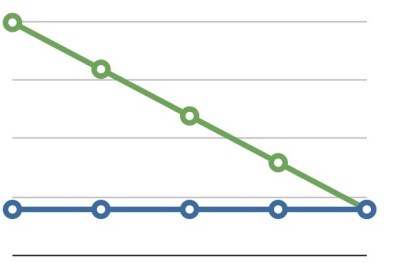
He drew a graph that looked like this.

The blue line is the basic cost of supporting the church’s infrastructure. The green line is the ministries it supports. Rick’s point is that you can’t just keep paring until you get to zero. At some point, the budget would reach a point at which the church could no longer sustain the weight of its own bureaucracy. At this point, he thought, everything would just collapse.

In Episcopal terms, the blue line is the basic cost of supporting the infrastructure of a churchwide entity—a presiding bishop, a president of the House of Deputies, a General Convention. The green line is the (declining) amount of money to spend on various ministries—anti-racism, women’s, Christian formation, youth, for instance, to name some of the Episcopal Church’s ministries that have been cut or are proposed to be cut in recent budgets.

So what will happen when green meets blue? The proposed budget for the next three years of the Episcopal Church made me wonder if, perhaps, we’ve reached that point. The budget, as I read it, eliminates the General Board of Examining Chaplains, the group that administers the General Ordination Exams, the series of tests that prospective priests take to prove their competency in the seven areas required by the canons of the church. The GOEs have been seen as a necessary part of the church’s bureaucracy. The canons require competency. Not all dioceses have the resources to assess competency on their own. There’s an argument to be made, anyway, for national standards of competency. So the church developed the Board of Examining Chaplains, which, in turn, oversees the GOEs.

Our church has these great canons that lay out a detailed structure for a way of being church. Yet if we don’t have the money to put into practice what those canons require, what’s the point? Where does it leave us as a church?

This General Convention is going to name the committee to lead the search for the next presiding bishop. One wonders, though, at the rate we’re going just how much church will be left for him or her to preside over.

How “mission” shapes budget

Here’s an example about how the Episcopal Church’s failure to have a conversation about what we mean by mission produces contested and confusing budgetary decisions.

The budget proposed for the next three years in the Episcopal Church adds close to $700,000 for the Office of Government Relations, to be focused on anti-poverty advocacy. Great! All Christians can get behind anti-poverty advocacy, right?

Except that it comes at the expense of other programs. More than a million dollars cut from funding the work of the Anglican Communion Office. Close to three million cut from the budget for youth programs.

The first thing to note is that these are policy decision being made without, to my knowledge, policy debates being had. I used to be a reporter and covered lots of budget debates in lots of organizations. One realization I always came away with is that how a group spends—and doesn’t spend—its money reflects its values.

The closest Episcopalians have come to a conversation about budgetary priorities is the constant repetition in the church of the word “mission” without any clarity as to what that word means. And since, as we’ve seen, one influential document defined our mission as simply being what Jesus says in Luke 4, spending more money on anti-poverty programs makes a lot of sense; “good news to the poor” and all that. (Of course, in the rest of the Gospel of Luke, Jesus spends precious little time with people we would identify as “the poor,” raising questions about how to interpret this passage. But that’s an exegetical conversation for another time.)

What if we defined mission a bit differently? This is not the place to lay out a full-blown missiology but what if we said that God’s mission is the restoration of right relationship between humans and between humans and God? (Our catechism says something very similar.) What if we saw relationships as being at the centre of our role in God’s mission? What if we thought that in the Incarnation, God in Christ takes relationship to a whole new level, crossing the barrier between divine and human and engaging with those who are different in a credible, costly, and vulnerable way?

In short, what if we said that mission is about building meaningful relationships with those who are different than us as we work towards that glorious day when there will be “a great multitude that no one could count, from every nation, from all tribes and peoples and languages, standing before the throne and before the Lamb, robed in white, with palm branches in their hands. They cried out in a loud voice, saying, ‘Salvation belongs to our God who is seated on the throne, and to the Lamb!’” (Rev. 7:9-10) Although in our polarized and fractured world we demonize and mock those who are different than us, the witness of Scripture is that, at the end, all of us who are different will be united in one. We might as well start working towards that, and, in the process, follow the example of Christ who engaged with difference in a way no one had ever seen before or since. It would be a powerful, counter-cultural model to the world around us if the church could be an incubator of heterogeneity rather than a mere simulacrum of the world’s drive towards homogeneity.

If we said all this, we might have different priorities. We’d spend our money on a place like the Anglican Communion Office so it can continue its important work of bringing together different people from different backgrounds and different parts of the world to find common ground in projects like Continuing Indaba and the Bible in the Life of the Church. We’d make sure that the Episcopal Youth Event stays in business so young people from different backgrounds can engage in meaningful, Christ-centred interaction in a way they get almost nowhere else.

But we might not increase funding for the Episcopal Public Policy Network, making the painful decision that in a time of limited funds, policy advocacy is not part of the church’s unique charism.

You might disagree with these ideas (and you’ll note undoing EPPN’s additional funding doesn’t produce enough to fund EYE and the ACO) or you might have different ideas for moving money around in the budget. Terrific! What I wanted to illustrate in this post is the impact of not talking seriously about mission. My hope is that the church can begin to have a conversation about its budget—and the future of the church—that grapples with the missiological issues at stake.

If we’re going to place “mission” at the centre of everything, could we at least start talking about it?

How? or Why? And what’s the mission?

A friend who has read Diana Butler Bass’s latest book told me the other day about a point Bass makes repeatedly. Basically, as I understand it, Bass argues that the church has been too busy asking how questions that it no longer asks why questions.

I haven’t read the book but the insight struck me as true. We ask ourselves how we are “doing” church but we don’t talk about why we are bothering with it. Ashes To Go, an exciting idea that takes the imposition of ashes out of the church on Ash Wednesday, is still basically a how conversation. How do we impose ashes, not why are we bothering with this liturgy? What does Ash Wednesday mean in this day and age? (Why and what questions are closely related.) Perhaps, we think, the answer to the why questions are obvious but few things with Christianity ever are.

These questions are particularly pressing in the Episcopal Church as we prepare for a General Convention this summer that will be asked to make decisions about restructuring and pass a budget that deals with the painful reality of substantially diminished income.  Both these questions—restructuring and budget—are how questions. How do we be a church and spend our money in light of the realities of church life in 2012?

The answer that has been given to the underlying why questions is, simply, “mission.” We are told we must be structured for mission and we must spend our money on mission. But what is mission? Why is it important? This conversation does not appear, to my knowledge, to have been had. And it is a particularly important conversation to have because mission is in danger of becoming a buzzword, meaning different things to different people and so losing its force in dialogue.

To take one example, the Chief Operating Officer of the Episcopal Church, Stacy Sauls, last year proposed a resolution calling for a special convention on church structure. It reads, in part: “The Special Commission shall be charged with presenting a plan to the Church for reforming its structures, governance, administration, and staff to facilitate this Church’s faithful engagement in Christ’s mission to proclaim good news to the poor, release to the captives, recovery of sight to the blind, freedom to the oppressed, and the acceptable year of the Lord (Lk. 4:18) in a way that maximizes the resources available for that mission at all levels of this Church.”

The text thus claims to answer the why mission? question. It does so in a way that is faithful to scripture by pointing to Jesus’ “inaugural address” in the Gospel of Luke. (We should note, of course, that Jesus is here quoting the prophet Isaiah. There is little thought given in this resolution to what Jesus “adds” to this Isaianic mission, though of course he must add something or the Gospel would no longer be good news but good olds.)

But is Luke 4 the only way to think about mission? Hardly.

What about when Jesus says, “I have come that they may have life and have it more abundantly”? (John 10:10) Or when Jesus is asked what to do to perform the works of God and he replies, “This is the work of God, that you believe in him whom he has sent”? (John 6:29) What about when Abraham is told that if he follows God’s commands to get up and go, “in you all the families of the earth shall be blessed” (Genesis 12:3), a promise repeated in Genesis? What about Jesus pre-resurrection commands to “to proclaim the kingdom of God and to heal” (Luke 9:2) and post-resurrection commands to, famously, “Go therefore and make disciples of all nations, baptizing them in the name of the Father and of the Son and of the Holy Spirit, and teaching them to obey everything that I have commanded you”? (Matthew 28:19-20) There’s a whole whack of Pauline passages to consider as well, of course.

None of these are contradictory and all form a piece of the mission to which we are called as followers of God in Christ. Nor is God’s mission necessarily something best learned by pointing to individual passages. Rather, I’d have us consider the entire witness of the people of God as recorded in the Bible. But these few verses certainly complicate the picture of mission put forth in the Sauls resolution.

The recently-released budget for the next three years of Episcopal Church spending points up exactly why we need to be having a conversation on what we mean by mission. While the narrative to go with the budget mentions mission in its first paragraph, there is almost no explanation as to what the budget drafters think the word means. The result is that the conversation about the budget has been almost entirely about how questions, not why ones. Every decision in the budget is one rich with missional implications—cutting funding for youth events but increasing it for policy advocacy is a missional decision, for instance—and I want to talk about the what and the why before talking about the how.

Here is a non-exhaustive list of questions I’d like to think about in the run-up to General Convention

  • What is the mission to which we are called as followers of God in Christ?
  • What does the church have to offer the world in this generation?
  • Why is the Christian witness significant/important/meaningful in this time and place?
  • Why does the Episcopal Church exist? What is the unique offering that Episcopal followers of God in Christ can make to the world?

I have some thoughts on all these questions and hope to get around to sharing some of them. For now, though, I hope we can change our budget and structure conversation away from one that pits Episcopalians against one other in a scarce fight for money and power and towards one that starts asking what and why before asking how.