Five Marks of Mission: History, Theology, Critique

In recent years, many Anglicans have given new attention to what are known as the Five Marks of Mission. It’s a definition of mission first formulated by the Anglican Consultative Council in the 1980s but not taken into widespread use until the late 2000s when then Presiding Bishop Katharine Jefferts Schori used them repeatedly, including to structure her budget proposals and one of her books. At one point, the Episcopal Church even produced a Facebook quiz to let you figure out which mark of mission you were. In the Church of England, candidates for ordination are asked to evaluate themselves against these marks. At the 2016 meeting of the Anglican Consultative Council, there was an unsuccessful attempt to make them a fifth instrument of communion.

In teaching mission in Cambridge in the last few years, it felt obligatory to talk about these marks of mission. As I tried to do this I realized that little had been written about their origin or their theology. So I started doing my own research, which eventually resulted in a new article in The Journal of Anglican Studies, published last week.

You can read the entire article for yourself but here are some key themes:

  • The Five Marks of Mission were heavily influenced by non-western Anglican leaders, particularly African ones. People like David Gitari, a Kenyan bishop, and Benjamin Nwankiti, a Nigerian one, drew on their experience of mission in their own contexts to shape an approach to mission that Anglicans worldwide adopted. Mission thinking is a site of cross-cultural consensus-seeking in the Anglican Communion.
  • Gitari, Nwankiti, and others were heavily influenced by contemporaneous debates among evangelicals like John Stott and others about the nature of mission. Was mission solely about individual evangelism or did it also involve social action? The Anglican Consultative Council reports that gave birth to the Five Marks of Mission sometimes quote verbatim (and not always with citation) from these evangelical reports of the same era. Although it was non-evangelicals like Katharine Jefferts Schori who brought the Five Marks of Mission to wider Anglican attention, they are deeply rooted in the evangelical wing of the Anglican tradition.
  • For a long time, no one called this definition of mission the Five Marks of Mission. In fact, the definition sat on a shelf for at least a decade more or less undisturbed. The need to turn it into a slogan is part of a larger series of Anglican mission slogans, from Mutual Responsibility and Interdependence in the 1960s to Partners in Mission in the 1970s and 1980s, the Decade of Evangelism in the 1990s, the Millennium Development Goals in the 2000s, and the Five Marks of Mission today. (And if “Five Marks of Mission” is too long, the image above suggests they can be reduced to five words beginning with T.) In studying each of these slogans, it is possible to see how Communion-wide thinking about mission has shifted in the intervening half century.
  • The way in which the Five Marks of Mission are used now—as a check-list approach to mission and as a source of mission strategies—diverges from their original intention, which was as a definition of holistic mission. Lambeth Conferences, Anglican Consultative Councils, and other bodies have produced no shortage of mission reflection over the years, some of it quite good. We should ask ourselves why, of all that material, the Five Marks of Mission rose to such prominence, particularly when their shortcomings are readily apparent (something I wrote about many years ago and expanded in this article).
  • Anglican mission slogans have historically lasted about a decade. New leadership in the American church and in the Church of England is emphasizing other themes—the Jesus Movement, reconciliation, discipleship—and we should not expect the Five Marks of Mission to last much longer. But we can hope the process of cross-cultural consensus-seeking in thinking about mission continues.

As I say, you can read the entire paper I wrote by clicking on this link. Your feedback is welcome.

UPDATE: I’ve fixed the link to the .pdf version of the article so it should be possible for all readers to access now.

Mission = expanding the Eucharist

Scott Gunn has resurrected his blog and written a cogent explanation of why the passing of the peace during the Eucharist is not best served by turning it into a hugging-and-chatting marathon.the peace

I’ve been a part of churches like that and it’s been fine. But he’s also right that the purpose of the peace is not to ask our friend how the weekend has been but to embody the reconciliation with one another that is ours in Christ. As he notes, it is Christ’s command in the Sermon on the Mount to “be reconciled” before bringing our gifts to the altar that provides the grounding for the act. Moreover, in the earliest recorded teaching on the Eucharist (I Corinthians 11) St. Paul lambasts the Corinthians for the divisions in their community when they celebrate the Eucharist—the rich eat well together and the poor stay separate and eat, well, not a lot presumably (v. 21). Paul says this amounts to showing “contempt for the church of God.” (v. 22) It’s no mistake that in the following chapter Paul offers his lengthy teaching on the body of Christ, a reminder of how we are all in this together. So if we’re not reconciled with one another before receiving the Eucharist, we’re kind of missing the point.

This raises a particular question, one that a commenter asks of Gunn in his post:

I am not aware of reconciling being possible at that time. If I need to reconcile it would require more than an smile and a handshake.

How are we supposed to resolve the pressing divisions in our community and in the world with a handshake, a hug, or—if we’re being properly Biblical—a kiss?

The answer? We’re not.

The passing of the peace is simultaneously both a handshake that reminds us of our need for reconciliation with our neighbour and an embodiment of the work of reconciliation that has already been wrought on the cross. The bread and wine that we use at the Eucharist is both “just” bread and wine and at the same time the mystical body and blood of Christ. When we enact the liturgy, we are both doing normal, everyday acts—reading, speaking, handshaking, giving, receiving, eating—and participating in the work of salvation and redemption—hearing the intertwining of our life with the Biblical narrative, embodying reconciliation, returning to God what has been given to us, receiving the body and blood of Christ.

The liturgy, therefore, prompts us to ask questions that help us gauge the rest of our lives. The passing of the peace, I find, raises some of the following questions for me:

  • With whom in this congregation am I trying to avoid passing the peace? With whom do I genuinely need to seek reconciliation?
  • Does it feel particularly false with anyone when I say, “Peace be with you”?
  • Most importantly, who is not in this congregation? With whom am I missing opportunities for reconciliation because of their absence from this Eucharistic community? Whom should I be looking to invite into this community?

And that leads to a reminder that our liturgy is not just something we do to feel good about ourselves. It is not something we have to get through before we can get on to the important stuff. Our liturgy is mission(al). It is the enactment of our faith.

Indeed, my favourite definition of mission is simply this: expanding the Eucharistic community. When we draw more people into this community of people who are in right relationship with God (confession/absolution), with another another (passing the peace), and gathered around the crucified and risen Christ on the altar, then we are truly sharing the love of God in Christ with the world.

What the church has that the Sunday Assembly doesn’t

What, no cassock?

The Sunday Assembly—an atheist, churchlike organization based in London—has received a bit of press lately, first in the Economist and then on the BBC.

On the one hand, I think the apparent success of the Sunday Assembly points to the deeply felt need in the Euro-Atlantic world for community and togetherness. So much of our lives is pulling us apart these days (or bringing us together in unhelpful ways) that I think lots of people are looking for a safe place simply to be with one another. If, for one reason or another, they can’t find it in church, they might look for something like the Sunday Assembly. That they have to look to the Sunday Assembly for this is an indictment of the church, not a critique of the Sunday Assembly.

But as I was listening to the BBC story—lots of upbeat, encouraging chatter, like “who’s ready for another song?”—I could think only of one thing: my many years as a summer camp counselor. In that line of work, the keys to success are enthusiasm and energy—the more the better. I have convinced scores of children to sing inane songs by acting like it was the most wonderful, best, coolest thing ever—my enthusiasm led to my success. The way these Sunday Assembly folks were whipping up their congregation was, I thought, more than a little similar.

But there are problems in this world—illness, addiction, death—to which more enthusiasm is not the answer. The Christian tradition, however, addresses these issues by speaking of sin, grace, repentance, forgiveness, mercy, and so on. I hope people go to church when they are feeling good about life. But it is when people are struggling with life that they should feel especially welcome. Church is the place you go when things aren’t working out. (That it is not always seen this way is another indictment of the church.) It is hard to see how a new widower grieving the loss of his wife would find comfort or solace in singing “Celebration” but hopefully in the celebration of the Eucharist he finds the reminder of Christ’s ultimate triumph over death. And even my energy and enthusiasm as a camp counselor could give way to pastoral attention when the situation called for it.

(I grant that my knowledge of the Sunday Assembly is limited and perhaps they have ways of addressing these concerns I do not know about. Still, it’s hard to see a moment of silence compares to the triumphant victory of Christ.)

Church people don’t always like to admit this, but churches exist in a competitive marketplace—whether it is the Sunday Assembly, soccer games, or simply morning television, there are lots of other activities out there competing for people’s attention. But one thing about competition is that it can force organizations to refocus on their core competencies, their competitive advantage.

I wonder if the Sunday Assembly can help churches return to the central themes and traditions that have carried it the past 2000 years.

Malek, South Sudan

Malek has a special place in the mission history of South Sudan.

IMG_6694
The first CMS team, plus a visitor from the Uganda mission. Shaw is back row, left.

In early 1906, six young men—none older than 30—arrived at this community on the east bank of the Nile River, fresh-faced and eager to convert the Dinka people to Christianity. They were representatives of the Anglican Church Missionary Society, and what they lacked in experience they made up for in enthusiasm.

Within 18 months, five of the six were gone, felled by a combination of ill health, incompetence, and sheer frustration at the perceived obstinacy of the Dinka. The one who remained, Archibald Shaw, soon contracted malaria and was sent to Khartoum to recuperate. The Anglican presence among the Dinka was nearly extinguished almost before it had begun.

Shaw returned to Malek and began building a mission station. By the time he retired in 1939, Malek had a school and a church but CMS had found much greater success elsewhere in southern Sudan. Malek continued on as a mission station, but Shaw and others saw their work among the Dinka largely as a story of failure. Such Dinka Christians as there were were former students who were largely disconnected from their traditional way of life.

In time, the independent government of Sudan took over running the school at Malek. But the school was destroyed during Sudan’s first civil war. It was re-built in the 1970s during a period of peace, and then destroyed again during the second civil war.

Today, this is all that remains of the house that the CMS missionaries built for themselves.IMG_7324

But here is the church.IMG_7326

And there’s not only a primary school, but also a secondary school in the community.

In virtually every village around Malek, there is now a mud-and-thatch church, a fact that would have stunned those early CMS missionaries, whose evangelical tours through those same villages are a record of frustration.

The Dinka church on the east bank of the Nile River is a thriving institution. Indeed, the growth has been so quick and comprehensive, that Anglicans in Malek now want the church to carve Malek out of the existing Diocese of Bor and make it a free-standing Diocese of Malek.

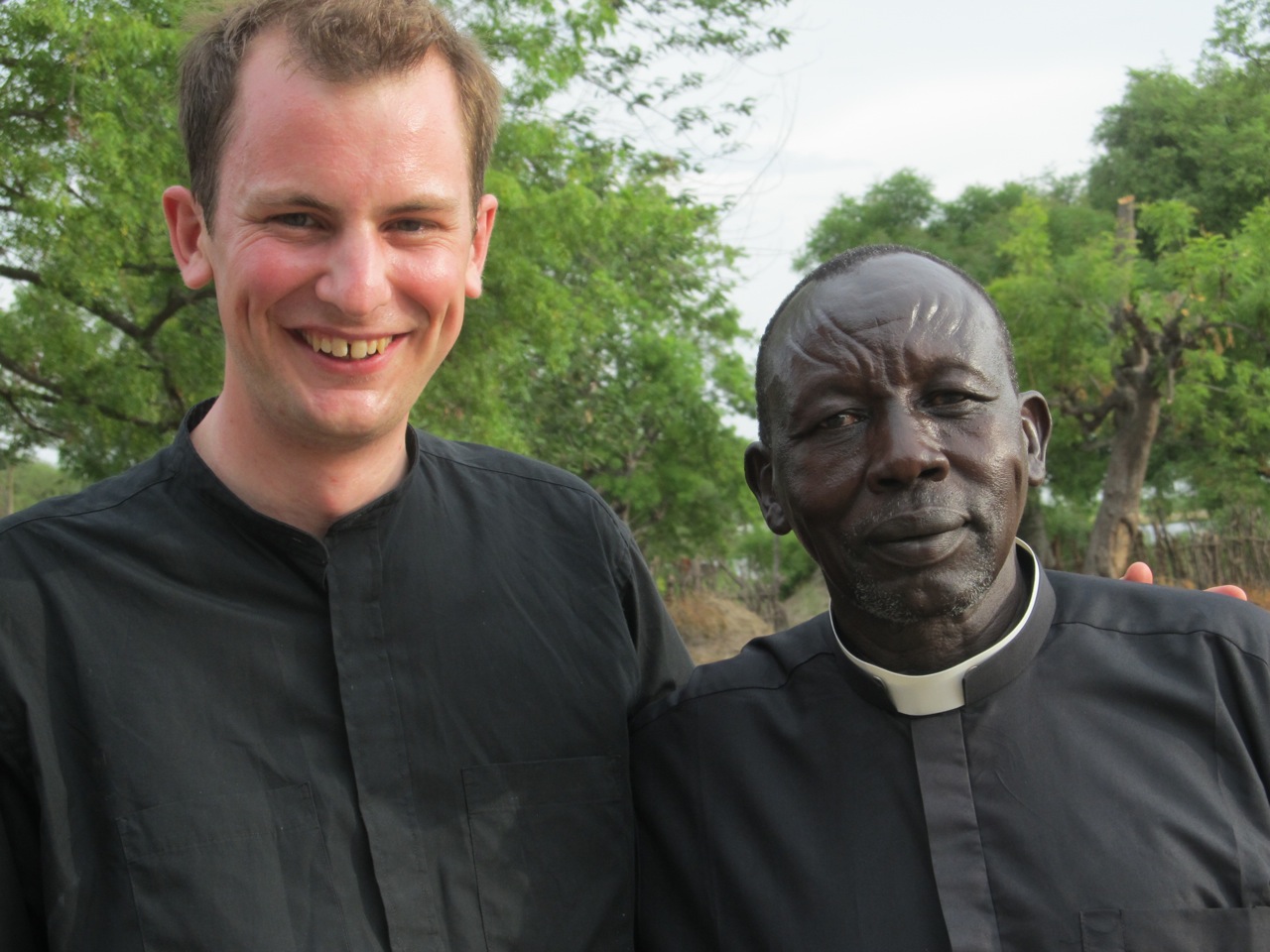
One of the clerics in this picture decided it was just too hot to wear a collar.

It is this man who now oversees the Malek archdeaconery and is leading the effort to create the diocese. Joseph Akol Gak was ordained in the 1980s, when the school had just been rebuilt (and was about to be razed again). He spent time ministering to Christians in refugee camps in Ethiopia and across southern Sudan. In the span of his ministry, he has seen the Dinka church move from being a socially marginal institution to one that is at the centre of Dinka life.

Regardless of whether or not Malek becomes a diocese, it will still stand for me as an example of the importance of consistent, faithful Gospel witness across generations. The world is always pressing on us the need for results, the sooner, the better. Timelines contract. Horizons shrink. The church is not immune from this pressure.

But mission requires the long view. Sometimes our plans seem frustrated. But when we look closer, we can see the hand of God at work often even despite our best efforts.

Thinking again about church membership: neglected evangelism tool?

LarkNews has a satirical story about church membership:

Faith Community sent polite but firm letters to families who attend church services and “freebie events” but never volunteer, never tithe and do not belong to a small group or other ministry. The church estimates that of its 8,000 regular attendees, only half have volunteered in the past 3 years, and a third have never given to the church.

The story is funny, as it is meant to be, but it also gets me wondering about what we mean by church membership. The Episcopal Church has detailed canons about what it means to be a member of a congregation, how one transfers one’s membership to another congregation, etc. It’s all there in Title 1, Canon 17. Here’s a snippet:

A member of this Church removing from the congregation in which that person’s membership is recorded shall procure a certificate of membership indicating that that person is recorded as a member (or adult member) of this Church and whether or not such a member:

Upon acknowledgment that a member who has received such a certificate has been enrolled in another congregation of this or another Church, the Member of the Clergy in charge or Warden issuing the certificate shall remove the name of the person from the parish register.

I’ve been a member (I thought) of a handful of Episcopal congregations in my life. I have never once done this. Has anyone?

The thing is, I think membership might be something we want to reclaim more actively in the church. So much of the world today is about minimizing commitment—people want one-off obligations, if they want obligations at all. It’s not only churches that are having trouble getting people to join. It’s political parties, service organizations, and (famously) bowling leagues. (In my mind this lack of commitment is related to prevelance irony and sarcasm in society: why commit to something when you can make fun of it?)

But Christianity is (inter alia) about a life-long commitment to God in Christ, and the church is where we experience that commitment. Membership is how we express that commitment. Commitment is one of many ways in which Christianity is counter-cultural.

The trouble is, as attendance/membership has declined and the Euro-Atlantic world has become a more secular place, the church has responded not by highlighting the importance of commitment, but minimizing it. Here, take communion, some say. You don’t even have to be baptized! The Episcopal Church welcomes you! You can belong before you believe!

There may be good reasons to say these things, but the point here is that the church comes to sound more and more like the world around it: you don’t have to commit. Along the way, our canons on membership appear to have become a casualty.

I visited a church once that had membership forms. It was such an unusual thing to see that I picked one up. The form invited me to give my information and have a meeting with the priest. That kind of form I had seen before. But what this form also said was that if I became a member, I would publicly affirm my commitment to the church in a liturgical fashion during a Sunday service. I had not seen that before. I was a visitor so I didn’t fill out the form, but I found myself impressed by it. Among other things, it indicated to me that this place really took itself seriously. (This is not the only way of showing you take yourself seriously, of course.) I should say this church was going like gang-busters when I was there.

There can be a real reluctance in the world these days to draw in-out lines. But I wonder if that’s not what the church needs to do sometimes. This is not a hostile act. On the one hand, we might say, “These are members of the church, and this is what members of the church do.” (That, more or less, is what our canons already do.) On the other hand, we say to those not in the church, “And we can’t wait for you to come join us and be committed to the transforming love of God in Christ as well. And we’re so eager for you to join us, that we’re going to come to you and show you how we’ve experienced that grace.”

It would certainly be different than what the world is used to hearing.

I’m genuinely curious (as always) how you think this might play out in the congregation you know best.

“So that the world may believe”

It is an often overlooked fact that Jesus’ prayer for unity among his followers—”that all may be one”—is, in fact, a missional prayer: one of the next phrases in the verse is “so that the world may believe.” (John 17:21) Jesus connects our unity with our witness to the world. Indeed, it seems that the pattern of relationship among believers is central to that community’s ability to share the good news of Jesus Christ.

Why might be this be? I don’t want to make any guesses about what Jesus was thinking but it does seem to me that in our present environment, unity is a counter-cultural value. We live, as I have written, in an age of “I have no need of you”—politically, economically, socially. We are sorting ourselves into ever smaller groups of like-minded people. The presidential election, which has become more about turning out the base than winning over swing voters, is a paradigmatic example. For the church to live in unity in this context is intensely counter-cultural. This is why I think unity is missional; I want people to look at the church, see a different pattern of relationship than that which obtains in our day-to-day life, and think, “How do I become part of that?”

Unfortunately, of course, this is not quite how things work. Churches are divided within themselves, both at the congregational and denominational level. There are often good reasons for this—people of good faith can disagree on what it means to follow Jesus—but often these disagreements seem to swamp any mutual recognition that the other is a fellow member of the body of Christ.

These thoughts have come to mind in recent weeks as I have read, first, of the way in which the Episcopal Bishop of California was excluded from the consecration of the new Catholic archbishop and, second, the apparent expulsion from the Episcopal church of the bishop of South Carolina. Each of these events is the product of a long and complex chain of events, which I won’t claim to understand. Nor do I want to make it seem as if either is easy to resolve or that I’m saying, “Wouldn’t it be great if we could all just get along?” I am saying neither.

But at a time when the word “mission” is constantly being invoked by Episcopalians (with good reason) these events are for me moments of great sadness because they represent lost missional opportunities. When I hear people (from any number of sides in church debates) exulting at the “purity” of the church, I think they sound a lot more like members of a political party than the body of Christ. I find these news items to be deeply mournful and pray that we can have the grace to see others as equally baptized children of the same God. If we really believe in our baptism, it seems like we have no other choice.

It won’t solve all our problems—or even any of them—but I think it would make us more like a church than anything else we could do.

The Death of Christian Britain: “What’s Theology?”

Before my recent move to England, I was told repeatedly that I would be surprised at how secular Europe has become. To that end, I’m inaugurating a new series of posts on this blog—inspired by a book from a few years back—called “The Death of Christian Britain.”

My introduction to the secularization of Europe actually happened on the ship that we took over here. My wife and I wanted to celebrate a Eucharist on a Sunday morning. We approached the purser’s desk and explained what we wanted to do: “We’d like to have an Anglican or Episcopal Eucharist service on Sunday.” The man behind the desk—who was German—looked at us uncomprehendingly. It was clear the words “Anglican,” “Episcopal,” and “Eucharist” totally flummoxed him.

“You know,” we said, “we want to have a mass.”

He did understand that word. “There’s a Catholic mass every day on board,” he said.

“But we’re not Catholic,” we said. “We want a Protestant Eucharist.”

“Oh,” he said, now getting it. “The captain will hold some sort of”—he paused, looking for the right word before hitting on it—”multicultural service on Sunday.”

“You mean, ‘ecumenical’,” we said.

“Yes, that,” he said, now completely uninterested. He referred us to the entertainment director who helped us set up the service.

Today, we went to set up a bank account. The woman who was helping us needed our professional details and I said I was a student.

“What do you study?” she asked, as she needed the information for her records.

“Theology,” I said.

“Oh,” she said, “what’s theology?” She added hastily, “I don’t need it for my records, I just want to know what it is.”

I had not expected this and fumbled for an answer. “Well,” I said. “I guess the classic answer is ‘faith seeking understanding.'”

“Oh,” she said. “Sounds interesting” and went back to filling in the details.

In 30 seconds or less, how would you have answered her question?

Before too long I hope to have another series on this blog: the Renewal of Christian Britain. For now, however, secularization is much easier to spot!

“Progressive Evangelism” and proclaiming the Gospel afresh in every generation

I was once in the customs and immigration line at Heathrow airport with the Rev. Otis Gaddis and watched as he struck up a conversation about faith with two other people in line. It was a sight to behold and I was filled with admiration for how skillfully he was able to do so. So it is no surprise that Otis—and several other of my former classmates—are among those profiled in a recent article about “progressive evangelists” in the Episcopal News Service.

“It [progressive evangelism] assumes that Christ is already present,” Gaddis said during a recent telephone interview. “The goal is not to bring people to church but to reveal the presence of church between you and the person you’re talking to.”

This line from Otis reminded me of something Max Warren, the former general secretary of the Church Missionary Society (and no “progressive” about evangelism or much of anything else) once said. He noted that the first thing a missionary should do when arriving in a new place is remove his shoes because he is standing on holy ground. That is, wherever we go, God has been there before us.

It reminds me also of Stephen Bayne, the first executive officer of the Anglican Communion, who once told a group of missionaries: “missionaries do not go out into the world to introduce the world to God or He to it. He is already there; He has been there from the beginning; He is standing waist deep in history, calling us to join Him. For the mission is His and not ours.”

I love that image of God being “waist deep in history.” God is already out there. We are going to join in. The progressive evangelists profiled in this story remind us that as much as we’d like we can’t do so on our own terms.

The ENS article provoked this comment from a Tom Swift:

Neither Jesus (“Go and make disciples of all nations”) nor Paul (“I preach Christ and him crucified”) would recognize this as evangelism. Christian evangelism is sharing the good news that sin and death have been overcome by the death and resurrection of Jesus. “Changing peoples’ minds and belief systems” is exactly the point! Such good news must be spoken with great love and respect for the other person’s values and beliefs, but it must be spoken to be evangelism.

This critique, I think, is helpful. I am reminded of Desmond Tutu’s line about the need to “share grace gracefully.” Particularly for Episcopalians—who have long made central our membership in the catholic church—a conversation about faith is not enough. A line like this

Progressive evangelism is not, however, about converting or getting people to church, he said.

can be a little worrisome, if you think about it. On some level, we believe that the grace that is in the sacraments needs to be shared broadly. Evangelism, at some point, has to be about “getting people to church.” (Or, even better, “converting” them.)

One of my favourite churchy slogans is “Proclaim the Gospel afresh in every generation.” The generation of which people like Otis and Adrian and Matthew and I and so many others are a part of bears this burden like every other generation prior to ours.

What’s interesting is the way in which the conversation started by evangelists in this article focuses so much on method: how do we proclaim? In this case, the answer seems to be by showing up in places where folks don’t expect the church to be. It’s also defined negatively, as in, not like those other, more conservative denominations.

I think what is missing from the conversation in the church these days is a focus on the third word in this slogan: Gospel. What is the Gospel we have to proclaim? What is the good news that people need to hear in this world? In what particular form does the good news of Christ’s death and resurrection need to be proclaimed? What is the kerygma—to use the word Paul uses—that we want to share?

These are the questions that still need to be addressed.

“You converted because of the songs”

My class of Sudanese Episcopalians last Saturday considered the rapid conversion of many Dinka to Christianity in the 1980s and 1990s. For the teacher, this raises an interesting conundrum: how to teach about something which the students experienced firsthand. The solution? Prompt them to talk about their experience and try to provide some concepts to frame the experience in terms of mission and how and why people convert.

What is so fascinating about the conversion of the Dinka is that for many decades European missionaries tried—to no avail—to convert the Dinka. What happened when the missionaries left, however, is that the Dinka were able to encounter Christianity on their own terms and in a way that was coherent with their culture.

I got a lesson in this in my class on Saturday when one student told me about how he converted. Singing has long been important to Dinka culture; indeed, in many ways, it is the chief artistic expression. Before war decimated the Dinka homeland, young men would tend cattle in camps. They’d wrestle, talk about women, tend their prize bull, and, in the evenings, write songs about all of it. If it was a good song, it would be sung by others and passed around.

When the Sudanese civil war sent many of these young men into exile, they did the same thing: composed songs about their experience. Only this time, the experience of displacement had (for a variety of reasons we can talk about in another post) introduced Christianity to their mix. In one refugee camp of tens of thousands in Ethiopia, there were two Sudanese pastors. These pastors held services under the trees and taught the boys songs about Jesus. The boys would learn the songs and go back to their shelters and teach others. As they learned more, they began to compose new songs about Jesus. The good ones began to spread. The Gospel was being transmitted to the culture in the most culturally-appropriated medium. As the student said on Saturday, “You converted because of the songs.” The message they were transmitting was appealing and it was unencumbered of the culture of the European missionaries.

This, for me, is a textbook example of the way in which Gospel and culture can come together and lead to the mass conversion of a people. It’s one thing to preach the Gospel. It’s entirely another thing to preach it in a way that people can interpret in light of markers they already know.

So Saturday’s class got me thinking: what’s the equivalent in American culture? North Atlantic culture, we are often told, is moving away from Christianity. In some places, it is outrightly hostile to the faith. This part of the world is now a chief “mission field.” So how do we speak to non-Christians in this part of the world in a way that will be understood?

One challenge, of course, is the fracturing of culture and media. There are now so many sub-cultures (in a way there weren’t necessarily in Dinka culture) that to think about hitting on one method is probably foolish. Still, the reason I’m so fascinated by mission history is that I think it has lessons for us today.

So… in our own time, what’s the equivalent of converting people by song?