The harvest is plentiful…

Students of history will know that the Episcopal Church (and other Anglican churches) used to have missionary areas overseen by missionary bishops. In places where the church did not yet exist, the church consecrated men to serve as bishops who had the sacramental authority needed to build the church in that area. Over time, the missionary areas grew into full dioceses capable of supporting themselves.

(For the record, one of the reasons the Anglican Church in North America is so purple-heavy is that they’ve adopted a similar strategy. Todd Hunter’s Accidental Anglican has more on this. Evaluating that decision is for another post.)

A lot of great missionary bishops are in the commemoration calendar of the church, people like Jackson Kemper and Philander Chase. (The latter of Kenyon College fame: “The first of Kenyon’s goodly race / Was that great man Philander Chase; / He climbed the Hill and said a prayer, / And founded Kenyon College there.”) But they are no longer. While some dioceses of the Episcopal Church receive financial support from the central church, they are all self-governing. Missionary areas and bishops are a thing of the past.

Or are they?

News comes from the Anglican Church of Canada that one of its dioceses, the Diocese of Moosonee, will become a mission area of the province of Ontario.

The plan evolved after almost a year of discussions and consultations on the fate of the diocese, which has been burdened by extreme financial difficulties….

Under the plan, the Ontario metropolitan will exercise the authority, jurisdiction and powers presently held by the diocesan bishop. The metropolitan may authorize other bishops to perform episcopal duties including the ordination of deacons and priests, confirmations and consecration of churches, chapels and churchyards.

Is Moosonee the canary in the coal mine for dioceses in the Episcopal Church? There are many dioceses that face similar financial difficulties. (Just look at this list of diocesan giving and see how small some of the budgets of dioceses are. How do they survive?) There’s been talk of combining dioceses. (In at least one case, it was tried and the vote failed.) What would it mean if, instead of combining, dioceses reverted to mission areas?

I happen to know something about the diocese of Moosonee and the part of the country it’s in as it’s where my grandparents lived. (In fact, the current bishop of Moosonee presided at my grandfather’s funeral.) It’s rural. It’s relatively poor. There’s a large native population. It is The North (capital T, capital N), rich in natural resources, plagued by chronic illness, shut out of political power. It is a place dear to my heart, though the years I spent in the northern latitudes were to the west. It’s an area (like every other) that needs to hear the good news of Jesus Christ.

Moreover, many Christians recognize this. If you drive through some of these hard-up towns in northern Canada, you’ll see quite a few pentecostal-style churches in old malls and storefronts. The spread prosperity gospel churches on First Nation reservations is one of the great unreported trends of North American Christianity. Evangelism is happening here. I just happen to think the Anglican/Episcopal interpretation of the Christian faith has a lot to offer. That, sadly, is not happening.

I was reading about the Moosonee at the same time I was reading about news from the ongoing General Convention of the Episcopal Church. There’s all kinds of talk about how the church needs to change, take risks, be bold, make sacrifices, etc., etc. Love it. It’s great rhetoric. But as more than a few have noted, where’s the action to back up the talk?

There’s no doubt in my mind that there is a lot of energy and enthusiasm in the church, especially among its younger generation. What would it mean for some of this energy and enthusiasm to be translated into some of the great missionary areas of this continent, places like Moosonee, that so need to hear the good news of Jesus Christ? What would it mean to consecrate missionaries—bishops or not—who don’t expect any perks of status or rewards of income but are so fired to share the teachings of the kingdom of God that it doesn’t matter to them? What would it mean to take this great well of energy and enthusiasm that is—let’s face it—concentrated in the urban areas of the country and spread it wider across the land? It’d be risky. It’d be bold. It’d be sacrificial.

I’m not sure what the result would be. But I do know that if we don’t try, we’re going to end up with a few American dioceses going the way of Moosonee.

Memo to bishops-elect

The General Convention of the Episcopal Church will vote in the next day or two to confirm  several new bishops who have been elected in the last four months. No doubt, these bishops will take office full of plans for their tenure and ready to implement them. As they do, I— presumptuously—have a thought for them.

The definition of the ministry of a bishop in the Episcopal catechism includes, “to act in Christ’s name for the reconciliation of the world and the building up of the Church.” Bishops are symbols of unity in the worldwide church, representing the universal to the local and the local to the universal.

My thought for the new bishops is that they be sure to use their time as bishop to establish solid companion diocese relationships. This is not, in itself, that surprising an idea. Many dioceses already have such relationships.

What I want to urge the new bishops to do, however, is to build relationships in unlikely places. As I found out in my travels last summer at this time, there are several dioceses in the church in Nigeria that are eager for American companions. (See my posts here and here for more on this.) I heard time and again how interested people in those dioceses were in establishing relationships that moved the Anglican Communion beyond the divisive rhetoric of the last decade or more. Without ignoring the differences of opinion, these people still wanted to establish companion relationships. And yet, no matter how hard they tried, the Nigerians I met were turned away. “Sorry,” they were told. “Our churches can’t be in relationship.”

These bishops-elect have an incredible opportunity to change the discourse in the Anglican Communion from one of fracture to one of unity. (I’ve written before about the importance of companion diocese relationships.) Just imagine what a companion relationship between an American diocese and a Nigerian one could mean for the Anglican Communion.

I imagine that being a bishop can be pretty overwhelming. I imagine it can be pretty easy to end up focused solely on the pressing concerns of the diocese. My hope for the new bishops—and all bishops—is that they’ll remember to work for the reconciliation of the world.

The church—and the world—needs it.

Mission and marriage, they go together like a…?

Complete the sentence and win a prize. I’m stuck.

Episcopal News Service has a commentary I wrote on my recent wedding and young marriage.

The unity of our relationship, and every other marriage relationship, is a testament to the hope-though not always the reality-that fractured relationship can be restored. (I interpret the current debate about same-sex marriages in the church to be, in large part, about whether that same hope can be found in such relationships.) Our marriage, then, is not simply about the love we have for one another or our desire to spend our lives together. Our marriage is part of our role in God’s reconciling mission. Marriage is missional.

You can read the rest of it here.

There are some good comments on the piece at the article itself. Or you can leave them here, on the article or speculation on what it might mean to follow the article’s logic through to the upcoming General Convention.

“The Dinka national characteristic is laziness.”

The title of this post is taken from an article in the Church Missionary Society’s Gleaner newspaper in 1906. Missionaries of the new CMS mission among the Dinka people of southern Sudan were reporting back on what they were learning. As you might guess from this extract it’s not all that positive.

I gave this article (which I found while doing research at school this spring) to my class of Dinka students in the Sudanese American Theological Institute that I’m teaching at in Phoenix this summer. We were talking about the early years of the European mission effort in southern Sudan. Here are some other extracts from the article:

The value of the medical mission in breaking up the fallow ground is again receiving marked demonstration in the Dinka Mission. Illness is naturally prevalent owing to the fact that the Dinka will use the same water hole for drinking, washing himself, and watering his cattle! As the benefit of proper treatment is appreciated the pioneer doctor’s hands are kept full.

Contact with clothed Europeans is also having an excellent civilizing effect. Clothes are desired, and the possession of cloth leads to the need of soap. Clothing does not harmonize with the daubing of grease, red ochre, and ashes, and so the civilizing process goes on.

(This is actually not true. In separate letters home, the doctor and others complained about not having enough to do because the Dinka basically ignored them. But facts never got in the way of anyone’s fundraising appeal!)

The article makes me wince when I read it. It reeks of the late Victorian, noblesse oblige that so characterized mission efforts of that time. The way the word “civilization” is used constantly is a reminder that missionaries saw it as their job not just to spread the good news but also to bring with them their cultural suppositions.

I gave it to the students and I wanted to know what they thought. Right off the bat, one male student read it and said, “That’s accurate.” A female student agreed and said that it was the women who do all the work in Dinka culture. That prompted a male student to say, “They didn’t understand what men do in Dinka culture.” And the conversation took off from there. (For what it’s worth—and I noted this in class—I’ve read lots of ethnographies of Dinka from various points of the last 150 years and it’s amazing how often the word “lazy” crops up.)

We ended up talking at length about how—if at all—missionaries can separate their own cultural background from the gospel they are seeking to share. Ultimately, the answer is not entirely. The gospel is always enculturated. Missionaries share the way they understand the gospel and then it is received and transformed as it enters a new culture. The question for missionaries to ask, then, is what parts of what I am sharing are essential to the gospel and which are not?

This is all pretty obvious stuff for folks who’ve been engaged in cross-cultural mission. But it’s worth reading wince-inducing mission histories because it reminds us of this central dynamic in Christian mission between gospel and culture.

Mainline Protestant denominations have, in the past several years, moved away from explicit evangelism to a partnership model of mission that stresses the development of relationships. There is much to commend to this model and I’ve written a book that essentially endorses it without, of course, losing sight of the kerygma of Jesus Christ.

Even as we do so, however, I think it’s still important to step back and ask ourselves the question: what is gospel and what is culture? In working with other cultures—even in partnership—we still bring with us cultural suppositions as deeply rooted (if less obviously offensive) as those the first CMS missionaries brought with them when they went to southern Sudan.

Learning from the past

This is the first summer in five in which I will not visit some part of Africa and spend time with our sisters and brothers in Christ in that part of the world.

But I’ve found what is, perhaps, the next best thing.

St. Paul’s Sudanese Mission in South Phoenix is an Episcopal church like no other in the country: it’s the only free-standing Sudanese Episcopal church in the country. The congregation is primarily what are often called “Lost Boys”: some of the thousands of children who walked into refugee camps in Ethiopia and Kenya twenty or more years ago and were resettled in the U.S. a decade ago.

On past trips to Sudan, I’ve done a fair amount of teaching: in dioceses, and in seminaries. (I’ve also done much more learning than I’ve done teaching.) St. Paul’s has a Saturday school for lay people that they call the Sudanese American Theological Institute. Thanks to a generous grant from the Evangelical Education Society of the Episcopal Church and building on a course I did at Yale this past spring, I’m teaching a course this summer on Sudanese Church History. Here’s the first class.

Now, at first glance, you might think it a bit odd that an American should be a teaching a bunch of Sudanese about their own church history. In fact, however, many Sudanese, particularly many of the Lost Boys, became Christian after they were forced to leave southern Sudan. Their conversion happened in places like Kakuma Refuge Camp and Khartoum. Church history is not something that is widely known.

So on Saturday we began at the beginning, with the so-called Ethiopian eunuch of Acts 8 (Really, he was from the Meroitic empire in what is now northern Sudan) and the Nubian Christian empire that withstood an Islamic invasion and was a flourishing Christian kingdom for centuries on the Nile River. We talked about what we can learn about the enculturation of the Gospel, missionary strategies, Christian-Muslim relations, and much more.

I had them read extracts from the sixth century writer, John of Ephesus, who documented the work of missionaries to the Nubian kingdoms.

Then we talked about the pros and cons of a missionary strategy that focused on converting kings and nobles and discussed how relations between the Nubian kingdoms changed from enmity to friendship when the kings became Christian.

You get this sense, sometimes, that westerners think Christianity is a relatively recent import to Africa, brought by Euro-Atlantic missionaries in the last century or two. That’s obviously not true. After Pentecost, the Gospel radiated in every direction from Jerusalem—not just to the north-east—and we do well to remember that. Christianity is part and parcel of African history. Studying that history seems like a good idea to me, both for what we learn about what happened and for what it can teach us about our own time.

Next up: the beginning of the European mission era. Why did European missionaries—who had so much success elsewhere in Africa—fall flat on their face when they encountered the Dinka people? And what does that tell us about mission and evangelism in our own time?

Visions for Christian Unity: Roland Allen and the Body of Christ

The Episcopal Church commemorated Roland Allen on June 8. (I’m a day late with this post. Oops.) Allen was an Anglican missionary to China and later Kenya in the first part of the twentieth century. For a variety of reasons—notably what his commemoration generously calls “a gregarious temperament combined with absolute confidence in his ideas”; i.e. he was a real S.O.B.—Allen never rose particularly far in the church hierarchy.

The church commemorates Allen primarily because of one book he wrote, Missionary Methods: St. Paul’s or Ours? This is everything an author could ask for in a book: short, profound, and still in print nearly a century after its publication. (And it’s now on Kindle for less than $2!) Allen argues that St. Paul’s missionary method was to found churches, teach them the gospel, establish a leadership structure, and then leave them to grow on their own. He contrasts that with the decades- and centuries-long hand-holding among mission agencies of his own time. (You may have heard of Allen because Vincent Donovan cites him heavily in Christianity Rediscovered, which, as far as I’m concerned, should be read by every Christian alive.)

Allen (and Donovan) can be criticized on various grounds but I want to remember Allen for something that is rarely mentioned about his writing: the vision he articulated for worldwide Christian unity.

But first, something slightly more recent. For the last quarter century, the Anglican Communion has pursued its efforts toward unity by arguing that the church is something like the Trinity. The loving relations of the three members of the Trinity are what the church is trying to approximate. Just as the Trinity is many but one, so too should the church be.

This is due, in large part, to an Orthodox theologian and bishop named John Zizioulas, who spoke at Lambeth 1988 and whose book, Being as Communion, was hugely influential on Anglicans (and others). The 1997 Virginia Report shows this influence: “Our unity with one another is grounded in the life of love, unity and communion of the Godhead. The eternal, mutual self-giving and receiving love of the three persons of the Trinity is the source and ground of our communion, of our fellowship with God and one another.” (2.9)

These Trinitarian themes have continued in Anglican theology, as, for instance, in the proposed Anglican Communion Covenant, which says, in its first paragraph, “the communion of life in the Church participates in the communion which is the divine life itself, the life of the Trinity.” (The Presiding Bishop’s recent talk to provincial synods is in this vein as well, though she also seems heavily influenced by this more recent book.)

So, with that context in mind, back to Allen.

Allen’s vision for worldwide Christian unity was animated not by the Trinity but by something more Pauline: the body of Christ. Allen rooted his case for unity between churches in countries that sent missionaries (like his own England) with churches that were growing in places where missionaries were being sent (like China, where he wrote Missionary Methods). His insight was that the teaching about the body Paul applied to individuals within the Corinthian, Roman, and other churches could be applied to individual churches within the broader Church catholic.

That is to say, just as individuals in Corinth needed one another to be a fully functioning Christian community, so too did Christians in England need Christians in China (and elsewhere) to be a fully functioning Christian body. Coming at a time when mission reeked of colonialism and noblesse oblige, this was a pretty profound thing to be saying. Moreover, Allen realized, this meant each church was co-equal and had something of value to contribute. (Allen was silent on just what the Chinese church could contribute, an indication, perhaps, of the way in which he was still captive to his own time.)

One of the implications of thinking in this way—and Allen realized it—is that Christian unity is not something that is created by Christians. Rather, it is something that is a gift from God that Christians realize in their relationships. Christians join a body that exists long before they—or anyone else—were around.

Allen was not the first to apply the body of Christ imagery to the world church—John Chrysostom had done so in his sermons—but he is, so far as I can tell, the first to develop it in such great detail. He had a vision for the unity of the world church and that vision was rooted in the idea of the body of Christ. The Church Catholic is one body. Each individual Christian and individual church is a member of it and has gifts to contribute and gifts to receive from it. This body is not created but is joined.

Nor was Allen the only Anglican to rely on this vision to promote Christian unity. Bishops relied on it at the 1930 Lambeth Conference to talk about Anglican unity. The idea reached an apex in 1963 in Mutual Responsibility and Interdependence in the Body of Christ, the manifesto that laid out a new way of understanding the Anglican Communion. (Elsewhere, I’ve written an article about why MRI needs to be remembered in the Anglican Communion.) And it makes sense. Paul’s teaching on the body is intuitive and easily graspable.

In this context, the Trinitarian vision of unity in the past quarter-century seems like something of an outlier. And yet Anglicans have been debating and discussing and arguing about unity as if the Zizioulas-Trinity vision is the only way we have of understanding what it means to be a worldwide church without ever seriously questioning if it is the most helpful vision for Christian unity

It seems likely that the Anglican Covenant is dead. The debate surrounding it has focused primarily on its Section IV, the one that promises unspecified “relational consequences.” As Anglicans figure out a way forward post Covenant, perhaps we might also have a conversation not just about Section IV but also about the implicit assumptions underlying our visions for worldwide unity. What does it mean to say we are a “world church”? How do we understand relations between these various parts of that world church? Are those relations important? If so, why? The body of Christ, I think, gives us the language to begin answering some of these questions.

I’m hoping to publish a paper on this in the not-very-distant future so I’m not going to list all the reasons why I think the Trinitarian consensus of the last quarter-century is lacking and why the body of Christ might be a better answer. But perhaps we might use the commemoration of Roland Allen to reflect on just what vision we have for our world church. Zizioulas, at Lambeth 1988, said, “ecumenism needs a vision.” Substitute “intra-Anglican relations” for “ecumenism” and the point remains sound.

When we start looking for that vision, I think we might find that it’s time to turn away from the Trinity and return to the Body.

A Spirituality of Mission

Tell me if this sounds familiar.

You’re off “helping the poor” somewhere—soup kitchen, homeless shelter, outdoor church ministry, wherever. This is great. You’re participating in “mission,” which has become the buzziest buzzword in the church in recent years.

But the focus has become the actual task at hand: making the sandwiches to feed the people at the outdoor church, cutting the carrots to make the soup. Somehow, the focus on the people you were supposed to be working with has been lost, subsumed beneath the never-ending mountain of need you’re encountering.

I know this feeling well—extremely well, as a matter of fact. When I was a missionary in South Africa, it was easy to let the tasks at hand overwhelm the reality that what mattered was building relationships with the people in the community where I worked. Since I’ve been back in the U.S., I’ve seen these same dynamics at play, like the time I helped a group make sandwiches for an outdoor church and then, when we arrived, watched as our group, myself included, handed out the sandwiches with utmost efficiency—and nary a word spoken to any of the people attending the church. Watching the situation I thought to myself, “Hmmm… something’s missing here.”

Mission is not a cost-free enterprise. It’s not something that we can fit into a little box—Sunday afternoon, 2 to 4, mission—and then go on with the rest of our life. It’s about an approach to life, one that demands that we engage with those who are different than us, whether they are just down the street or halfway across the world. It’s what Jesus did when he chatted with the woman at the well. It is, ultimately, what God in Christ did in the moment of the Incarnation, coming to we who were “far off” and engaging with us. Difference exists in this world (and we are ever more aware of it as our world is drawn closer and closer together). Mission is what happens when we encounter it in a Christ-like way.

And it’s all kind of scary and unsettling. It’s much nicer to have all the answers—to know exactly how many sandwiches we need or how many gallons of soup—than to have none but strike up a conversation and see where it leads. But if we want the Gospel to unsettle the world, it must first unsettle us.

One thing that is missing, then, from the church’s conversation about mission is what might be called a “spirituality of mission.” I owe this phrase to the work of Gustavo Gutierrez, who has written of the need for a “spirituality of liberation” to go along with his theology of liberation. His question is how to get people who are poor and oppressed to see that liberation can begin with them, in spite of the years of oppression.

How do we become the people who can overcome our fear and reach out to those who are different than us? We do that by cultivating our relationship with God in Christ, the one whose most frequent teaching was “fear not,” and who modeled exactly what the fearlessness looks like and exactly where it can lead.

What gives you the spiritual resources to continue to engage in God’s mission in the world?

“Moral Realism” about Christian service

In his column today, David Brooks encourages those in my generation committed to service around the world to develop a sense of “moral realism” by reading novels by folks like Hammett and Chandler:

There’s only so much good you can do unless you are willing to confront corruption, venality and disorder head-on….

A noir hero is a moral realist. He assumes that everybody is dappled with virtue and vice, especially himself. He makes no social-class distinction and only provisional moral distinctions between the private eyes like himself and the criminals he pursues. The assumption in a Hammett book is that the good guy has a spotty past, does spotty things and that the private eye and the criminal are two sides to the same personality.

Christians say something similar, only we use words like sin, grace, and forgiveness. Christians know that “corruption, venality, and disorder” begin at home, within ourselves. The point that I make in my new book, Grace at the Garbage Dump, about my years as a missionary in South Africa, dovetails neatly with what Brooks has to say: we can be committed to changing the world all we want, but unless we are also committed to changing ourselves then we will get nowhere.

When I first showed up for work in a shantytown community in South Africa, I was committed to making the world a better place, “solving” the problems of global poverty and poor health. Naturally, with an attitude like this, I fell immediately and repeatedly flat on my face. It wasn’t until I began to realize that my attitude towards and outlook on the world and my work needed to change. I had to be willing to confront my fears head-on, instead of burying them in a welter of emotions about world change. I had to be willing to build an actual relationship with someone who seemed markedly different to me and whom I wanted to treat not as a person but as an object whose problems needed to be solved.

Historically, the Christian tradition has seen baptism as the moment when we are received, forgiven, and transformed by God in Christ. We remember this moment each time we celebrate the Eucharist. In my Episcopal Church, however, baptism is now seen as a moment of “commissioning” to join in God’s work in the world. This is right, more or less, except I get the sense we’re sometimes leaving off the part about the personal transformation and focused solely on the world’s transformation. When we do that, we end up eliding a huge part of the Christian tradition and becoming more or less like the folks Brooks is writing about.

The world needs to change, true. But change begins at home.

“Get up and go”

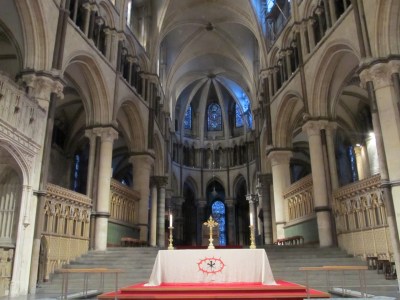
I’ve just returned from pilgrimage to Canterbury Cathedral in England, the “mother church” of the Church of England and the Anglican Communion.

There is much that is moving about Canterbury—the site of Thomas Beckett’s murder, the throne of St. Augustine, the lively and vibrant congregational life that makes this cathedral no different than a country parish on Sunday mornings, the fabulous choir that leads Evensong every day.

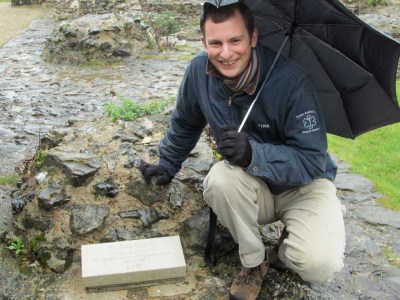
But what I found memorable was the visit—in the rain—to St. Augustine’s Abbey a short way from the cathedral. Augustine was sent by Pope Gregory in the late sixth century to evangelize the Anglo-Saxons. Augustine set off but got cold feet and turned around in France. When he returned to Rome, Gregory sent him off again—this is immortalized in stained glass in Lambeth Palace that has Gregory pointing and saying to Augustine, “Go!”—and Augustine eventually showed up in what is now Kent.

There, he met Queen Bertha, who was from the Continent and already Christian. Together, the two of them set about evangelizing the area, eventually converting Bertha’s husband, Ethelbert. And so Christianity was reintroduced to this part of the world.

The ruins, from the cathedral tower.

Augustine is buried in the abbey and his grave is a pile of stones. Our group thought about what it says about Anglicanism that our notional founder is buried in such modest style. The contrast with, say, St. Peter’s Basilica in Rome, is stark.

For a long time, the abbey in Canterbury was a major centre of religious life. But then the Reformation came along and Henry VIII shuttered the monasteries. The abbey was put to a number of purposes but eventually abandoned and left to fall further into ruins.

In the nineteenth century, this began to change. A missionary college was built near the ruins and the ruins were preserved. Thus, at the same site at which Augustine arrived after being told to “Go!”, scores of British missionaries were trained to go out into all the world, spreading the Gospel, and laying the foundation for our contemporary Anglican Communion.

For all that we get squeamish these days when we recollect the mission past, when I was standing in the ruins of St. Augustine’s Abbey last week, the word “Go!” was sounding in my head like a gong. Movement—across barriers and boundaries of language, culture, race, class, sex, identity, and so on and so forth—is at the heart of our Christian faith and the abbey ruins reminded me powerfully of it.

The signboards at the ruin call the abbey an “early foothold of Christianity in England.” We know, of course, that Christianity is on the wane across Britain. I wondered if in the future there will be more such ruins, and if this former abbey, once a harbinger of what Christianity would look like in the British Isles, is now a harbinger of the shape of Christianity in generations in come.

We returned to the cathedral for Evensong that day and the lesson was from Genesis 12. God said to Abram, “Get up and go to the land that I am showing you.”