Quechua Episcopalians?

So here’s an interesting story about the Episcopal Church in Latin America.

In the last year or so, about 30 Quechua communities have approached the Episcopal Diocese of Central Ecuador and expressed an interest in leaving behind the Catholic Church and becoming Episcopal. As I understand it, they think they’re not getting the sort of pastoral attention they want and the sacramental tradition of the Episcopal Church appeals to them. On the face of it, this is great news for the Episcopalians (especially in light of Pope Benedict’s overtures to Anglicans in the last six months).

These Quechua communities are quite poor. They are high in the mountains and the people who live in them were for a long time labours on the large farms of distant landowners. It’s only in the last few decades that they’ve come to own land for themselves and even then it’s not the best land.

But the problems immediately begin to raise their heads. For one thing, the Catholic diocese in the area isn’t totally thrilled, especially since two Catholic priests are becoming Episcopal priests. For people who care about the unity of the Body of Christ, this isn’t great news.

A large problem is language. The Episcopal prayer book is translated into Spanish but not Quechua. Many of the older people in these communities speak little Spanish. The service that they take part in might be as foreign to them as any Xhosa-language service was to me in South Africa. It’s not like the Episcoplians have a surfeit of Quechua-speaking clergy to translate either.

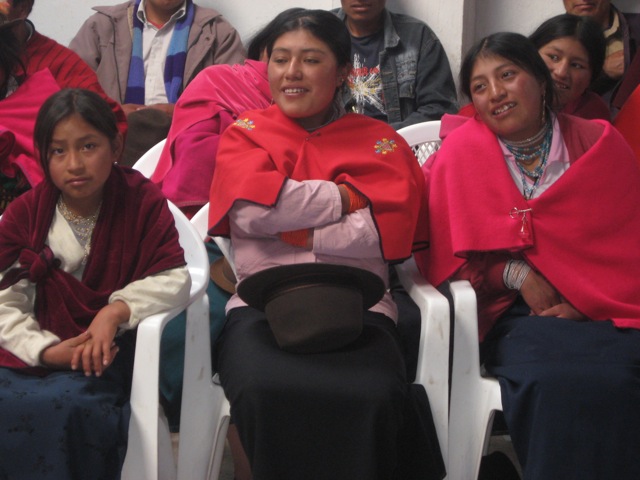
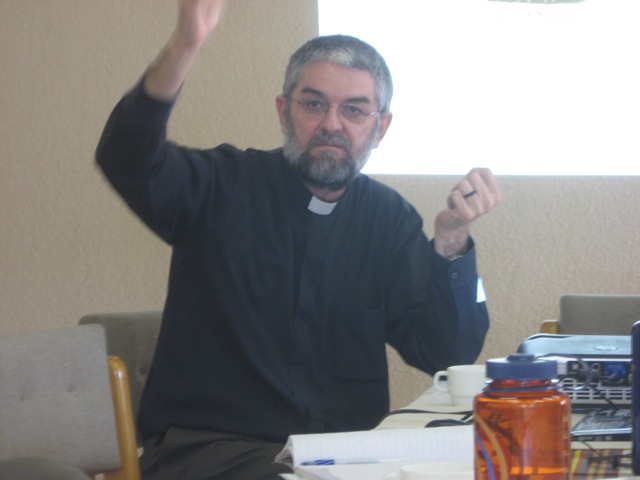
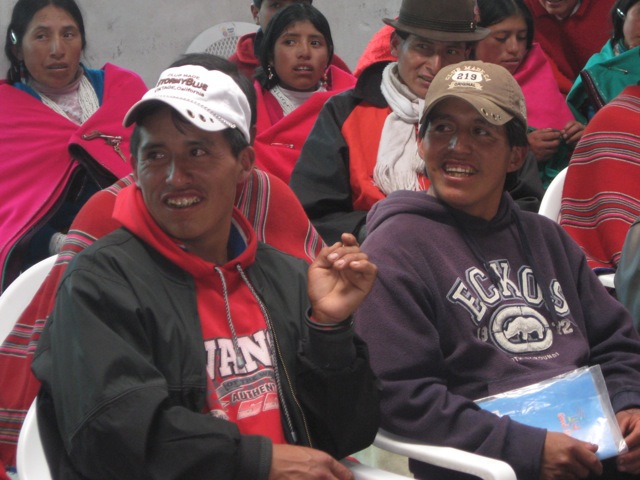
Clergy is another issue. Neither the Catholics or Episcopalians have a bunch of clergy hanging around who can provide pastoral attention to these villages. One way they’re getting around it is by holding monthly educational sessions in a central location on how people in the villages can take on some of these roles themselves. We attended part of one of these on a Saturday. I was impressed they could get 100 or so people to walk four or five hours to come to a meeting like this.

At a Saturday session on pastoral care – don’t see Episcopalians dressed like this very often!

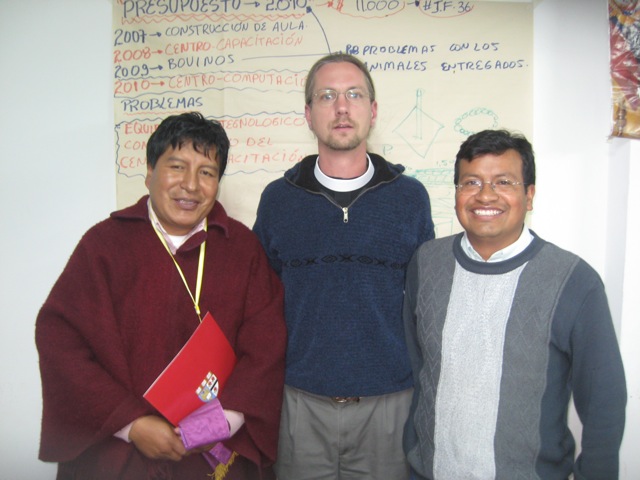
The work also puts a strain on the clergy. Two clergy for 30 villages isn’t a great ratio. We meet Father Eulogio and Father Luis Alberto. They are both very talented, smart, and hard-working but it is clear that multiple services per day in different communities is taxing.

Father Luis Alberto

Chris Morck with Fathers Eulogio and Luis Alberto

One of the most interesting issues at stake is, of course, power. The Episcopal diocese welcomed these villages with open arms but now at least some people have reason for pause. The diocese has maybe 2000 congregants now. These 30 villages represent maybe 5000 congregants. If and as these new communities join the diocese that could dramatically shift the face of the diocese, making it an indigenous-dominated one and not a mestizo-dominated one. I’m all for democracy in the church but I think this is making some Quito-based Episcopalians think again.

There’s another question at play about how seriously these villages want to be Episcopal, as opposed to just generally Christian. It’s not clear at all that the Episcopal Church can do a better job than the Catholics at providing pastoral attention. If that proves to be the case, then we heard that some villages might consider evolving into their own sort of a-denominational Christian church. They might just be passing through the Episcopal Church on their way to something else.

All of these issues make this a fascinating situation. We were fortunate to observe part of the Saturday afternoon session on pastoral care. In the late afternoon, we drove up to one of the villages (San Francisco de Telon) and joined them for worship. It was a standard Episcopal prayer book liturgy, in Spanish. There were a dozen or so of us gringos and maybe 40 Quechua in their ponchos and felt hats in a small, thatch-roofed church that is nearly 200 years old.

Church from the outside (above) and inside (below)

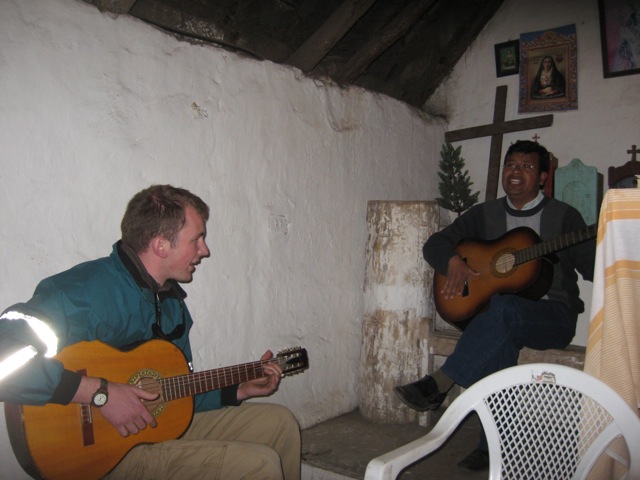
Chris Morck with Father Eulogio preparing the table; Father Luis Alberto leading music.

While we waited for the service to begin, Father Luis Alberto invited me to play guitar with him. I shared a few of my favourites and he taught me a few Quechua tunes. I hadn’t been feeling great because of the altitude and an oncoming cold but this really perked my spirits up.

You know the Bob Marley song “Jammin'” – “We’re jammin’ in the name of the Lord”? That’s what I was thinking about.

When I was planning the trip, I had thought about skipping the first day of classes and avoid having to take the red-eye back to New York but I resolved to make it back for Monday because I really wanted to be in the World Christianity class and I was glad I did. But I couldn’t help but thinking that some of the best education in world Christianity had been in that church on Saturday night.

Ecuador, Part I

I am back from my first excursion into South America, a short trip to Ecuador. Here are some highlights.

The trip was organized through Memorial Church at Harvard but there were students from four universities among our number. It was explicitly organized as an educational seminar centred on the themes of mission, sustainability, and globalization. And it was short, only six days in country. Initially, this had made me wary of going – all that money for a plane ticket for just six days? how do you build relationships in that little time? – but I overcame that wariness and am glad I did. We were hosted in Ecuador by Chris Morck, an Episcopal missionary who splits his time between the Diocese of Central Ecuador and the Latin American Council of Churches (CLAI, by the Spanish and Portuguese acronym).

A friend at Yale told me last semester that I struck her as the kind of person who is more comfortable on a garbage dump in South Africa than a place like Yale Divinity School. Driving through Quito on the first night in Ecuador, I was surprised at how at ease I felt – the traffic was nutty and there was a guy breathing fire at one intersection – but it all felt very familiar and comforting.

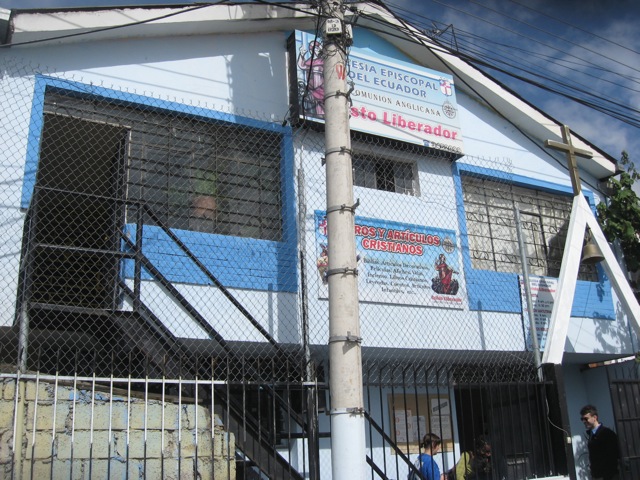
On our first full day, we visited a local Episcopal church and said morning prayer with the usual congregation of senior citizens. It was a proud-to-be-Episcopalian moment. There were thirty or so seniors who show up for morning prayer and breakfast afterwards. The church pays for the breakfast itself even though it’s in a poor neighbourhood. The church wasn’t much – just a converted house – but they still get 100+ people on Sundays and run a pre-school nearby.

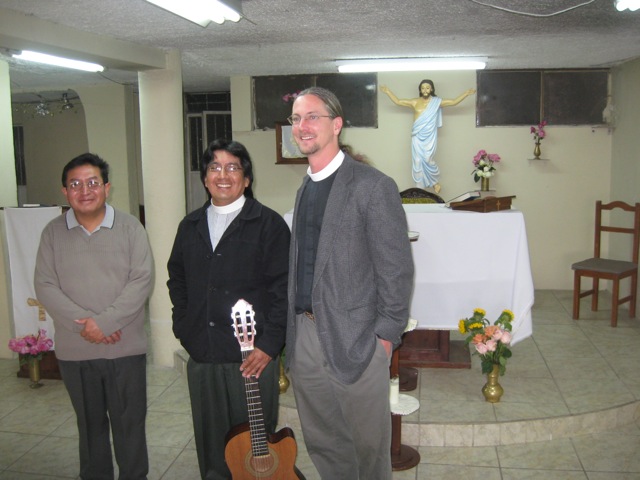
From right to left: Luis, a postulant for ordination; Father Raoul, a priest in the diocese; and Chris Morck, Episcopal missionary in the church pictured below

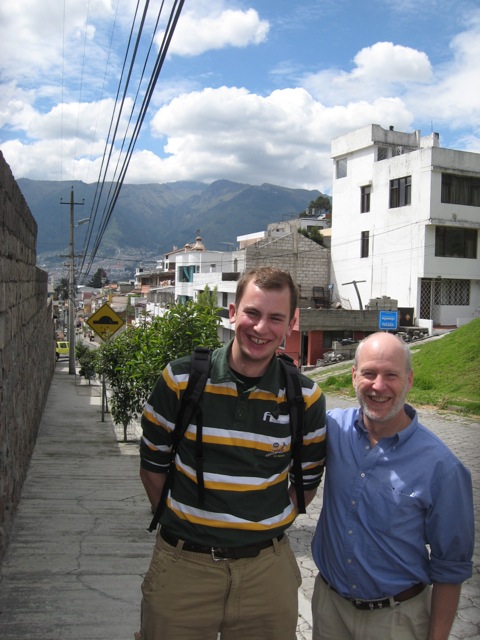
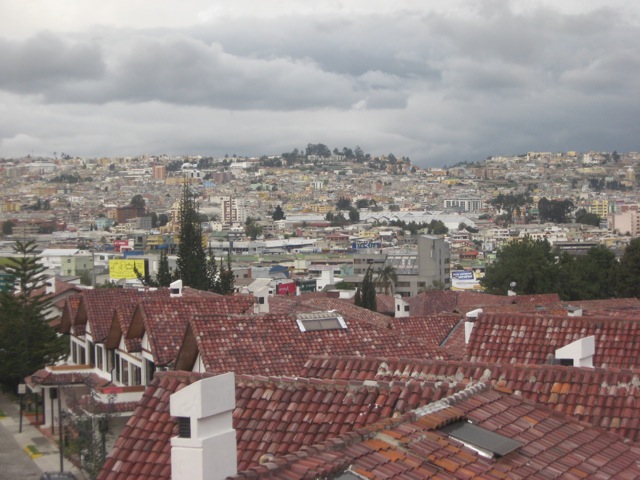
Fellow Berkeley-ite Steve and I with Quito in the background.

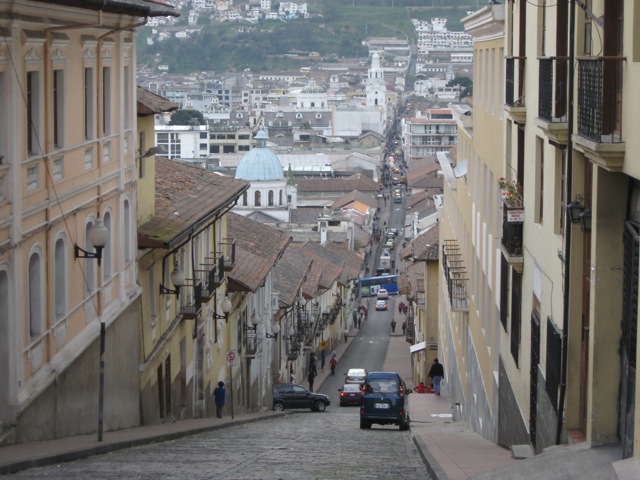
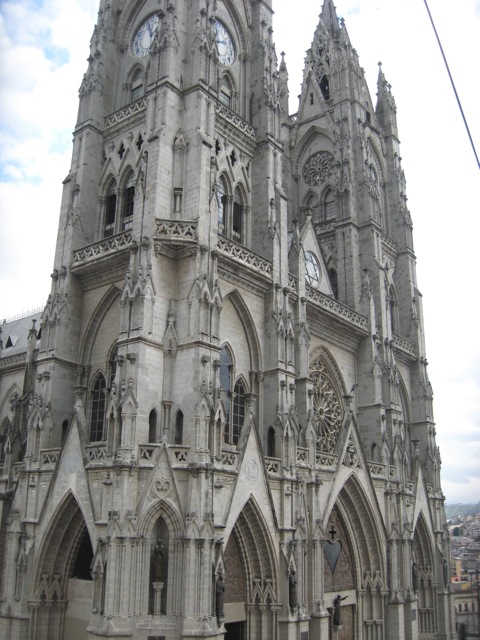
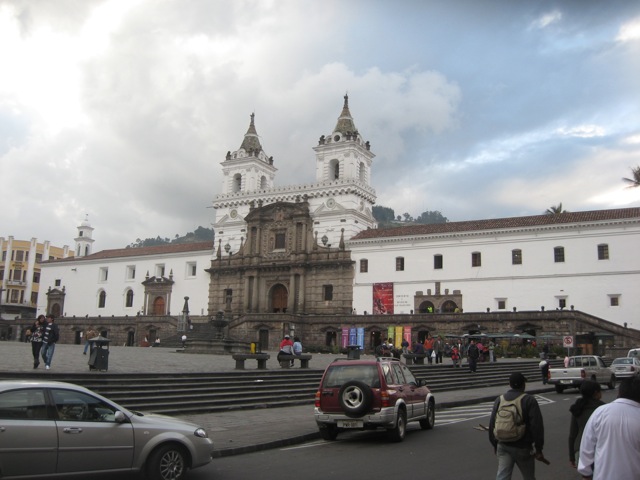
In the afternoon, we strolled through Quito’s old, colonial section. It was very interesting, all the big churches the first missionaries had thought it necessary to build and the close proximity of the presidential palace to the archbishop’s residence.
Steep streets in the Old Town.
The major basilica, the name of which eludes me at the moment.
A church built by the Franciscans.
I speak about 12 words of Spanish but I could understand this! Sadly, all the books were in Spanish.

Our next two days were spent at CLAI, meeting with various CLAI (and non-CLAI) people about a wide variety of topics – indigenous cosmology and theology, ecological perspectives from Latin America, ecumenism, and a bunch else. I have a lot of notes.

For me, this was really the first time in which I’d heard an educated, middle-class perspective from the developing world. In South Africa, the people I worked with were poor and uneducated and didn’t often have the resources to intentionally reflect on their situation and share that with me in a way I could understand. But the people at CLAI are thinking about this all the time and are adept at PowerPoint presentations and making their views comprehensible to people like me from the north. In fact, one of our presenters had just returned from the Copenhagen climate change conference.

What struck me the most was how our presenters framed issues. Language use has always interested me – for instance, why is it that when a tax is called the “death tax” there is more support to repeal it then when it is called an “inheritance tax”? – and our presenters used language in ways that was unfamiliar to me.

For instance, Frederick Canelos, an economist for CLAI who has also worked for the government, framed the issue that I previously knew as “debt relief” as “illegitimate and illegal debt.” The idea is that the money the north loaned to the south was illegitimate, because it was loaned to dictatorial regimes and didn’t benefit the people, and illegal because some of the projects the loans supported weren’t lawful. (There are arguments to back up these statements but I won’t rehearse them here.) As such, these are not loans that are to be forgiven because they never should have been incurred in the first place. It is the north that should be asking for forgiveness from the south because of the way in which the money was given and the ways in which the loans have forced developing world governments to repay them multiple times over with high rates of interest.

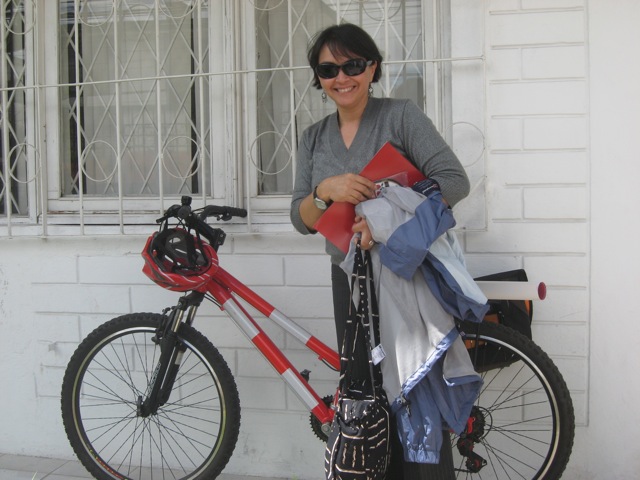
Another presenter, Ivonne Yanez, from an NGO called Accion Ecologia, told us about “ecological debt.” This is the idea that the combined impact of global warming, resource exploitation, industrial agriculture, and so on has created an ecological debt that the north owes to the south. Ivonne was particularly pointed in her presentation, using the word “you” a lot, about how our lifestyle has contributed to the problem, but it was well-received. She articulated the “Verona principle,” taken from Romeo and Juliet, that the offender needs to atone for the wrong-doing and then leave the city altogether, as Romeo did. In this case, that means that big oil companies in the Amazon have to atone for the wrong they’ve done and then get out and never come back. (It’s possible she also meant the Verona principle to apply to us but that wasn’t clear.)

Yvonne, the environmental activist, with her bike.

We heard a lot about “food sovereignty,” which is the idea that a country should be able to produce all the food it needs itself. This is distinct from the idea of food security, which is the idea that a country needs to be able to access all the food its people need. In many respects, the food sovereignty movement is like the “locavore” movement in the United States. Its leaders, some of whom we met at a very impressive CSA-like organization, are teaching and encouraging people to grow and buy local, Ecuadorian food and take themselves out of the agribusiness food chain. I didn’t get a good answer to the question of how really poor people, like those I worked with in Itipini, could credibly take part in the food sovereignty movement.

We heard an excellent presentation about the indigenous Andean worldview, from Julian Guaman, a Quechua theologian. He talked about the idea of harmony and non-linear thinking and how these ideas challenges the western way of thinking that holds true even in Ecuador. He was critical of liberation theology as a western way of thinking, which was surprising to me as I had always associated it with Latin America. But as I learned and re-learned on this trip there are divisions in the region between indigenous Andeans and the mestizos who have most of the power. He showed us how on the Quechua calendar there are 500-year periods of rise and fall. This is a period of decline but the eras shift in 2012. Look out!

(Liberation theology, we heard time and again, is definitively not dead. It may be dead – or in disfavour – among the Roman Catholic hierarchy but it is still the animating principle at CLAI and among many other people we met with.)

Ecuador has a large population of Colombian refugees and we heard about the discrimination they face. They are stereotyped as narco-traffickers or paramilitary types, even though they are usually just refugees from the long civil war. It is easy for us in the United States to see South America as one giant, undifferentiated place. That’s obviously not the case and hearing about the divisions that exist within and between countries was important for me. One of the women who taught about this was a Mennonite missionary from Colombia to Ecuador. The example of south-to-south mission was relatively new to me.

Our group was a wide mixture of people but one theme that was common in many of them was a general suspicion or distrust of mission based on what I would consider out-dated (but still dominant) ideas about mission and missionaries. One person said, “Wouldn’t it be great if missionaries could become agents of dialogue?” I shot back, perhaps a bit too brusquely, “What do you mean – ‘become’?”

I asked several presenters about how people from the north could best support people in their positions. Time and again, the answer I heard was some variation of “listen to the people you want to work with” or “learn about what you are doing” or “come alongside us.” All of it was very much supportive of the thinking about incarnational mission I had been doing in South Africa.

But the idea that stayed with me the most was something we heard in our first presentation from Nilton Geise, the general secretary of CLAI. He concluded by saying, “Latin Americans don’t usually do what I did today, which is speak. Latin Americans generally just listen to Americans. Dialogue works when both are speaking.” That struck me as so true and reminded me of all the times I had gotten myself in trouble in South Africa by failing to actually listen to the people I was working with. I was left wondering how we can create more situations in which people like Nilton, our other presenters, and those we didn’t hear from, could share their message more broadly.

Nilton, secretary general of CLAI.

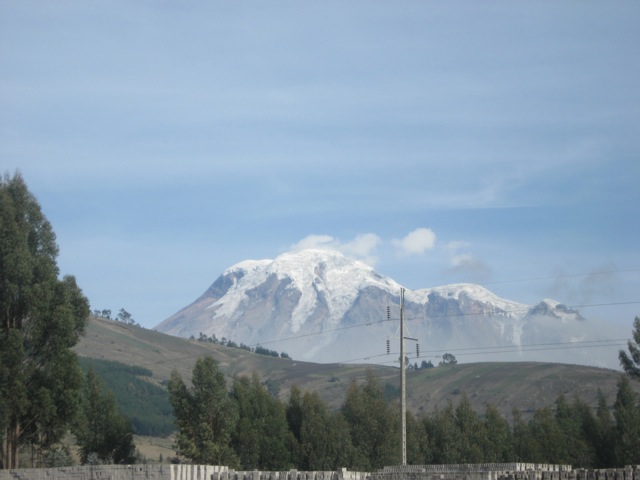
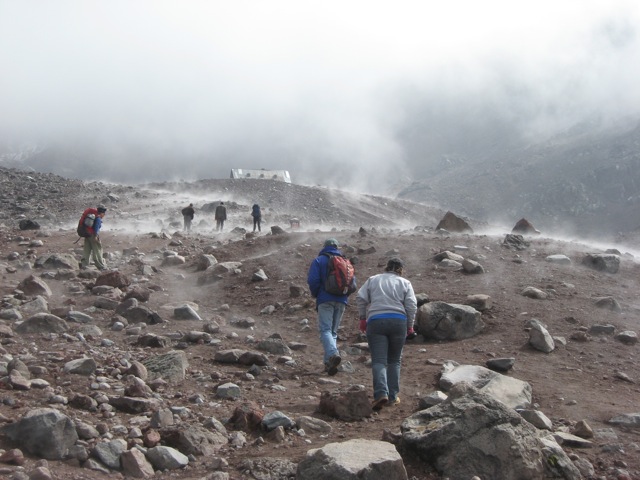
On the second half of the trip we visited the rural area around Riobamba, higher in the Andes and about three hours south of Quito. I’ll say more about the learning aspects of what we did there in another post but let me end with a few pictures of Chimborazo, one of the highest peaks in the Andes. (Because of the bulge at the equator, the peak of Chimborazo is closer to the sun than the peak of Everest.) We drove to about 15,500 feet and then were able to hike up to 17,000 feet. It was intense! The altitude really does a number on you at that elevation and going uphill is a matter of saying to yourself, “one foot, other foot, one foot, other foot…” and on up. Going down is a lot easier than going up, a reminder of how much gravity weighs us down.


Going up Chimborazo with the mist burning off

That was Sunday morning. I left Sunday night, was back in New Haven on Monday morning, and in class at 1:30 that afternoon. Seventeen thousand feet to sea level – outdoors, above the tree line, to classroom environment. Can you say whiplash?

Fear Of Missing Out

When I lived in Alaska, some friends of mine had an expression I always liked. When something was happening, or some trip was planned and they didn’t go along on it, they had FOMO or Fear Of Missing Out – missing out on the social experience, the gossip, the time outside, whatever.

This term I’ve been going to Morning Prayer virtually every day. That means I have to get up earlier than I’d like and sometimes, especially now that it’s cold, there are many mornings when waking up in the dark to bike 10 minutes through the cold to get to the service isn’t entirely appealing. But I keep going anyway.

I was trying to figure out recently why it is that I keep going and realized I have FOMO. I’m afraid that at some service God is going to do something or act in my life in such a way that if I’m not there I’ll miss out on it. This might sound kind of silly but I routinely have several silly thoughts in a day (and they still let me into Yale!).

After a semester of doing this, I can’t say that God has utterly transformed my life while reciting the Venite for the umpteenth time. But I do think my daily attendance at Morning Prayer has helped me make some friends I wouldn’t otherwise and helped me feel like I’m a real part of the community and that’s an important transformation in its own way.

A friend of mine said a while back that the key to being a successful priest was “just keep showing up.” I think there’s a lot of truth to that. If you just keep showing up places and being a part of the community where you are, then good things start happening. It may not be the transform-in-a-moment I’m looking for but maybe that’s not what I need. Sometimes my attendance at Morning Prayer is “justified” simply by a brief hello with someone as we put on our coats at the end of the service. That’s perhaps as important as anything else.

Anyway, I’ll keep going to Morning Prayer next term but maybe it won’t be because of FOMO. Maybe it’ll be because I see the value of “just showing up.”

New Lenses

Here’s a sign that I’m no longer in South Africa.

There, when I ordered contact lenses, it took me easily six weeks to get them due to a variety of reasons.

On Monday, I went to the eye doctor for a new prescription. I asked how long it would take to get the contacts. “Tomorrow,” he replied.

“You mean, I can order them tomorrow?” I asked.

“No, if you order them before 4 o’clock today, we can have them by 10 o’clock tomorrow morning.”

I sat back, more than a little stunned. So this is how things are supposed to work! Efficiency can be a great thing.

(Speaking of efficiency, I am procrastinating by writing this post instead of studying for my history exam tomorrow. Efficiency isn’t all that it’s cracked up to be.)

Mission of God or mission of the church?

One of the things you learn almost as soon as you start taking an interest in contemporary mission theology is that mission belongs not to any individual or organization or church but to God. God’s mission is one of reconciliation and it is our job, as baptized Christians, to discern what role we are privileged to play in that mission.

This mission of God language is a shift away from earlier language of the mission of the church. For instance, the catechism in the 1979 prayer book refers to the mission of the church and not the mission of God.

In the last few months at divinity school (!), I’ve heard people talk about the mission of the church. On a few occasions, I’ve gently challenged them or corrected them. Sometimes people look at me as if to say, “What’s the big deal? Isn’t it all the same?”

One way it would be the same is the extent to which the church is seen as the body of Christ and not as an institution. But how often do we really think like that? When I hear the word “church,” I think of institutions, institutions that were created and are operated by sinful human beings and that are easily drawn away from the mission of reconciliation.

I feel about this issue the same way that some people feel about using non-masculine pronouns to refer to God, e.g. “Blessed is the one who comes in the name of the Lord” rather than “Blessed in he who comes in the name of the Lord.” I could say, “Isn’t it all the same?” but I know many people who think the distinction is vitally important and I respect their views.

It’s the same with the “mission of God” versus the “mission of the church” and so I’m going to keep picking on people to think about what they say and what they mean.

“Are you king?”

(Note the intentional references at the end to Victoria’s “presence” and “being” and not anything about what she did. Note also that this is the first of my sermons in a long time not to include a long excursus on mission. It didn’t seem to fit and would have made an already long sermon too long.)

22 November 2009 – Christ the King Sunday
Daniel 7: 9-10, 13-14
Psalm 93
Revelation 1: 4b-8
John 18: 33-37
Christ Church Cathedral, Springfield, MA
Jesse Zink

Let us pray. Gracious Lord, show us the path to your kingdom in this world and the next. Amen.

I bet that if I ask you what a king is, we would all come up with a similar sort of picture. We might think about someone seated on a throne. We might think about crowns. Or the royal jewels. We can think about the power of kings to command people and order them to act in particular ways. Kings are often associated with battles and the military.

These ideas about kingship are echoed in the Old Testament readings this morning. The Psalm tells us the “Lord is king, robed in majesty… girded with strength.” Kingship is associated with strength and excellence. This is echoed in the beautiful vision set forth in the book of Daniel. God is described as seated high on a throne of fiery flames, with thousands upon thousands of people waiting in attendance upon him. The king is the center of attention.

It was these sorts of ideas that shaped the Jewish vision of what to expect when the Messiah came again. If God was all-powerful and mighty and could sit on a throne made out of fire, surely God’s Annointed One would be just as powerful and could rescue the Jews and restore the glory of their ancient kingdoms. This is certainly what is suggested by the second half of the vision in Daniel. “One like a human being” who rides on “the clouds of heaven” comes before God. With the benefit of hindsight, we identify this person as Christ. Christ is given “dominion and glory and kingship, that all peoples, nations, and languages should serve him. His dominion is an everlasting dominion that shall not pass away”. This is a sweeping and all-encompassing vision. ALL peoples, ALL nations, ALL languages will serve this Christ and his kingdom will not pass away. These Jewish communities had memories of the large kingdoms of people like David and Solomon. But those kingdoms didn’t rule over everyone in the world and eventually did pass away, as the Jews remembered all too well. This Messiah would be different.

I begin by talking about kings today because today is the last Sunday of the liturgical year. On this day, we celebrate what is known as Christ the King today. It is the church holiday on which we celebrate Christ as king over all the world.

And when we think about Christ as king, we have to think about these Old Testament passages through the lens of the New Testament. When we do that, we know, of course, that the Jews were disappointed. The Messiah sent by God to establish a kingdom ended up as we read in this Gospel passage – a poor carpenter from a backwater village on trial in front of the Roman governor. Rome, the representation of all the known power on earth, is putting to death the one who was supposed to redeem the Jewish nation.

That very Messiah is engaging in a very un-royal and confusing conversation. Pilate asks, “Are you the King of the Jews?” You know that Jesus’ Apostles who are in the crowd are whispering under their breath, “Say yes, say yes!” That’s what kings are supposed to do. They are supposed to proudly proclaim their position. They’re supposed to put themselves at the center of attention.

Instead, Jesus answers not with a declaration but with a question of his own: “Do you ask this on your own, or did others tell you about me?” You can see the Apostles looking at each other with puzzled looks on their face: “What does that have to do anything? Just proclaim your kingdom and smite this Pilate down and the chief priests with him.” Pilate answers, “Your own nation and the chief priests have handed you over to me. What have you done?” Jesus has a pretty good story to tell of things he’s done – healed the sick, reached out to the poor, feed thousands, walked on water. It’s time for him to brag, to talk about himself, to put himself at the center of attention. That’s what kings do.

Instead, he says, “My kingdom is not from this world.” Pilate is confused: “So you ARE a king?” Jesus is still not being any clearer about things, even given this great opportunity to declare just who he is: “For this I came into the world, to testify to the truth. Everyone who belongs to the truth listens to my voice.” We know how this story ends. Jesus is on a cross within hours. So much for the kingdom of God. So much for the Messiah. Where is Christ the King now?

Let’s pause from that question for a moment and turn to another place. For the last two years, I was a missionary of the Episcopal Church in a town called Mthatha, in South Africa. Specifically, I worked in a neighbourhood of Mthatha called Itipini. Actually, to call Itipini a neighbourhood is going a bit too far. It’s a shantytown. The people there live in shacks made out of old car parts, pieces of tin, rocks, tarps, old trees, milk cartons, even the occasional beer bottle. The word Itipini means “at the dump” and that’s exactly where Itipini is. The community started on the municipal garbage dump so residents could scavenge off the garbage. The dump has since been moved but the community persists. Since there has been no reclamation work done, the place is still a dump with garbage everywhere.

I worked in a community center that was right in the middle of this shantytown. We had a pre-school, an after-school program, and a primary care clinic and worked with the residents of this community in a variety of ways. The clinic is particularly important because the health indicators of this community are some of the worst in the country. HIV, AIDS, and tuberculosis are prevalent. Alcoholism and drug use are rife. There are a huge number of chronic conditions that go unaddressed by an overwhelmed health care system.

One day a young woman of about 23 staggered into the clinic. Her name was Zikhona. She was one of those people you could just look at and see she had AIDS. She was emaciated and very weak and needed to lean against a wall to stand up. She was clutching her small baby in her arms and the baby was in worse shape than his mother. He was dehydrated and barely breathing, gasping for each breath. It turned out that these were his last moments. In a few minutes this three-month old child had died in Zikhona’s arms. He could not be resuscitated. Zikhona had no energy to grieve. All of her energy was going towards keeping herself alive.

Zikhona had to go to the hospital. She needed care we couldn’t give her. She also had to begin a long process that would get her the anti-retroviral drugs that would combat her AIDS and help her prolong her life. A young friend of hers named Victoria offered to go along to keep her company and be her advocate in the hospital. I gave both of them a ride.

Zikhona stayed in the hospital that night and Victoria stayed with her. The next day, Victoria showed up by herself at our clinic. They had taken a taxi back from the hospital but the closet the taxis stopped was in a mall parking lot a mile away and Zikhona didn’t have the energy or ability to make that trip. She was just too sick.

So Victoria and I got in the car again and off we drove. It was an early summer day in mid-December and it was really hot. Victoria and I pulled into the mall parking lot and I began scanning the taxi rank for Zikhona. “No,” Victoria said, “over there” pointing away from the crowd of people waiting for taxis and across the parking lot to the far edge.

Now municipal services in Mthatha aren’t that great so garbage tends to collect in places, including at the edge of this parking lot. When we got over to the edge, we found Zikhona. She was lying in one of the piles of trash that had accumulated on the edge of the parking lot. Even though it was sweltering, she was shivering and wrapped up in a blanket they had taken to the hospital. On the edge of this big parking lot, there was one young woman dying on a trash pile. Victoria and I helped Zikhona stand up, put her in the car, and drove her back to the clinic.

Victoria continued to help care for Zikhona in the next few days and weeks. I gave them a few rides so that Zikhona could continue the process that would help her get on anti-retroviral drugs. We made sure Zikhona had food and was as comfortable as she could be when you live in a run-down shack with tin walls and a tarp full of holes for a roof. But we couldn’t snap our fingers and cure her AIDS. We could only alleviate her suffering in some kind of modest way. Let me say, it feels pretty helpless to know someone is so sick and be able to do so little for them to change their situation. And in any event, our efforts were too little, too late. Zikhona died not long after Victoria and I had picked her off the trash pile.

I knew many more people like Zikhona in my time in South Africa, people whose life had been lived entirely on the margins, people dying on the edges, people living lives where it was difficult to see the hope. Many of these people I knew died in similar circumstances. It’s hard to sit through a situation like this and not want to scream in frustration at God and ask the same question that Pilate asks Jesus. “Are you a king?” I want to yell. “Don’t you care? I’m helpless here and there’s a woman dying on a pile of garbage. Where is your fiery throne now? Where is your strength? Where is your majesty?” All Jesus says in response is, “I came into the world to testify to the truth.” It can seem like not a lot of comfort.

What is that truth that Jesus testifies too? Well, on one level it is fairly clear. Just a few chapters earlier, Jesus has described himself as “the way, the truth, and the life.” Jesus himself is the Truth. Through his life and ministry, he testifies that God loves the world so much that God chooses to share an existence with humans and live and die for us.

But there’s another kind of truth that Jesus acknowledges as well. That is the truth that the world is not perfect, that the world is full of people who don’t always do what God wants us to, that the world has a tendency to marginalize and oppress some of its weakest members. Jesus testifies to this truth simply by how he lives his life and how it stands in contrast to the usual stories of kings.

When you read the stories about kings, how many times do you usually hear about widows or orphans? How many times in the story of Pharaoh in the Old Testament does Pharaoh show the slightest bit of concern for anyone outside his family or court? The book of Kings in the Old Testament are stories of kings and their courts and almost never about the people outside those positions of privilege. The kingdom is all about how great the king is.

Now take a look at the history of Christ in the Gospels. It is full of stories about those on the fringes: widows, orphans, poor fishermen, reviled tax collectors, prostitutes, lepers, beggars, the poor, the paralyzed, the sick, the kind of people who would die on piles of trash on the edges of parking lots. And Jesus’ royal court is not stuck in one place but always on the move, reaching out to new people.

Here is a new kind of kingdom. Contrary to the traditional stories of kings in which the king is the most important and the center of attention, Jesus turns that relationship around. It’s not just about who is king – it’s about who the subjects in that kingdom are. And those subjects are precisely the kind of people who are always on the fringes. So when a woman is dying on a trash pile in South Africa, Jesus is saying, “I am right next to you. You are welcome in my kingdom.”

Christ the King whom we celebrate today is king of those on the outside and the character of his kingdom is determined not just by the kind of king it has but by the kind of people who are part of that kingdom. The story doesn’t end there, however.

This morning’s reading from Revelation tells us there is one more part of that kingdom. Jesus “loves us and freed us from our sins by his blood and made us to be a kingdom, priests serving his God and Father.” Let’s take that one at a time. Yes, Jesus loves us. Yes, Jesus freed us from our sins. Yes, Jesus made us – even us! – subjects in his kingdom. But what is this bit about “priests serving…God”? There are only a few priests in this church and they’re the ones who wear the robes and have the magic hands to celebrate the Eucharist.

A priest is the person who connects this sinful and fallen world with the divine and holy realm of God. The Latin word for priest means “bridge builder” and that’s what priests are supposed to do – bridge that gap between this world and that realm beyond us so that the two can come closer together. The people that we call priests do this in a variety of particular ways, in sermons that bring part of the knowledge of that holy realm into this world, in the sacraments that make the holy and the profane one, and in a pastoral ministry that embodies the love of Christ.

This passage from Revelation calls us priests in this broader sense. We who have knowledge of Christ and of Christ’s kingdom must be people who build bridges in this world. It is our calling to show forth the love of Christ to those around us and in so doing bring them closer to that divine and holy realm where God dwells. The kingdom of God includes people like you and me. But it also brings with it responsibilities. Our job is to perform that priestly function, to reach out and draw more people into that kingdom.

This idea can sometimes make Episcopalians a little wary. “What’s this?” I hear you say. “Drawing people into the kingdom of God? You’re not talking about some sort of…evangelism, are you?”

Let’s go back and think about Zikhona’s last weeks again because I want to tell you about the other figure in that story, Victoria, the young woman who cared for Zikhona. Victoria is 19 and the mother of a delightful and rambunctious 3-year old son. She’s also a full-time high-school student. She had four older siblings and three are now dead, two of AIDS and one in a horrible car crash. Her mother also has AIDS and for a while was very sick and near death herself before recovering with the help of these anti-retroviral drugs. Victoria’s mother is so happy to be recovered that she spends most of her days drinking and doing little to support the family. Victoria has a lot on her plate – more than I can ever imagine – and like many people in Itipini she has to do an incredible amount of work just to ensure her daily survival. But it was she who volunteered to help Zikhona. It was she who came to get me when Zikhona was lying on a pile of garbage. It was she who leaned over and picked Zikhona off that garbage pile and put her in the car. It was she who tended to Zikhona in her shack while Zikhona’s condition worsened.

By doing all of this, Victoria was narrowing the distance between the holy and fallen. By reaching out and drawing Zikhona in, she brought together God who sits on the fiery throne in heaven and Zikhona dying on garbage pile on the edge of the parking lot. By her actions, Victoria was saying to Zikhona, “You are a subject in the kingdom of heaven. Christ is here with you.”

There’s a kind of paradox here. The kingdom that Christ proclaims is not of this world. It is a kingdom where we live in right and just and good and true relationships with each other and with God. That kingdom will never come to pass in our own time. Its perfect peace is beyond the grasp of this fallen creation.

And yet that kingdom is with us right now. It is with us right now because Christ came to earth and lived among us and taught us exactly how we must be as subjects in his kingdom. We must be the priests that narrow that divide and draw the holy and the sinful together.

The kingdom of God is beyond us. We will never attain it. And yet we are called to live as if it is here among us right now. That is the truth that Jesus was proclaiming before Pilate and it is that truth that must guide us now. It is the truth that Victoria recognized when she was such a valuable presence in Zikhona’s life in those last few weeks of that tragic life. And it is that truth to which we are surely being called on this day and every day.

Amen.
Choosing vulnerability

15 November 2009
Hebrews 10:11-14 (15-18) 19-25
Mark 13:1-8
St. John’s, Northampton, MA

Let us pray. Dear Jesus: do you really mean it when you say “not one stone will be left upon another”? Even at St. John’s? Amen.

Good morning and thank you, as always, for letting me into this pulpit once again. This time, I come back to this pulpit with the benefit of a little perspective. In the time since I returned from South Africa at the end of June, I’ve been to several other churches in this diocese of Western Massachusetts to speak about my time as a missionary. And before this school year ends, I’ll have been to many more churches in the diocese. There are many very nice congregations, with lots of friendly people and interesting clergy. One thing that has stood out to me in particular is the the differing church architecture in this diocese.

But it always puts a little spring in my step to come back here to St. John’s because – with benefit of this broad experience – I can say that St. John’s has one of the nicest-looking churches of any building in this diocese. Just take a minute to look around. The beautiful bell-tower. The bell in that tower. The rough rocks that make up the exterior of the building. The beautiful tile work on the floor up here. That lovely wood floor down there that I have scuffed up in countless places. This gorgeous pulpit that is at just the right height for someone my size. A great organ. These soaring arches that are painted an only-in-Northampton kind of pink. The great parish house and parlours and library. This is truly a beautiful place and I always feel so privileged to be a part of it.

How ironic then that I should return on this day to to hear this Gospel passage. Jesus says, “Do you see these great buildings? Not one stone will be left here upon another; all will be thrown down.” This comes in response to a disciple who sounds a lot like I just sounded. The disciple looks at the temple and says, “Wow, Jesus, look! Look at the size of those stones! Look at the size of those buildings!”

“Not one stone will be left here upon another; all will be thrown down.”

While I’ve been traveling this fall, I’ve been learning another story beyond the friendliness of the people in this diocese and beyond. About a month ago I was at a church where the congregation has to reduce the hours of their rector because they can’t afford to pay him full-time anymore.

Three weeks ago I was at diocesan convention where we heard about St. James in Great Barrington. About a year ago, a stone wall in the church just gave way and collapsed. The building was condemned and the church now meets in a banquet hall. At convention we also heard stories of declining attendance and declining revenue across the diocese and for the church around the country. The average Episcopal congregation in this country is seeing its attendance decline by 2-point-7 per cent per year. Many of you will remember when St. John’s had two full-time clergy and will know that there were once many churches in this diocese like that. Now – except for the cathedral and its Spanish-language ministry – there is not one church in this diocese that has two full-time clergy dedicated to ministry in that congregation.

Two weeks ago I went to a church in Hartford. It was the congregation’s last Sunday in that church. There aren’t enough people coming anymore to support the physical plant. So the congregation is merging with the cathedral congregation and the diocese plans to sell the church building.

Last week, I went to a play in a theatre that is in a converted church. Clearly, at one point that was a congregation that couldn’t support the building. I commented to a friend that architecture schools need to start offering courses on redesigning old church buildings because there are going to be a lot of them coming on the market in coming years.

“Do you see these great buildings? Not one stone will be left here upon another; all will be thrown down.” Jesus’ prediction to his followers is no longer a prediction in our day. Our churches are falling down, literally as in the case of Great Barrington, and figuratively, in the story of declining attendance and revenue.

Why would Jesus give us this vision of the destruction of the Temple? Why must this happen? What would happen if it did? To answer that, I want to turn to my time in South Africa.

For the past two years I was a missionary of the Episcopal Church in a town called Mthatha in South Africa. Specifically, I worked at a community center in a neighbourhood of Mthatha called Itipini. Actually, to call Itipini a neighbourhood might be going too far. It’s not like Florence or Leeds or Bay State or any of the other neighbourhoods in Northampton. It’s a shanytown. The people who live there live in shacks made out of old car parts, pieces of tin, rocks, tarps, old trees, milk cartons, even the occasional beer bottle. The word Itipini means “at the dump” and that’s exactly where Itipini is. The community started on the municipal garbage dump so residents could scavenge off the garbage. The dump has since been moved but the community persists. Since there has been no reclamation work done, the place is still a dump with garbage everywhere.

The community center I worked in was right in the middle of Itipini. In contrast to the rest of the community, we had concrete pads under our buildings and clear pathways between them. Our buildings were sturdy, made out of cinder blocks or lumber and had windows made of glass. We didn’t have electricity – no one in Itipini does – but we had nice big windows and a generator for when we really needed it. We didn’t have running water but the tap was right in the middle of our community center area so we didn’t have to haul it very far, unlike most people in the community. Our doors had locks on them. When we left at night we knew things would be pretty safe. Just to be sure, we hired locals to serve as watchmen both during the day when we were there and at night when we weren’t.

When I first arrived in Itipini a little over two years ago, I felt immediately overwhelmed. Almost no one speaks English. There are huge cultural and racial barriers to cross. Mthatha has a reputation for being an unsafe and crime-ridden city. White South Africans generally steer clear. They definitely steer clear of Itipini, Mthatha’s poorest section. I very much stood out when I first showed up in Itipini. It was more than a little bit nerve-wracking and even a little bit scary.

In that context the few hundred square feet of concrete and sturdy buildings over which the community center was spread was like a fort to me. I nestled myself firmly and cozily into that area and stayed put. I let the people come to me. Pre-school children showed up in the morning and I played guitar with them. They left at the end of the day and I had no idea where they went. High school students passed through our area on the way home from class and I tried to engage them in conversation but they were on the move and in a hurry. They didn’t stay long and I wasn’t about to follow after them. Sick people came to our primary care clinic and I helped them there. They had to come to me. As long as I could deal with people on my own terms from this place of safety, I was fine. At the end of the day, I got in the car, and drove through Itipini to get out but I never stopped. It was outside “our” community area and my place of safety. In those first few months, there were maybe a handful of occasions in which I actually descended into the mire that was Itipini but then it was always with one of our watchmen and then only to retrieve a sick patient when the watchmen needed a little extra manpower. I went with a purpose and came right back.

If you look at my pictures from this time, you can tell I didn’t range far. My pictures of the shacks are taken from a distance, perched atop the playground looking out over a whole swath of the community. The backgrounds to all my pictures of people are buildings in our area. There’s the clinic in one, the kitchen in another, the playground in another.

And then one day things changed. It was a hot early summer day in December after I’d been in Itipini for about four months. It was a quiet day in the clinic, the pre-school was humming along, it was still a while until lunch, and I didn’t have much to do. I don’t know how I got this idea but I thought I should go for a little walk. I started off up the hill behind the clinic with no destination in mind and just kept going. By this point, I knew enough of Xhosa – the local language – to be able to exchange greetings so that’s what I did when I walked past people’s shacks. There were people sitting around outside, cooking, washing clothes, washing dishes, drinking, smoking, gossiping. I just sort of greeted them and kept on going, a little stunned at what I was doing.

Eventually, I came to a dead end on one of the paths in front of a shack. There were some women I knew sitting outside and they invited me to sit down with them. I had just learned the Xhosa word for sleep so I decided to try it out on one of the children who was there. “Ulalaphi?” “Where do you sleep?” He happily took my hand and led me into the warren that was his shack, into a back room and proudly showed me his creaky, rusty frame with a thin mattress, and no blanket to speak of. This was his room, a place he shared no doubt with several siblings. I was crouched over in the shack and a little stunned at how I had found myself in this place. I felt vulnerable in a way I hadn’t before but I also felt at ease in a way that was new.

From that point forward, my approach to life in Itipini changed. No longer would I wait for people to come me. I was going to go to them. The fortress-like aspects of the community area that had given me so much comfort – my own big temple walls – were being thrown down. It turns out that not every child was coming to pre-school. Some didn’t even know they could. If I confined myself to only working with the children who were showing up, I was missing out on a big chunk of the population. Those high school students wanted help but they also needed to be back in their homes doing chores. I couldn’t have learned that from staying put. Some people were so sick they couldn’t make it to the clinic on their own. I made it my job to seek out those people and figure out how we could help them.

My pictures started changing as well. I have pictures of shacks close up. I have pictures of the insides of shacks. I have a whole series of photos I call “where do you sleep?” of children in front of their beds. Those all started that first day I ventured forth. The backgrounds of my pictures changes too. There are more pictures of people in or in front of their shacks or in front of their cooking fires or washing their laundry or drinking or resting in the shade of a bush.

So when we return to the question of why Jesus would predict the destruction of the Temple I think it has to do with the idea of vulnerability. This is an idea we in this western society don’t like to hear. In this culture, we seek control over everything – no vulnerability! I wanted people to come to me in the community area in Itipini so I could control the interaction on my terms. The temple in ancient Israel was the dwelling place of God. It was the way the priests centralized worship so they could control God.
Standing opposite this is Jesus. This is the Jesus who makes himself vulnerable in his life and ministry. “Let the little children come to me,” he says, when the disciples shoo them away. You can just imagine what those disciples would say today. “The children, Jesus? They probably have swine flu!” Jesus hears his name called out by the beggars when he walks through town. Everyone traveling with him wants to control Jesus and his schedule. “C’mon, Jesus we have to get to Jericho on time,” you can hear them saying. But Jesus is the one who stops, lets go of control, and finds out what the beggars want. And of course there’s the greatest act of vulnerability ever, willingly taking up a cross and dying, voluntarily subjecting himself to a painful and dehumanizing death.

For Jesus this vulnerability is a choice. It is a choice he can make only because he comes from a position of great power. He is, of course, God Incarnate. God had this great power and could have stayed in heaven. But God didn’t. God choose to “empty himself” as Paul later writes and take the form of a human. God sacrifices God’s immense power to become human, that is to say, powerless.

This church gives us a lot of power. Just the fact that this building is standing here means someone at some point had the economic power to build it. The fact that people have been worshipping in this place in this community for so long is a source of power. The education and wealth of the members of this congregation is a source of tremendous power. And that leaves us with a choice. Do we lock all that power up behind these beautiful walls and make people come to us on our terms or do we choose vulnerability and venture forth?

And if we do venture forth, how do we do it? Which direction do we go? I think there’s a clear direction we head and it was embodied in a word I used earlier to describe myself when I said I was a missionary of the Episcopal church. That word “missionary” can be so difficult to hear in our day and age. It has – to say the least – a mixed history. Missionaries have too often in history been associated with events that tear down the kingdom of God rather than build it up. But I want to hang onto it.
A missionary, to state the obvious, has a mission. And to whom does that mission belong? Does it belong to the missionary? The missionary’s congregation? The missionary’s diocese? The national church? The “church” as an abstract entity? It is none of these. Mission belongs to God. And God’s mission has been the same throughout the history of the Bible. God yearns for people to exist in right relationship with each other and with God. To put God’s mission into one word, God yearns for reconciliation.
If we think of mission this way then mission is not about sending people across the world to baptize the masses and found churches. It’s not even just about sending people across the world. The need for reconciliation is as strong in Northampton and Western Massachusetts as it is in a place like Itipini. The need takes a different shape and our responses will be different but there is a yearning for reconciliation here nonetheless.

We must respond to the mission of God by asking this question: where is God’s mission around us and what role are we privileged to play in that mission? To ask it another way, where is reconciliation needed and how can we help bring it about? The variety of answers to this question will be as varied as the people in this congregation. Some people are called to make music because music is a way that people connect to God and to one another. Some people are called to make this a welcoming place so that when people enter they know that God is here with them. For some people, these callings may be a new challenge, a stepping beyond what we are used to, a call to go from a position of power to vulnerability.

Now let me say there is a lot of vulnerability in this world and not all of it is holy. The wife in an abusive relationship is vulnerable to the violence of her husband and there is nothing holy about that. The workers being exploited by their boss are vulnerable in that situation and that is also not holy. The wife and workers are not operating from positions of power and not choosing vulnerability. That is not the kind of vulnerability I’m encouraging us to embrace here.

This Gospel passage is calling us to deliberately embrace a sense of vulnerability in this way: look around you, think about yourself – how are you powerful right now? What skills and talents and resources do you have that give you power and the ability to control a situation? Now, ask yourself how can I sacrifice this control? How can I venture beyond these great big walls that are around me? How can I journey in a new way, a way that is guided by God’s mission of reconciliation?

The truth of mainline Protestant churches in these early years of this new century is that the church is falling down around us, stone upon stone, literally and metaphorically. It does us no good to deny this reality. But what if we were to embrace this new reality and the vulnerability it creates and take it as an opportunity to venture beyond what we have so long known, beyond what have been our traditional sources of power and control? What if we gave up trying to control every last thing? What if we moved forward in the spirit of the mission of God?

Jesus tells us this morning that these signs and portents are the “beginnings of the birth pangs” of a new world. If we moved forth in this way, I’ll think we’ll find ourselves at the beginning of something new and joyous and wonderful.

Amen.

Mission=work?!?!

I thought I had left language barriers behind when I left South Africa. I thought it would be easy to talk about mission and Mthatha now that everyone (or most everyone) I would be talking to spoke English as a first language. Ha!

A few weeks back I spoke at diocesan convention. There was a sign language interpreter there and I later asked here what the sign for “mission” is. She showed me it and said it was the same sign for “work.”

I thanked her and walked away but I was horrified. All my time in South Africa I had realized that mission is not about work but about presence and relationship. I started using the phrase “mission being and doing” to capture this reality. (This phrase was picked up at a higher level in the church.)

And now deaf people were hearing me talk about my “work”! It’s enough to make me scream with frustration.

And then I remember that mission happens as much in the overcoming of barriers as it does once those barriers are overcome.

YASC in the spotlight

There’s a marvelous new video about the Young Adult Service Corps – the program that took me to Mthatha, South Africa for two years – on the Episcopal Church’s web site.

The best link I can find is http://www.episcopalchurch.org/80056_ENG_HTM.htm.

This might also be a good time to note that my successor in Itipini has a blog as well, which some of you might be interested in.

The address is http://richardinmthatha.blogspot.com/.

“Thou shalt make history come out right.”

Sometimes the reading I do for class seems pretty obscure and distant from the kind of things I’m interested in. But every once in a while something leaps off the page at you and makes the interminable hours of frustration worth it.

Here’s what I found recently while reading the Mennonite theologian John Howard Yoder for ethics:

‘Thou shalt make history come out right,’ is so deeply founded in our culture that we cannot even perceive that it might be in need of verification.

It reminded me of the experience I had with Nolizwi, one of my students in South Africa. I had a great plan to solve all the problems in her life and we put it into action and it all came crashing down on our shoulders. Here’s what I concluded then:

All my energy and effort these last few months has amounted to nothing except heartache and trouble for Nolizwi. It’s a clear example of how one’s best efforts and intentions to help – when mediated through cultural and language barriers – can actually end up doing more harm than good. It’s an example of how misplaced people’s expectations are when they expect me to solve their problems for them. I can’t do it. And it’s not my job! I’ve found myself asking if Nolizwi wouldn’t have been better off if I had just stayed out of her life altogether.

Ultimately, it is not us who makes “history come out right” but God. That’s a counter-cultural idea in this day and age but always one worth remembering.