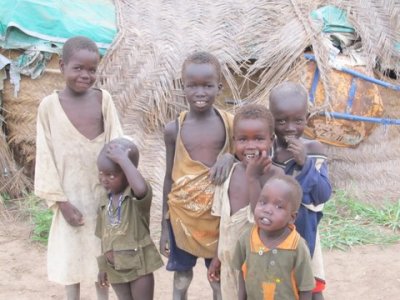
South Sudan, one year on

One year ago today, I was in Juba, South Sudan for the independence celebrations of the world’s newest country. It was a huge event, and I shall not soon forget it, even if my friend here was holding his flag in the wrong spot.

It’s been a hard first year for South Sudan. Not only are there serious unresolved issues in its relationship with what remains of Sudan, it has been beset by inter-tribal violence, plagued by corruption, and unable to address the many pressing social needs of its people.

But when people ask me, as they often do, what I think about South Sudan, my reply always includes the lines, “I have a lot of hope for the future.” And I do. My visits to Sudan have convinced me that the potential in that country is huge.

I am particularly convinced of this because of the continued and powerful witness of the church in Sudan for peace and reconciliation. When Jonglei state was plagued by inter-tribal violence earlier this year, the government turned to Archbishop Daniel Deng Bul of the Episcopal Church of Sudan. He negotiated a peace deal that has held and has created the space necessary for long-term peace-building to get underway. Archbishop Daniel and his Catholic counterpart Paulino Lukudu Loro have issued a statement on their continued hopes for the future of South Sudan.

So when you read the truly horrific news that the continued violence along the border is producing another “Lost Boys”-type situation or the awful conditions in some new refugee camps, I hope that a gasp of horror won’t be your only response. On this July 9—and every other day—I hope you’ll join in prayers for this new nation, read the letter from the archbishops, and think about ways in which you and your church can support our sisters and brothers in Christ in South Sudan.

Together, perhaps, the enthusiasm displayed by this young man can soon become a reality shared by all.

What we talk about when we talk about mission in the church

I’ve written before about how the church is in need of a conversation about what we mean when we use the word “mission” in the church.

And how, there’s more, this time on the Episcopal News Service, partly adapted from my new book, Grace at the Garbage Dump:

Those first few weeks, I stayed close to our clinic and let the residents of Itipini come to me if they needed help. It was safe. “They” came to “me.” But it was an untenable and unsatisfactory situation. I hadn’t moved to South Africa to sit in a clinic all day. Gradually, I began to venture forth. I met people like Fumanekile who made it feel safe to wander farther afield. I began to think in terms of “we,” not just “they” and “me.”

I came to think of the Incarnation in a new light. By being born in a manger, God in Christ crossed the hitherto impassable barrier between human and divine and showed up in a place no one expected. Jesus took time — thirty years, in fact — to build relationships with those around him. If I was going to model my life on Christ’s — be a Christian, in other words — something of the same had to happen in my life. I needed God’s grace to overcome my fear and share an existence with people who seemed different than me and lived in a different place. Gradually, imperfectly, incompletely, that happened.

God’s mission calls us to engage the multiple forms of difference in this world — down the street or around the world — and doing so in a vulnerable, Christ-like way. It’s great that we’re talking so much about mission in the church. But if we don’t talk about it without also talking about our individual, personal need to change — the forgiveness, renewal, and transformation that comes in baptism and is reaffirmed each time we celebrate the Eucharist — and the difficulty and joy of modeling our lives on Christ’s, then it’s hard to see how the conversation is going to help us proclaim the good news of God in Christ.

Read the whole thing. And then read the first two chapters for free on Amazon to read even more about the Fumanekile, the man whose story I tell in this piece.

McCarthyism in Church Politics

Last summer, when I was visiting the Church in Nigeria, some of my blog posts got picked up by the American Anglican Council. I was accused of preaching “deviant theology” (especially for this post about a diocese trying to educate girls). I didn’t think much about the comment but I did start keeping an eye on some of the more polemical Anglican web sites out there, both conservative and not.

At the same time, you might remember, Congress was consumed by a conversation (a generous word, perhaps) about raising the federal debt ceiling. As I listened to that debate and read Anglican commentary, I was struck by the similarity in the rhetoric: scorched-earth, difference-equals-wrong, the-apocalypse-is-around-the-corner-if-the-other-side-gets-their-way, etc., etc. You know how it is.

I still keep an occasional eye on the American Anglican Council and was recently perusing their quarterly newsletter. There’s coverage in there of a recent meeting in South Africa that was—gasp!—not polemically opposed to same-gender marriage. On the face of it, this article is not awful. In fact, it’s more coverage than many other Anglican news organizations mustered about the event.

What’s chilling about it, however, is the inclusion of a list of participants—sometimes quite vague; someone “who spoke about oppression of women,” for instance—with the clear indication that participating in such a conversation was somehow an indictable offense. Forget, indictment, actually. The tone of it is that they are already guilty. It seems a clear case of judging people by whom they chose to meet and interact with.

You know who else was judged for exactly that? A Galilean carpenter. That same Galilean carpenter who once stopped at a well in Samaria of all places for a drink, a place where no one expected him to be, and talked with a woman, someone he wasn’t supposed to be talking to. And the result? Transformation, for the woman and her town, as she became the gospel’s first evangelist.

My travels in the world church have repeatedly prompted one question in me: what would happen if Anglicans, modeling themselves on Jesus, started showing up in places where no one expects us to be and listening to people who are different to us?

I don’t know for sure but I do know we’ll never get there if we keep terrorizing people who try to do exactly that.

World AIDS Day at Yale Divinity School

I spoke at our service commemorating World AIDS Day today in Marquand Chapel at Yale Divinity School.

Here’s what I said:

My friend Pakama lives in a place called Itipini, a shantytown community built on the landfill of small city in South Africa, the country with more HIV-positive people than any other in the world. I worked in a clinic in Itipini and when Pakama first came there three years ago, she was weak, gaunt, and emaciated. Her collar bones poked through her shirt. She had AIDS and tuberculosis.


I helped her navigate the complex health system, looking for the right combination of drugs to treat her diseases. I knew anti-retroviral therapy for AIDS was incredibly effective but I wasn’t sure Pakama was healthy enough to make it through the system in time. She lost the energy to walk and I had to lift her in and out of the car and carry her to appointments. She lay in bed in her shack the rest of the day. Each morning, as I drove to Itipini, I mentally prepared myself to hear the news that she had died the night before. In those weeks of traveling through the health care system with Pakama, her brother and aunt, both of whom were HIV-positive, died of the disease. I didn’t have much hope Pakama would be different.


It took a long time and a lot of work but she got started on ARVs. There was no sudden shift, however. She was still weak and thin – but alive. There were other patients to look after and  I saw less of Pakama. Then, I was away for a few weeks. When I returned, the first thing I did was seek her out. 


I found her in front of her shack washing clothes. She smiled broadly to see me again and asked how I was.


“I’m fine,” I said. “But I want to know how you are. Can you walk?”


“Yes,” she replied. She was supporting herself just fine while washing the clothes but I needed to see for myself. 


“Show me,” I said. 


She gave me a look that said, “What does he think? Of course I can walk by myself.” But she humoured me. Without struggle or undue effort, she casually walked down one side of the shack and back to the door and then turned to look to see if I was satisfied. I was. She was like a whole new person.


When I worked in South Africa, friends at home often asked me if there was hope in the face of the HIV/AIDS pandemic. On that glorious day when I saw Pakama stroll back and forth in front of her shack, I knew the answer is definitively yes. I saw Pakama again this past summer when I went to visit Itipini. Her weight has nearly doubled and she has a small fruit stand in town that enables her to pay school fees for her children.


But as I read the news last week about the craven decision by the international community to effectively kill the Global Fund to Fight HIV/AIDS and Tuberculosis, I wonder about Pakama’s supply and whether next year on this day I’ll still be able to point to her as a story of hope.

It’s worth noting that the clinic I worked at in South Africa was church-related and church-funded. Across Africa, churches are on the front lines of the HIV/AIDS epidemic. The funding cuts to the Global Fund seem to be an excellent opportunity for the church – in Africa, in the United States, in Europe, working together – to seize its prophetic role and work to overturn the decision.

What you should really read, though, is former UN Envoy Stephen Lewis’ statement on the gutting of the Global Fund, which I heard him deliver on Monday of this week in New Haven. I’d post an excerpt except the whole thing is incredible.

Shoulder-to-shoulder

Here’s the kind of story that rarely gets told in conversations about Anglican unity, though I suspect it’s more common than we might think.
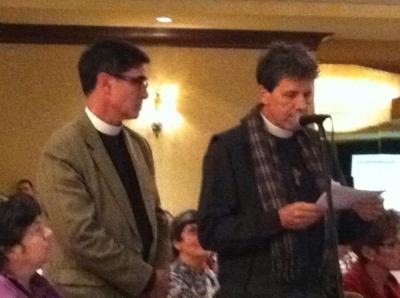
This is a picture of two priests – Len (right) and Rob – in my diocese, Western Massachusetts, at our diocesan convention last weekend. Both are rectors of good-sized churches and well-known around the diocese.

I didn’t know either particularly well but before last weekend. But I knew enough to know they’d probably be on opposite sides of any conversation about sexuality-related issues. Len is the more conservative, Rob the more liberal.

There were two resolutions up for debate at convention, both related to encouraging the blessing of same-gender marriages in the diocese. Several people got up to speak on the resolution, some in favour, others against, all with varying degrees of articulateness and emotion. It was a fine display of the kind of church democracy that is foundational to the governance of the Episcopal Church: a bunch of people, in a hotel ballroom, on a Saturday afternoon, trying to discern what God is calling the church to do.

I noticed Len and Rob standing by the same microphone waiting their turn to speak. It struck me as odd that they would wait together when there was another microphone with a much shorter line.

Len spoke first. He recalled how he had testified at General Convention 2003 against Gene Robinson’s election as bishop of New Hampshire. He mentioned that because the one thing he remembered most of all was how there seemed to develop a de facto split in those waiting to testify. Those in favour at one microphone, those against at another. At our convention, Len said, he wanted to stand shoulder-to-shoulder (almost literally) with his friend and brother in Christ Rob to show that although they disagreed on the issues in the resolution, it was not going to be an issue that would impede their sharing of Christian unity.

Len went on to explain why he disagreed with the resolution and would vote against it. Then he stepped aside and Rob stepped up. He explained how much he respected, admired, and cared for Len and how they disagreed on the issues under consideration. But nothing, he said, would take away from his respect for Len and his belief that they were equally members of the body of Christ. (I’m paraphrasing from memory here as I wasn’t taking notes.) Then Rob explained why he supported the resolution and would vote for it. Then they both sat down.

I have a whole stock of stories about the church in Nigeria, Sudan, South Africa, Uganda, Ecuador, China, and numerous other places that I tell to Americans about how committed and eager Anglicans in other parts of the world are to share in God’s gift of unity to the worldwide body of Christ. Len and Rob have given me a story I will take with me when I travel again.

Both resolutions, it should be noted, passed. But delegates, mindful of the global reality of the church, also passed a third resolution, that read as follows:

RESOLVED that the 110th Convention of the Diocese of Western Massachusetts affirm its commitment to Christ’s missional prayer “that all may be one…so that the world may believe” (John 17:21); and be it further

RESOLVED that the 110th Convention of the Diocese of Western Massachusetts declare its belief that the church can be an instrument of unity and reconciliation in a fracturing world; and affirm its earnest commitment to deepen our relationships across the Anglican Communion both by seeking to explain to our sister and brother Anglicans around the world our response to the Gospel of Jesus Christ in our context and by committing to listen and learn from them, all in a spirit of Christ-like humility, vulnerability, and gentleness.

Yes, there are disagreements and we should talk about them, explore them, and question them. But they need not divide.

And yet we persist in thinking otherwise.

Small Steps

I’ve spent the last week in Mthatha, South Africa, my former home, visiting the people I used to work with at the Itipini Community Project. There were far too many people to catch up with in far too short of a time. Two years is a long time and people have changed – as I have, presumably.

For me, it was a lesson in small steps and little victories. Many people I once knew are now dead, most from AIDS. There were several stories of tragic deaths too young. Nomantombi was a delightful young woman who died in June this year. Sipho and Pamela were a married couple who died with six months of each other, leaving behind several children, including two daughters whom I helped into high school. Those two daughters are still going to school, even as they planned funerals for their parents. Though these deaths were tragic, they were not exactly surprising. It was clear when I left two years ago that some people were not long for this world.

More surprising were the people who lived. A handful of the HIV-positive people I knew well and worked closely with to help get them on anti-retrovirals are now thriving. Pakama, one woman I invested lots of energy in, even as her family was dying of AIDS around her, is still alive. Whereas I could once carry her around the hospital in my arms, she is now – there’s no other way to put this – fat. Three years ago when I was visiting her every day, she bottomed out at 47kg. She now weighs 82.5kg. I had a great time sitting with her on this visit and listening to her talk about these last three years. For every Pakama, there are three or four Siphos or Pamelas. But that one Pakama matters a lot.

The same is true for the high school students I used to know. Many have done one or more of the following things: dropped out, had a(nother) child, or tested positive for HIV. (Two hit the trifecta and did all three.) One dropped out because her mother got quite sick and she had to take care of her. Others struggled with the English-language education and the lack of resources.

But there are a few who have stuck with it and two passed the high-stakes graduation exam and got a high-school diploma. This puts them in rarefied company in Itipini. I can’t imagine more than a half-dozen people in the entire community have diplomas, if that. Those two are now in college. Looking at the students still in school, there are probably three more who have a really good shot at passing the test. Of those three, one, Khayakazi, a daughter of Pamela and Sipho, will be a trend-setter if she passes. (You can read more of her story from two years ago here.)

Five years ago she had a child. She took two years off then came to me and asked for help going back to school. She has stuck with it – even as her son has started first grade and her parents have died. If she passes, she will be the first young woman to our knowledge to have a child, stop school, and go back and finish. Buoyed by her progress, I was walking around Itipini this last week talking to all the young woman I know who’ve dropped out of high school and making sure they know it’s possible to go back.

So a few steps forward, many more steps back. That seems to be how things work.

See “Cities” and Exciting Bishops

The penultimate diocese on my summer tour is Nzara, one of seven Anglican dioceses in South Sudan’s Western Equatoria State. This is the bishop, Samuel Peni. (I like a bishop who can untuck his shirt on a hot afternoon.)

The diocese here is coming up to its second anniversary and has made huge strides in that time. It’s built diocesan offices and a great conference center. It has a house for its bishop. And just yesterday, it opened a really impressive clinic and medical center – well-stocked, well-trained staff, good facilities. Nzara is a little bit older than Aweil and points the direction for a place like Aweil. If Nzara can make this much progress in such a short while, Aweil can surely find a new house for its bishop.

Nzara is an interesting case in South Sudan. For much of the civil war, this part of Western Equatoria was in SPLA control so Nzara didn’t suffer as grievously as other places – like Aweil – did. However, in the last few years this part of Western Equatoria has been devastated by the Lord’s Resistance Army, a rebel army that began in northern Uganda but is now migrating around central Africa, leaving chaos in its wake. Thousands of people in Western Equatoria have been displaced from rural areas to the cities and towns, where they have been for a few years now. That has resulted in the closure of a huge number of churches in rural areas of the dioceses. Ezo, the diocese to the west of Nzara, has been particularly hard-hit by the LRA.

My time in Nzara has given me a chance to reflect on two developments in the church in Sudan. The first is the rapid growth of dioceses in the Sudanese Episcopal church. There are now 31 dioceses I think, with more on the way. (The province doesn’t create them at random, though. Many of the senior clergy in Nzara have told me about the lengthy process they had to go through so Nzara could split from Yambio and become its own diocese.) Traditionally, a diocese is centred on one city, the see city. Practically speaking, the see city gives the diocese an economic base so it has parishioners who have enough money to give to the church to help the church function. But there aren’t that many true cities in South Sudan. (The country only has a population of eight or nine million after all.)

Nzara is a county capital but to call it a city – or even a town – is a bit of stretch. It has no bank, no gas station, no Internet access, and a market that only meets three days a week. For the diocese to do any of its business – like paying the people building the clinic – someone has to drive to Yambio, the state capital, 25 minutes away. (Twenty-five minutes isn’t that bad. Ezo is even farther.) Gas costs $2/liter. Things are beginning to change – there’s a rumour Nzara will be getting a bank – but there’s no doubt the location puts a huge crimp in the diocese’s activities.

But this is how it must be. There are so many Episcopalians in Sudan, the church needs to create dioceses so bishops are reasonably close to their people. As the church continues to grow – and more dioceses are in the offing – there are going to be more see “cities” like Nzara. I myself come from a relatively rural diocese and we make things work so it’s not impossible. But it’s worth noting this is a challenge of church growth in South Sudan.

The other development to note in the Sudanese church is the bishops. He has a lot of help but the man leading the charge in Nzara is Bishop Samuel. He’s part of a cohort of new, young, energetic, and educated bishops in the church, who work incredibly hard. Their formative years came during the war and they are now determined to lead their people into a full and just peace. It is impossible to meet people like Bishop Samuel – or any of these other bishops – and not be hopeful and excited about what the future holds for the church in South Sudan.

The “African Church”

I try not to use the word “Africa” – ever. The continent of Africa is a huge and varied place that an undifferentiated and imprecise term doesn’t seem to be of much use.

Yet I have often heard reference to the “African church,” as in, “The African church believes x” or “The African church doesn’t like y.” Yet as I have traveled around “Africa” – this summer and on other visits – I never fail to be impressed with the diversity within this allegedly monolithic entity.

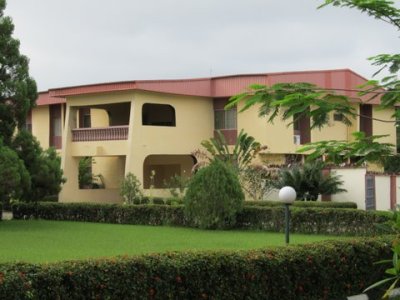
For instance, here is the bishop’s house in Owerri, Nigeria, where I was in June.

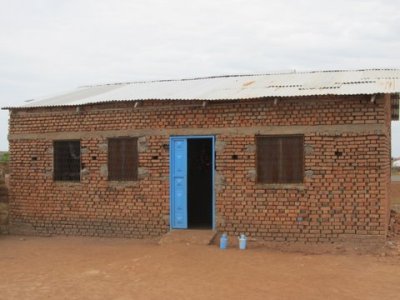
And here is the bishop’s house in Aweil, South Sudan, where I was last week.

What you can’t see is that the house in Owerri is part of a large compound with nicely-tended gardens. The bishop in Owerri has three sitting rooms (he needs them all to entertain his many visitors) and they are air-conditioned. In Aweil, that little building has two rooms – with dirt/sand floors – that serve as housing not only for the bishop but also the diocesan school principal and his family. The building also serves as the bishop’s office. In Owerri, the bishop has two offices in two different buildings, at least one of which is larger than the entire building in Aweil.

Here are some women after church on a Sunday in Owerri.

And here are some parishioners in Aweil.

What you can’t tell from the pictures is that the women in Owerri speak great English and smell great. That might be because they have running water in their homes (a few even have hot water) and cook over propane or electric stoves. In Aweil, those women speak Dinka and Arabic and – there’s no other way to put this – have a certain odour about them, which I have often come across in people who are not able to bathe all that often and cook all their meals over smokey fires. Perhaps that’s because they have to carry all their water in buckets from a well.

As I sat in Aweil last week, I couldn’t help but pine for my air-conditioned bedroom in Owerri with a tub with hot water and a sink with taps in it. Instead, I had my umpteenth bucket bath – I’m developing an odour not unlike those women – in the grass hut outside and immediately got my feet all sandy when I walked back into the bishop’s house and crawled into my bed crammed against a wall. (Great thing about bathing outside, though, is you get to look at the stars while you wash – or, in one memorable case, watch an amazing thunder storm roll in across the plain.)

These are two little visual examples of the differences between a place like Owerri and Aweil. There are a huge number of others, of course. Owerri has countless programs, construction projects, and events going on. Aweil can barely provide enough wafers for monthly communion in its cathedral. There are at least twenty church schools in Owerri and many are quite good. The school in Aweil is in huts with flimsy grass walls. Life in Owerri is more similar to life in an American diocese than it is to life in Aweil.

And just as there is programmatic and financial diversity within the “African church,” there is also theological, philosophical, liturgical, and ideological diversity as well. Nigeria and Sudan were both evangelized by the Church Missionary Society but have developed on quite separate paths. There is quite a lot of difference between a Sunday morning in Aweil and a Sunday morning in Owerri.

So how can we speak of the “African church”? Maybe instead of speaking about it so much, we should start spending more time visiting it.

Needed: a little dash of prosperity gospel?

The major reason I’m in South Sudan this month is to visit some of the students I met last year when I was at Bishop Gwynne College in Juba. I want to learn about the context in which these students minister as a way to think more about what unites us as Anglican seminarians and how best to support them in their education.

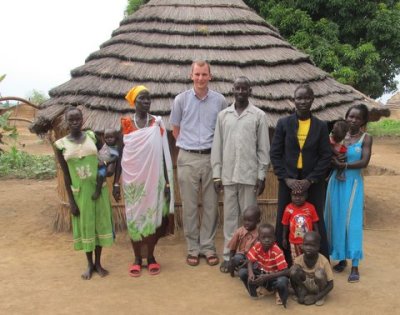
I had a chance to do just that last week in Aweil. After teaching the clergy, I went with Paul, one of my classmates at BGC last year, to see his church. Here he is with his family (and a visitor) in front of his house.

During the war, Aweil was occupied by the northern army. The only church presence was the Catholics, who have been in this area for decades. The Episcopal presence, by contrast, only dates to the late 1980s and there were no Episcopal churches in Aweil during the war. Dinka who ventured too close to the city were shot. So the church grew in the rural areas but not in Aweil. (This region – Northern Bahr el Ghazal – is where Achak Deng, the author of What is the What, a book that did much to introduce Americans to the Lost Boys, is from. It’s also where Abraham Nhial, author of Lost Boy No More, which preceded What is the What, is now bishop.)

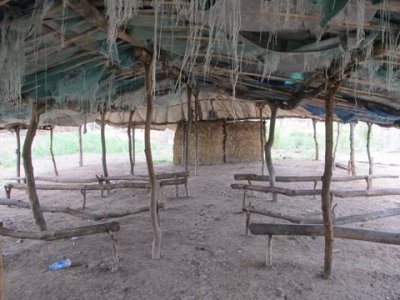
That changed after the signing of the Comprehensive Peace Agreement in 2005. Paul, who had been ordained in the bush, moved to Aweil with his family and began an ECS church under a tree. It quickly migrated to the rough shelter under which the congregation now meets – about 300 people, on average, per Sunday. Paul is the only priest, though he has one deacon and a lay evangelist to help him out.

The church is trying to build a more permanent structure for itself. They had the money to put up the walls. They’re still looking for the money to put on a roof. When (not if) it is finished, it will be the largest Episcopal church building in the diocese.

The neighbourhood where Paul’s church is is a new part of Aweil. It is all people like Paul who have moved back to the city after the war. Social services have not quite caught up with the population growth. There is no school in the neighbourhood, which means these children have nothing to do during the day.

The church would like to start a school and help fill some of the other needs in the community. But those things take money and the church doesn’t have a lot of that at the moment.

One sharp contrast between Sudan and Nigeria is in stewardship. In Nigeria, the prosperity gospel has hugely increased giving to the church, allowing the church to do quite a lot in some parts. In Sudan, giving is anemic. This past Sunday I preached at a church where attendance was nearly 900. Collection receipts? Less than $100 – and I know I gave about 10-percent of that. People here aren’t rich but that is still abysmal giving. Say what you want about the prosperity gospel – and I can say quite a few negative things about it – but it increases giving. One church I preached in in Nigeria had an attendance of 14 and collection receipts of about $25. Perhaps Paul’s church needs a little dash of prosperity gospel. Of course, can you ever have something like a “little dash” of prosperity gospel? Or will it just take over the church entirely?

“There is always something new to learn from the Bible”

Here I am with the clergy of the Diocese of Aweil at the end of a two-day clergy conference I led last week.

That’s right. Me. I taught 50-odd priests about the Bible for two days.

At first glance, it might seem odd that a seminarian would be teaching clergy. But many clergy here are not well educated. (One of my classmates at Yale was flabbergasted to learn that a person could be ordained a priest in parts of the Anglican Communion without an M.Div. Welcome to Aweil.) As a result, they are hungry to be taught. It really is amazing, actually, just how eager they are. It’s a helpful reminder to me – and one I won’t soon forget – that my education is a true privilege and not something I should take for granted.

I structured my teaching by asking the questions, “What is the church?” and “What kind of leaders does the church need?” Obviously, there was a lot more meat to those bones but if you want to hear the content of the teaching, well, you’ll just have to invite me to your clergy conference…

Everything I did was Biblically-grounded. In fact, my teaching was basically two days of Biblical exposition. (I’ve written before about why this is important in Africa.) At the end of the first day, one priest, who has been ordained 22 years, came up to me and said, “Thank you. You have reminded me that there is always something new to learn from the Bible.”

In my living and traveling through Africa – and other parts of the developing world – I am always asking myself what my role is in response to what I see. What can I give? This is not an easy question to answer. As I’ve found in the past, giving stuff and giving money are not ideal solutions. For various reasons, they make me uncomfortable and are of questionable effectiveness.

But I have been thinking again and again this summer that sharing knowledge is one thing I can give without any serious qualms or doubts. People here want it – desperately – and I have it to give. So it was a delight to spend the time with the clergy of Aweil, though more than a little exhausting. Teaching for two straight days really takes it out of you!

The real question I have at the end of this conference is this: where is everyone else? There are clergy across Africa who are desperate for learning. Where are the people with education to help them out? Where are the Americans, Canadians, British, etc. who are willing to help our brothers and sisters in Christ out? Why do the clergy of Aweil have to be taught by an inexperienced seminarian and not, say, a cathedral dean or the rector of a cardinal parish with years of preaching and teaching under their belt? I met Bishop Moses Deng of Wau and within 32 seconds of meeting me – I mean that almost literally – he wanted to know when I could come back and teach his clergy as a first step in starting a Bible school.

My teaching was not in any way “conservative” or Biblically fundamentalist, which, according to some stereotypes, is all Africans know. Nor did our differences on some questions of sexuality pose any kind of obstacle. My teaching was the sort of thing you hear in mainline denominations in the U.S. – and people ate it up. Is the African church “conservative” because it’s an accurate reflection of where they are as a church? Or because that’s who their foreign influences are?

Not for the first time on my summer travels, I found myself lamenting the mainline Christian retreat from the world church. It is at our own peril.

As every good teacher knows, hand motions are key. I was glad my translator got in on the act as well.