Drawing the circle wide

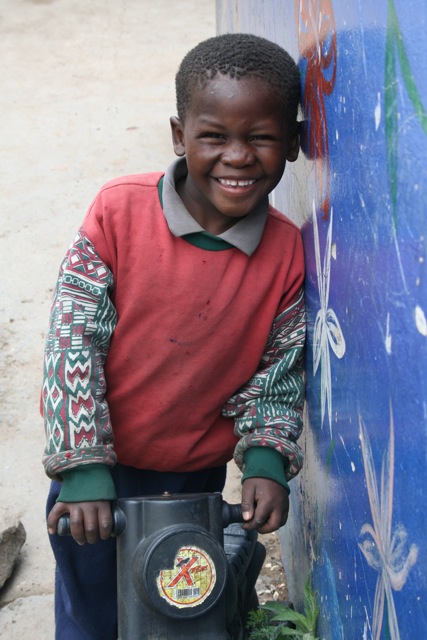
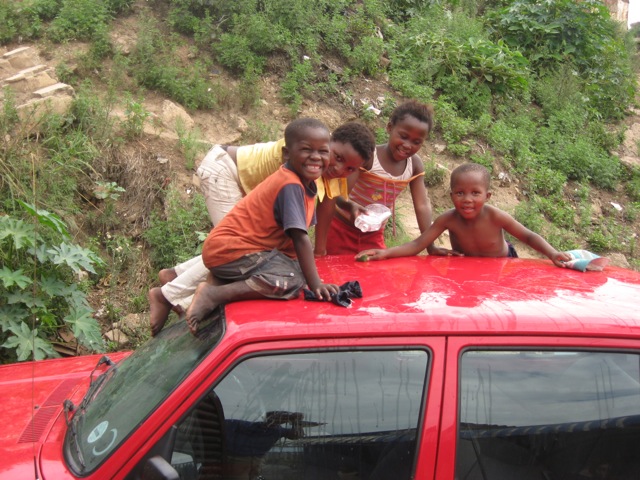
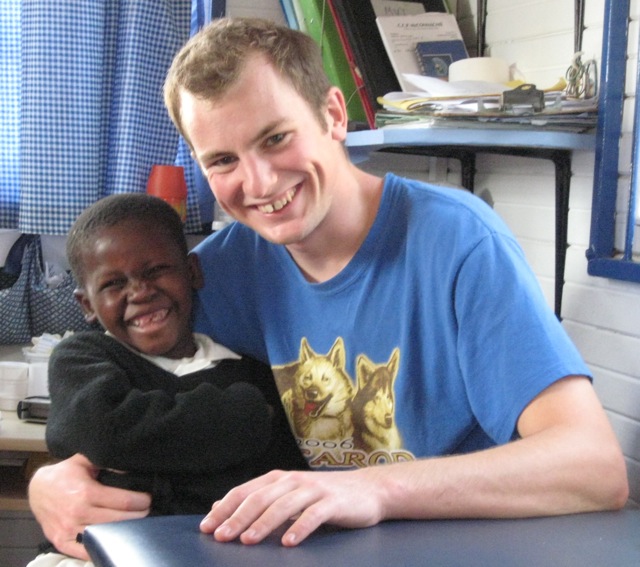
(There are some pictures of Anele at the end of the sermon.)

31 January 2010
Jeremiah 1:4-10
Psalm 71:1-6
I Corinthians 13:1-13
Luke 4:21-30
St. Andrew’s, Grafton, MA
Let us pray.

Fling us out, o Lord, to the margins of the world that we may see you and know you more. Amen.

It is human nature, I think, to want to put ourselves at the centre of things. We interpret and define our experience of the world in terms of ourselves. Think about when we say something like, “Well, if I was you…” That line of thought assumes that our experiences have something to say to somebody else. I know that I can get so caught up in my school work that all that seems to matter is how I perform on an exam or what grade I get on a paper. I lose sight of other things that might matter in life like, say, my relationships with other people or world hunger or whatever new gadget Apple has out. I am tightly focused… and focused only on myself.

The people of Nazareth certainly put themselves at the centre of their thinking, as we see in this morning’s Gospel passage. This sequence is sometimes called Jesus’ “inaugural address” because in Luke it is the first teaching and speaking he does after his temptation in the wilderness. Last week, we heard the first half of the story. Jesus reads from the book of Isaiah: “The Spirit of the Lord is upon me, because he has anointed me to bring good news to the poor. He has sent me to proclaim release to the captives and recovery of sight to the blind, to let the oppressed go free, to proclaim the year of the Lord’s favor.” Then he rolls up the scroll and hands it back and sits down. You can almost feel the tension in the synagogue. Everyone is staring at him. They’re a bit confused because they know this Jesus as the child who grew up among them. But now they’re hearing stories about the power of this same Jesus. On this day, all he’s done is read a passage from Scripture they know well. That’s it? Surely this wonder worker they’ve heard of can do more than that.

Then Jesus speaks: “Today this scripture has been fulfilled in your hearing.” This is remarkable. The passages from Isaiah that predict the coming of the anointed one have finally come true and they’ve come true right here in Nazareth, a place that didn’t have a great reputation in Biblical times. You can imagine everyone sorting of sitting up a bit straighter in their pews and mentally patting themselves on the back. God has chosen to act right here in their little synagogue. The Messiah turns out to be that little snot-nosed kid who was training to be a carpenter. Everyone’s probably thinking back to their memories of the little child they once knew and giving themselves credit for all the hard work they must have done to produce such an upright young man. He’s the Messiah, he’s here, and he revealed himself not in Jerusalem or the other big cities but right here in tiny little Nazareth. Not bad for a Sabbath visit to the synagogue!

But Jesus isn’t done speaking. When he opens his mouth again, things begin to change a little. He cites a few examples from Old Testament history. There’s the time when the prophet Elijah, who could perform miracles and communicate with God, used that power to heal not Israelites suffering from a great famine but a foreigner from Sidon whose child had recently died. Jesus points to Elisha, also blessed with great powers from God, who used that power to heal Naaman of leprosy, even though Naaman was the general in charge of a threatening foreign army. The Israelites believed themselves to be a chosen people, a people who had been brought up out of slavery in Egypt by God, a people who had been given a covenant by God as a mark of their uniqueness. Jesus is pointing to a few examples from history that show that sometimes God is working on behalf of other people outside that covenant.

The mood of the people of Nazareth suddenly flips. If Jesus isn’t going to confirm their good opinions of themselves then they have no need of him. They drive him out of town and it is only divine intervention that saves him from death.

It’s very easy to think that we are at the centre of the world, to act as if the known world is only what touches our lives and matters to us. We do it. The people of Nazareth did it. But what Jesus does this morning is re-centre the faith of the Nazarenes. It’s as if the Nazarenes are putting themselves at the centre of a circle. God is working wonders in the world but those wonders are on the margins of their existence. The centre of God’s circle is somewhere else. The people of Nazareth all of a sudden need to draw their circle again and draw it wider.

I take two lessons away from the aftermath of Jesus’ inaugural address. The first lesson is that God is a God who messes with our expectations and challenges our cultural values. The people of Nazareth were a little surprised, I imagine, that the Messiah was one of their own but I am sure they quickly adjusted. It’s easy to justify news that is unexpected but also good. “Well, of course that makes sense.” “Naturally, the Messiah would come from Nazareth.” But then Jesus challenges them again and says, actually, no, you are not the centre of the world and my ministry is not primarily to you. Don’t think you deserve any special treatment. This is harder to take.

The second lesson is that God is a God who acts in the world. This sounds obvious but sometimes we forget it. God didn’t just create the world. God continued to act throughout the Old Testament, as Jesus reminds us with the healing of Naaman and the raising of the widow of Zaraphath’s son. God acted mostly fully in the form of Jesus himself, who taught and lived and loved as one of us and then died on the cross and rose again. And I believe that God continues to act even today in and through all of us. And when God does act, we are reminded by this scene in Nazareth that God is often acting on the margins. One of the reasons we may think that God isn’t very active anymore is that we are too busy putting ourselves at the centre of our world that we fail to see God at work in the fringes of the world around us.

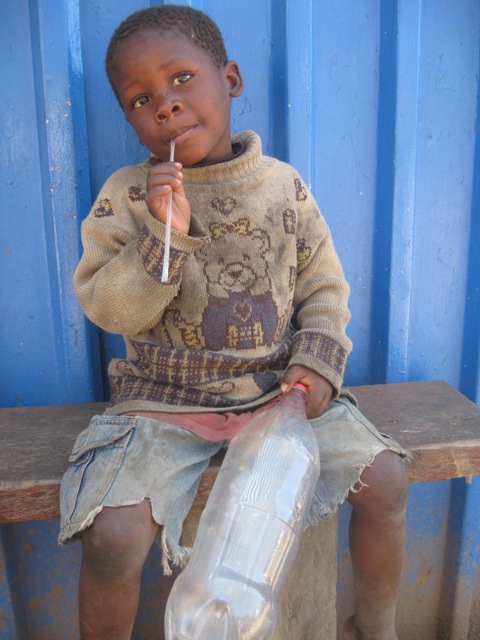
This reading from Luke reminds me a bit of an experience I had with a young child I knew named Anele when I lived in South Africa. For two years, I was a missionary of the Episcopal church in a town called Mthatha in South Africa. Specifically, I worked at a community center in a neighbourhood of Mthatha called Itipini. Actually, to call Itipini a neighbourhood might be going too far. Itipini is a word that means “at the dump” and that’s an accurate name for a shantytown community that was built on the site of a former garbage dump so people could scavenge off the garbage. There is no running water or electricity and the shacks people live in are made out of random pieces of tin, tarps, assorted old car parts, sticks, mud, and even, in one instance, a few beer bottles. Basically, people use whatever will provide minimal protection from the elements but it’s not much. When it rains, shacks leak, and during the winter, they get cold inside. Itipini is one of the poorest parts of South Africa and the socioeconomic indicators there are among the worst in the country – high rights of unemployment, school drop-out, and HIV infection, for instance.

Our community center had a pre-school and there were two kinds of children in Itipini: those who went to pre-school and those who didn’t. The former were the ones who had mothers who looked after them, washed their clothes, and made sure they were on time each day. The latter were generally children whose parents or guardians – if they had them – were so burdened with other responsibilities they couldn’t get their act together and get their children to pre-school. Our teachers made an effort to reach out to these parents but the teachers were fighting against entrenched social patterns that are hard to break.

I developed a kind of rapport with the children who did show up to pre-school. I played my guitar with them and taught them English through songs. I played with them on the playground. They always wanted to climb on me like a jungle gym but over time I was able to set some boundaries on their activity so that I wasn’t being constantly beaten up. My role with these pre-school children was becoming, in part, the centre of my existence in Itipini. I was getting comfortable with this role and putting myself at the centre of the pre-school action.

That’s when Anele entered the picture. When I first met him, he was about 4 years old and sort of hanging around Itipini. His clothes were dirty and tattered and he was so clearly lonely and bored. Even in a place like Itipini, Anele was a sorry case. He was on the fringes of Itipini and that means the fringes of South African society.

Now one obvious answer in a situation like this is to try to involve Anele in the pre-school program. He was the right age. He would get fed at pre-school. He would have some activities to keep him busy for part of the day. He might even learn something along the way. But there was a problem: Anele was so annoying! When I tried to engage him, he would get so engaged he’d start pulling my hair and yanking me around. He had so much energy but didn’t know how to channel it productively. It made him a very difficult person to love. It was easy to think – why bother? I have these other children and I don’t need to include Anele. Time passed and I wasn’t having much success. My efforts to invite Anele to pre-school result in his very sporadic attendance. When he did come, he was so annoying I just ended up liking him less. What was the point?

It took me a long time – too long – to realize this but God was acting in Anele’s life. God’s plan for Anele’s life did not include him sitting around all day with nothing to do in the same torn and dirty clothes. When I looked at the situation with fresh eyes, it was easy to see Anele’s rambunctiousness as a desperate cry for attention and TLC. I started doing some investigating. It turned out that Anele’s young mother had left him with his grandmother while she went to a big city to look for work. That was several years ago and no one had heard from her since. The grandmother was trying to take care of Anele and her other children and grandchildren. Like many other grandmothers in Itipini, she was overworked and struggling to support everyone. Anele’s obvious energy and enthusiasm that manifested itself in some exuberant behaviour made him easy to dismiss as a “bad kid” and so not worthy of a lot of attention.

Seeing the situation in this way, I gradually started working more with Anele and his family. I checked to make sure he came to school. When he joined us on the playground, I tried to teach him the boundaries I had established. We made sure he had some extra clothes. Our relationship began to improve. As he grew older, he developed a love for washing my car. Except for the one time he got so enthusiastic he ripped the rear wiper off the car, I was happy to help him channel his energy. When the time came, he entered first grade and is still in school today.

Gradually, Anele who had been on the margins was drawn in. My circle, which had been focused on me and the other children, was drawn wider until we had a new centre that wasn’t about me but was more centred on God, with Anele and the other children and I taking our roles in that circle. God was calling me into action in Anele’s life. It just took me a while to realize that. I found God acting on the margins and fringes of what I had made my existence to be.

Now I know that it can sometimes to be a challenge to get us to look to the margins. I am not saying that all of us are called to play with the grubby, snot-nosed, dirty, and smelly children on a garbage dump in South Africa. Reaching out the margins is not exactly everyone’s idea of a good time. But guess what? God knows that. So to conclude, I want to suggest two bits of wisdom that God gives us to help us as we re-centre our faith and look to the fringes.

The first is that sometimes we don’t feel prepared for what God is calling us to do.  This is a major theme in the Bible and we see it particularly in the Jeremiah call story this morning. God calls Jeremiah to be a prophet and Jeremiah says, “Not me – I don’t know how to speak. I’m only a boy!” God will have none of it. God reminds Jeremiah that God has known him since before he was born and has formed him for this role. That’s important for us to remember: we may not feel prepared for what we believe God is calling us to do but we can take strength from the knowledge that God has known us and formed us for the roles God puts before us.

Even if we still feel uncertain about where God is leading us, we can remember that God is with us every step of the way. That’s what God reminds Jeremiah of this morning. We hear that reminder again in this morning’s psalm. God will deliver us and rescue us. God is our rock of refuge and strong fortress. God saves us from the wicked and unjust.

Sometimes when we look at those marginal areas in this world, it can seem pretty overwhelming. I thought that when looking at Anele – a broken home, little food or money in the household. Really, God, you want to me address this situation? The same is true of many situations in this world. Homelessness? Really, God? What do you expect us to do about that? There’s way too much to do! The second bit of wisdom that God gives us about heading out towards those marginal areas addresses this issue directly. God reminds us that sometimes it’s not about what we can do but who we are that really matters. We are, after all, called human beings and not human doings for a reason.

The reading from Corinthians this morning is a particularly good reminder of this. It’s the well-known reading about love – “love is patient, love is kind, love is not envious or boastful or arrogant or rude” and so on and so forth. A common Bible study idea with this passage is to insert your own name for love and see how you stack up. Jesse is patient, Jesse is kind, Jesse is not envious or boastful or arrogant or rude. So far, I’m 0 for 6. How are you doing? Jesse does not insist on his own way. 0 for 7. Jesse is not irritable or resentful. Did I mention how annoyed I got at Anele? Anyway, I think you get the idea.

What’s important to remember here is that none of these qualities of love are things we actually have to do – patience and kindness are qualities of our personhood. When we venture out towards those marginal areas, we must go as the people God has called us to be. I didn’t actually do much for Anele. I just tried to be patient and kind to him and his family and things started happening. It might seem overwhelming to do anything for the homeless person you pass on the street. But what happens when you first ask the question, who can I be around the person – patient? kind? not rude?

God is always calling us to re-centre ourselves and look to where God is acting – even now – in the world. It’s true that we draw in and gather together in church on Sundays but this isn’t the end of the story. We are here to be nourished and fed and strengthened so that we can be flung out again into the world, to those marginal and fringe areas outside our normal range of vision. We go to those areas to draw the circle of our lives wide to include all God’s people with God at the centre.

We can go out in the confidence because we know that God is with us and has called us to this role. And we go out with the knowledge that we are called simply to be, to be the people of God in the world. That is good news! It is the good news Jeremiah heard from God. It is the good news Jesus proclaimed in the synagogue in Nazareth two thousand years ago. It is the good news Paul shared around the Mediterranean. It is the good news I learned from Anele. And it is the same good news our world needs to hear this day and every day.

Amen.
“Deliverables”

One of the great things about being an Episcopal divinity student is that there is plenty of money out there to support any efforts you might want to make towards global mission. A couple of organizations routinely fund summer mission trips.

We had a representative from one of these organizations on campus a while back to explain the application process. This person spent a good bit of time on how to write a good project proposal and that prompted a question from me, similar to one I asked at the beginning of the term. I said that I thought the fruits of mission were mostly in the time spent and the relationships built, not in any projects completed, especially given the short time most divinity students have to devote to these trips.

The answer I got was very clear: “there have to be deliverables.” You have to come back with something to show for the money.

That word “deliverables” has been stuck with me ever since. I really don’t like it.

Quechua Episcopalians?

So here’s an interesting story about the Episcopal Church in Latin America.

In the last year or so, about 30 Quechua communities have approached the Episcopal Diocese of Central Ecuador and expressed an interest in leaving behind the Catholic Church and becoming Episcopal. As I understand it, they think they’re not getting the sort of pastoral attention they want and the sacramental tradition of the Episcopal Church appeals to them. On the face of it, this is great news for the Episcopalians (especially in light of Pope Benedict’s overtures to Anglicans in the last six months).

These Quechua communities are quite poor. They are high in the mountains and the people who live in them were for a long time labours on the large farms of distant landowners. It’s only in the last few decades that they’ve come to own land for themselves and even then it’s not the best land.

But the problems immediately begin to raise their heads. For one thing, the Catholic diocese in the area isn’t totally thrilled, especially since two Catholic priests are becoming Episcopal priests. For people who care about the unity of the Body of Christ, this isn’t great news.

A large problem is language. The Episcopal prayer book is translated into Spanish but not Quechua. Many of the older people in these communities speak little Spanish. The service that they take part in might be as foreign to them as any Xhosa-language service was to me in South Africa. It’s not like the Episcoplians have a surfeit of Quechua-speaking clergy to translate either.

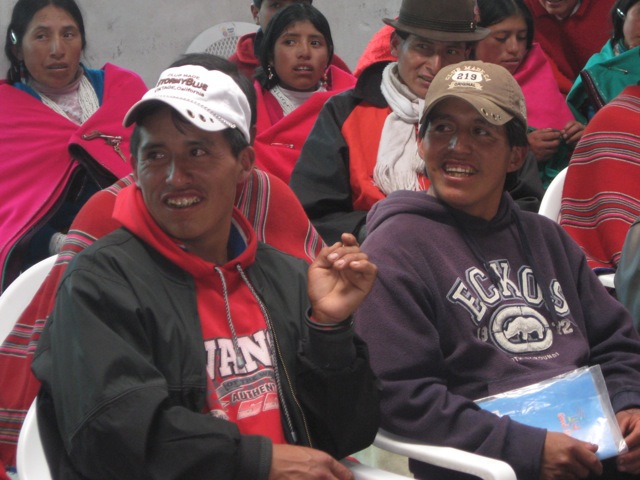
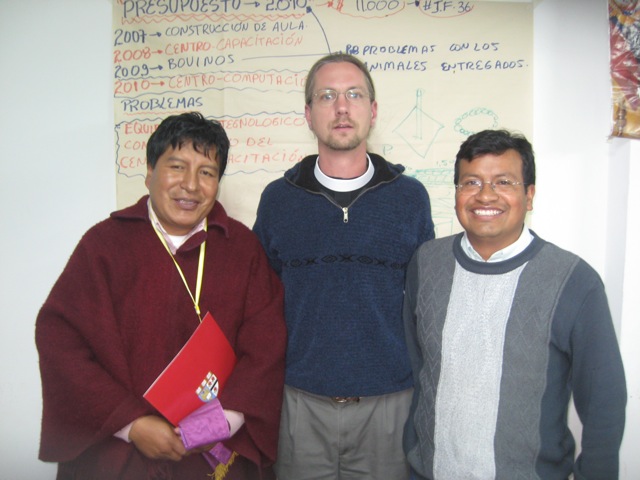
Clergy is another issue. Neither the Catholics or Episcopalians have a bunch of clergy hanging around who can provide pastoral attention to these villages. One way they’re getting around it is by holding monthly educational sessions in a central location on how people in the villages can take on some of these roles themselves. We attended part of one of these on a Saturday. I was impressed they could get 100 or so people to walk four or five hours to come to a meeting like this.

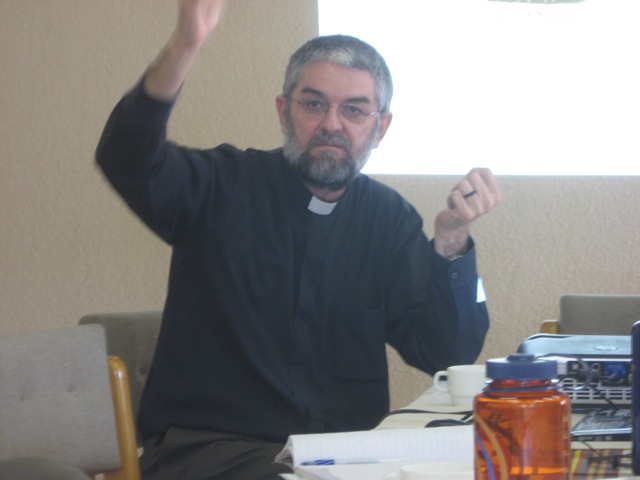
At a Saturday session on pastoral care – don’t see Episcopalians dressed like this very often!

The work also puts a strain on the clergy. Two clergy for 30 villages isn’t a great ratio. We meet Father Eulogio and Father Luis Alberto. They are both very talented, smart, and hard-working but it is clear that multiple services per day in different communities is taxing.

Father Luis Alberto

Chris Morck with Fathers Eulogio and Luis Alberto

One of the most interesting issues at stake is, of course, power. The Episcopal diocese welcomed these villages with open arms but now at least some people have reason for pause. The diocese has maybe 2000 congregants now. These 30 villages represent maybe 5000 congregants. If and as these new communities join the diocese that could dramatically shift the face of the diocese, making it an indigenous-dominated one and not a mestizo-dominated one. I’m all for democracy in the church but I think this is making some Quito-based Episcopalians think again.

There’s another question at play about how seriously these villages want to be Episcopal, as opposed to just generally Christian. It’s not clear at all that the Episcopal Church can do a better job than the Catholics at providing pastoral attention. If that proves to be the case, then we heard that some villages might consider evolving into their own sort of a-denominational Christian church. They might just be passing through the Episcopal Church on their way to something else.

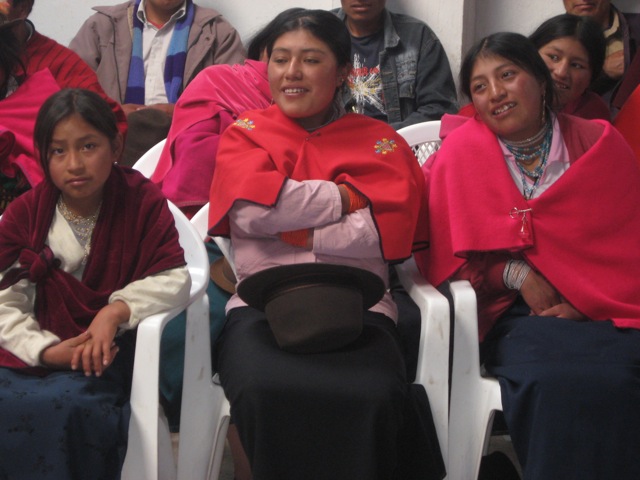
All of these issues make this a fascinating situation. We were fortunate to observe part of the Saturday afternoon session on pastoral care. In the late afternoon, we drove up to one of the villages (San Francisco de Telon) and joined them for worship. It was a standard Episcopal prayer book liturgy, in Spanish. There were a dozen or so of us gringos and maybe 40 Quechua in their ponchos and felt hats in a small, thatch-roofed church that is nearly 200 years old.

Church from the outside (above) and inside (below)

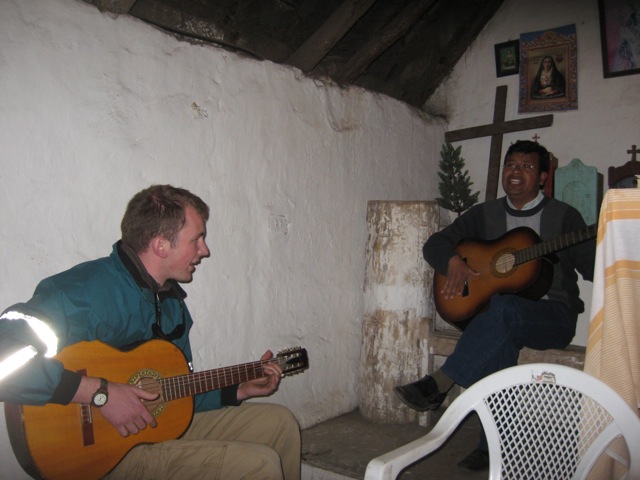
Chris Morck with Father Eulogio preparing the table; Father Luis Alberto leading music.

While we waited for the service to begin, Father Luis Alberto invited me to play guitar with him. I shared a few of my favourites and he taught me a few Quechua tunes. I hadn’t been feeling great because of the altitude and an oncoming cold but this really perked my spirits up.

You know the Bob Marley song “Jammin'” – “We’re jammin’ in the name of the Lord”? That’s what I was thinking about.

When I was planning the trip, I had thought about skipping the first day of classes and avoid having to take the red-eye back to New York but I resolved to make it back for Monday because I really wanted to be in the World Christianity class and I was glad I did. But I couldn’t help but thinking that some of the best education in world Christianity had been in that church on Saturday night.

Ecuador, Part I

I am back from my first excursion into South America, a short trip to Ecuador. Here are some highlights.

The trip was organized through Memorial Church at Harvard but there were students from four universities among our number. It was explicitly organized as an educational seminar centred on the themes of mission, sustainability, and globalization. And it was short, only six days in country. Initially, this had made me wary of going – all that money for a plane ticket for just six days? how do you build relationships in that little time? – but I overcame that wariness and am glad I did. We were hosted in Ecuador by Chris Morck, an Episcopal missionary who splits his time between the Diocese of Central Ecuador and the Latin American Council of Churches (CLAI, by the Spanish and Portuguese acronym).

A friend at Yale told me last semester that I struck her as the kind of person who is more comfortable on a garbage dump in South Africa than a place like Yale Divinity School. Driving through Quito on the first night in Ecuador, I was surprised at how at ease I felt – the traffic was nutty and there was a guy breathing fire at one intersection – but it all felt very familiar and comforting.

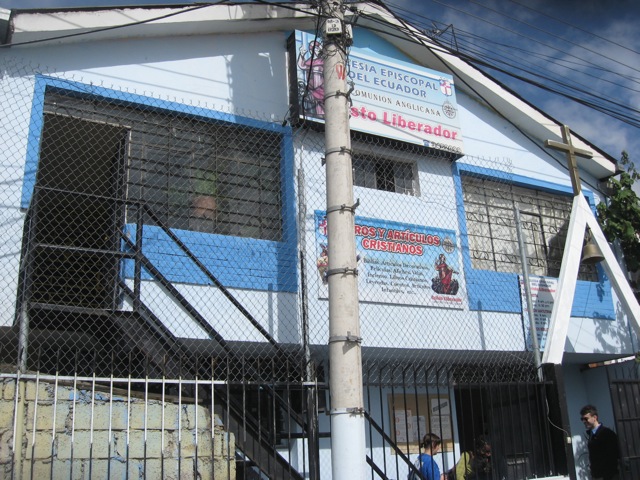
On our first full day, we visited a local Episcopal church and said morning prayer with the usual congregation of senior citizens. It was a proud-to-be-Episcopalian moment. There were thirty or so seniors who show up for morning prayer and breakfast afterwards. The church pays for the breakfast itself even though it’s in a poor neighbourhood. The church wasn’t much – just a converted house – but they still get 100+ people on Sundays and run a pre-school nearby.

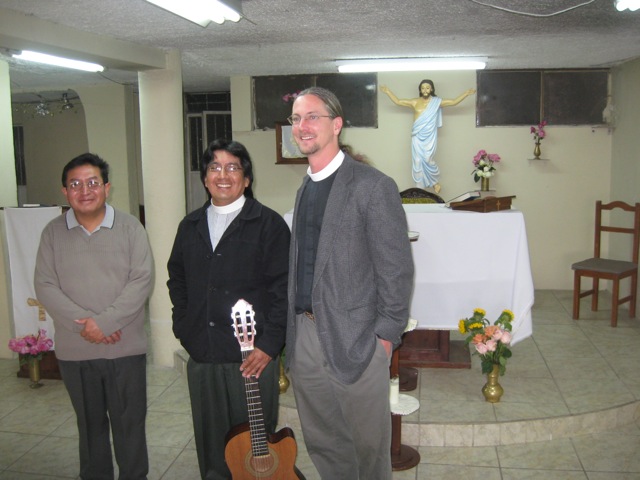
From right to left: Luis, a postulant for ordination; Father Raoul, a priest in the diocese; and Chris Morck, Episcopal missionary in the church pictured below

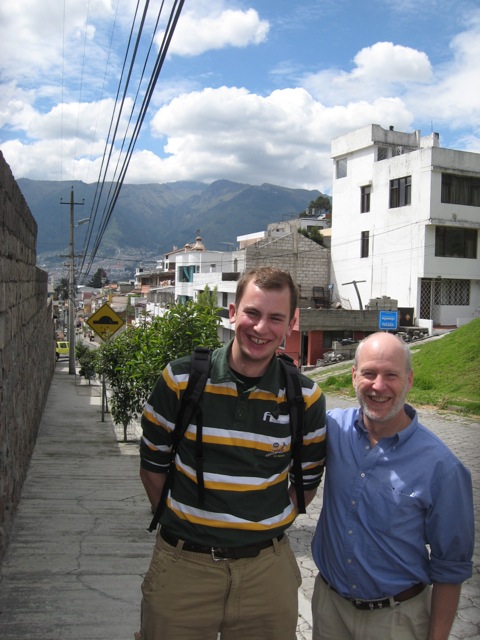
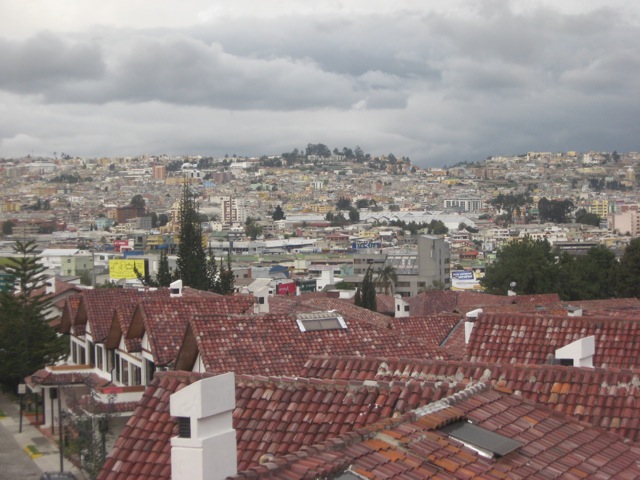
Fellow Berkeley-ite Steve and I with Quito in the background.

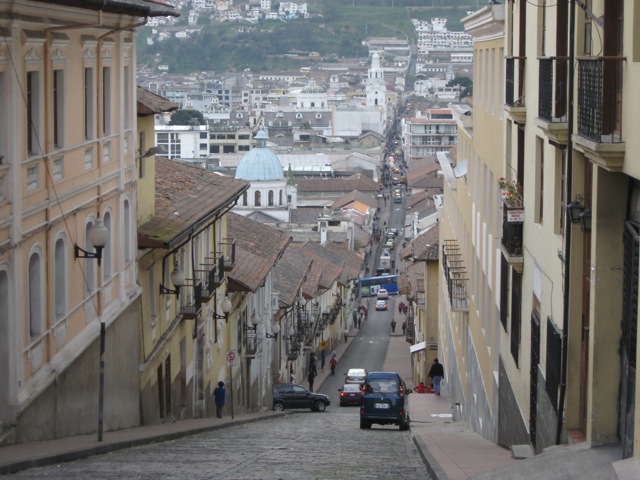
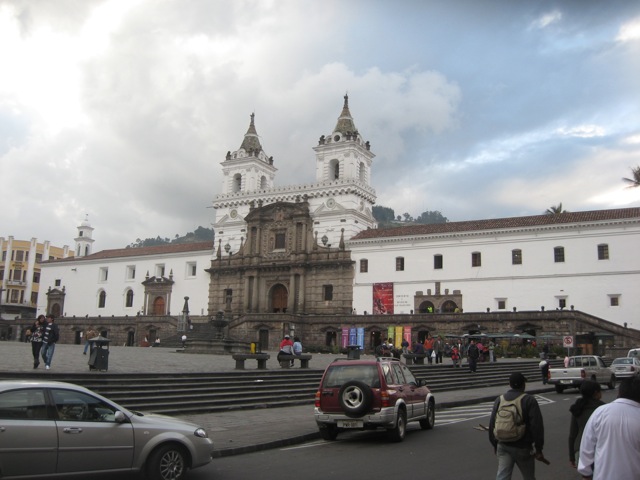
In the afternoon, we strolled through Quito’s old, colonial section. It was very interesting, all the big churches the first missionaries had thought it necessary to build and the close proximity of the presidential palace to the archbishop’s residence.
Steep streets in the Old Town.
The major basilica, the name of which eludes me at the moment.
A church built by the Franciscans.
I speak about 12 words of Spanish but I could understand this! Sadly, all the books were in Spanish.

Our next two days were spent at CLAI, meeting with various CLAI (and non-CLAI) people about a wide variety of topics – indigenous cosmology and theology, ecological perspectives from Latin America, ecumenism, and a bunch else. I have a lot of notes.

For me, this was really the first time in which I’d heard an educated, middle-class perspective from the developing world. In South Africa, the people I worked with were poor and uneducated and didn’t often have the resources to intentionally reflect on their situation and share that with me in a way I could understand. But the people at CLAI are thinking about this all the time and are adept at PowerPoint presentations and making their views comprehensible to people like me from the north. In fact, one of our presenters had just returned from the Copenhagen climate change conference.

What struck me the most was how our presenters framed issues. Language use has always interested me – for instance, why is it that when a tax is called the “death tax” there is more support to repeal it then when it is called an “inheritance tax”? – and our presenters used language in ways that was unfamiliar to me.

For instance, Frederick Canelos, an economist for CLAI who has also worked for the government, framed the issue that I previously knew as “debt relief” as “illegitimate and illegal debt.” The idea is that the money the north loaned to the south was illegitimate, because it was loaned to dictatorial regimes and didn’t benefit the people, and illegal because some of the projects the loans supported weren’t lawful. (There are arguments to back up these statements but I won’t rehearse them here.) As such, these are not loans that are to be forgiven because they never should have been incurred in the first place. It is the north that should be asking for forgiveness from the south because of the way in which the money was given and the ways in which the loans have forced developing world governments to repay them multiple times over with high rates of interest.

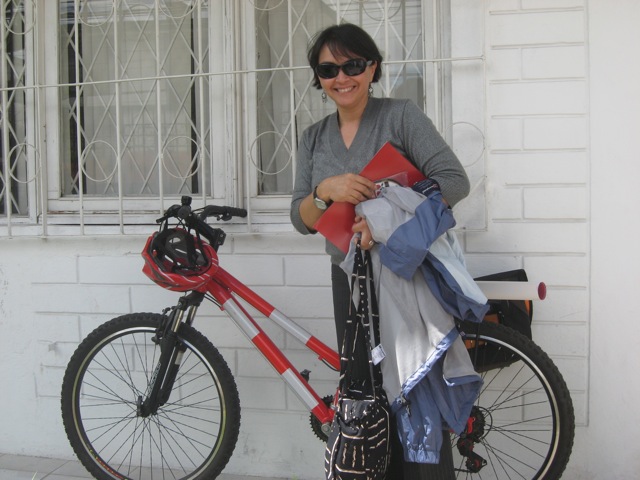
Another presenter, Ivonne Yanez, from an NGO called Accion Ecologia, told us about “ecological debt.” This is the idea that the combined impact of global warming, resource exploitation, industrial agriculture, and so on has created an ecological debt that the north owes to the south. Ivonne was particularly pointed in her presentation, using the word “you” a lot, about how our lifestyle has contributed to the problem, but it was well-received. She articulated the “Verona principle,” taken from Romeo and Juliet, that the offender needs to atone for the wrong-doing and then leave the city altogether, as Romeo did. In this case, that means that big oil companies in the Amazon have to atone for the wrong they’ve done and then get out and never come back. (It’s possible she also meant the Verona principle to apply to us but that wasn’t clear.)

Yvonne, the environmental activist, with her bike.

We heard a lot about “food sovereignty,” which is the idea that a country should be able to produce all the food it needs itself. This is distinct from the idea of food security, which is the idea that a country needs to be able to access all the food its people need. In many respects, the food sovereignty movement is like the “locavore” movement in the United States. Its leaders, some of whom we met at a very impressive CSA-like organization, are teaching and encouraging people to grow and buy local, Ecuadorian food and take themselves out of the agribusiness food chain. I didn’t get a good answer to the question of how really poor people, like those I worked with in Itipini, could credibly take part in the food sovereignty movement.

We heard an excellent presentation about the indigenous Andean worldview, from Julian Guaman, a Quechua theologian. He talked about the idea of harmony and non-linear thinking and how these ideas challenges the western way of thinking that holds true even in Ecuador. He was critical of liberation theology as a western way of thinking, which was surprising to me as I had always associated it with Latin America. But as I learned and re-learned on this trip there are divisions in the region between indigenous Andeans and the mestizos who have most of the power. He showed us how on the Quechua calendar there are 500-year periods of rise and fall. This is a period of decline but the eras shift in 2012. Look out!

(Liberation theology, we heard time and again, is definitively not dead. It may be dead – or in disfavour – among the Roman Catholic hierarchy but it is still the animating principle at CLAI and among many other people we met with.)

Ecuador has a large population of Colombian refugees and we heard about the discrimination they face. They are stereotyped as narco-traffickers or paramilitary types, even though they are usually just refugees from the long civil war. It is easy for us in the United States to see South America as one giant, undifferentiated place. That’s obviously not the case and hearing about the divisions that exist within and between countries was important for me. One of the women who taught about this was a Mennonite missionary from Colombia to Ecuador. The example of south-to-south mission was relatively new to me.

Our group was a wide mixture of people but one theme that was common in many of them was a general suspicion or distrust of mission based on what I would consider out-dated (but still dominant) ideas about mission and missionaries. One person said, “Wouldn’t it be great if missionaries could become agents of dialogue?” I shot back, perhaps a bit too brusquely, “What do you mean – ‘become’?”

I asked several presenters about how people from the north could best support people in their positions. Time and again, the answer I heard was some variation of “listen to the people you want to work with” or “learn about what you are doing” or “come alongside us.” All of it was very much supportive of the thinking about incarnational mission I had been doing in South Africa.

But the idea that stayed with me the most was something we heard in our first presentation from Nilton Geise, the general secretary of CLAI. He concluded by saying, “Latin Americans don’t usually do what I did today, which is speak. Latin Americans generally just listen to Americans. Dialogue works when both are speaking.” That struck me as so true and reminded me of all the times I had gotten myself in trouble in South Africa by failing to actually listen to the people I was working with. I was left wondering how we can create more situations in which people like Nilton, our other presenters, and those we didn’t hear from, could share their message more broadly.

Nilton, secretary general of CLAI.

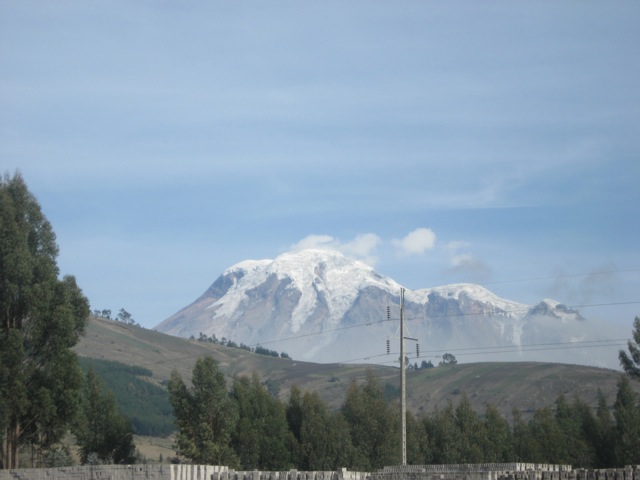
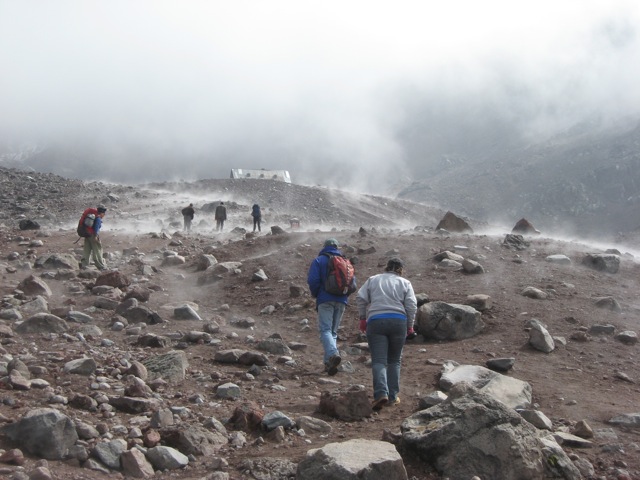
On the second half of the trip we visited the rural area around Riobamba, higher in the Andes and about three hours south of Quito. I’ll say more about the learning aspects of what we did there in another post but let me end with a few pictures of Chimborazo, one of the highest peaks in the Andes. (Because of the bulge at the equator, the peak of Chimborazo is closer to the sun than the peak of Everest.) We drove to about 15,500 feet and then were able to hike up to 17,000 feet. It was intense! The altitude really does a number on you at that elevation and going uphill is a matter of saying to yourself, “one foot, other foot, one foot, other foot…” and on up. Going down is a lot easier than going up, a reminder of how much gravity weighs us down.


Going up Chimborazo with the mist burning off

That was Sunday morning. I left Sunday night, was back in New Haven on Monday morning, and in class at 1:30 that afternoon. Seventeen thousand feet to sea level – outdoors, above the tree line, to classroom environment. Can you say whiplash?