Having Fun

There’s something undeniably exciting about riding to church in a convoy of cars.

That’s what happened to me on Sunday morning. The bishop was off to make a pastoral visit to Christ Church, the largest in the diocese. We had a four-car convoy – the archdeacon at Christ Church in his own car, two congregants in the church’s van, the bishop’s Corolla, and a visiting bishop in a Forerunner. I felt like the president on his way to make some speech. Sure, A Corolla isn’t a heavily armored limo and our convoy was quickly broken up by motorized tricycle taxis darting in and out. But it still felt neat.

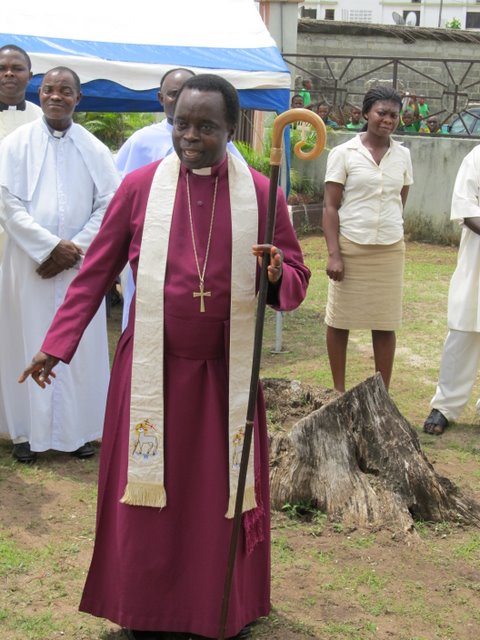
Then, a few block short of Christ Church – right in the middle of Owerri’s sprawling market – we were met by a band. A band! There were about six trumpets and a few drummers. The bishop put on his stole, screwed together his collapsible crozier, got out of the car, and started waving to shoppers in the market and blessing all who passed by.
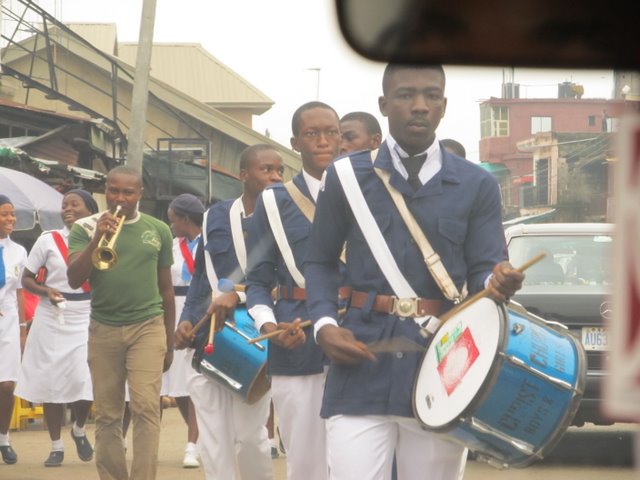
Pretty soon, we were in the church compound where scores of people were in the yard to greet the bishops. They marched around to the front doors, blessing the members of the choir as they went, and – barely missing a beat – started the procession into the service.

I got mixed up in the procession with the choir and was swept down the centre aisle. There were a thousand people in the church and it was almost too much – overwhelming music, vivid colours in the clothing, dancing, and people, so many people. But it was also amazing – the energy, the enthusiasm, the sheer sense of the magnitude of what was going on.
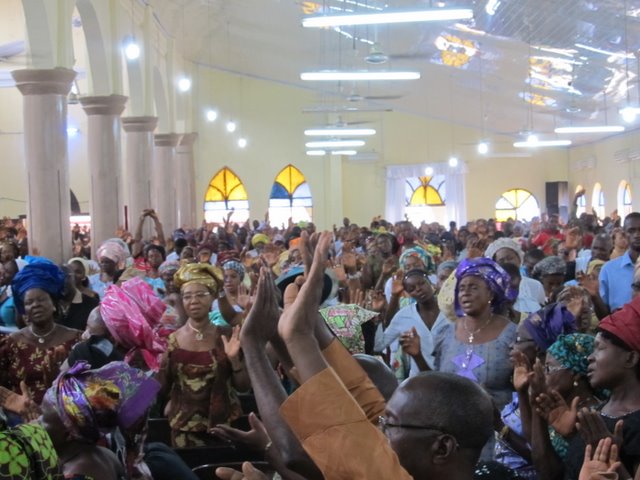
(Pictures do not even begin to do this justice.)

The bishop greeted everyone in what amounted to a boisterous, exuberant fifteen-minute pre-service praise session – lots of Hallelujahs, lots of singing, lots of praying, lots of laughter. Then the bishops went off, vested, came back and did the service. The energy that was there at the beginning carried through the service.

Say what you want about Anglicans in Nigeria but this cannot be denied: they’re having fun.
“The ambit of Anglicanism”

One of the obvious features of the growth of the church in the non-western world is its charismatic and pentecostal nature. I’m using these words kind of loosely here but basically I mean them to say that worship services in the developing world are not generally staid and traditional affairs. Often, it is the charismatic churches that are growing the fastest.

This creates a problem for Anglicans, who have historically been defined by a set liturgical structure. In Nigeria, the Anglican church – seeing the independent pentecostal churches as a threat to its growth – has responded with becoming more flexible and adopting and adapting more charismatic styles of worship. One priest here told me, “If those other churches are singing and dancing, then let us do that too. Let the pastor jump around. Let us change the liturgy.” In fact, this same priest told me, “I’m not boasting but I’m better than any charismatic pastor. Now, they all want to be like me.” These changes create the same tensions in Nigeria that worship changes do all over the world – basically, the young people love the new style and the old people don’t. That leaves it to the bishop to sort things out. This priest was ordained in 1994 and he told me that when he was newly ordained, he used to “pray for bishops who support charismatic worship, but none did. Now, almost all do.”

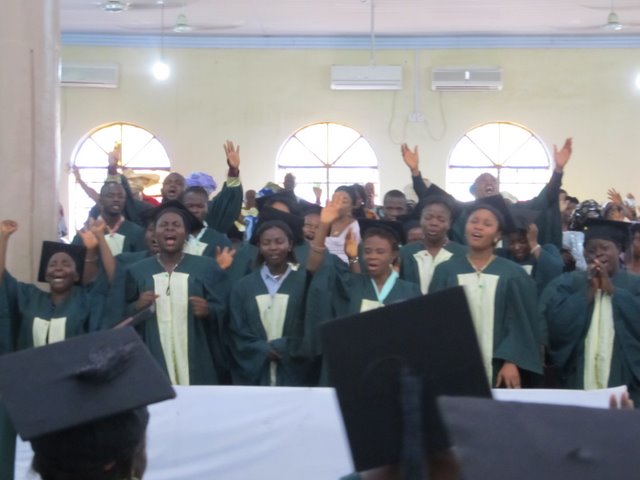
I saw the effects this morning in church where the service alternated between old standards from Hymns Ancient and Modern, a communion anthem from Handel’s Messiah (no, really – and the choir did a good job of it too), and praise choruses from the band. There was an immense amount of energy and exuberance in the service. (At least at first. By about hour four, people were fading.) It was a communion service and the words of institution were said. But a lot of other words, many of which are not – gasp! – in the prayer book, were said as well. There was more than a fair bit of ex temporizing going on. I’ve been to a few non-communion services here which bear little resemblance to anything in any prayer book I’ve ever seen.

All this amounts to a challenge to Anglican unity – and you don’t have to come all the way to Nigeria to see this. There are charismatic, non-liturgical churches in the Church of England as well. One of the hallmarks of Anglican identity is said to be the common structure of prayer based, to some degree, on Cranmer’s Prayer Book. But the influence of pentecostalism in Nigeria and elsewhere challenges that. I asked one priest if he had a set liturgy for his services. He paused. “Not really,” he said. But, he hastily added, “it is within the ambit of Anglicanism.” (He really said “ambit.”)

Who gets to decide what counts as “the ambit of Anglicanism”?

(The influence goes both ways, incidentally. Unaffiliated pentecostal church leaders admire the vestments and do-dads that Anglican priests get. So you start seeing charismatic leaders in purple shirts or cassocks. As a result, vestment-making in Owerri is big business. Perhaps as Anglicans become more charismatic, charismatics are becoming more Anglican.)

A global awareness

As I travel this summer, I am thinking often of a man named Howard Johnson. He was the canon theologian at the Cathedral of St. John the Divine in New York City in the 1950s and early 1960s. From 1959 to 1961, he took a leave of absence and – at the prompting of the Presiding Bishop’s Council on Anglican Relations – he visited every province of the Anglican Communion in one long journey – 730 days of non-stop travel. When he returned, he wrote a book about it called Global Odyssey and spoke widely about his travels.

At the 1963 Anglican Congress in Toronto, he had this to say:

We Anglicans stumbled into universality – prodded, I believe, by Providence. But our consciousness of ourselves has not yet caught up with the reality of ourselves. In actuality we are a multiracial, multilingual, multicultural body, but in awareness we are still parochial and provincial.

I used to think this was still true. Certainly the vast majority of Episcopalians and Anglicans I have met – especially in the U.S. – identify first with their local parish, second with their diocese, third with their national church, and fourth with the Anglican Communion. Many never make it beyond the parish level.

But then I came to Nigeria. I continue to be amazed at how many Nigerian Anglicans know about and are interested in ongoing conflicts in the Anglican Communion. I’m not talking about bishops and archdeacons here. The parishioners I’ve spoken with know something about it as well. Obviously, it’s impossible to draw sweeping judgments on these things when I will only ever met a small handful of the members of the Anglican Church of Nigeria but I thought one young man’s comment was telling the other day. When I asked him what he knew about the American church, he said, “I know there are some in the church who obey the Scripture and some who do not. We have sent bishops to help those who obey Scripture and have not turned it upside down to suit them.” The impressive weekly diocesan paper carries quite a bit of news on global Anglican affairs. One archdeacon I met has read reports from the Episcopal Church’s General Convention and the Lambeth Conference going back to the late 1950s. How many American priests have done that with their own Convention reports, let alone the reports of the Church of Nigeria?

As I’ve noted, all the church signs here identify the churches as, for instance, St. Paul’s Church, Diocese of Owerri, Church of Nigeria (Anglican Communion). No one has been able to tell me why they say “Anglican Communion,” instead of just “Anglican Church of Nigeria” but it’s the way it has always been and means many Anglicans here are, by default, reminded of the existence of the Communion every time they go to church.

There’s also a strong effort to raise young people in a particularly Anglican identity. That same young man used words like “preferment (of archdeacons),” “translation (of a bishop),” “collation (of canons),” and knew about the Lambeth Quadrilateral. He learned these things in his youth group. The mind boggles. How many American Episcopalians know these sorts of things?

Those who care more deeply about an issue, it is clear, usually triumph in the end. Right now, Americans – and broadly “liberal” Anglicans in general – are completely ceding the playing field. This is in keeping, of course, with Americans’ generally narrow-minded approach to the world that can’t see why everything that’s important isn’t found right at home. But given this context, it’s not surprising that the forces that tend towards disunity and fracture are doing so well.

Other Voices of Nigerian Anglicanism

I have been deeply impressed by the clergy I’ve met so far in the diocese of Owerri. They are spiritual, prayerful, educated, thoughtful, and work incredible hours. With labourers like these, it is no wonder the church is growing so quickly here.

Here are snapshots of three.

Paul is the archdeacon in charge of the cathedral and also overseas continuing education for the clergy. We’ve had some good conversations about the importance of servant leadership. He worries that young people are becoming priests for the wrong reasons – status, influence – and prays for as much time as possible to mentor the fifteen or so priests under his charge. He recently preached a sermon on the statement that came out of last year’s Lausanne Conference in Cape Town that called Christians to a life of “simplicity, integrity, and humility.” “If 4000 Christians can agree on that,” he told me, “surely there is something we can learn from it.”

Chuks came to pick me up from the airport. He has five children, is in charge of a cluster of churches, helps prepare confirmands around the diocese, and teaches religion at a local university. He just finished – about three weeks ago – his Ph.D dissertation, which was on how the church can respond to people with physical disabilities. He has extensive experience as a church planter. One church he started grew from 20 people on the first Sunday to over 500 less than two years later. I asked him the secret to successful evangelism. “Church planting demands sacrifice. You must devote your all to it.” The second secret? “You must not condemn people. They must know you first and then they will accept the Gospel.”

Chike was a businessman for twenty years but always involved in various forms of lay ministry. Eleven years ago, he was ordained a priest. “I always knew that God had a calling on my life,” he said. “But I never thought it would involve wearing a collar.” When he went before the committee that decides whether to approve him for ordination, he was asked, “Why do you seek to enter the ministry now?” “Point of correction,” he replied. “I am already in the ministry. I am just seeking a different form of it.” Chike overseas formation for new priests now and is especially interested – as all good priests here are – in deepening the faith of people who already profess Christianity. He says there is a three-pronged approach to mission: reach, build, send. “God did not save you to get you to heaven,” he tells people. “God saved you to send you.” Chike is also a prolific author and has written several books.

All these men are, well, men, as are most of the people I’ve spoken with in my time in Owerri thus far. It’s not for lack of trying that I haven’t spoken at length with women but cultural barriers can be difficult to breach. I’m still working at it.

I should say that I have also discussed with all these men the question of homosexuality and divisions in the Anglican Communion. All of them are opposed to homosexuality and believe it is incompatible with Scripture. But none of them are opposed in a polemical fashion. They are interested in hearing what I have to say and how gay people can come to be students at a seminary. They also think that it is possible to disagree on this question and still be united as Anglicans.

Any of these priests would make great bishops and may yet be called. But they also have a lack of ambition that comes from a deep sense of self-assurance, which means they likely never will be. Still, as I talk with them, I ask myself: what would happen to the Anglican Communion if these were the voices of Nigerian Anglicanism that were the loudest?

Anglican Christian Fathers’ Fellowship

A few years ago, the diocese of Owerri began a new organization – the Anglican Christian Fathers’ Fellowship as a way to reach out to men in their congregations, somewhat as a Mothers’ Union-type organization for men. This past weekend was the annual diocesan conference – about one thousand men, representing all the parishes of the diocese, listening to talks on various subjects, all under the theme “Our Children Are Coming.” There was even a lengthy talk on hypertension. (Whenever you think I am just gallivanting around Africa having a grand ol’ time, remember the hour and a half I spent listening to an exquisitely-detailed talk on high blood pressure. This is research, people, not vacation.)

I wasn’t able to be part of the entire conference but I did catch a good deal of it. One text that was repeatedly referred to was Ephesians 6:4 about how fathers are supposed to rear their children in the ways of godliness. (Or something like that. I don’t have the text in front of me.) In his keynote address on Saturday, the bishop said that in Igbo culture, men are so focused on having sons that they ignore their daughters. This, he said, was wrong and un-Biblical, citing the Ephesians passage. (It is a rare example of the household codes being used for a liberative purpose.) He looked at lots of fathers in the Old Testament – Abraham, Moses, Samuel – and drew lessons from them. The major lesson was that you need to be involved with your children’s lives. He also essentially endorsed women’s ordination along the way.

(The contrast the bishop drew with Christian practice and the demands of Igbo culture reminded me that in my experience, Christians in Africa are so much more aware of how their culture influences their faith than westerners are. This is likely because the experience of living in a non-Christian culture is at most only a few generations removed. But culture, of course, shapes the American church as well. Is it any wonder that a society as individualistic and consumeristic as ours has produced a theology that stresses the importance of a “personal relationship with Jesus Christ” and worship services that resemble rock concerts? But we fail to notice these things and instead think we can be both Christian and live the values of our culture.)

The conference concluded with a five-hour (!) thanksgiving service on Sunday which all the senior clergy in the diocese attended. Awards were handed out to “distinguished Christian fathers.” The evangelistic worship style of the Nigerian church was on full display, more on which in another post.

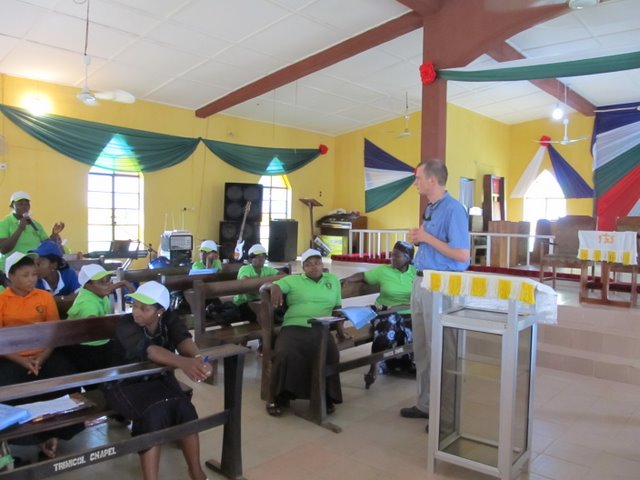
Here I am addressing the thanksgiving service and presenting Bishop Cyril with a Yale Divinity School paperweight.

I had some questions about the fathers conference – for instance, is it really accessible to all men or just the sub-set of wealthy fathers? There was a registration fee for the conference and significant costs associated with attending. But as I have learned elsewhere in Africa, the Anglican church has a lot of repenting to do for being too focused on higher-status and wealthier people.

Those concerns aside, I found it so fascinating that a church could be full of men three days in a row. What a concept!

(There are a few more pictures on Facebook.)

“They treat us like animals”

In the mid-1990s, there was an article in the Atlantic Monthly titled “The Coming Anarchy,” that posited that in some parts of the world – the author’s prime example was West Africa – the world would soon seen societies that are barely governable. The exact details of the argument escape me at the moment but the title makes the point pretty clear.

Now I find myself in West Africa and have been thinking about anarchy a lot lately. Owerri seems like a nice place but to listen to its inhabitants tells a different story. They are always on edge that something will happen – a kidnapping, a protest march that gets out of control, a random murder. To an extent, these are fears that people all over the world live with. But they seem much more close at hand here, to judge by how people speak of them. No one has much confidence in the police. Who would? Their main job seems to be to set up road blocks around town to extract bribes from passing drivers. One priest told me that the government treats the people “like animals,” while the politicians enrich themselves from the state.

Because of the government does not justify their confidence, people work towards making themselves independent of the state. In the bishop’s compound, he has planted lots of fruit trees and put in a quite-impressive fish pond, the results of which we enjoy at his table. Power generation is so sporadic in Nigeria that almost everyone who can owns a generator. The bishop’s compound has a very nice one, along with plenty of tanks to store water. The bishop says he wants to teach his churches and his people to be “self sufficient” and independent of the government. I’ve been wondering if self sufficiency is a Gospel value.

The bishop and all his priests have been keeping me on a tight leash. I don’t go anywhere without at least one priest in a cassock. Today, I wandered off – within the cathedral compound of a neighbouring diocese – and it was like the Queen of England had gone missing, such were the alarms I set off. I appreciate their concern and respect their control of me but I find it chafing a bit that I can’t aimlessly wander through town and soak things in as I have in other countries.

The contrast here with a place like Uganda or Ethiopia is striking to me. In both those places, I felt quite safe, even when I was by myself. That, I suppose, is the virtue of traveling in an authoritarian state. The government has enough control to impose security – by their definition – and tourists like me can benefit from it. Here, no one seems to have that kind of control.

What makes all this so frustrating is the contrast between Nigerians and their government. The latter is corrupt, weak, and incompetent. The former, however, are educated, creative, and incredibly hard-working. Observers always talks about Nigeria’s wasted potential. I see it in these talented people who live in fear rather than plan for a hopeful future.

A tale of two cathedrals

Yesterday, I went to the Diocese of Awka for the annual synod. It was held in the Cathedral right in the middle of town. The cathedral is an incredible building – sprawling, with lots of crazy angles, and plenty of side rooms for meetings and whatnot. I won’t say that it was exactly to my architectural tastes but it was impressive nonetheless. It was dedicated about two years ago.

Right next door, literally ten feet away from the new cathedral was the old one, a tiny little church built by the missionaries. There was nothing wrong with it – it was functional and served its purpose. It’s time was up. (To be fair, it was never built to be a cathedral. Awka is a relatively new diocese.) When I walked inside, there was a chicken crossing the floor. (Why did the chicken cross the cathedral? I don’t know.)

I read in the synod program the diocese’s proposal to build a new conference and retreat center to host not only church groups but also business and non-governmental organizations. The estimated price tag is close to 17-million dollars. My diocese in the U.S. has closed its conference center and is on the verge of selling the property.

The Anglican Church in Nigeria – and I say this having experienced only wealthy dioceses thus far – is a confident and forward-looking organization. They are well-organized and well-run. If I needed any further confirmation (and I don’t) that the control of the church, which for some time has resided with people like me (white, male, educated, western), has passed to others, the synod meeting in Awka is a pretty good testament. So what is my role here?

Life as a Nigerian Bishop

I’ve really been enjoying the chance to visit with Bishop Cyril Okorocha of Owerri. He is my host these first few weeks in Nigeria and a fascinating person. Leaving aside his personality, though, here are some things he’s told me about his job that might help bring flesh to the idea of what it means to be a bishop in Nigeria.

Bishops in Nigeria – as in England – are referred to as “my Lord.” His title is the Rt. Rev. Dr. Cyril C. Okorocha, the Lord Bishop of Owerri. (He did his Ph.D at Aberdeen with Andrew Walls, the premier mission scholar of the 20th century.) People stand when he walks into a room, no matter what else they are doing. He and I talked about this and the challenges it poses to ministry. For instance, when he began as bishop, he drove himself places. But people were shocked at that and said a bishop can’t drive. “Alright,” he said. “I’ll walk.” “No,” they said. “Bishops can’t walk.” So he got a car and driver – the current car is a Toyota Corolla sedan.

His diocese is now much smaller geographically than it was when he began serving as bishop in 1999. That’s because the growth of the church has led to the creation of about ten new dioceses out of his one diocese in the last decade, including four in the last three years. It now takes him only an hour to drive to the farthest away church.

The largest number of confirmations he’s ever done in one service is – wait for it – 700. The service ended at 1 am. Now, he “limits” the confirmands to 200 per service. Confirmation here is a big deal and often involves the young people renouncing – often in very public ways – gangs and non-Christian cults they may have been involved in.

He has about 120 clergy and probably 25 or so more at some point in the preparation process. The parishes and clergy are divided into 18 archdeaconeries. The archdeacons are a super capable bunch of people and do most of the administration of the local needs but it is still a lot of people to keep track of, especially since some people become priests for the social standing that comes with it. Bishop Okorocha has to put out the fires caused by people who don’t behave quite as is expected of priests. (This is something bishops all over the world do, I guess.)

Bishop Okorocha lives in the Bishop’s Bourne – another nice hold-over from England – which is a fairly large compound. His house has three large sitting rooms and a large dining room, all to entertain the groups of people who come to see him. The grounds of the Bourne have several different fruit trees, a well, a generator, and a fish pond (for eating, not looking at). It’s all part of the bishop’s drive for self-sufficiency in the face of the weakness of the Nigerian state, which is a post for another time.

There is a weekly chapel service in the bishop’s chapel, open to anyone who wants to come. The service was a mere three hours this past Wednesday. Afterwards, several people hung around to get a word in with the bishop, asking him to help solve a problem of some sort, no doubt. It’s a lot like a medieval lord holding a weekly audience, I thought. Because everyone is always wanting to talk with him, it takes forever to get anywhere.

There are lots of great questions to ask about the episcopacy in Africa and how it interacts with pre-existing traditions of chiefdom and how those traditions help or hurt the idea of servant leadership. I won’t say that all those questions are answered in Owerri. But they are being asked.

Wives

On Thursday, I visited a seminary in a neighbouring state about an hour drive away. In a small church connection, a friend of one of my Yale professors teaches there and he happily welcomed me.

He was particularly intent on having me hold a “forum” with the students. But as it was the day before graduation, they proved difficult to round up. Their wives, however, who had come to the seminary for a week-long, pre-graduation training on how to be a clergy wife, were happy to see me. (The church of Nigeria ordains woman as permanent deacons but not priests, though several people I’ve spoken with expect that to change in the not-too-distant future.) I got handed a microphone in front of a chapel-full of women and told to start talking.

I asked about them and about what sort of challenges they expect to face when their husbands go into ministry. At first, everyone was quiet, likely because they are not used to having guest speakers who ask them questions. But once one person broke the ice, everyone had something to say. Challenges included not having enough money, interacting with older women in the church (many of the women are quite young), dealing with syncretistic faiths and cults, and many others.
(Usually, they looked a little more interested than this.)

I gave a bit of my spiel on unity and everyone seemed to agree unity was important. Then I noted that, in fact, we Anglicans are having trouble with unity. Everyone knew about the “gay issue” but I asked them if they knew anything else about the American church. “Some of your priests smoke!” “Your women do not wear anything on their heads and they can wear trousers!”

I talked about how at my seminary I have classmates who are gay and that they tell me – and I believe them – that God has created them to be this way. As I was saying this, I heard a few voices say, “Not true” or “Not possible” or “No, no, no.” I had clearly opened a can of worms and everyone wanted to say something. Basically, they wanted to tell me – over and over again – that homosexuality was condemned by the Bible. One woman wanted to know if I was gay. (Later, my professor’s friend told me that there are two sides to the issue in Nigeria – you are either opposed to homosexuality or you are homosexual yourself. The idea that someone could defend homosexuality without being gay himself does not seem to be known.)

I won’t say that the conversation was hostile because it wasn’t but it also wasn’t exactly fun and friendly, in the way that similar conversations I had last summer in Sudan were. I immediately realized why – I had no relationship with these women. They didn’t know me and I didn’t know them. I had just dropped in and started talking and the conversation had turned to serious topics pretty quickly. Not a good way to broach difficult subjects. Relationships matter.

As it was, we were soon out of time. I wrapped up the conversation by insisting I wasn’t trying to change anyone’s mind on whether homosexuality is acceptable but I did want to say that I thought we could disagree on this question and still have unity. After all, Christians disagree on plenty of other questions. There were some definitely negative looks when I said this, like it wouldn’t be possible but others that seemed more welcoming of the idea.

And it didn’t prevent them all from gathering for a picture, at their instigation, not mine.

The library at the seminary probably has 1500 or 2000 books, which is not all that bad. But almost all of them are more than 25 years old. Given where theology was 25 years ago, is it any wonder that we are having such severe disagreements over sexuality-related (and other) issues?

My “stump speech”

As I have been traveling, I often find that as a guest I am invited to introduce myself or give a “testimony” as to why I am here and what I am doing. In the last week, I’ve addressed a group of clergy, the diocesan ordinands, a group of students at a seminary, and some clergy wives. I don’t always say the same thing but here are the thoughts I draw from.

I say something about the importance of unity, which is not, I stress, the same thing as uniformity. Jesus prays for unity in John 17 and I am interested in finding out what that unity looks like when there are followers of Jesus around the world. Unity is important, I say, because Jesus connects it to our mission and witness – “that they all may be one…so that the world may believe.”

Unity is also important, I say, because it is eschatologically important. At the end, we will all be united (whether we like it or not…). The more we live like that now, the more we pre-figure the eschaton, which is exactly what Christians are called to do.

Unity has ecclesiological significance as well. The church is called to be a counter-cultural witness to the world – Romans 12:2 is one obvious example but there are many others. To live united in a world that so prizes division is a counter-cultural witness.

(I should say, by the way, that all these “big” theological words I am throwing around here are well understood by the people I am talking to.)

I often talk about the body of Christ and how we are part of a body that spans the world. I talk about how that body is called to particular kinds of action, namely those actions which the actual body of Christ endured – weakness, suffering, sacrifice, humility. This is Paul’s message in I Corinthians, I say, pointing to I Cor. 1:18 – “the message about the cross is foolishness to those who are perishing but to us who are being saved it is the power of God.” Maybe, I say, we can find our way towards the unity of the worldwide body if we start embracing some of these values.

The key thing about all this, I’ve realized, is that it is all rooted in the Bible. Christians in Africa know their Bible. Many are virtual concordances. I can say, “What verse is this?” and quote about three words and they can name chapter and verse. If what you say cannot be linked to the Bible, then no one is going to listen to you. I want to show that we are reading the same Bible – I am just choosing to emphasize different portions than some of them are.

The other neat thing about all this is that this “stump speech” flows from work I’ve done in the classroom and library at Yale. My time visiting in the world church creates questions which I then pursue at school which creates new material to share with people on later trips. If that’s not a virtuous circle, I don’t know what is.