What we talk about when we talk about mission in the church

I’ve written before about how the church is in need of a conversation about what we mean when we use the word “mission” in the church.

And how, there’s more, this time on the Episcopal News Service, partly adapted from my new book, Grace at the Garbage Dump:

Those first few weeks, I stayed close to our clinic and let the residents of Itipini come to me if they needed help. It was safe. “They” came to “me.” But it was an untenable and unsatisfactory situation. I hadn’t moved to South Africa to sit in a clinic all day. Gradually, I began to venture forth. I met people like Fumanekile who made it feel safe to wander farther afield. I began to think in terms of “we,” not just “they” and “me.”

I came to think of the Incarnation in a new light. By being born in a manger, God in Christ crossed the hitherto impassable barrier between human and divine and showed up in a place no one expected. Jesus took time — thirty years, in fact — to build relationships with those around him. If I was going to model my life on Christ’s — be a Christian, in other words — something of the same had to happen in my life. I needed God’s grace to overcome my fear and share an existence with people who seemed different than me and lived in a different place. Gradually, imperfectly, incompletely, that happened.

God’s mission calls us to engage the multiple forms of difference in this world — down the street or around the world — and doing so in a vulnerable, Christ-like way. It’s great that we’re talking so much about mission in the church. But if we don’t talk about it without also talking about our individual, personal need to change — the forgiveness, renewal, and transformation that comes in baptism and is reaffirmed each time we celebrate the Eucharist — and the difficulty and joy of modeling our lives on Christ’s, then it’s hard to see how the conversation is going to help us proclaim the good news of God in Christ.

Read the whole thing. And then read the first two chapters for free on Amazon to read even more about the Fumanekile, the man whose story I tell in this piece.

McCarthyism in Church Politics

Last summer, when I was visiting the Church in Nigeria, some of my blog posts got picked up by the American Anglican Council. I was accused of preaching “deviant theology” (especially for this post about a diocese trying to educate girls). I didn’t think much about the comment but I did start keeping an eye on some of the more polemical Anglican web sites out there, both conservative and not.

At the same time, you might remember, Congress was consumed by a conversation (a generous word, perhaps) about raising the federal debt ceiling. As I listened to that debate and read Anglican commentary, I was struck by the similarity in the rhetoric: scorched-earth, difference-equals-wrong, the-apocalypse-is-around-the-corner-if-the-other-side-gets-their-way, etc., etc. You know how it is.

I still keep an occasional eye on the American Anglican Council and was recently perusing their quarterly newsletter. There’s coverage in there of a recent meeting in South Africa that was—gasp!—not polemically opposed to same-gender marriage. On the face of it, this article is not awful. In fact, it’s more coverage than many other Anglican news organizations mustered about the event.

What’s chilling about it, however, is the inclusion of a list of participants—sometimes quite vague; someone “who spoke about oppression of women,” for instance—with the clear indication that participating in such a conversation was somehow an indictable offense. Forget, indictment, actually. The tone of it is that they are already guilty. It seems a clear case of judging people by whom they chose to meet and interact with.

You know who else was judged for exactly that? A Galilean carpenter. That same Galilean carpenter who once stopped at a well in Samaria of all places for a drink, a place where no one expected him to be, and talked with a woman, someone he wasn’t supposed to be talking to. And the result? Transformation, for the woman and her town, as she became the gospel’s first evangelist.

My travels in the world church have repeatedly prompted one question in me: what would happen if Anglicans, modeling themselves on Jesus, started showing up in places where no one expects us to be and listening to people who are different to us?

I don’t know for sure but I do know we’ll never get there if we keep terrorizing people who try to do exactly that.

“The church speaks the language of reconciliation. Not the government.”

I am a reader of The Economist, the British news magazine that has, to my knowledge, more foreign correspondents than any print news organization in the world. The Economist covers events even after they drop from the headlines in the rest of the world’s media.

But even it can falter. I thought about that while reading about the primate of Canada’s recent visit to the Church in Melanesia. Part of the visit included time in the Solomon Islands with Fr. Sam Ata, an Anglican priest and chair of the Truth and Reconciliation Commission in the Solomons.

Let’s be honest. How many of us are aware of the ongoing process of recovery in the Solomons following the violence between 1998 and 2003? How many of us know that this TRC process has been ongoing for some time? Not even The Economist has been giving much play to it.

And yet—there is the church. When the eyes of the world are turned away, when even sister and brother Anglicans are focused on a proposed covenant, the sex (or sex life) of its bishops, or any of a myriad of other things, the local church in the Solomon Islands remains an instrument of peace and reconciliation.

It reminds me of the church in South Sudan, a place where I’ve spent some time. There, in intensely poor and incredibly remote parts of the country, the government’s remit does not run. But the church is still there, running schools, building clinics, feeding refugees, and much else; “preaching good news of peace” (Acts 10:36) in other words. When society is on the verge of breakdown because of inter-tribal violence, who does the government ask to negotiate peace? The church. No one else has the authority, the stature, or the ability to do so.

So, as at least part of the attention of the church is occupied by a defeated covenant, a proposal for “radical hospitality,” and conversation (dare I call it naval gazing?) about church structure, spare a thought for our sisters and brothers in Christ around the world on the frontlines of some of the most difficult and intractable situations imaginable.

And then ask yourself: how can we support our fellow members in the one body of Jesus Christ?

Grace at the Garbage Dump now on Kindle!

If you’re technologically inclined—and not interested in waiting for the mail to arrive—you can now download Grace at the Garbage Dump directly to your Kindle!. Amazon has it available for the low price of $9.99.

Even if you’re not technologically inclined, you can still surf over there and read the first two chapters for free. What a deal!

The hard copy of the book will be available on Amazon in due time (another few weeks). In the meantime, order it from your local bookstore or directly from the publisher—still the cheapest and fastest way to get it.

For now, orders for addresses outside of the U.S. need to be made by e-mailing or contacting the publisher directly. orders@wipfandstock.com or (541) 344-1528.

Thinking Outside the Box on the See of Canterbury

What if the next Archbishop of Canterbury wasn’t British? Who would it be?

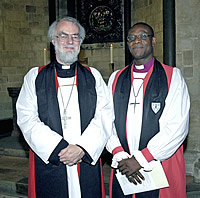
I recommend Thabo Makgoba, archbishop of Cape Town and primate of the Anglican Church of Southern Africa. He’s educated, outspoken on important issues, young(ish), and has been called “the Denzel Washington of the Anglican Communion.”

Filling Rowan Williams’ shoes was never going to be easy—any successor will have to stack up to one of the greatest theological minds of the generation. Going for an outside-the-box appointment—first Archbishop of Canterbury from outside England since Augustine?—lays to rest those possible comparisons and frees the successor to be fully himself (or herself, but that won’t happen—yet—to the see of Canterbury).

The Archbishop of Canterbury fills at least three roles simultaneously—(nominal) diocesan of Canterbury, primate of All England, and a figure of unity for the Anglican Communion. As a non-English Anglican, I, naturally, put the most emphasis on that last role, which is why I’d love to see the position filled by someone who represents the part of world where Anglicanism is growing fastest. The Crown Appointments Commission, I think, probably has that second role chiefly in mind, along with the ceremonial functions that go with being head of an Established church.

If not Archbishop Thabo, how about Josiah Idowu-Fearon, bishop of Kaduna in Nigeria? He’s super-educated, an expert on Islam, and has shown his independence from the Nigerian church hierarchy by, inter alia, calling for primates not boycott a Primates Council meeting. Not sure how old he is, though. (Wikipedia says he’s about 63.)

Other thoughts for outside-the-British-Isles picks for the next occupant of St. Augustine’s throne?

Can we sustain our own weight?

A year or so ago, I heard Rick Ufford-Chase, former moderator of the Presbyterian Church USA, speak at Yale Divinity School. Rick has had—and continues to have—a fascinating ministerial career so it’ll be unfair to him that the comment I remember best from his presentation has to do with budgets.

Rick remembered that in each budgeting process while he was moderator, some ministry of the churchwide office was cut. The church was spending less and less money each year and so having to pare itself further and further down.

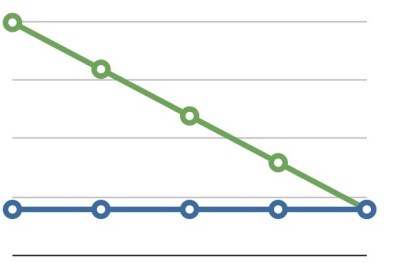
He drew a graph that looked like this.

The blue line is the basic cost of supporting the church’s infrastructure. The green line is the ministries it supports. Rick’s point is that you can’t just keep paring until you get to zero. At some point, the budget would reach a point at which the church could no longer sustain the weight of its own bureaucracy. At this point, he thought, everything would just collapse.

In Episcopal terms, the blue line is the basic cost of supporting the infrastructure of a churchwide entity—a presiding bishop, a president of the House of Deputies, a General Convention. The green line is the (declining) amount of money to spend on various ministries—anti-racism, women’s, Christian formation, youth, for instance, to name some of the Episcopal Church’s ministries that have been cut or are proposed to be cut in recent budgets.

So what will happen when green meets blue? The proposed budget for the next three years of the Episcopal Church made me wonder if, perhaps, we’ve reached that point. The budget, as I read it, eliminates the General Board of Examining Chaplains, the group that administers the General Ordination Exams, the series of tests that prospective priests take to prove their competency in the seven areas required by the canons of the church. The GOEs have been seen as a necessary part of the church’s bureaucracy. The canons require competency. Not all dioceses have the resources to assess competency on their own. There’s an argument to be made, anyway, for national standards of competency. So the church developed the Board of Examining Chaplains, which, in turn, oversees the GOEs.

Our church has these great canons that lay out a detailed structure for a way of being church. Yet if we don’t have the money to put into practice what those canons require, what’s the point? Where does it leave us as a church?

This General Convention is going to name the committee to lead the search for the next presiding bishop. One wonders, though, at the rate we’re going just how much church will be left for him or her to preside over.

Grace at the Garbage Dump Published!

Cascade Press has published Grace at the Garbage Dump: Making Sense of Mission in the Twenty-First Century by the Rev. Jesse Zink. The book is a theological memoir and reflection on the importance of mission drawn from Jesse’s years as a Young Adult Service Corps missionary of the Episcopal Church in Mthatha, South Africa.

The book is being widely praised. Brian McLaren says Jesse Zink is “talented as a writer, honest as a Christian thinker, and smart as an activist—exactly the kind of voice we need.” The bishop of Connecticut, Ian Douglas, says “I can think of no more exciting study of Christian mission than Jesse’s book. It is a welcome resource to the many people who are looking for a meaningful and contemporary presentation of what God is up to in the world today.” Read more about what people are saying.

Here’s the text on the back of the book.

Like many young people in his generation, Jesse Zink had long been eager to work overseas and make the world a better place. As a missionary working in a shantytown community in South Africa, he found all that and much more—in demanding, unexpected, and surprising ways.

Grace at the Garbage Dumptakes readers with Jesse through his years in South Africa: struggling with AIDS patients to get life-saving drugs, coaching women through a micro-credit program, and teaching preschool students to sing (and dance) to “Johnny B. Goode.” It’s a story that leads us to a deeper understanding of our world and is at once hopeful and uplifting while also being credible and serious.

The headlines are dominated by disaster and despair but young people remain passionate about service to the least among us. Grace at the Garbage Dump is an invigorating call to respond to the difficulties of our time with an active and engaged faith. Whether you end up at the local soup kitchen or halfway around the world, you’ll be challenged to seek God’s grace in even the most adverse circumstances.

The best and cheapest way to get a copy of the book is directly from the publisher.

How “mission” shapes budget

Here’s an example about how the Episcopal Church’s failure to have a conversation about what we mean by mission produces contested and confusing budgetary decisions.

The budget proposed for the next three years in the Episcopal Church adds close to $700,000 for the Office of Government Relations, to be focused on anti-poverty advocacy. Great! All Christians can get behind anti-poverty advocacy, right?

Except that it comes at the expense of other programs. More than a million dollars cut from funding the work of the Anglican Communion Office. Close to three million cut from the budget for youth programs.

The first thing to note is that these are policy decision being made without, to my knowledge, policy debates being had. I used to be a reporter and covered lots of budget debates in lots of organizations. One realization I always came away with is that how a group spends—and doesn’t spend—its money reflects its values.

The closest Episcopalians have come to a conversation about budgetary priorities is the constant repetition in the church of the word “mission” without any clarity as to what that word means. And since, as we’ve seen, one influential document defined our mission as simply being what Jesus says in Luke 4, spending more money on anti-poverty programs makes a lot of sense; “good news to the poor” and all that. (Of course, in the rest of the Gospel of Luke, Jesus spends precious little time with people we would identify as “the poor,” raising questions about how to interpret this passage. But that’s an exegetical conversation for another time.)

What if we defined mission a bit differently? This is not the place to lay out a full-blown missiology but what if we said that God’s mission is the restoration of right relationship between humans and between humans and God? (Our catechism says something very similar.) What if we saw relationships as being at the centre of our role in God’s mission? What if we thought that in the Incarnation, God in Christ takes relationship to a whole new level, crossing the barrier between divine and human and engaging with those who are different in a credible, costly, and vulnerable way?

In short, what if we said that mission is about building meaningful relationships with those who are different than us as we work towards that glorious day when there will be “a great multitude that no one could count, from every nation, from all tribes and peoples and languages, standing before the throne and before the Lamb, robed in white, with palm branches in their hands. They cried out in a loud voice, saying, ‘Salvation belongs to our God who is seated on the throne, and to the Lamb!’” (Rev. 7:9-10) Although in our polarized and fractured world we demonize and mock those who are different than us, the witness of Scripture is that, at the end, all of us who are different will be united in one. We might as well start working towards that, and, in the process, follow the example of Christ who engaged with difference in a way no one had ever seen before or since. It would be a powerful, counter-cultural model to the world around us if the church could be an incubator of heterogeneity rather than a mere simulacrum of the world’s drive towards homogeneity.

If we said all this, we might have different priorities. We’d spend our money on a place like the Anglican Communion Office so it can continue its important work of bringing together different people from different backgrounds and different parts of the world to find common ground in projects like Continuing Indaba and the Bible in the Life of the Church. We’d make sure that the Episcopal Youth Event stays in business so young people from different backgrounds can engage in meaningful, Christ-centred interaction in a way they get almost nowhere else.

But we might not increase funding for the Episcopal Public Policy Network, making the painful decision that in a time of limited funds, policy advocacy is not part of the church’s unique charism.

You might disagree with these ideas (and you’ll note undoing EPPN’s additional funding doesn’t produce enough to fund EYE and the ACO) or you might have different ideas for moving money around in the budget. Terrific! What I wanted to illustrate in this post is the impact of not talking seriously about mission. My hope is that the church can begin to have a conversation about its budget—and the future of the church—that grapples with the missiological issues at stake.

If we’re going to place “mission” at the centre of everything, could we at least start talking about it?

How? or Why? And what’s the mission?

A friend who has read Diana Butler Bass’s latest book told me the other day about a point Bass makes repeatedly. Basically, as I understand it, Bass argues that the church has been too busy asking how questions that it no longer asks why questions.

I haven’t read the book but the insight struck me as true. We ask ourselves how we are “doing” church but we don’t talk about why we are bothering with it. Ashes To Go, an exciting idea that takes the imposition of ashes out of the church on Ash Wednesday, is still basically a how conversation. How do we impose ashes, not why are we bothering with this liturgy? What does Ash Wednesday mean in this day and age? (Why and what questions are closely related.) Perhaps, we think, the answer to the why questions are obvious but few things with Christianity ever are.

These questions are particularly pressing in the Episcopal Church as we prepare for a General Convention this summer that will be asked to make decisions about restructuring and pass a budget that deals with the painful reality of substantially diminished income.  Both these questions—restructuring and budget—are how questions. How do we be a church and spend our money in light of the realities of church life in 2012?

The answer that has been given to the underlying why questions is, simply, “mission.” We are told we must be structured for mission and we must spend our money on mission. But what is mission? Why is it important? This conversation does not appear, to my knowledge, to have been had. And it is a particularly important conversation to have because mission is in danger of becoming a buzzword, meaning different things to different people and so losing its force in dialogue.

To take one example, the Chief Operating Officer of the Episcopal Church, Stacy Sauls, last year proposed a resolution calling for a special convention on church structure. It reads, in part: “The Special Commission shall be charged with presenting a plan to the Church for reforming its structures, governance, administration, and staff to facilitate this Church’s faithful engagement in Christ’s mission to proclaim good news to the poor, release to the captives, recovery of sight to the blind, freedom to the oppressed, and the acceptable year of the Lord (Lk. 4:18) in a way that maximizes the resources available for that mission at all levels of this Church.”

The text thus claims to answer the why mission? question. It does so in a way that is faithful to scripture by pointing to Jesus’ “inaugural address” in the Gospel of Luke. (We should note, of course, that Jesus is here quoting the prophet Isaiah. There is little thought given in this resolution to what Jesus “adds” to this Isaianic mission, though of course he must add something or the Gospel would no longer be good news but good olds.)

But is Luke 4 the only way to think about mission? Hardly.

What about when Jesus says, “I have come that they may have life and have it more abundantly”? (John 10:10) Or when Jesus is asked what to do to perform the works of God and he replies, “This is the work of God, that you believe in him whom he has sent”? (John 6:29) What about when Abraham is told that if he follows God’s commands to get up and go, “in you all the families of the earth shall be blessed” (Genesis 12:3), a promise repeated in Genesis? What about Jesus pre-resurrection commands to “to proclaim the kingdom of God and to heal” (Luke 9:2) and post-resurrection commands to, famously, “Go therefore and make disciples of all nations, baptizing them in the name of the Father and of the Son and of the Holy Spirit, and teaching them to obey everything that I have commanded you”? (Matthew 28:19-20) There’s a whole whack of Pauline passages to consider as well, of course.

None of these are contradictory and all form a piece of the mission to which we are called as followers of God in Christ. Nor is God’s mission necessarily something best learned by pointing to individual passages. Rather, I’d have us consider the entire witness of the people of God as recorded in the Bible. But these few verses certainly complicate the picture of mission put forth in the Sauls resolution.

The recently-released budget for the next three years of Episcopal Church spending points up exactly why we need to be having a conversation on what we mean by mission. While the narrative to go with the budget mentions mission in its first paragraph, there is almost no explanation as to what the budget drafters think the word means. The result is that the conversation about the budget has been almost entirely about how questions, not why ones. Every decision in the budget is one rich with missional implications—cutting funding for youth events but increasing it for policy advocacy is a missional decision, for instance—and I want to talk about the what and the why before talking about the how.

Here is a non-exhaustive list of questions I’d like to think about in the run-up to General Convention

  • What is the mission to which we are called as followers of God in Christ?
  • What does the church have to offer the world in this generation?
  • Why is the Christian witness significant/important/meaningful in this time and place?
  • Why does the Episcopal Church exist? What is the unique offering that Episcopal followers of God in Christ can make to the world?

I have some thoughts on all these questions and hope to get around to sharing some of them. For now, though, I hope we can change our budget and structure conversation away from one that pits Episcopalians against one other in a scarce fight for money and power and towards one that starts asking what and why before asking how.

“Get up and go”

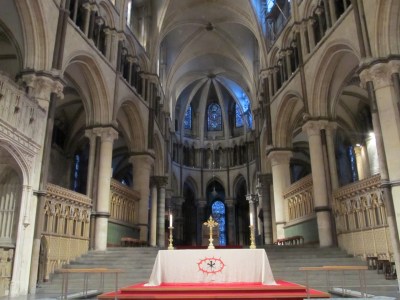
I’ve just returned from pilgrimage to Canterbury Cathedral in England, the “mother church” of the Church of England and the Anglican Communion.

There is much that is moving about Canterbury—the site of Thomas Beckett’s murder, the throne of St. Augustine, the lively and vibrant congregational life that makes this cathedral no different than a country parish on Sunday mornings, the fabulous choir that leads Evensong every day.

But what I found memorable was the visit—in the rain—to St. Augustine’s Abbey a short way from the cathedral. Augustine was sent by Pope Gregory in the late sixth century to evangelize the Anglo-Saxons. Augustine set off but got cold feet and turned around in France. When he returned to Rome, Gregory sent him off again—this is immortalized in stained glass in Lambeth Palace that has Gregory pointing and saying to Augustine, “Go!”—and Augustine eventually showed up in what is now Kent.

There, he met Queen Bertha, who was from the Continent and already Christian. Together, the two of them set about evangelizing the area, eventually converting Bertha’s husband, Ethelbert. And so Christianity was reintroduced to this part of the world.

The ruins, from the cathedral tower.

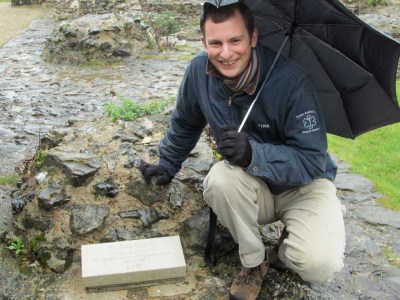
Augustine is buried in the abbey and his grave is a pile of stones. Our group thought about what it says about Anglicanism that our notional founder is buried in such modest style. The contrast with, say, St. Peter’s Basilica in Rome, is stark.

For a long time, the abbey in Canterbury was a major centre of religious life. But then the Reformation came along and Henry VIII shuttered the monasteries. The abbey was put to a number of purposes but eventually abandoned and left to fall further into ruins.

In the nineteenth century, this began to change. A missionary college was built near the ruins and the ruins were preserved. Thus, at the same site at which Augustine arrived after being told to “Go!”, scores of British missionaries were trained to go out into all the world, spreading the Gospel, and laying the foundation for our contemporary Anglican Communion.

For all that we get squeamish these days when we recollect the mission past, when I was standing in the ruins of St. Augustine’s Abbey last week, the word “Go!” was sounding in my head like a gong. Movement—across barriers and boundaries of language, culture, race, class, sex, identity, and so on and so forth—is at the heart of our Christian faith and the abbey ruins reminded me powerfully of it.

The signboards at the ruin call the abbey an “early foothold of Christianity in England.” We know, of course, that Christianity is on the wane across Britain. I wondered if in the future there will be more such ruins, and if this former abbey, once a harbinger of what Christianity would look like in the British Isles, is now a harbinger of the shape of Christianity in generations in come.

We returned to the cathedral for Evensong that day and the lesson was from Genesis 12. God said to Abram, “Get up and go to the land that I am showing you.”