Farewell

So here I am in the Lagos airport – and the only thing on TV is the Casey Anthony murder trial; honestly CNN, is this the most important thing going on in the world right now? – getting ready to leave Nigeria. My visa expires tomorrow. I have to go.

This brings to the end phase II of my summer trip travels, investigating what Jesus’ prayer for unity means when the body of Christ spans the globe. God willing and Kenya Airways consenting, phase III begins in South Sudan later this week. My aim there is to visit some of the seminary students I met in Juba last September and learn about what ministry is like in their home dioceses.

I’m excited about the next phase of this trip but disappointed to be leaving Nigeria. My month here has flown past and I leave with scores of new friends, hundreds of pictures, and pages and pages of notes. I was convinced when I arrived that Nigerian Anglicans had something of value to teach the world church. I now know that’s true. I hope you’ve been able to read about some of that in posts here over the past few weeks.

I have one or two ideas for posts so there might be a bit more about Nigeria popping up from time to time. But for now, it’s farewell – with the hope that someday I’ll be able to return.

Pietistic Arminianism

Here am I with A.C., a priest in the diocese of Owerri. He was the first person here to give me one of his books and it’s the one that has provoked the most thought for me. In The War Within, he asks the question, “How come Christians still sin after they have been born again?”

In the west – especially in the liberal denominations where sin is hardly discussed – this might not seem like a pressing issue. But in Nigeria, it is. Being a Christian in Nigeria means you are supposed to subscribe to a particular set of behaviours and norms – no drinking, no smoking, no lying, no stealing, etc. A Christian may have no trouble not smoking, say, but can be just as corrupt as everyone else. (One priest wondered aloud to me what percentage of his Sunday collection plate is ill-gotten gains.) This causes no end of consternation to priests and bishops, who want to improve the nation by applying “Biblical principles” and practicing “Biblical leadership.”

For me, it is all very reminiscent of the early church. The Donatist heresy began (early 4th century, I think?) when some Christian leaders, facing persecution, recanted their belief so as to avoid death. The Donatists said this was not right and that these leaders were suspect. Even the baptisms they had performed before wilting were suspect. This led to lots of confusion about who was properly in the church and who wasn’t. After Christianity became legal in the Roman empire, the debate evolved into how many times a Christian could sin after being baptized. If memory serves, the answer was once. This got tied in with Pelagianism as well, the belief that a person’s works got them into heaven. Augustine of Hippo was the major orthodox figure in all these debates and wrote some great material against them that did much to draw out a theology of grace. This all happened in Africa, by the way.

(The Donatists are not to be confused with the Donutists, another debate in the early church between people who wanted to serve donuts at coffee hour and those who wanted a healthier option. But I digress.)

I see A.C.’s book as another entry in this debate. I haven’t read the whole thing yet but he basically talks about grace and how ultimately what we do and don’t do is secondary to how we are saved.

This is an important message here. I’m no theologian – as my recap of the Donatists no doubt proves – but the theology I’ve heard preached here – when it’s not prosperity gospel – combines the worst parts of pietism and arminianism. The first says – more or less – that how you behave matters. That’s the no drinking, no smoking bit. The second says that one’s works and deeds contribute to whether or not one is saved. I heard a preacher discuss how hard it had been to get a visa for a trip to the U.S. “But,” he said, “you have to work even harder to get to heaven.” The combination means that people are being told that you have to act a certain way to get to heaven. This is not my theology.

The issue is particularly pressing because of one fact that Chinua Achebe observed nearly 30 years ago in his famous little book, The Trouble with Nigeria:

Whenever two Nigerians meet, their conversations will sooner or later slide into a litany of our national deficiencies. The trouble with Nigeria has become the subject of our small talk in much the same way the weather is for the English. But there is a great danger in consigning a life-and-death issue to the daily routine of small talk. No one can do much about the weather: we must accept it and live with it or under it. But national bad habits are a different matter; we resign ourselves to them at our peril.

People here are always talking about the government, politics, and the state of the nation. Security, economic growth, political accountability, corruption, and many other issues are all wrapped up into one bundle that is on everyone’s mind. On the TV news the other night, there was a story about a major Anglican church in Lagos that held a conference on “the future of Nigeria” (or some similar topic) that was attended by government figures. Can you imagine an Episcopal church in the U.S. doing that and having it make the national news?

The answer the church is providing right now is pietistic Arminianism. I’m sorry, but this is never going to work. Somehow, you have to take account of Romans 7:18: “For I have the desire to do what is good, but I cannot carry it out.” That’s why grace is so important. I see A.C.’s book as one more entry in a long-running debate in the church that has spanned centuries.

St. Luke’s, Waciri

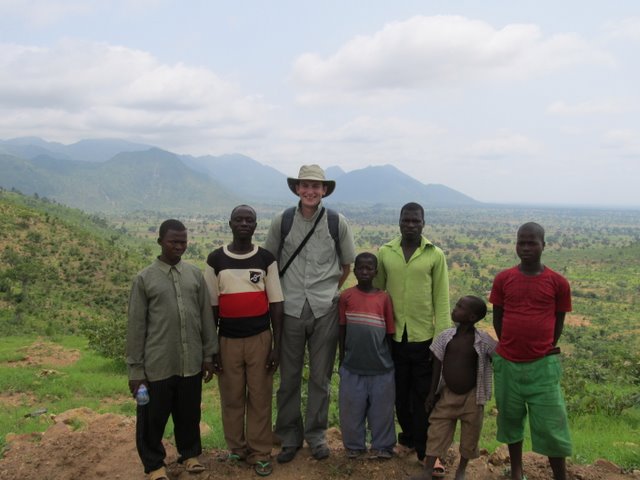
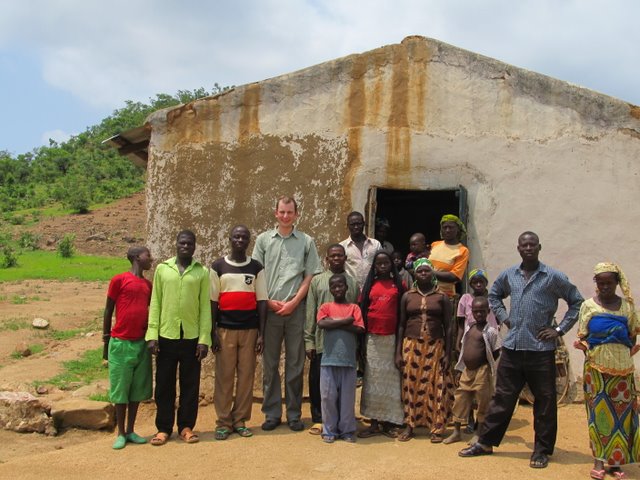
Here’s how you get from Yola to St. Luke’s, Waciri. (In this picture, I’m with some of the members of St. Luke’s.)

Take the paved road south from Yola that leads to Cameroon. After 15 minutes, turn right onto a dirt road that is not all that bad. You’ll have to dodge the huge herds of cows and goats that meander across the road but it’s a fairly smooth ride. Follow this road for an hour.

At a junction, veer left. You know it’s your road because it is just awful. Pitted, rutted, eroded, it barely qualifies as a road. In fact, it’s mostly just a motorcycle track. After 45 minutes bouncing on this road, across rivers, through gullies, up steep hills, you’ll find yourself in the village of Mari. The road ends here. You can see why, too. All around are steep, forested hills.
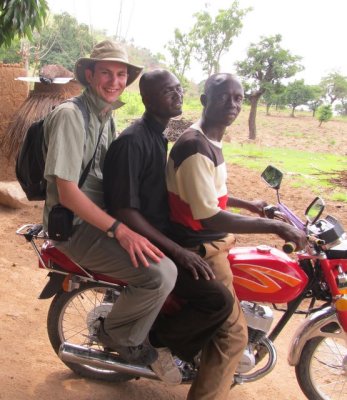
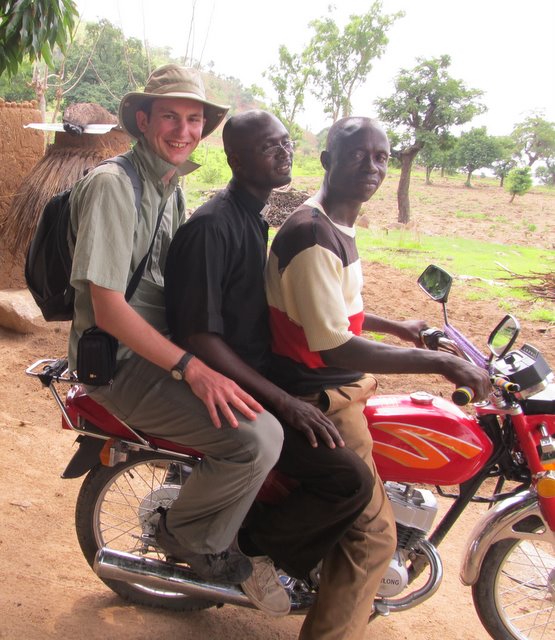
Hop onto the waiting motorcycle of the local canon and ride for 15 minutes into the foothills – more gullies, more hills. He’ll make you get off and walk from time to time because his little bike can’t handle the weight. Eventually, that track ends. Now you’re on foot. It’s 30 minutes (if you’re in decent shape) straight up hill. Of course, since you left Yola later than you planned, it is now the middle of the day, the sun is shining brightly, and pretty soon you’re rationing all that water you brought with you.

But if you can make it this far, you’ll find the views in the village of Waciri to be gorgeous. It’s the rainy season so everything is green and you can look out over the valley floor that you bounced across not too long before. Waciri itself is a village of mud huts, thatch roofs, and fields everywhere – maize and groundnuts, primarily. There is no thinking this is an easy life. In the fields are men and women bent over hoeing acres and acres by hand. The huts are crumbling in places. Water is hard to find. There is no school or clinic up here. Children have large bellies from the lack of protein and more than a few older people have large goiters at their throat from a lack of iron. (I think?)

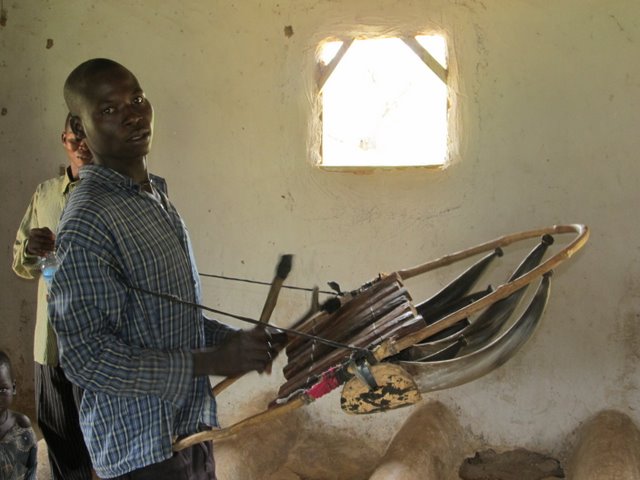
St. Luke’s Anglican is the only church in Waciri. It gets about 50 adults on Sunday, overseen by a lay worker of the diocese, who also lives in Waciri. The pews are rounded mud benches. There are a few drums and some traditional instruments, including a xylophone-type thing made of cow horns and mahogeny.

Almost no one at St. Luke’s owns a Bible. It hasn’t been translated into Koma, their language. Many speak at least a little Hausa, the main language around here, but not all can read so a Bible would be beside the point. They are the first Christians I’ve met in Nigeria who do not know who Jesse is in the Bible.

The Koma people in this region were “discovered” in the mid-1980s when – as the story goes – the governor was passing over in his helicopter and noticed people living in the mountains. When others went to investigate, they found whole communities of people who practiced subsistence agriculture, hunted with bows and arrows, and wore clothing made of leaves – if they wore anything at all.

It is this last point, no doubt, that is responsible for the Christian presence in the area. In the 25 years since their “discovery,” several churches and Christian organizations have arrived in Koma, determined to – using a word I heard several times today – “civilize” the Koma. Many Koma have come down from the hills and live in places like Mari, where there is a (church-run) school. Everyone wears some kind of clothing now but it is not uncommon to see topless women around. This Christian mission effort – spread among many denominations – has been entirely led by Nigerians. I talked with the principal of the school and she is a woman from Lagos, who with her husband, came to Mari 15 years ago because they felt called by the Lord to teach the Koma about Jesus (and other stuff). I thought again about how the Gospel is out of “our” control.

(There are nine churches in Mari. Only the Lutherans and the Anglicans have churches in the little villages in the hills like Waciri.)

Because of the length of the journey and the fact that I’m leaving tomorrow, our visit to the Koma Hills was too short. (We were supposed to come on Saturday but were rained out.) Waciri isn’t even the end of the path. There’s another village two hours more up the mountain that has a church.

I didn’t have any great Anglican unity moments like I did a few weeks back with a pineapple. Indeed, almost none of the people at St. Luke’s knows what an Anglican is. They just go to church. They asked me what kind of food we eat in the United States and I showed them a Nature’s Harvest granola bar. They sampled it and were not too impressed.

I also told them who Jesse was in the Bible. I said he had a son named David, who was the youngest and was almost forgotten by his father. But God specifically selected David and made him king. This is part of God’s pattern of taking people who the rest of the world has forgotten and making them important in God’s eyes. God built a whole church out of apostles who were not exactly the leading lights in society.

St. Luke’s may not be the largest or richest church in the diocese or have the nicest building. But it is exactly the far-flung places like this where, I believe, God is present and at work. Out of such as these is the kingdom of God made.
A free market of religion

I’ve written before about the competition in Nigeria for church members. This morning, I experienced it for myself.

I visited a new church plant in Bachure, a small neighbourhood of Yola. The congregation is led by a seminary student, Joe, and his wife. (Since he is often away at school, she does most of the teaching, preaching, and leading. But women can’t be ordained in Nigeria. Go figure.)

The service began at 9 and we arrived at 8:30. We drove past these two churches on our way in.

The first one is only a few months old. The second one is one of the established churches in the neighbourhood.

This is the Anglican church – the same church that we laid the foundation for on Thursday.

The established church we drove past has a band and a loud sound system so we could hear every single word of their service throughout ours. (And the echo in their sound system: pray-pray-pray-se-se-se the-the-the Lor-Lor-Lord-d-d-d.)

At 9am, we had seven people in church: me, Joe, his wife, and their four children. We began anyway. Slowly, over the next hour, people began to trickle in. The congregation peaked at 14. I preached and the service was fine all around – some nice bits of Anglican liturgy and some nice free-flowing bits as well.

It’s hard to convey, though, what it is like to preach with another church less than 100 feet away. (Kind of like going to a funeral with three others going on simultaneously, actually.) If people don’t like what they’re hearing here, they can just get up and leave – taking their offering with them. It may not happen in the middle of the service – people are too polite for that – but they might not return next Sunday or show up for the mid-week service. Where does that leave the pastor? This close connection between the quality of the pastoral leadership and the success of the congregation is something that I am not familiar with in the U.S. It’s a free market of religion and if you can’t perform, you’re done.

The city of Yola is growing quickly and there are lots of new neighbourhoods like Bachure springing up. Bishop Marcus would love to plant Anglican churches in all of them – the Pentecostals are so he needs to as well – but he lacks enough talented clergy and the money necessary for the task.

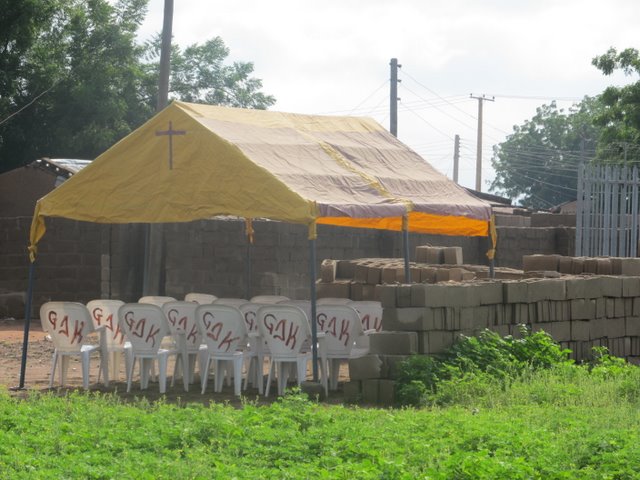
The Anglican church – as well as that new one in the tent – are operating under a significant burden. People see those bricks outside and know that the congregation is trying to erect a building. That takes money. And being in a tent or a grass-walled structure means you don’t have electricity, which means no band, which means bad worship (so goes the equation here). Prospective members will wait until after the church has built the building and then join. But the congregation struggles to put up the building with such a small number of people.

But this little Anglican church has made good progress. They began in a person’s living room before getting together the money for the land and their current structure, none of which came from the diocese. Joe and his wife have already planted one church outside of town. That one began under a tree and now has 60 to 80 people on Sunday and a really solid building.

So it’s possible. But it sure seems like a long row to hoe.

(Is this the direction the American church is headed? The decline of endowments and collection receipts could be leading us in this direction. Our problem is that we have gigantic buildings that take so much money to support. We’ll collapse under the weight of our infrastructure before we learn how to live off the effectiveness of our pastoral leadership.)

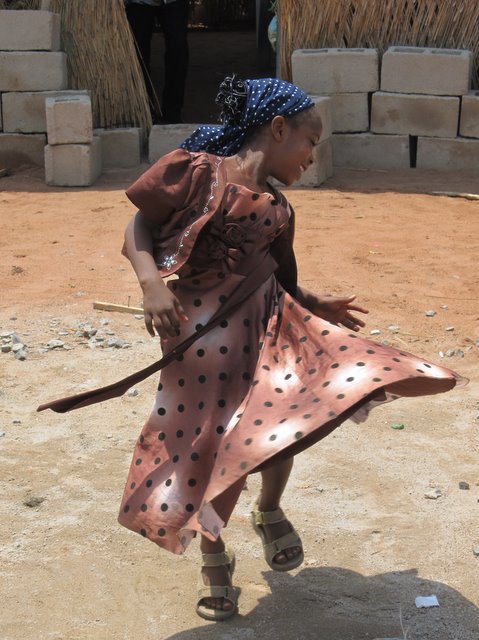
Joe’s daughter Deborah danced around the church while her parents and the church treasurer counted the collection receipts.
This is possibly my favourite picture I’ve ever taken.

The Achilles Heel of Christianity

I recently heard sex described as the “Achilles heel of Christianity.” Christians just can’t seem to come out of conversations about sex looking good. Sex is complicated and the (stereotyped) Christian response has often been too facile: don’t have it. A young woman told me the other day that “the greatest sin is immorality” (she meant sexual immorality). I wanted to protest – what about the Bible’s repeated condemnation of economic injustice? What about structural sin? – but it was clear she would not budge from this position. It was what she had been taught.

A few posts back, I pointed to an example that suggested that fidelity to the Bible is not actually what is driving opposition to homosexuality among Nigerians and others similarly opposed. (You should read that post if you haven’t because you won’t understand this one without it.) If fidelity to the Bible mattered, then the practice of giving in the Nigerian church might be different. So what might underlie this opposition?

In the Greco-Roman world, one reason Jewish people were misunderstood or discriminated against was the practice of male circumcision. For the Jewish, this was and is a sign of their membership in the covenant. For the Greeks and Romans, it was a difficult practice to accept. Intentionally “mutilating” the body was hard enough to accept. But to mutilate THAT part? Well, that was just too much. The Greeks and Romans, I think it is fair to say, reacted with disgust and horror at a practice they didn’t understand.

It strikes me that in the conversations I’ve had with many Africans about homosexuality, disgust is always present. We can talk the issue round and round, from cultural differences to Biblical interpretation. At some point, however, my interlocutor will say something like, “OK, fine. In our culture we have close friendships between two men and there is nothing wrong with that. But to have sex? That is not OK.” You see the same thing in people who agree homosexuality is fine so long as people are celibate and do not “practice” it. There was one moment in my conversations in Sudan last year when I was asked, “How do two men or two women actually have sex?” I didn’t answer because they didn’t need me to tell them. They were already revolted and disgusted at the thought.

I think there’s a good deal of similarity between the Greco-Roman reaction to Jewish circumcision and the conservative Christian reaction to “practicing” homosexuals. Men – and it is men driving this conversation – just can’t handle the thought of gay sex. (Women are maybe the same way but, for various cultural reasons, I haven’t been able to talk to as many of them about this.) There are many possible reasons for this – I think the most likely is that it relates to a particular idea of what it means to be a man – but the reaction is, to judge from my experience, disgust.

I’m not a psychologist but it’s easy to see that disgust is a pretty powerful emotion. It can lead to involuntary physical reactions. I used to dry heave just when I looked at the cooked carrots my mother put on my plate. (She made me eat them anyway.) Disgust can also lead to all manner of attempts to rationalize, justify, and provide a framework to explain the disgust. The Bible provides a handy tool for doing just that.

If there’s one thing I learned in CPE, it is that feelings matter. Indeed, they often precede the thoughts we have, often without us even realizing it. I think disgust is one possible explanation for the (one might argue) excessive fidelity to the Bible on the question of homosexuality but not on other counts. No one gets disgusted when you give money publicly.

If I’m right about disgust, the work of reaching consensus on homosexuality, then, will not be done by lengthy conversations about the Bible or culture or biology. That has been done, many times over, and has amounted to almost nothing beyond preaching to the choir. It will require addressing some pretty serious emotions and feelings surrounding sex, sexuality, and gender, especially, I think, masculinity.

Unfortunately, history shows us that the church has continually failed to talk about these subjects in a way that befits their importance.

What is Peter Akinola afraid of?

In the introduction to Christ and Culture: Communion After Lambeth – which is on a book shelf in the Bishop’s Court in Yola – Mark Chapman looks at the theology of communion laid out by Rowan Williams at the 2008 Lambeth Conference. Chapman concludes that what is needed most in the Anglican Communion is a “Christ-like…ability to listen to and to love the other person.” But he adds that this will not be acceptable to all.

Naturally, there are many for whom this form of authority is an evasion of leadership and a betrayal of the gospel. But perhaps this is based on a fear of opening themselves up to the deep listening that comes with Christ-like vulnerability.

Reading those sentences in Nigeria, I’m struck by its truth. Nigerian church leaders – former primate Peter Akinola prime among them – are exactly the sort of people who would condemn this listening as a betrayal of the Bible. The vehemence of the reaction these last ten years or so makes it clear that there is something deeper going on. I think fear is a good explanation.

So the question is: what are opponents of the American and Canadian churches who reject even dialogue – Peter Akinola was one but there are many others – afraid of?

I’ve already written about how important the Pentecostal influence is in understanding Anglicans in Nigeria. There is a fierce rivalry between the mainline denominations and the “new generation” churches. Rivalry is one thing and may even be good for the church. But the more I talk with people about this, the more convinced I am that Anglicans fear the Pentecostal churches.

The rich and powerful in communities have long been either Catholic or Anglican. These people are critical for the church. They tithe the most and so generate the income that allows the churches to continue to improve themselves and continue to attract new members. (When you don’t have an endowment, what comes in in the offering plate Sunday after Sunday is crucial to your success.) But increasingly, the younger generation of rich and powerful people are not Anglicans or Catholics but Pentecostals. A bishop I met recently told me, “The next twenty years will be very significant for the Anglican church,” emphasizing “very.” The way he was talking, he made it sound as if the survival of the church was at stake as older rich people die and are not replaced.

This may be a bit of an exaggeration. The Anglican church in Nigeria is too well-established to just vanish in a generation. But the style of living, the position in society, and the status the church and its leaders currently enjoy may definitely be threatened by the Pentecostal explosion in Nigeria. As I’ve written, the Anglican church has become more like the Pentecostals so as not to lose members – in style of worship, preaching, etc. It goes without saying that as the Bible is centrally important to Pentecostals, so too will Anglicans be forever faithful to it. (“Faithful” being somewhat of a loose term, as we have seen.)

Into the mix comes the Nigerians’ global Anglican partners who all of a sudden – or so it seems – decide that they can be wobbly on the Bible, “ignore” bits of it they don’t like, and generally be a complete embarrassment to Nigerian Anglicans. The actions of Americans or Canadians hurt the church because it makes the Pentecostals able to say, “See, those Anglicans don’t really believe the Bible. They’re a gay church. Come to us.” Again, it is worth remembering just how many people here – Anglicans and not – know about the Anglican Communion. This is why there was a proposed amendment at Lambeth 1998 that said, “homosexuality is a sin which could only be adopted by the church if it wanted to commit evangelical suicide.” (To which Catherine Roskam of New York responded, “to condemn it is evangelical suicide in my region.”)

Moreover, the proposed response – listening – will never work in this competitive context. You can say all you want, “That’s what Jesus did” or “Jesus never cared about status” or whatever you like. The message won’t work here. I’ve also been looking at a little book lately called Religion and the Nigerian Nation: Some Topical Issues. One of the points it makes is that in the context of Nigerian Christianity, size and strength matter. People aren’t going to church to feel weak. They’re going for strength and security in the face of societal uncertainty. So if a Nigerian Anglican were to say, “Oh, no harm can come from talking and listening to our Anglican friends,” well, let’s just say, it wouldn’t go over very well. (In fact, a Nigerian archbishop did suggest just that. He got demoted.)

I don’t want to press this too far. Fear of lost status does not explain everything that is going on in the Anglican Communion. But I think it explains something. Just last night at our evening Bible study, we looked at Exodus 1 where pharaoh, in his fear of the Israelites, engages in some remarkably destructive behaviour. Fear is a powerful motivator to destruction.

How ironic that the most repeated message of the Bible is “fear not.”

Books, books, books


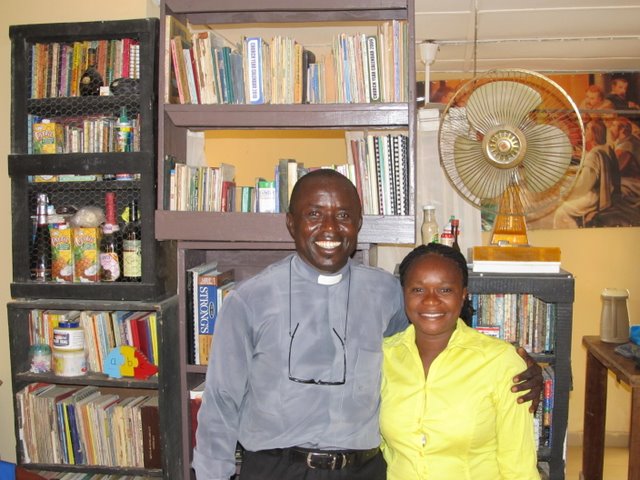
This is a picture of Samuel, a really lovely priest in Yola, and his wife, in their living room. Samuel doubles as sole vicar of a growing church and principal of the diocesan secondary school. He also raises turkeys and chickens on the side to pay his children’s school fees.

All of that is very interesting but I want you to look at what is behind him: lots and lots of books.

All the priests I know in the U.S. have lots of books in their homes. It’s a natural part of the job. But in my experience in Africa, this is unusual. In Sudan, priests owned no books but the Bible and sometimes not even that. Even in South Africa, there weren’t a lot of books because the cost of the books put them out of reach.

But in Nigeria there is a vibrant publishing industry. The books are riddled with typos and layout mistakes but no one seems to care. They are inexpensive and widely available. Many even have ISBNs so they can be officially registered. Some of them are little more than pamphlets, some extensively-footnoted academic works. My luggage has gotten much heavier than I anticipated in Nigeria because so many priests I meet want to give me autographed copies of their books. Here are some titles: Purity & Power, The Mission of the Church in the 21st Century, Putting the Igbo Woman in Her Place: An African Perspective on The Interpretations of the Household Codes, Where is the Lord God of Elijah? A Prophetic Outcry for Revival, The War Within: Christians and Inner Conflicts, and so forth.

(I wonder if this is what it was like during the American Revolution when people like Thomas Paine could publish pamphlets that made such an impact.)

Seeing all this material, I’ve realized again something I realized in China – it’s out of “our” control. The development of Christianity and Christian theology can no longer be controlled by people who look like me and have for so long written the books that have shaped theological education not just in the west but around the world. According to mission theory, the fourth step in the formation of a church is that it become self-theologizing. These books represent that work in the Nigerian church. I, for one, celebrate it. (I also get really jealous. The religious publishing in the U.S. is in such bad shape. Wouldn’t it be great to have an equally vibrant conversation in the U.S.?)

But here’s the other thing: a lot of these books are, well, wrong. There are countless books about Anglicanism here – have I mentioned that people care about being Anglican here? – and I’ve read many of them. Not only are there interpretations of difficult issues that I disagree with, there are incredible factual mistakes. I read one history of the creation of the Anglican Consultative Council that was totally, comically wrong. Another, in discussing resolution 1.10 from Lambeth 1998 – the one that said homosexuality is “incompatible with Scripture” – said that Lambeth is the Communion’s “highest policy-making body.” It’s not. Bishops at Lambeth have never been able to set policy (to the chagrin of many, we should add).

But you see those books behind Samuel in this picture? Almost all of them were published in Nigeria. As I read these, I not only celebrate the indigenizing of theology, I also worry that Nigerians and Americans are creating two different sets of facts about the current debates in the Anglican Communion. If that happens – perhaps it already has – it will be even more difficult to reach common ground. (It’s analogous to the way I saw China and the U.S. operating with two different narratives.)

So how do we create a genuinely international and cross-cultural academic dialogue? There are books that seek to do that but I’ve seen none of them for sale in Nigeria. Perhaps it takes more people, more visits, more conversations going in all directions.

Unfortunately, there’s little sign of that happening.