Renewing the Church: Bible, Eucharist, Prayer, and Leadership

Every week I write a note to the community at Montreal Diocesan Theological College. This week’s is posted here:During my recent leave, I read through a new report from Renewal Works, an organization in the American Episcopal Church that works for congregational renewal and church growth. The report is based on a survey they conducted of over 12,000 Episcopalians in nearly 200 churches. I commend the entire report (17 pages) to your attention. But I particularly want to draw your attention to what the survey revealed to be “key catalysts for spiritual growth” (pp. 7-8). Based on the survey, the report concludes that these four “catalysts” bring transformation and spiritual growth to congregations:

  • Engagement with scripture
  • The transforming power of the Eucharist
  • A deeper prayer life
  • The heart of leader

On first glance, there is nothing surprising about this list. These four catalysts remind us that being Christian is about engaging not just our mind but also our hearts, souls, and bodies as well. Each leads us deeper into engagement with God made known in Christ—in word, in sacrament, and in prayer. The list points to the importance of the kind of work we do in the college, forming people who see themselves as leaders of Christian communities. In one way or another, each of these items is a hallmark of our Anglican tradition.

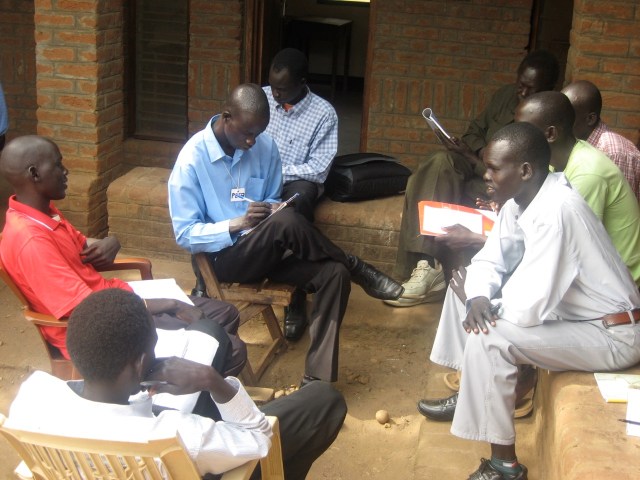
A favourite picture of mine from a trip to the Diocese of Akot in South Sudan

You might, therefore, find yourself asking: if the key catalysts for spiritual growth are hallmarks of the Anglican tradition, how come Anglican churches aren’t universally thriving? But as I look at the list more closely, I find myself asking how many of these catalysts are actually present in our churches. To take one example: it’s not clear to me that all of our churches have regular and readily-accessible Bible study groups and strongly encourage their members to participate in one. To take another: it’s not clear that all our churches create varied and regular opportunities to explore prayer in its many forms outside of the Sunday morning liturgy, or teach their parishioners how to pray.

This report is one contribution to the vigorous and welcome debate about the future of the church and of Christianity in an increasingly secular west. One message I take from this research is that part of the key to church renewal lies in returning to the habits and practices that have long been foundational to our Anglican tradition.

Praying, Fasting, and Remembering in South Sudan

In 2010, I first went to Bishop Gwynne College, an Anglican theological college in Juba, South Sudan. Among the many students I met was Simon Wal Geng, a bright, funny, and hard-working student. Unusually for a member of the Episcopal Church of the Sudan, Simon was a Nuer and part of a small minority at the college. Nonetheless, he made many friends. I remember the way he engaged in the classroom and in conversation, whether that was when we talked about the ways in which our churches were different or when he was learning about agriculture in the college’s model garden. I remember how he liked to joke and to laugh but also was serious about his studies and knew the opportunity that had been afforded him by being able to study at Bishop Gwynne. I later learned that the college administrators had taken a chance on him in letting him enroll on the introductory foundation year. His past academic performance  was not terribly stellar. Through his enthusiasm and his commitment, he succeeded and eventually transferred into the diploma program from which he in time graduated.

Simon on the front right, in a classroom discussion

Last July, I learned that Simon had been shot and killed in the violence of South Sudan’s ongoing civil war. He had returned to his home diocese of Akobo and was arranging local meetings for peace (something that grassroots church leaders in South Sudan have a lot of experience with) and it was then that the fatal shooting occurred. As with many deaths during this civil war, the details are sketchy but the outcome is not. Simon’s death is but one of many senseless deaths and one that makes peace that much harder to achieve.

Pope Francis has designated this Friday, February 23, as a special day of prayer and fasting for the people of South Sudan and the Democratic Republic of the Congo. Many Anglican leaders have joined this call as well. When I think about the scale of violence in these countries and in the world, it is hard not to feel overwhelmed and discouraged. When I think about the senselessness of a death like Simon’s, I grieve at the potential futures that are lost because of it. Prayer and fasting, in lament, from a place of pain and grief, are a wholly appropriate response.

But as a Christian I also know that it is in death that God in Christ works God’s great power to save. So I pray as well that Simon’s death and the deaths of so many tens of thousands of others become places in which the people of South Sudan and the DRC may see God’s reconciling grace working in new ways.