“This is a time for optimism and faith in the church”

So it’s official. Justin Welby, the Bishop of Durham, will be the next Archbishop of Canterbury.

His first press conference was fascinating and, I thought, quite impressive. He expressed his hope for the future of the church—as I’ve quoted in the title of this post—and answered questions (at least the ones I saw before the BBC cut away) with skill. The friends I have in the Diocese of Durham speak very highly of him.

Three things I appreciated about what I saw of his introduction:

  • He wants the church “to be a place where we can disagree in love.” I so strongly share this view and it was so encouraging to hear him highlight it.
  • He is “always averse to the language of exclusion when what we are called is to love in the way Jesus love us.” He challenged himself to listen to the experiences of those he does not know about, referring especially to the LGBT community here. Just wait until the conservative Anglican polemicists jump on him for this. I hope he ignores them.
  • His pectoral cross is (and I believe I’m correct about this) the Cross of Nails from Coventry Cathedral. This is a symbol of the powerful reconciliation work that has emerged from that cathedral since it was destroyed in World War II and which Welby was involved with before becoming Dean of Liverpool. Reconciliation is at the heart of the Gospel and I’m encouraged he has been so involved with this work in its many forms.

As I’ve written, I think Welby’s appointment could be a moment when Anglicans begin to move beyond (but not resolve) the battles of the last decade or more, given his apparent credibility with evangelicals and the church in Nigeria.

The response to his appointment so far seems to have been fairly positive. I take that as good news and as a hopeful sign for Anglicans around the world.

For now, however, Welby goes back to Durham until the end of the year and the fevered speculation can come to a rest. We’ll have to wait until March 21 and his installation to see how all this unfolds.
A Nixon goes to China moment for Anglicans

Sometimes in life, to really make progress, you need to have someone do the unexpected. Richard Nixon’s visit to China was one such moment. A man with an uncompromising stance towards communism was the one who changed the nature of relations between the United States and China. It took a Democratic president, Bill Clinton, to sign welfare reform into law. In order for change to happen and for it to really “stick”, you need someone who comes from the opposing view but has been brought around to a new view. It is these moments that mark the change as permanent.

The conflict over sexuality in the Anglican Communion has thus far pitted two (at least) sides firmly against one another, with each trying to gain the upper hand. On one level, this is fine; it’s how democracy, ecclesial or otherwise, works.

But I’ve been thinking lately that for true progress to really stick—and for Anglicans to move forward—it’s going to take something more. In that regard, Rowan Williams was never the right person to make progress on this issue. Whatever his merits as archbishop and as a theologian—and I believe they are many—he was always too identified with the “liberal” group to be trusted on this issue.

There are hints that Williams’ successor will be Justin Welby, the Bishop of Durham, and a man who, from what I can gather, was heavily influenced by Holy Trinity Brompton, a church at the heart of Anglican evangelicalism, and who has worked closely with the Nigerian Anglican Church. Yet there are tantalizing hints that his views on sexuality questions are more nuanced and complex than that traditionally associated with conservative evangelicals or Nigerian Anglicanism.

Perhaps Welby is the person who will be able to move Anglicans beyond the trauma of the last many years. I don’t know quite what it will look like but I am coming to believe that it is only a person with “conservative” bona fides who will be able to help Anglicans move past this issue and onto the many other pressing issues we face.

I can dream, can’t I?

“So that the world may believe”

It is an often overlooked fact that Jesus’ prayer for unity among his followers—”that all may be one”—is, in fact, a missional prayer: one of the next phrases in the verse is “so that the world may believe.” (John 17:21) Jesus connects our unity with our witness to the world. Indeed, it seems that the pattern of relationship among believers is central to that community’s ability to share the good news of Jesus Christ.

Why might be this be? I don’t want to make any guesses about what Jesus was thinking but it does seem to me that in our present environment, unity is a counter-cultural value. We live, as I have written, in an age of “I have no need of you”—politically, economically, socially. We are sorting ourselves into ever smaller groups of like-minded people. The presidential election, which has become more about turning out the base than winning over swing voters, is a paradigmatic example. For the church to live in unity in this context is intensely counter-cultural. This is why I think unity is missional; I want people to look at the church, see a different pattern of relationship than that which obtains in our day-to-day life, and think, “How do I become part of that?”

Unfortunately, of course, this is not quite how things work. Churches are divided within themselves, both at the congregational and denominational level. There are often good reasons for this—people of good faith can disagree on what it means to follow Jesus—but often these disagreements seem to swamp any mutual recognition that the other is a fellow member of the body of Christ.

These thoughts have come to mind in recent weeks as I have read, first, of the way in which the Episcopal Bishop of California was excluded from the consecration of the new Catholic archbishop and, second, the apparent expulsion from the Episcopal church of the bishop of South Carolina. Each of these events is the product of a long and complex chain of events, which I won’t claim to understand. Nor do I want to make it seem as if either is easy to resolve or that I’m saying, “Wouldn’t it be great if we could all just get along?” I am saying neither.

But at a time when the word “mission” is constantly being invoked by Episcopalians (with good reason) these events are for me moments of great sadness because they represent lost missional opportunities. When I hear people (from any number of sides in church debates) exulting at the “purity” of the church, I think they sound a lot more like members of a political party than the body of Christ. I find these news items to be deeply mournful and pray that we can have the grace to see others as equally baptized children of the same God. If we really believe in our baptism, it seems like we have no other choice.

It won’t solve all our problems—or even any of them—but I think it would make us more like a church than anything else we could do.

News from Abyei

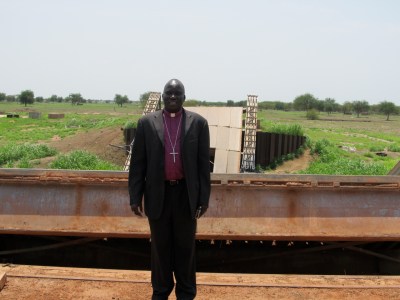
Here’s a picture I took a year ago:

That’s Bishop Abraham Yel Nhial, bishop of the Diocese of Aweil in Sudan. I took the picture when Abraham and I were in Abyei, the contested border region between north and south, which is part of his diocese. The bridge behind him was destroyed in attacks in May 2011 by a northern-allied militia. Its destruction meant, at the time of our visit, that Abraham was unable to visit all parts of his diocese, including the town of Abyei, the centre of the region. Instead, we went to Agok, a town in the southern part of the region where a huge number of people displaced from Abyei had sought refuge, many in a church school.

I just heard from Abraham that he made it to Abyei, this time with the Archbishop of Sudan, Daniel Deng Bul. They have only just returned and have—to date—a very short report to share. Nonetheless, it is devastating to read:

An Episcopal Church of Sudan delegation led by Archbishop Daniel Deng Bul has just returned from a visit to Abyei. They were shocked at what they saw. The town is deserted apart from “a few stragglers”, and has been completely destroyed. One eye-witness from the delegation described it as reminiscent of World War II photos of the aftermath of the atomic bombs dropped on Japanese cities. Only the mosque was untouched. The Catholic church, Catholic and ECS schools, boreholes, administrative offices, government houses, power station, shops, even the latrines, have all been destroyed. The UN forces are perceived as being biased against the Dinka. There appear to be no humanitarian agencies working there, as apparently it is consider part of Sudan and they do not work cross-border. A huge number of refugees from Abyei, perhaps as many as 100 thousand, are in Agok with very few basic services. The people simply ask for what is their right under the Abyei Protocol of the CPA, agreed by both parties: a referendum in which they can choose their destiny.

The Church will be releasing a full report, with pictures and video, in the near future.

Details to follow. In the meantime, an item for your prayers.

Stepping away

Back in May, I wrote two posts about the razing of Itipini, the shantytown community in South Africa that I used to work in (and which I wrote a book about.)

I haven’t been good about keeping this blog updated with news from Itipini, in part because the destruction of Itipini filled me with such mixed emotion, I barely knew how to begin writing about it.

But some things have become clear in the intervening months. African Medical Mission, the NGO that ran the Itipini Community Project, has announced that it is ending its work there and beginning the process of winding down its work. Jenny McConnachie, the Episcopal missionary who worked in Itipini, is stepping away from the work.

I managed to get my thoughts in order to write about that for the Episcopal News Service:

There is a sense in the church, at times, that the era of long-term overseas mission is behind us; that people who devoted their lives to the church around the world belong only to the history books. We speak now primarily of short-term trips and companion diocese relationships. These are important elements of the church’s role in God’s mission.

At the same time, however, Jenny—and the other long-term missionaries like her around the world—embody our church’s commitment to taking our role in the global body of Christ. Their work with our sisters and brothers around the world is a concrete step towards realizing the unity for which Jesus prayed among his followers. People like Jenny—who shun the spotlight and never imagine their work has any significance beyond its local context—are some of the most important representatives of the Episcopal Church around the world. Their long-term commitments allow them to develop deep relationships and accomplish much.

You can read the whole thing here.

Thabo Makgoba on qualifications for next archbishop of Canterbury

Thabo Makgoba, the archbishop of Cape Town, has given an interview in which he speaks about, inter alia, the ongoing selection process for the next archbishop of Canterbury. His point of departure was the recent Anglicans Ablaze gathering in Johannesburg:

Makgoba said the Anglicans Ablaze conference reflected “a synergy of positive energies within our church” with people of contrary worship and theological positions coming together.

“We should bring whatever challenges we have into this milieu and grow together as Anglicans. 


Makgoba said that despite the diversity among Anglicans, certain “fundamentals” such as “breaking bread together”, kept the church together.


Commenting on the appointment of a successor to Archbishop of Canterbury Rowan Williams, Makgoba said the global church faced major issues including new human identities and degradation of the environment, which required ongoing strong leadership.
Being Archbishop of Canterbury was “an impossible job. If you really believe that you are only a conduit for the grace and love of God, it is do-able.


“I hope that whomever becomes archbishop will take up where (Archbishop Williams) ended, inject theological strength into our debate, yet know that there are no easy answers. 


“As an archbishop (the next incumbent) needs to create an enabling environment for people to really live what it means to be an Anglican in the beauty of our diversity.”


Remembering George Bell

The Church of England today commemorates George Bell, Bishop of Chicester during World War II. Bell is remembered, inter alia, as a bishop who opposed the Allies’ bombing campaigns in World War II and, it is thought, was passed over for the see of Canterbury as a result. You can do worse than read the Wikipedia entry for more on Bishop Bell.

Today I’ve been reading reflections from Paul Zahl and Rowan Williams about Bell. Both are brief and both worth reading, particularly for the way they connect Bell’s opposition to the war to elements of Christian witness in today’s world. Here’s a bit from Williams’

But Bell also knew that we could only be who we are at home with ourselves and with God, if we knew where our homeless and displaced brothers and sisters were; hence his concern for the refugees and the landless. And God’s challenge to us once again—’Where are you? Where are your brothers and sisters?’ —is a challenge about how we as believers in Jesus Christ answer for the lives of those who are being driven from their homes, their livelihood and their security by the terrible violence of our age.

At a previous commemoration of Bell a year or two ago, I remember mentioning him to a senior priest in the church. “Who’s that?” this priest responded.

So today I’ve been thinking about those who have gone before us, who (for whatever reason) were passed over for career advancement, and have now gone into obscurity. George Bell was a faithful minister of the Gospel in his context. How can we do the same?

It is appropriate, perhaps, that Bell’s commemoration falls as the Crown Nominations Commission makes it final deliberations as to who the next archbishop of Canterbury shall be. When that name is unveiled (whenever that may be), quite a lot of attention will focus on the person chosen.

But I hope that we also remember the long list of people who were considered and not selected, and, even more importantly, the long list of people who were never in a position to be considered. There’s lots of faithful witness at all levels of the church, forgotten, overlooked, and passed over for a variety of reasons. We do well to remember it.

Gathering momentum for a Thabo Makgoba candidacy

When Rowan Williams announced his resignation in March, I argued that the Crown Nominations Commission needed to look beyond the usual crop of suspects and consider the many talented African bishops in the Communion as possibilities.

Filling Rowan Williams’ shoes was never going to be easy—any successor will have to stack up to one of the greatest theological minds of the generation. Going for an outside-the-box appointment—first Archbishop of Canterbury from outside England since Augustine?—lays to rest those possible comparisons and frees the successor to be fully himself (or herself, but that won’t happen—yet—to the see of Canterbury).

Then in June, I expanded on this argument in a piece in Religion Dispatches:

It is in this context that the attention of the Anglican Communion has again turned to Canterbury. The bishop’s chair there will soon be vacant, even as Rowan Williams takes full advantage of the months preceding his December retirement. And while speculation as to his successor runs hot, most observers place their bets on current occupants of English sees. That would be a mistake. As the Anglican Communion continues its growth in the non-Western world, I believe its nominal leader must reflect that change: it is time for an African Archbishop of Canterbury.

(I should note that this piece was heavily edited before it was published and, as it appears now, contains several sentences and paragraphs I did not write. But I did write the one I just quoted.)

Since I first made these arguments, I believe the case for Thabo Makgoba has only strengthened. He has distinguished himself in his response to the Lonmin mine shooting in August. He continues to faithfully lead his diverse church. One of his dioceses (Swaziland) recently elected Africa’s first female bishop. I suspect he will consecrate her. Wouldn’t it be grand if he came to Canterbury and—finally, at last!—did the same thing in England?

The Crown Nominations Commission, meanwhile, appears to have deadlocked at its meeting last week. There is no British bishop who is sufficiently satisfactory, it seems.

So I repeat my plea to the CNC: turn your gaze outside of the Church of England! Look to the hundreds of other bishops around the world who could ably fulfill this role.

(As far as I can tell, the archbishop of Canterbury has to be a citizen of the Commonwealth, not necessarily an English citizen—e.g. Rowan Wiliams. All the candidates I have suggested so far meet this criterion.)

There’s a gathering Twitter campaign to suggest possible alternatives for the CNC to consider, using the hashtag #alternativearchbishops. It mostly appears to be facetious at the moment. Let’s open up this process in any way we can! Start throwing out your suggestions and maybe, just maybe, someone will see them.

The curious case of the bishop who didn’t celebrate the Eucharist

Here’s a picture of the Rt. Rev. Stephen Conway, the bishop of Ely in the Church of England.

By chance, I’ve been to two services in the past week at which he’s presided: one, a re-dedication of a refurbished church, the other, the installation of a new rector.

What was interesting to me is that at neither service did Bishop Stephen celebrate the Eucharist. I can’t remember the last time I saw an American bishop conduct a service at which he or she did not celebrate the Eucharist.

I was reminded of a comment my (English) liturgy professor once made in class: the American church, he said, had a case of “Eucharistic inflation.” That is, we celebrated the Eucharist at every possible juncture. The 1979 Book of Common Prayer makes it the “principal” service on Sundays and that thinking has spread to lots of other services such as, for instance, re-dedications and installations.

There are very good theological reasons for doing so and I do not for a minute want to minimize the significance of the Eucharist. Nor do I want to suggest that the Eucharist is not an important part of my (daily) devotional life. However, it occurred to me that if Episcopalians celebrated the Eucharist less, we might not be in such a knot about communion and baptism. We might also be able to lift up the many other significant services that form our life of prayer together. It seemed perfectly appropriate at the installation not to celebrate the Eucharist. There were many members of the community there—including the mayor and several other secular representatives—who were not necessarily religious types.

Perhaps the conversation about communion and baptism is, inter alia, a chance to think about opportunities not to celebrate communion and who we include—and who we exclude—when we do and when we don’t. What would Eucharistic deflation look like?

After all, if a bishop can happily conduct services without celebrating the Eucharist at every turn, can’t we learn something from that?

Seeds of hope in war-torn lands

In my experience, church-goers in the North Atlantic world struggle to come to grips with the expansive role the church plays in other parts of the world. The church in Sudan, for instance, teaches its seminary students agricultural skills so they can be extension agents when they return to their home villages. In the absence of effective central government, the church comes to play an outsize role—a fact that is almost always overlooked in other parts of the world.

I was thinking about that while reading Tim Butcher’s Blood River: A Journey to Africa’s Broken Heart. The book is excellent reporting on his journey from eastern Congo, down the Congo River to the Atlantic Ocean, retracing the steps of H.M. Stanley, the first European to make the journey.

To say the Congo has a difficult history is a profound understatement. What Butcher finds is a country in regress, less developed, urban, and safe than fifty years earlier when the colonialists left.

What struck me throughout the book, however, was the way in which Butcher kept coming across the church. When all other organs of society and culture seemed to be absent, Butcher still found friendly priests and bishops who hosted him and sent him on his way. He didn’t find many foreigners in Congo. But those he did find—and who weren’t working for the UN—were related to the church: missionary priests from the U.S. and Brazil, a missionary teacher from England. Unlike the UN types, these priests and missionaries were willing to leave their compounds and engage with the people around them.

The missionary from England tells Butcher:

The war has had one major effect in that there are only two real ways left for Congolese people to get on. Before, there was at least a system of schools to go to paid for by the state, a transport system so that people could reach other parts of the country, a health system so that if you were ill you could stand a chance of recovery. But today all of that has gone, so that you only have two real options—you join a church, the only organization that provides an education, a way for someone to develop, or you join one of the militias and profit from the war.

It’s a depressing view, this, but it also has the seeds of hope. I am reminded of John, my Sudanese friend who said to me last year before our visit to Abyei, “We are the church. We are always on the ground!” Or it reminds me of a General Synod address Rowan Williams gave last year about his visit to Congo and Kenya.

Although Butcher’s book makes for disturbing reading, I found in it the seeds of hope, that even in the most war-torn parts of the world, the church remained. And if the church remains, hope remains.