Anglican Communion awareness increasing?

The Episcopal News Service has a lengthy article today that follows up a lot of the questions raised at General Convention about the Church’s huge cuts to funding for the Anglican Communion Office. It also makes some grand claims about the nature of the Anglican Communion nine years after the election of Gene Robinson as bishop of New Hampshire.

Here’s the article’s lede:

The world’s 80 million Anglicans are much more aware today than they were 10 years ago that they belong to a global communion, a realization that has led to a flourishing of international relationships between the Episcopal Church and other provinces, dioceses and individuals.

Although the article claims to be concerned with Anglicans all over the world, the only evidence it musters is in the Episcopal Church. This is a hallmark of one of the most depressing of all American characteristics, namely the willingness to generalize from quite particular experience. To write an article like this merely reinforces what many people around the world already think: Americans are self-centred, solipsistic, and parochial.

The thing is, our brother and sister Anglicans around the world have known and cared about the Anglican Communion for a lot longer than many Americans have. When I traveled in the church in Nigeria (where 1 in 4 of those 80 million Anglicans live) last summer, one of the aspects of the church that was most noticeable to me was the way Nigerian Anglicans cared about being part of the Communion. The official name of the church is Church of Nigeria (Anglican Communion). When you leaf through a diocesan newsletter, there’s plenty of material about other Anglicans around the world. In a remote diocese in South Sudan a few years back, I was asked what I thought about Rowan Williams’ decision to deny Katharine Jefferts Schori her mitre on a visit to England. In a remote Bible college in a China, I was once asked about the Anglican Communion. It’s the Americans who have woken up and smelled the Anglican Communion coffee in the last decade. The rest of the world, at least, was already aware.

My sense of the last decade is that the American church, particularly its liberal wing, has been rushing to catch up with the rest of the world in terms of understanding itself as part of a global Communion. For a variety of reasons—including prioritizing domestic concerns, feeling unsure about how to relate to newly-independent churches, and so forth—the Episcopal Church began a fairly large retreat from its global commitments in the late 1960s all the way through the 1990s. This, in many ways, set the stage for the “crisis” of the last decade.

In 1963, Anglican lay people, priests, and bishops from around the world got together for an Anglican Congress in Toronto. One of the speakers was a man named Howard Johnson, who, a few years prior, had completed a two-year tour of every province in the Anglican Communion. At the Congress, he had this to say:

We Anglicans stumbled into universality – prodded, I believe, by Providence. But our consciousness of ourselves has not yet caught up with the reality of ourselves. In actuality we are a multiracial, multilingual, multicultural body, but in awareness we are still parochial and provincial.

My sense is that Johnson’s observation is still largely correct. It is true, however, that the election and ordination of Gene Robinson means that Episcopalians now know more than they used to about the Anglican Communion whether they like it or not. But has that had the positive impacts the article claims? On that question, I think, the jury is still out.

KNOM Memories

It’s August, travel time for lots of people, including me. Even my blogging has been traveling. I was asked to contribute a guest post to the Alaska Radio Mission blog.

When I worked at KNOM and people asked me what I did, I’d often say, “I tell stories.”

The great virtue of being a news reporter is that you can call people up and ask them what’s going on. That’s what I loved doing in the two years I worked in the KNOM newsroom. I interviewed governors, lawmakers, senators, candidates for office, and, on one memorable occasion, then-Defense Secretary Donald Rumsfeld. In one way or another, they were telling stories—and KNOM was molding, shaping, and challenging how those stories were presented to our listeners.

Haven’t heard of KNOM? Check it out. It’s the best little radio station anywhere on this continent and might just be the place you want to spend a few years.

The “law of homogeneity” in the church

One of the (possibly the only) downsides of the high profile Desmond Tutu had in the 1980s and 1990s is that other eloquent, faithful, and prophetic African Anglican leaders were overshadowed.

I thought about that as I was preparing for my class on Sudanese church history last week. Bishop Francis Loyo of Rokon has been bishop of his diocese through the long years of civil war. He’s seen the Episcopal Church of Sudan in all its glory—and its pain.

In 1999, he wrote an article called “The Church Today As I See It.” A (rather long) excerpt is below, which I gave my students on Saturday. As the new nation of South Sudan continues to be confronted by tribalism (and churches in the U.S. increasingly mirror the partisan division of the country at large), I find his words to be important, more than a dozen years after they were first written:

Will the church languish in conformity and accommodation? Or will the Church bring the power and presence of Christ to bear on the Sudanese national crisis? The Church in Sudan must apply the test of practical Christianity. In the present situation both the Christian faith and freedom are being destroyed. Therefore, the Church in Sudan must do everything possible to overcome this false alternative. Christians can only overcome this when the Church becomes radical again and seriously considers who it is that they believe in and what the authentic experience of God actually is. To achieve this the Church in the Sudan must rediscover the long forgotten subversive traditions of freedom in the Bible. To believe in God means nothing less than to experience one’s own liberation. The name of the true God means freedom. Only be experience of the true God can the Church in Sudan know true freedom. The truth of human freedom is love. It leads to unrestricted, solid and open communities. Only this freedom in our communities can heal the wounds which oppression has caused and continues to cause in Sudan and in its Churches.

The Church in the Sudan is seen as the “Church of hope” despite the difficulties which the Church is undergoing. The Church in Sudan advocates a human community that is not only based on the similarity of its members—the same race and same language, the same class, the same views and the same morals. These are the things that always bind people together. We find people who are different from us disturbing. That is why we love our friends and hate our enemies and despise strangers. People have built up societies based on class, or caste or systems of apartheid according to the laws of homogeneity. The power which drives these societies is self-righteousness.

The Christian Church lives quite differently to this law of homogeneity. It lives in recongition of other people in their otherness, and that means reconciliation. “Here there is neither Jew nor Greek, there is neither slave nor free, there is neither male nor female, for you are all one in Christ Jesus. If you are Christ’s, then, you are Abraham’s offspring and heirs according to the promise.” (Gal 3:28-29) This is the peace that the Church in the Sudan advocates—a peace in Christ who has broken down the dividing wall between us, taking the hostility through his flesh. (Eph. 2:14)

The driving force behind the Church in Sudan lies in the righteousness of faith which is founded on reconciliation through God. The Christian community in the Sudan begins at the very point where fences and walls are set up between human beings, where nations are divided, countries are separated, and families are split.

The Church in the Sudan must resist every kind of separation if it wants to remain the community of the Church and to minister to people. But even in the Christian Church the law of homogeneity prevails again and again. There are national Churches, Churches of particular races or ethnic groups, middle class Churches, Churches in different social classes. All these are heretical in their practical behaviour, for they spread enmity not reconciliation and their effect is to exclude and not to invite. It is only when congregations can be made up of Black and Arab, poor and rich, uneducated and educated, handicapped and non-handicapped, that there will be a witness to divine reconciliation in this hostile Sudan.

Congregations like this will have a difficult time. They will be despised and pushed aside. They will become congregations under the cross. But they are the sign of hope for the Church in the Sudan because what they do in their divided society is reconciling and healing. The Church in the Sudan must encourage policies of reconciliation always and everywhere. It is only through reconciliation to self and one another that the vicious circle of revenge is broken among Christians. It is only through reconciliation that the law of retaliation is abolished. It is only through reconciliation that hostility is overcome. But Christ teaches us that there can only be reconciliation on the foundation of the sacrifice of oneself and on the basis of righteousness and justice. It can never be at the expense of other people and on the ground of injustice.

The hatred seen in the divided Sudan has eaten its way deep into the Sudanese thinking in both North and South. It is always fear which teaches people to hate their opponents, and the person who preaches hate spreads fear. Politically, Christ is not against the Muslim in the Sudan. He died for them too. God reconciled “the world” to himself and that includes the other religious or political parties. That is why a Christian cannot become the enemy of his/her enemies. Christians in the Sudan need to see Christ in those who hate them.

But loving one’s enemies does not mean being subjected to the system of one’s enemies. Or saying nothing about their hostility. Love of one’s enemies presupposes immense assurance and liberty. It has to be intelligent so that it can understand the fear that makes the enemy hostile, and it has to become inventive in order to change the situation so that enmity becomes unnecessary.

I took this text from But God is Not Defeated! Celebrating the Centenary of the Episcopal Church of Sudan, 1899-1999 (Nairobi: Paulines, 1999), pp. 39-40.

Flexibility and change in the Episcopal Church: The Commemoration of William Reed Huntington

In the debate over a potential covenant for the Anglican Communion, you might see mentioned from time to time the idea that Anglicans already have a covenant of sorts: the so-called Chicago-Lambeth Quadrilateral of 1886/1888. You can read all about it in your Book of Common Prayer (p. 876) but it has four elements:

  • Old and New Testaments as containing all things necessary for salvation;
  • The creeds as a sufficient statement of the faith;
  • Dominical sacraments (baptism and Eucharist) rightly administered;
  • Historic episcopate locally adapted.

The man behind the Quadrilateral was William Reed Huntington, whom the Episcopal Church commemorates today. Huntington was a parish priest, long-time deputy to General Convention, and advocate for ecumenical reunion in the United States. In fact, it was his desire to see the church united that led to the Quadrilateral. These were the elements Episcopalians had to see in another church to be reunited with them. The Quadrilateral remains a factor today, explaining why the Episcopal Church can be in full communion with the Evangelical Lutheran Church in America but not, say, the Presbyterians, who have a much different understanding of the ministry of the episcope. (Huntington was also a priest for many years in Worcester, Massachusetts. Although the Diocese of Western Massachusetts didn’t exist then, it’s more proof that it may be a small diocese but still one that punches above its weight.)

Efforts to use the Quadrilateral as the basis for intra-Anglican unity are a category mistake. The Quadrilateral is about ecumenical relations. And there’s good reason for this. If we say that the Quadrilateral is essentially a proto-Anglican Covenant, then we’re saying that our relations with the Anglican Church of Southern Africa or the Anglican Church of Canada are no different than our relationship with the ELCA or the Moravians. We may sometimes feel that way but the whole idea of the Anglican Communion, as I interpret it, is that those churches that have a historic relationship have some sort of special relationship that is distinct from that shared with other members of the one, holy, catholic, and apostolic church.

Now you may think, as I largely do, that the proposed Anglican Covenant is unnecessary. But don’t say that Anglicans already have a covenant. Huntington had something entirely else in mind when he was devising the Quadrilateral.

Sometimes the Quadrilateral is seen as a bit too firm and an obstacle to reunion, particularly the part about bishops. But what I like about Huntington was his advocacy for  flexibility and change in other parts of the church’s life to facilitate ecumenical reunion. He thought, for instance, the church could be a bit more open to liturgical change. To this end, he spent a lot of time on prayer book revision.

Huntington’s commemoration, then, poses several questions to the church in this time of change: what do we think is worth preserving about our church? What can we more readily compromise on?

“You converted because of the songs”

My class of Sudanese Episcopalians last Saturday considered the rapid conversion of many Dinka to Christianity in the 1980s and 1990s. For the teacher, this raises an interesting conundrum: how to teach about something which the students experienced firsthand. The solution? Prompt them to talk about their experience and try to provide some concepts to frame the experience in terms of mission and how and why people convert.

What is so fascinating about the conversion of the Dinka is that for many decades European missionaries tried—to no avail—to convert the Dinka. What happened when the missionaries left, however, is that the Dinka were able to encounter Christianity on their own terms and in a way that was coherent with their culture.

I got a lesson in this in my class on Saturday when one student told me about how he converted. Singing has long been important to Dinka culture; indeed, in many ways, it is the chief artistic expression. Before war decimated the Dinka homeland, young men would tend cattle in camps. They’d wrestle, talk about women, tend their prize bull, and, in the evenings, write songs about all of it. If it was a good song, it would be sung by others and passed around.

When the Sudanese civil war sent many of these young men into exile, they did the same thing: composed songs about their experience. Only this time, the experience of displacement had (for a variety of reasons we can talk about in another post) introduced Christianity to their mix. In one refugee camp of tens of thousands in Ethiopia, there were two Sudanese pastors. These pastors held services under the trees and taught the boys songs about Jesus. The boys would learn the songs and go back to their shelters and teach others. As they learned more, they began to compose new songs about Jesus. The good ones began to spread. The Gospel was being transmitted to the culture in the most culturally-appropriated medium. As the student said on Saturday, “You converted because of the songs.” The message they were transmitting was appealing and it was unencumbered of the culture of the European missionaries.

This, for me, is a textbook example of the way in which Gospel and culture can come together and lead to the mass conversion of a people. It’s one thing to preach the Gospel. It’s entirely another thing to preach it in a way that people can interpret in light of markers they already know.

So Saturday’s class got me thinking: what’s the equivalent in American culture? North Atlantic culture, we are often told, is moving away from Christianity. In some places, it is outrightly hostile to the faith. This part of the world is now a chief “mission field.” So how do we speak to non-Christians in this part of the world in a way that will be understood?

One challenge, of course, is the fracturing of culture and media. There are now so many sub-cultures (in a way there weren’t necessarily in Dinka culture) that to think about hitting on one method is probably foolish. Still, the reason I’m so fascinated by mission history is that I think it has lessons for us today.

So… in our own time, what’s the equivalent of converting people by song?

Lessons from the Church in Wales

The meeting was notable for the number of contributions from members with a common message: “The Church cannot go on doing the same things in the same way; some things need to change and we are open to – and indeed encourage – that possibility.

Sound like a familiar sentiment? But rather than being from the just-concluded General Convention of the Episcopal Church, the sentence is how the new Review of the Church in Wales begins. The Welsh church commissioned the report two years ago and it was released earlier this week.

On the assumption that the Episcopal Church—which just created a super-committee to consider restructuring—has something to learn from our Welsh sisters and brothers, I had a look through the report.

The report spends a lot of time calling for larger Ministry Areas—something like deaneries, though it is careful not to call them that—in which the lead pastors would be both ordained and lay. “A radical change of perspective is needed,” the authors write, “from parish to a much larger area, and from a single priest, to a team with different gifts.” (p. 8) I think the report is to be commended for so highlighting the role of lay people in ministry. The call to move to the larger Ministry Areas is a sign of the straits the church is in that it feels it can’t keep the close connection to communities the parish system gives it.

Given the recent focus of this blog, the report’s commentary on ordination training was interesting, particularly the way in which it upholds residential training as a part of such training, even if combined with non-residential portions (p. 14). The report also acknowledges the increased need for non-stipendiary clergy (p. 17). We call them “bivocational” clergy in the U.S. but the idea is the same. Clergy need to start thinking about income sources independent of the church. The report suggests the church in a few years think about moving from six dioceses to three (p. 19). Since you need to have four dioceses to stay a province of the Anglican Communion, I’m not quite sure what that would mean for the Church in Wales status but that doesn’t seem to have been considered by the authors. (Perhaps Wales could get around that by having some missionary areas?)

The most interesting aspect of the report is its identification of a problem in the culture of the Church in Wales: “namely the respect in which the office of Bishop is held in the Church in Wales and the authority which he wields by virtue of his office.” The authors write:

A number of people have said to us that the Church in Wales is still characterised by a culture of deference and dependence. This is a model of leadership that is carried over into the parishes, where so often the complaint has been that it is all about the clergy, that there is a culture of “Father knows best”. What this means in practice is that people look to the Bishops and clergy to take initiatives and it has been suggested to us that nothing much happens without this. (p. 6)

I’d say there’s an element of this in the American church as well, though less than there used to be, perhaps, and less so than there is in Wales. Moreover, I think many bishops in both Wales and the U.S. would be happy to give up some of this authority if only we’d take it from them. I hope that this Review, as well as whatever process the Episcopal super-committee goes through, can start a conversation on what we expect of bishops and how we remain true to our Anglican tradition while remaining able to relate to the challenges of our time.

One thing that is clear, however, is that no structural change can change this cultural situation the Review identifies. And so what I think this report reveals most fundamentally is that we can tinker—even quite dramatically—with the structure of the church but it all means nothing if the people in the church don’t change as well. It’s one thing to (unanimously) establish a committee to investigate church structure (and sing it into being). It’s quite another to look in the mirror and ask how—independent of any structural concerns—each member of the church can become a more missional follower of God in Christ.

And that, I think, is the ultimate disappointment of this Review. It doesn’t go far enough. Perhaps that’s what you get when your committee is composed of three well-connected church personages. I get the sense that the report’s authors simply decided to shrink and combine the church’s functions in response to its diminished financial position. The Review does a good job at the beginning and the end of identifying what the purpose of church is —”to proclaim the Gospel and draw people into the life of Christ” (p. 37)—but sometimes I struggle to see how that goal is connected to some of its recommendations.

The annex of this Review is fascinating: a summary of all the other structure reports in the last generation in the Church in Wales. And yet here is the church, again calling for review and reform. Will this report end up on a similar list at some point in the future? It might, if we put all our energy into changing structure and none into changing the disciples we are forming.

Church structure reform: now the work really begins

For decades, Alaskan politicians have been looking for a way to develop the state’s natural gas resources on the North Slope. In 2007, the state legislature passed a piece of legislation called AGIA (the Alaska Gasline Inducement Act) that, it was believed, would at last lead to the building of the gas pipeline to transport the gas to market.

I can’t remember if I was in the legislative gallery at the time or not (I think not) but I do remember the palpable sense of excitement and enthusiasm that surrounded AGIA. Of the 60 lawmakers in the House and Senate, exactly one voted in opposition.

I’ve been thinking about AGIA in the wake of the General Convention’s unanimous approval of a resolution that creates a committee to overhaul the structure of the church. There is that same sense of excitement and enthusiasm that I remember from AGIA. People want change and they are pinning their hopes on this committee to bring it.

So perhaps it is time for a dose of reality: the way ahead for this super committee is hugely difficult. Committee members (whomever they may end up being) have a huge amount of work to do. They have to learn the ins and outs of the current governance structure to figure out what to change or whether and how to start over. It surely makes sense that committee members also explore how other denominations govern themselves. They’ll need to think and dream about what is needed from a national church structure in the twenty-first century. And they have to do all this (and much more) in just under two years, with uncertain staff support and while all of them have jobs and lives elsewhere that are competing for their attention.

At the same time, the hundreds of deputies who passed this resolution will be headed home. The enthusiasm will naturally dissipate as they re-engage with the work of ministry in their local contexts. When actual changes begin to be proposed, there will no doubt be stout opposition from defenders of the status quo. This could be difficult to overcome if people are no longer paying close attention.

Moreover, we can’t “save” the church simply by changing its structure. We need church members who are continually open to the transforming work of God in Christ upon them, people who are agents of God’s mission in the world, people open to following in the sacrificial way of Christ. If we don’t have that—and we don’t take our focus off it—the work of the super-committee will be moot.

All of this is to say that the resolution passed by this General Convention is not the end of anything: it is the beginning of what I hope is a process that transforms the church. While leadership of that process is about to be passed to a super-committee, the process itself  needs the continued care, support, and guidance of the whole church. That’s why a group like Acts 8 is so interesting. At their meeting last night, they talked about ways to spread this passion for church reform to all levels of the church.

All that enthusiasm for AGIA? It soon passed. Before too many months, those who had voted for it were running for office against it. Mutual recrimination followed. Alaska is no closer to a natural gas pipeline than it was before AGIA passed.

Let’s make sure the same thing doesn’t happen with this resolution. Let’s stay interested and engaged in this process, in the hope that the holy way of doing business so clearly exemplified by this Convention can be carried into the important work of the next three years.

The Episcopal Church: The Diocese of Texas of the Anglican Communion

Without much surprise, the Episcopal Church’s General Convention today passed its budget for the next three years. And, as presented on Tuesday, the budget sharply cuts funding for the church’s connection to the Anglican Communion.

While I find the decision disappointing—as I have noted here and here—it was not surprising. What was heartening was that the cuts to funding the Anglican Communion Office were so notably criticized on the floor of the House of Deputies. (I missed the budget debate in the House of Bishops.) I heard one delegate make the point I have made before, namely that how can we expect dioceses to give the full asking to the churchwide budget, when the church doesn’t give the full asking to the Anglican Communion Office?

I’ve heard a couple of figures on this but it seems like the Episcopal Church is currently giving between a third and a half of the asking to the ACO. That puts the church in Diocese of Texas territory: wealthy, well-resourced (comparatively) but unwilling to share any of those resources with the other institutions of the church to which it belongs. There’s been a lot of talk at Convention about the hierarchical nature of the church: as far as General Convention is concerned, the hierarchy stops with it. You give us your money, it says to the dioceses, but we’ll keep it for ourselves. Can you blame other dioceses for saying the same thing to the church?

When we start squabbling over resources like this—pointing out how much some dioceses give but not others, arguing over apportionments, etc.—it’s a sure sign of an institution in decline. If we can no longer meet our commitments, something needs to change. I, for one, am hopeful that the new structure super-committee that has been created by this Convention can discern ways for the church to remain a full, active, and engaged member of the one, holy, catholic, and apostolic church around the world to which we belong.

The body of Christ on July 9

There are a lot of things that happen at a General Convention beyond the business of passing legislation: movie screenings, talks, networking, and, oh yeah, worship.

In celebration of the first anniversary of the independence of South Sudan, there was a Eucharist on Monday evening for those connected to the work of the Episcopal Church of Sudan. It was a terrific service: lots of great singing led by the Sudanese there, support from some of the many bishops in the Episcopal Church who have Sudanese congregations in their diocese, an honest acknowledgement of the pain and suffering that has happened and remains ongoing, and much else.

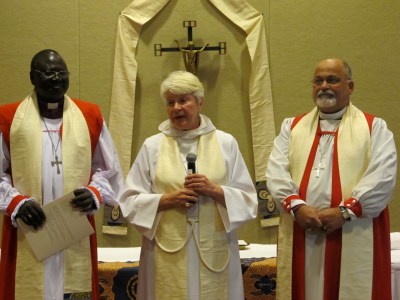
There is lots packed into a General Convention so the service didn’t begin until 9:30pm. As wonderful as it was, I have to say I was a bit weary during the first part of the service. That changed during the passing of the peace when the three bishops in the service took a liturgical liberty to tell the congregation about their relationship.

From left to right, that’s Ruben Akurdit, of Bor, Sudan; Cate Waynick of Indianapolis, Indiana; and Mauricio Andrade of Brasilia, Brazil. Together, they have a three-way companion diocese relationship. Last year, Cate and Mauricio were in Bor together. (Three-way companion relationships are increasingly common. We recently saw the fruit of another relationship in this letter to Rowan Williams from several bishops.)

In their comments, the three bishops stressed how they see in one another the body of Christ: difference (of race, background, culture, sex, etc.) but commonality in worshipping the same God in Christ.

I was completely awake by the time they had finished their short remarks. Then, in the Eucharistic prayer, each said the words of institution (the “take eat” part of the liturgy) in their own language. It is not often that a Eucharistic prayer I have heard so often and know so well can surprise and move me but it did on Monday night.

The act of celebrating the Eucharist in multiple languages with people from multiple backgrounds seemed to me to be so central to what the good news of the body of Christ is all about. And it’s yet one more reason I have hope about the future of the church and its role in God’s mission in the world.

Back by popular demand…

We had so much fun signing copies of my new book, Grace at the Garbage Dump, on Sunday that we’re doing it again today.

It’s the last day the exhibit hall is open at General Convention. So if you’re in Indianapolis, swing by the Global Episcopal Mission Network booth—#629, it fronts on the food area—and pick up a copy.

You can also learn all about the new study guide for the book and ways in which you can take all the rhetoric of mission that is swirling around Convention and turn it into reality in your local congregation and diocese.

Candidate for President of House of Deputies Martha Alexander took a break from campaigning to stop by on Sunday. You should too!

Check out some of the great reviews of Grace at the Garbage Dump or read the first chapter for free on Amazon. You’ll realize what an asset this book can be as you head back home from Convention.