“Seize the passion of young people”

The Springfield Republican has an article about my new book, Grace at the Garbage Dump: Making Sense of Mission in the Twenty-First Century.

Zink worked in a community called Itipini—the means “at the dump”–a shantytown community built on the site of a garbage dump. “It was built there so people could scavenge off the refuse and live in shacks they built themselves out of whatever is available,” he said. “As you can imagine, the socio-economic indicators here at not great—a high incidence of HIV/AIDS, for instance, high unemployment, high rates of poverty. So it is one of the poorest communities in one of the poorest parts of South Africa.”

At first, the experience was overwhelming to him because of the different culture, different language, different people. “I had shown up with such enthusiasm to ‘save the world’ and quickly realized I wasn’t much help at all,” he said. “It was a frustrating, difficult, challenging and completely humbling experience. Here were people in such great need, people I wanted so desperately to be of some use to, and I could barely say hello to them or ask them their name.”

Over time—and this was the advantage of staying two years—he learned their language, Xhosa. He learned how he could fit in and be of use to people, and he learned that the experience wasn’t so much about what he could do for others but about what they could learn from one another and how they could change in light of their meeting.

“I don’t think I’m alone in having my desire to see change in the world,” said Zink, 29. “I think people of my generation are eager to serve others.”

Read the whole article, read the first two chapters of the book for free online, and then tell your friends and order a copy of the book for yourself—from your favourite book retailer or (for the cheapest price) directly from the publisher.

Search for a Gospel that is both Good and New

Let’s say I’m a twenty-something with a college degree, living in Brooklyn. I kind of have a job but no benefits. I get by with money but I have lots of debt. I don’t see what the big deal is about gay marriage and it’s obvious that the earth is getting warmer. My parents dragged me to church a few times when I was growing up so I know something about all that religion stuff, but now my knowledge of religion is mostly based on people like Rick Santorum. I just don’t see the point of faith and I certainly don’t see the need for it in my life. I’m part of the “Rise of the Nones.”

Now let’s say that one day I’m surfing around the Internet and I come across the interview Katharine Jefferts Schori recently gave to the Huffington Post. The words “female” and “bishop” are so rarely connected in my mind that I click on the link to see what she has to say.

Stepping out of the Brooklyn millennial conceit, here’s the question I want to pose: as our fictional twenty-something peruses the interview, does he find anything that is genuinely Good News? That is to say, does he find any of the life-altering, world-changing, drop-everything-and-follow gospel of Christ Jesus?

(Let’s note, of course, all the provisos. Of course, she was responding to questions, of course the interviewers wanted to ask her about hot-button subjects—sex, creation, Scripture—and of course an interview is not a sermon.)

I think the answer to this question about the Good News is no. Our fictional Brooklyn resident wouldn’t find much to disagree with. Bishop Katharine is in sync on same-gender marriage. Good. The church wants to respond to the poverty of the world. Good. She calls it “God’s mission,” but whatever. We agree.

The thing is, while our fictional millennial may think what Bishop Katharine has to say is Good, none of it is New. He already believes all this stuff already. The church is arriving late to the party. Glad to have you here but you’re old news. You do your thing, Bishop Katharine, and I’ll do mine. None of what Bishop Katharine has to say would, I think, make our millennial think, “Wow, I’ve got to learn more about Jesus and get myself into church!” In fact, by my count, the presiding bishop is quoted mentioning General Convention (once), more than she mentions Jesus (none).

Again, all my earlier provisos apply and nothing in this post is a comment on the presiding bishop herself. This interview, I’m sure you will agree, well represents the dominant working theology in the Episcopal Church in the early twenty-first century.

If you read the Gospels or Acts, it is clear that when people heard the proclamation of the Good News, their lives were transformed. Not just adjusted or modified but completely reoriented towards Christ. The fact that the gospel had such an impact is, to my mind, one of the best confirmations of its truth.

What is the Gospel message in the twenty-first century that is both authentically Good and authentically New, the proclamation that seizes the attention of the hearer and brings about dramatic life change?

How do we preach the unique witness of Jesus Christ in a way that makes people who’ve never heard about Jesus want to devote their whole lives to following in the Way he first showed to us?

That, it seems, are questions we still need to answer.

The Cross in our Midst in Holy Week

There are many seemingly intractable situations in South Sudan but one that has gotten a fair bit of attention recently is the ongoing violence in Jonglei state. As we sit in this Holy Week, there is an update on the situation, in the form of a report from Daniel Deng Bul, Archbishop of the Episcopal Church of Sudan and a lead negotiator in Jonglei.

The Committee feels that there is a new momentum for peace in Jonglei State at all levels, from the grassroots right up the national government. We appeal to all stakeholders within Jonglei and South Sudan to put aside their differences and take this opportunity to work together for peace, reconciliation and tolerance. Enough is enough.

We appeal to all to speak the language of peace, reconciliation and tolerance, particularly our diaspora and intellectuals. We must all accept responsibility for what we say and what we do, to give peace a chance in Jonglei and the whole of South Sudan.

I highlight this for two reasons. First, it’s a reminder of the way our sisters and brothers in Christ around the world are on the frontlines of some difficult situations. It’s one thing, as I did last night, to sit and look at images of violence in the world and reflect on daily crucifixions in this world. It’s entirely another, as members of Archbishop Daniel’s commission will do tomorrow, to visit devastated villages on Good Friday and see the cross in our midst.

Second, it is always worth highlighting—since it seems it is so easily forgotten—that in many parts of the world, it is the church that is the active agent for peace and reconciliation in society, in part because that is the church’s calling but also because in some cases the church is the most well-established organization in society.

Daniel Deng Bul, incidentally, was recently nominated by a British think-tank for their person of the year award.

Tenebrae in Commemoration of Martin Luther King, Jr.

Tonight at our weekly community chapel service, we read these words for Martin Luther King, Jr. Speaking in his “Eulogy for the Martyred Children,” he says:

So they have something to say to us in their death. They have something to say to every minister of the gospel who has remained silent behind the safe security of stained-glass windows. They have something to say to every politician who has fed his constituents the stale bread of hatred and the spoiled meat of racism…. They say to each of us, black and white alike, that we must substitute courage for caution. They say to us that we must be concerned not merely about WHO murdered them, but about the system, the way of life and the philosophy which PRODUCED the murderers…. The innocent blood of these little girls may well serve as the redemptive force that will bring new light to this dark city.

As we heard these words, this is the picture that was projected on a screen at the front of the chapel.

It was one of the many powerful combinations of word and image we had in this evening’s service of Tenebrae at Berkeley Divinity School. Tenebrae is one of those rare gems of in the Episcopal (and other) liturgical tradition—the service of “shadows” that marks the Wednesday of Holy Week, the moment before the holiest three days of the Christian year begins. It’s a non-Eucharistic service that allows the congregation to dwell in the readings and psalmody and let the force of the coming events wash over us.

This year, the Wednesday of Holy Week (the so-called “Spy Wednesday”), falls on the anniversary of the martyrdom of Martin Luther King, Jr. It was 44 years ago today that he was killed on a balcony in Memphis, preparing to mark with striking sanitation workers.

We meshed the two together—a Tenebrae in Commemoration of the Martyrdom of Martin Luther King, Jr. We situated the events of this week and the killing of Martin alongside more recent crucifixions that have occurred and continue to take place every day in this world—rampant sexual violence in the eastern Congo; a history of lynchings in this country; protestors dying in Syria; and, of course, too much else to name or number even in one service. We read some of the Scripture readings appointed for the service but also listened to words from Martin and others. In lieu of a single icon in the chapel, we used an electronic iconostasis, projecting images during the readings.

I’m on the team that prepares worship at Berkeley so during most of evening services I’m a bundle of excess energy trying to make sure that everything is going to go just right. But tonight I sat down and let things wash over me. And it was simply incredible. Just as the one crucifixion two thousand years ago convicts me of my sin and imperfection—I was the one who went from shouting “Hosanna” to crying “Crucify”; I was the apostle that abandoned Jesus in his hour of need—the ongoing crucifixion in this world convicts me of my own disgraceful ignorance, apathy, and self-deceit.

But here is the good news, and it is news that is at the heart of the Christian Gospel: the story doesn’t end tonight. Holy Week doesn’t end on Friday on the cross. It ends with an earthquake and an empty tomb on Sunday morning.

As we left the chapel in silence, there was one final candle burning, the light that has kept people moving at even the darkest hours, the promise that new birth can—and will—come from even the darkest and deadest of situations.

What we talk about when we talk about mission in the church

I’ve written before about how the church is in need of a conversation about what we mean when we use the word “mission” in the church.

And how, there’s more, this time on the Episcopal News Service, partly adapted from my new book, Grace at the Garbage Dump:

Those first few weeks, I stayed close to our clinic and let the residents of Itipini come to me if they needed help. It was safe. “They” came to “me.” But it was an untenable and unsatisfactory situation. I hadn’t moved to South Africa to sit in a clinic all day. Gradually, I began to venture forth. I met people like Fumanekile who made it feel safe to wander farther afield. I began to think in terms of “we,” not just “they” and “me.”

I came to think of the Incarnation in a new light. By being born in a manger, God in Christ crossed the hitherto impassable barrier between human and divine and showed up in a place no one expected. Jesus took time — thirty years, in fact — to build relationships with those around him. If I was going to model my life on Christ’s — be a Christian, in other words — something of the same had to happen in my life. I needed God’s grace to overcome my fear and share an existence with people who seemed different than me and lived in a different place. Gradually, imperfectly, incompletely, that happened.

God’s mission calls us to engage the multiple forms of difference in this world — down the street or around the world — and doing so in a vulnerable, Christ-like way. It’s great that we’re talking so much about mission in the church. But if we don’t talk about it without also talking about our individual, personal need to change — the forgiveness, renewal, and transformation that comes in baptism and is reaffirmed each time we celebrate the Eucharist — and the difficulty and joy of modeling our lives on Christ’s, then it’s hard to see how the conversation is going to help us proclaim the good news of God in Christ.

Read the whole thing. And then read the first two chapters for free on Amazon to read even more about the Fumanekile, the man whose story I tell in this piece.

McCarthyism in Church Politics

Last summer, when I was visiting the Church in Nigeria, some of my blog posts got picked up by the American Anglican Council. I was accused of preaching “deviant theology” (especially for this post about a diocese trying to educate girls). I didn’t think much about the comment but I did start keeping an eye on some of the more polemical Anglican web sites out there, both conservative and not.

At the same time, you might remember, Congress was consumed by a conversation (a generous word, perhaps) about raising the federal debt ceiling. As I listened to that debate and read Anglican commentary, I was struck by the similarity in the rhetoric: scorched-earth, difference-equals-wrong, the-apocalypse-is-around-the-corner-if-the-other-side-gets-their-way, etc., etc. You know how it is.

I still keep an occasional eye on the American Anglican Council and was recently perusing their quarterly newsletter. There’s coverage in there of a recent meeting in South Africa that was—gasp!—not polemically opposed to same-gender marriage. On the face of it, this article is not awful. In fact, it’s more coverage than many other Anglican news organizations mustered about the event.

What’s chilling about it, however, is the inclusion of a list of participants—sometimes quite vague; someone “who spoke about oppression of women,” for instance—with the clear indication that participating in such a conversation was somehow an indictable offense. Forget, indictment, actually. The tone of it is that they are already guilty. It seems a clear case of judging people by whom they chose to meet and interact with.

You know who else was judged for exactly that? A Galilean carpenter. That same Galilean carpenter who once stopped at a well in Samaria of all places for a drink, a place where no one expected him to be, and talked with a woman, someone he wasn’t supposed to be talking to. And the result? Transformation, for the woman and her town, as she became the gospel’s first evangelist.

My travels in the world church have repeatedly prompted one question in me: what would happen if Anglicans, modeling themselves on Jesus, started showing up in places where no one expects us to be and listening to people who are different to us?

I don’t know for sure but I do know we’ll never get there if we keep terrorizing people who try to do exactly that.

“The church speaks the language of reconciliation. Not the government.”

I am a reader of The Economist, the British news magazine that has, to my knowledge, more foreign correspondents than any print news organization in the world. The Economist covers events even after they drop from the headlines in the rest of the world’s media.

But even it can falter. I thought about that while reading about the primate of Canada’s recent visit to the Church in Melanesia. Part of the visit included time in the Solomon Islands with Fr. Sam Ata, an Anglican priest and chair of the Truth and Reconciliation Commission in the Solomons.

Let’s be honest. How many of us are aware of the ongoing process of recovery in the Solomons following the violence between 1998 and 2003? How many of us know that this TRC process has been ongoing for some time? Not even The Economist has been giving much play to it.

And yet—there is the church. When the eyes of the world are turned away, when even sister and brother Anglicans are focused on a proposed covenant, the sex (or sex life) of its bishops, or any of a myriad of other things, the local church in the Solomon Islands remains an instrument of peace and reconciliation.

It reminds me of the church in South Sudan, a place where I’ve spent some time. There, in intensely poor and incredibly remote parts of the country, the government’s remit does not run. But the church is still there, running schools, building clinics, feeding refugees, and much else; “preaching good news of peace” (Acts 10:36) in other words. When society is on the verge of breakdown because of inter-tribal violence, who does the government ask to negotiate peace? The church. No one else has the authority, the stature, or the ability to do so.

So, as at least part of the attention of the church is occupied by a defeated covenant, a proposal for “radical hospitality,” and conversation (dare I call it naval gazing?) about church structure, spare a thought for our sisters and brothers in Christ around the world on the frontlines of some of the most difficult and intractable situations imaginable.

And then ask yourself: how can we support our fellow members in the one body of Jesus Christ?

Grace at the Garbage Dump now on Kindle!

If you’re technologically inclined—and not interested in waiting for the mail to arrive—you can now download Grace at the Garbage Dump directly to your Kindle!. Amazon has it available for the low price of $9.99.

Even if you’re not technologically inclined, you can still surf over there and read the first two chapters for free. What a deal!

The hard copy of the book will be available on Amazon in due time (another few weeks). In the meantime, order it from your local bookstore or directly from the publisher—still the cheapest and fastest way to get it.

For now, orders for addresses outside of the U.S. need to be made by e-mailing or contacting the publisher directly. orders@wipfandstock.com or (541) 344-1528.

Thinking Outside the Box on the See of Canterbury

What if the next Archbishop of Canterbury wasn’t British? Who would it be?

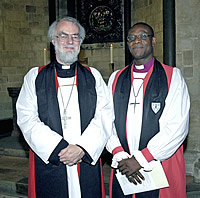
I recommend Thabo Makgoba, archbishop of Cape Town and primate of the Anglican Church of Southern Africa. He’s educated, outspoken on important issues, young(ish), and has been called “the Denzel Washington of the Anglican Communion.”

Filling Rowan Williams’ shoes was never going to be easy—any successor will have to stack up to one of the greatest theological minds of the generation. Going for an outside-the-box appointment—first Archbishop of Canterbury from outside England since Augustine?—lays to rest those possible comparisons and frees the successor to be fully himself (or herself, but that won’t happen—yet—to the see of Canterbury).

The Archbishop of Canterbury fills at least three roles simultaneously—(nominal) diocesan of Canterbury, primate of All England, and a figure of unity for the Anglican Communion. As a non-English Anglican, I, naturally, put the most emphasis on that last role, which is why I’d love to see the position filled by someone who represents the part of world where Anglicanism is growing fastest. The Crown Appointments Commission, I think, probably has that second role chiefly in mind, along with the ceremonial functions that go with being head of an Established church.

If not Archbishop Thabo, how about Josiah Idowu-Fearon, bishop of Kaduna in Nigeria? He’s super-educated, an expert on Islam, and has shown his independence from the Nigerian church hierarchy by, inter alia, calling for primates not boycott a Primates Council meeting. Not sure how old he is, though. (Wikipedia says he’s about 63.)

Other thoughts for outside-the-British-Isles picks for the next occupant of St. Augustine’s throne?

Can we sustain our own weight?

A year or so ago, I heard Rick Ufford-Chase, former moderator of the Presbyterian Church USA, speak at Yale Divinity School. Rick has had—and continues to have—a fascinating ministerial career so it’ll be unfair to him that the comment I remember best from his presentation has to do with budgets.

Rick remembered that in each budgeting process while he was moderator, some ministry of the churchwide office was cut. The church was spending less and less money each year and so having to pare itself further and further down.

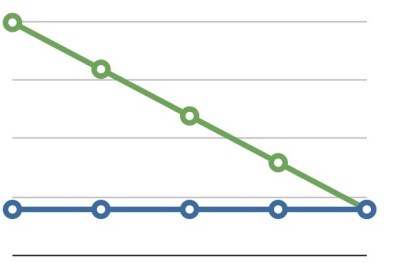
He drew a graph that looked like this.

The blue line is the basic cost of supporting the church’s infrastructure. The green line is the ministries it supports. Rick’s point is that you can’t just keep paring until you get to zero. At some point, the budget would reach a point at which the church could no longer sustain the weight of its own bureaucracy. At this point, he thought, everything would just collapse.

In Episcopal terms, the blue line is the basic cost of supporting the infrastructure of a churchwide entity—a presiding bishop, a president of the House of Deputies, a General Convention. The green line is the (declining) amount of money to spend on various ministries—anti-racism, women’s, Christian formation, youth, for instance, to name some of the Episcopal Church’s ministries that have been cut or are proposed to be cut in recent budgets.

So what will happen when green meets blue? The proposed budget for the next three years of the Episcopal Church made me wonder if, perhaps, we’ve reached that point. The budget, as I read it, eliminates the General Board of Examining Chaplains, the group that administers the General Ordination Exams, the series of tests that prospective priests take to prove their competency in the seven areas required by the canons of the church. The GOEs have been seen as a necessary part of the church’s bureaucracy. The canons require competency. Not all dioceses have the resources to assess competency on their own. There’s an argument to be made, anyway, for national standards of competency. So the church developed the Board of Examining Chaplains, which, in turn, oversees the GOEs.

Our church has these great canons that lay out a detailed structure for a way of being church. Yet if we don’t have the money to put into practice what those canons require, what’s the point? Where does it leave us as a church?

This General Convention is going to name the committee to lead the search for the next presiding bishop. One wonders, though, at the rate we’re going just how much church will be left for him or her to preside over.