Alleged Anglican Disunity Blocks the Mission of God

I spent Saturday at the diocesan council meeting of the Diocese of Yola. Yola is the capital of Adamawa state – “the Sunshine State” – and is in north-east Nigeria, not far from the border with Cameroon. Northern Nigeria is more Muslim, poorer, and less populated than the rest of the country so I knew that Yola would give me a different perspective on the church than I’ve had in my first weeks in the East. This meeting confirmed it.

A major topic of conversation was the purchase of a second car for the diocese. Right now, they only have the bishop’s car and it is used for everything, from travels around the diocese (the farthest church is five hours away on bad roads) to errands in town. They need another vehicle not only for back-up but also because there is just too much demand for the one vehicle.

The trouble is that they can’t afford it. The car they want – a 2002 Camry or a 2001 Peugeot 406 – costs about $11,000 and so far the diocese has saved about two-thirds of that. There was a lengthy discussion on whether to keep saving or buy something cheaper. That turned into a conversation about maintenance and which mechanics could care for which brands of car. It is clear that the diocese is taking this quite seriously, as I could tell by the way the conversation reached mind-numbing levels of detail.

The next topic after the car was completing construction on the new site for the diocesan secondary school. (I haven’t written about this yet but the government in Nigeria has essentially abdicated responsibility for education so the church plays a huge role in this.) They need 400 bags of cement to finish the next phase of construction. Each bag costs about $15. Again, they just don’t have the money so they brainstormed about how to raise that money – ask each deanery to contribute? approach richer members of congregations?

I had two thoughts on listening to these conversations. The first is how different it is to Owerri, where the diocese has about four cars, many parishes own vans, and 400 bags of cement would be nothing.
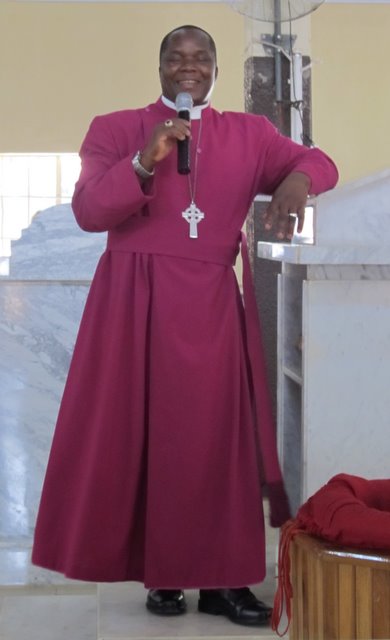
(Bishop Marcus as he introduces me to the cathedral congregation this morning.)

The second was how clear a need there is for international partnerships in a place like Yola. They have hard-working clergy here, who speak good English and manage their finances transparently. Bishop Marcus Ibrahim is young, smart, energetic, and educated in the U.S (and on Facebook). Yet not a penny of the money the diocese has spent in his six years as bishop has come from abroad. (Some of it comes from other Nigerian dioceses, including Owerri, however.) He has looked and looked for partnerships and had no luck. The reason? The divisions in the Anglican Communion. Mainline Americans (and others) are conditioned to think that Nigeria is closed territory to them. (It’s not, as my presence here demonstrates.)

But surely, you say, those conservative Episcopal/Anglicans in the U.S. and elsewhere that have made such a big deal of their support and concern for the “orthodox” church in places like Nigeria are helping out? Nope. GAFCON folks are nowhere to be found in Yola or any of these other dioceses that have serious needs. It seems like they confine themselves to the big cities, where the rich dioceses and senior bishops are.

The way in which artificial divisions among leaders are causing serious headaches – and creating serious obstacles to the mission of God – in a place like Yola infuriates me. Nigerian after Nigerian is telling me that while they disagree with me on some issues, there is no reason we cannot still work together. Yet that is not the narrative that is propagated at the highest levels of Anglicanism – and to which most people, unfortunately, seem to be listening.

Yola’s annual budget is approximately equal to that of a mid-sized Episcopal Church in the U.S. Yola – and other similar dioceses – present a terrific opportunity for mission-minded congregations throughout the Anglican Communion to form path-breaking new partnerships that would not only do important work in an important area of the world but also helpfully shake up the rather-stale discourse on alleged Anglican disunity.

“I am a true Nigerian!”

Apparently, the state of New York has approved same-sex marriage legislation.

Even if I had missed the news online, I would have heard about it this morning when I attended church at the chapel in the governor’s office. (It’s just down from the mosque.) The bulletin contained a message from the chaplain thanking the congregation for their support at his daughter’s wedding yesterday. It added that the “perversion of the world has distorted God’s concept of marriage,” citing New York as an example. “This is a sign of the last days and as Christians we need to be cautious of these times.”

I was at the government chapel because Bishop Marcus was preaching. New York was on his mind as well. He was especially concerned with what it would make the congregation – the movers and shakers of state government – think of him. They all know about the issues in the Anglican Communion. He reassured the congregation that he thought homosexuality was wrong and that they could be sure he would not allow same-sex marriages in his church. He wasn’t polemical or offensive about it. He just said he thought it was wrong. He concluded with an emphatic, “I am a true Nigerian!” as if opposition to homosexuality is part and parcel of Nigerian identity. (It may well be.)

Later, I was introduced as a visitor from America who was “brave” enough to come to Nigeria when bishops and priests refused to. The chaplain thanked me for coming and prayed for me, making some serious assumptions along the way. “We send you as a missionary to your country to quench this fountain of sin that has welled up in your society, this menace that threatens your country. We pray for righteousness to spring up in your land and for true followers to gather around you.” I was left feeling more than a little uncomfortable but there was no chance for me to speak, nor, if there had been, was I sure what I would have said.

Lest Americans forget (and we often do), the rest of the world is watching us all the time. Our actions have impacts around the world. I saw this in Sudan last year with priests who told me how people accuse them of belonging to the “gay church.” That doesn’t change the rightness or wrongness of our actions. But I hope we spare a thought for how our actions affect our brothers and sisters around the world, who have to spend lengthy sermon minutes defending themselves.

At the same time, I regret the assumption by the chaplain that only certain kinds of Americans would bother to visit Nigeria. Why does he think that only people who toe the line on one narrow issue are worthy of visiting? The answer is clearly that this issue has become a short-hand test for fidelity to a certain Biblical “orthodoxy.” Why is that? I think that’s a question for another post.

Uzuakoli Archdeaconery

So I’ve left Owerri – not without some pangs of regret at leaving behind great people and good friends – and am now (though by the time I post this will probably be gone) in Umuahia. The difference in dioceses is pronounced. Owerri is older, better established, and richer. These two regions, though only an hour drive away from one another, were evangelized by different Anglican missionaries and those differences still have an impact today.

Umuahia’s relative youth and poverty don’t prevent it from doing some great things, however. There are still large churches, impressive diocesan institutions, and capable clergy. The most interesting part of the visit for me, though, was the time I spent in the most rural of Umuahia’s archdeaconeries, centred on the small town of Uzuakoli.

During the missionary era, the different denominations split up territory. Uzuakoli was Methodist territory so there are some large Methodist churches around here. The Anglican presence was started by Yorubas (from western Nigeria) who worked on Nigeria’s once-thriving rail system. So Anglicanism has always been an outsider religion in Uzuakoli.

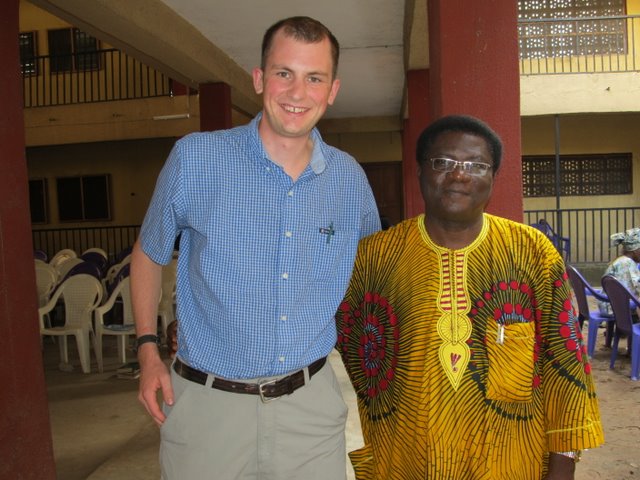
The archdeacon is a man named Simple (on the left in this picture – more than a passing resemblance to James Franco, I think). He is devoted to rural ministry and has spent a huge part of his career out in Uzuakoli, even though it’s not a great place to work if you’re interested in advancing your career.

His main church gets 30 people on Sunday. He has 11 other mission stations scattered around a huge territory. None of them are in church buildings. Mostly, they are just rented rooms with a few benches and a small altar, led by lay people. In a few instances, they actually meet in people’s homes. This is a far cry from the stories of overflowing thousand-member congregations I heard in Owerri.

I pressed Simple on why there had to be an Anglican presence in this area. Why not just let the Methodists (and Catholics) take care of things? They are Christian after all. Simple said that their real concern is the growth of what are called “new generation churches” – the charismatic, pentecostal, independent churches run by spirit-ordained pastors. He said many of them blur the lines between Christianity and sorcery, witchcraft, and whatnot and so he sees it as his job to teach the “raw Gospel” so that the truth will set people free. “Although there are many churches here already,” he said, “there is still need for those that preach only the Gospel.”

The most touching moment for me was in the last church we visited. There were the three archdeacons who were touring me around, a lay pastoral worker, a seminary student, and four, older members of the congregation – two-thirds of their Sunday attendance. As is my wont, I started asking questions about Anglican identity, the structure of the church, and so on. The conversation was in danger of turning into a seminar, especially since one of the archdeacons is a seminary professor.

Here we are as we are leaving.

But then one of the old men stood up. He had something to say. “Sometimes,” he said, “we are ashamed to be Anglicans in this village. Other churches are much bigger and we are ashamed of our little room.

“But today you have come here. It is evangelism for you to come here. People in our village will be talking, “The white man went to that little Anglican church!’ It will be the talk of the town.”

I told him that we were both members of the Anglican Communion and that there are millions of us around the world and there is nothing to be ashamed of in being Anglican. On the way out, I made sure to smile and talk with as many people in the village as possible. One of the women in the Anglican church gave me a pineapple as thanks.

Everyone is always asking what Anglican unity “looks” like. The answer? A lot like a pineapple.

Sudan: Bishop Calls for Churchwide Day of Prayer, Fasting for an End to Violence

21 June 2011

From the office of the Bishop of the Episcopal Diocese of Kadugli, Sudan:

A Call To Prayer and Fasting to End the Nuba Genocide, and for the Peace of all Sudan! – Sunday June 26, 2011

To all my brothers and sisters in Christ,

On behalf of my people in the Nuba Mountains of Sudan we are asking all Sudanese Christians wherever they are, and the Church throughout the world to join with us in a day of prayer and fasting on June 26, 2011.

Once again we are facing the nightmare of genocide of our people in a final attempt to erase our culture and society from the face of the earth. It is not a war between armies that is being fought in our land, but the utter destruction of our way of life and our history, as demonstrated by the genocide of our neighbors and relatives in Darfur. This is a war of domination and eradication, at it?s core it is a war of terror by the government of Sudan against their people.

As we approach the July 9 day of independence for the New South Sudan, President Bashir has declared for all the world to hear that Sharia will be the law of the land for the North, refusing to recognize the legitimate presence of the Christian minority. It is a declaration of their determination to also end the remembrance of our Christian heritage that dates back two thousand years to the story of the Ethiopian eunuch (who was from modern day Sudan).

At this moment, there is a meeting in Ethiopia with the different parties of Sudan, the African Union and other international parties seeking to find a true path of peace that recognizes our right to survive and thrive as a people, both Muslim and Christian alike, with equality and justice for all. Please pray and fast with us as you are able for a solution to this crisis.

Please forward to everyone.

Rt. Revd Andudu Adam Elnail

Bishop of the Episcopal Diocese of Kadugli, Sudan

Prosperity Gospel in Nigeria

I heard a sermon the other day – on Joshua 1:1-4 – which contained the following lines.

“Somebody’s business shall increase!” “Somebody’s property shall increase!” “Today heaven is laying a hand on you to do wonders in your life and family!” “As from today, anywhere you put the sole of your feet, he will give it to you!”

Each of these statements was followed by lots of “Amens” and “Hallelujahs.” The people were clearly excited at the prospect of – in the preacher’s words – being “little Joshuas.”

But I was thinking about how this sermon shows the influence of the prosperity gospel on the Anglican church in Nigeria. One bishop here told me that many of the independent pentecostal churches preach an “American-style gospel of prosperity.” I asked him if it had spread to the Anglican Church as well. “It’s a virus that is taking us over,” he replied.

The prosperity gospel basically emphasizes that by believing in God, good things will come your way. Often – in one stereotyped view – it is tied to donations to the church. If you give greatly to the pastor, God will greatly bless you (while he rides off in his new car…).

It’s not surprising that the prosperity gospel should be prevalent. Lots of people here watch Christian television stations like TBN that preach what I think is not exactly the most robust or accurate theology.

But the Anglican church is working against this. Last week, I attended an expository preaching conference put on by the Langham Institute of Nigeria. (Langham Place is the location of a famous evangelical Anglican church in London that John Stott once pastored. Its influence has spread far and wide.) It was a four-day conference for 120 clergy from Owerri and surrounding dioceses. I was very impressed. The presenters – all Nigerians – focused on helping clergy understand the context of a passage before preaching on it. The repeated line was, “You must know what it meant to them then before you can understand what it means to us now.”

Emeka, the leader of the conference, told me that “the root of the prosperity gospel is to say the Bible is all about me, me, me. We want to say the Bible is about God, God, God.” Later, he mocked (very effectively) a prosperity gospel-style sermon and had everybody laughing. But, he said, “we have turned the Bible into entertainment and that is why we have so many Christians who are not deep in the faith.”

Christian, another staff member, told me, “It is not that we are against prosperity. But I don’t think the reason Jesus Christ came to earth was to bring prosperity. He came to save mankind from sin.” The secret, Christian thought, was to preach “the way of the cross.” This is not very popular, of course, and the prosperity gospel has an inherent appeal: everyone wants to think that God will increase our territory. The Gospel will always be “foolishness to those who are perishing but to us who are being saved it is eternal life” (I Cor. 1:18).

I should say about that sermon I heard in church that the Joshua part was only one-third of the sermon. He also talked about the importance of forgiveness and unity. Two out of three ain’t bad, I guess.

Having Fun

There’s something undeniably exciting about riding to church in a convoy of cars.

That’s what happened to me on Sunday morning. The bishop was off to make a pastoral visit to Christ Church, the largest in the diocese. We had a four-car convoy – the archdeacon at Christ Church in his own car, two congregants in the church’s van, the bishop’s Corolla, and a visiting bishop in a Forerunner. I felt like the president on his way to make some speech. Sure, A Corolla isn’t a heavily armored limo and our convoy was quickly broken up by motorized tricycle taxis darting in and out. But it still felt neat.

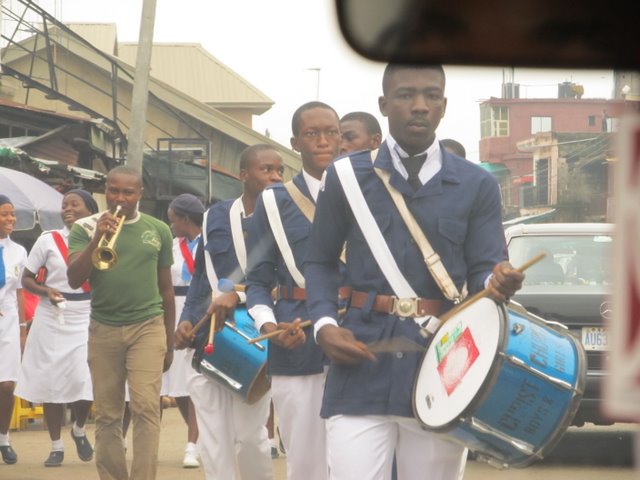
Then, a few block short of Christ Church – right in the middle of Owerri’s sprawling market – we were met by a band. A band! There were about six trumpets and a few drummers. The bishop put on his stole, screwed together his collapsible crozier, got out of the car, and started waving to shoppers in the market and blessing all who passed by.

Pretty soon, we were in the church compound where scores of people were in the yard to greet the bishops. They marched around to the front doors, blessing the members of the choir as they went, and – barely missing a beat – started the procession into the service.

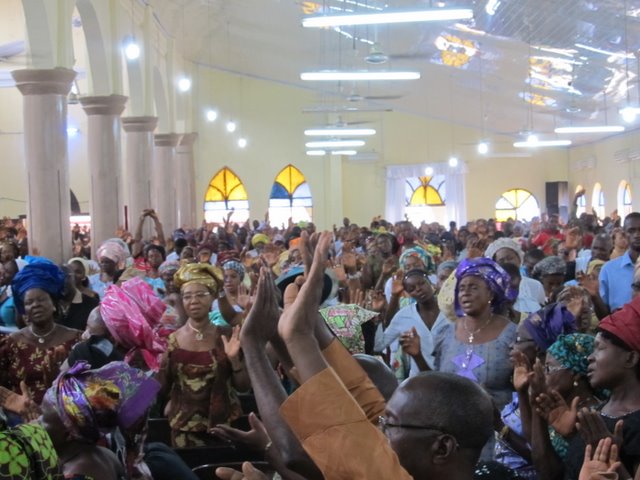
I got mixed up in the procession with the choir and was swept down the centre aisle. There were a thousand people in the church and it was almost too much – overwhelming music, vivid colours in the clothing, dancing, and people, so many people. But it was also amazing – the energy, the enthusiasm, the sheer sense of the magnitude of what was going on.

(Pictures do not even begin to do this justice.)

The bishop greeted everyone in what amounted to a boisterous, exuberant fifteen-minute pre-service praise session – lots of Hallelujahs, lots of singing, lots of praying, lots of laughter. Then the bishops went off, vested, came back and did the service. The energy that was there at the beginning carried through the service.

Say what you want about Anglicans in Nigeria but this cannot be denied: they’re having fun.

“The ambit of Anglicanism”

One of the obvious features of the growth of the church in the non-western world is its charismatic and pentecostal nature. I’m using these words kind of loosely here but basically I mean them to say that worship services in the developing world are not generally staid and traditional affairs. Often, it is the charismatic churches that are growing the fastest.

This creates a problem for Anglicans, who have historically been defined by a set liturgical structure. In Nigeria, the Anglican church – seeing the independent pentecostal churches as a threat to its growth – has responded with becoming more flexible and adopting and adapting more charismatic styles of worship. One priest here told me, “If those other churches are singing and dancing, then let us do that too. Let the pastor jump around. Let us change the liturgy.” In fact, this same priest told me, “I’m not boasting but I’m better than any charismatic pastor. Now, they all want to be like me.” These changes create the same tensions in Nigeria that worship changes do all over the world – basically, the young people love the new style and the old people don’t. That leaves it to the bishop to sort things out. This priest was ordained in 1994 and he told me that when he was newly ordained, he used to “pray for bishops who support charismatic worship, but none did. Now, almost all do.”

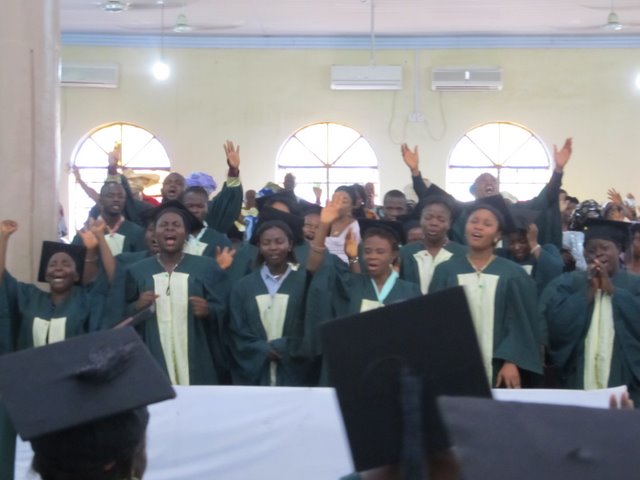
I saw the effects this morning in church where the service alternated between old standards from Hymns Ancient and Modern, a communion anthem from Handel’s Messiah (no, really – and the choir did a good job of it too), and praise choruses from the band. There was an immense amount of energy and exuberance in the service. (At least at first. By about hour four, people were fading.) It was a communion service and the words of institution were said. But a lot of other words, many of which are not – gasp! – in the prayer book, were said as well. There was more than a fair bit of ex temporizing going on. I’ve been to a few non-communion services here which bear little resemblance to anything in any prayer book I’ve ever seen.

All this amounts to a challenge to Anglican unity – and you don’t have to come all the way to Nigeria to see this. There are charismatic, non-liturgical churches in the Church of England as well. One of the hallmarks of Anglican identity is said to be the common structure of prayer based, to some degree, on Cranmer’s Prayer Book. But the influence of pentecostalism in Nigeria and elsewhere challenges that. I asked one priest if he had a set liturgy for his services. He paused. “Not really,” he said. But, he hastily added, “it is within the ambit of Anglicanism.” (He really said “ambit.”)

Who gets to decide what counts as “the ambit of Anglicanism”?

(The influence goes both ways, incidentally. Unaffiliated pentecostal church leaders admire the vestments and do-dads that Anglican priests get. So you start seeing charismatic leaders in purple shirts or cassocks. As a result, vestment-making in Owerri is big business. Perhaps as Anglicans become more charismatic, charismatics are becoming more Anglican.)

A global awareness

As I travel this summer, I am thinking often of a man named Howard Johnson. He was the canon theologian at the Cathedral of St. John the Divine in New York City in the 1950s and early 1960s. From 1959 to 1961, he took a leave of absence and – at the prompting of the Presiding Bishop’s Council on Anglican Relations – he visited every province of the Anglican Communion in one long journey – 730 days of non-stop travel. When he returned, he wrote a book about it called Global Odyssey and spoke widely about his travels.

At the 1963 Anglican Congress in Toronto, he had this to say:

We Anglicans stumbled into universality – prodded, I believe, by Providence. But our consciousness of ourselves has not yet caught up with the reality of ourselves. In actuality we are a multiracial, multilingual, multicultural body, but in awareness we are still parochial and provincial.

I used to think this was still true. Certainly the vast majority of Episcopalians and Anglicans I have met – especially in the U.S. – identify first with their local parish, second with their diocese, third with their national church, and fourth with the Anglican Communion. Many never make it beyond the parish level.

But then I came to Nigeria. I continue to be amazed at how many Nigerian Anglicans know about and are interested in ongoing conflicts in the Anglican Communion. I’m not talking about bishops and archdeacons here. The parishioners I’ve spoken with know something about it as well. Obviously, it’s impossible to draw sweeping judgments on these things when I will only ever met a small handful of the members of the Anglican Church of Nigeria but I thought one young man’s comment was telling the other day. When I asked him what he knew about the American church, he said, “I know there are some in the church who obey the Scripture and some who do not. We have sent bishops to help those who obey Scripture and have not turned it upside down to suit them.” The impressive weekly diocesan paper carries quite a bit of news on global Anglican affairs. One archdeacon I met has read reports from the Episcopal Church’s General Convention and the Lambeth Conference going back to the late 1950s. How many American priests have done that with their own Convention reports, let alone the reports of the Church of Nigeria?

As I’ve noted, all the church signs here identify the churches as, for instance, St. Paul’s Church, Diocese of Owerri, Church of Nigeria (Anglican Communion). No one has been able to tell me why they say “Anglican Communion,” instead of just “Anglican Church of Nigeria” but it’s the way it has always been and means many Anglicans here are, by default, reminded of the existence of the Communion every time they go to church.

There’s also a strong effort to raise young people in a particularly Anglican identity. That same young man used words like “preferment (of archdeacons),” “translation (of a bishop),” “collation (of canons),” and knew about the Lambeth Quadrilateral. He learned these things in his youth group. The mind boggles. How many American Episcopalians know these sorts of things?

Those who care more deeply about an issue, it is clear, usually triumph in the end. Right now, Americans – and broadly “liberal” Anglicans in general – are completely ceding the playing field. This is in keeping, of course, with Americans’ generally narrow-minded approach to the world that can’t see why everything that’s important isn’t found right at home. But given this context, it’s not surprising that the forces that tend towards disunity and fracture are doing so well.

Other Voices of Nigerian Anglicanism

I have been deeply impressed by the clergy I’ve met so far in the diocese of Owerri. They are spiritual, prayerful, educated, thoughtful, and work incredible hours. With labourers like these, it is no wonder the church is growing so quickly here.

Here are snapshots of three.

Paul is the archdeacon in charge of the cathedral and also overseas continuing education for the clergy. We’ve had some good conversations about the importance of servant leadership. He worries that young people are becoming priests for the wrong reasons – status, influence – and prays for as much time as possible to mentor the fifteen or so priests under his charge. He recently preached a sermon on the statement that came out of last year’s Lausanne Conference in Cape Town that called Christians to a life of “simplicity, integrity, and humility.” “If 4000 Christians can agree on that,” he told me, “surely there is something we can learn from it.”

Chuks came to pick me up from the airport. He has five children, is in charge of a cluster of churches, helps prepare confirmands around the diocese, and teaches religion at a local university. He just finished – about three weeks ago – his Ph.D dissertation, which was on how the church can respond to people with physical disabilities. He has extensive experience as a church planter. One church he started grew from 20 people on the first Sunday to over 500 less than two years later. I asked him the secret to successful evangelism. “Church planting demands sacrifice. You must devote your all to it.” The second secret? “You must not condemn people. They must know you first and then they will accept the Gospel.”

Chike was a businessman for twenty years but always involved in various forms of lay ministry. Eleven years ago, he was ordained a priest. “I always knew that God had a calling on my life,” he said. “But I never thought it would involve wearing a collar.” When he went before the committee that decides whether to approve him for ordination, he was asked, “Why do you seek to enter the ministry now?” “Point of correction,” he replied. “I am already in the ministry. I am just seeking a different form of it.” Chike overseas formation for new priests now and is especially interested – as all good priests here are – in deepening the faith of people who already profess Christianity. He says there is a three-pronged approach to mission: reach, build, send. “God did not save you to get you to heaven,” he tells people. “God saved you to send you.” Chike is also a prolific author and has written several books.

All these men are, well, men, as are most of the people I’ve spoken with in my time in Owerri thus far. It’s not for lack of trying that I haven’t spoken at length with women but cultural barriers can be difficult to breach. I’m still working at it.

I should say that I have also discussed with all these men the question of homosexuality and divisions in the Anglican Communion. All of them are opposed to homosexuality and believe it is incompatible with Scripture. But none of them are opposed in a polemical fashion. They are interested in hearing what I have to say and how gay people can come to be students at a seminary. They also think that it is possible to disagree on this question and still be united as Anglicans.

Any of these priests would make great bishops and may yet be called. But they also have a lack of ambition that comes from a deep sense of self-assurance, which means they likely never will be. Still, as I talk with them, I ask myself: what would happen to the Anglican Communion if these were the voices of Nigerian Anglicanism that were the loudest?

Anglican Christian Fathers’ Fellowship

A few years ago, the diocese of Owerri began a new organization – the Anglican Christian Fathers’ Fellowship as a way to reach out to men in their congregations, somewhat as a Mothers’ Union-type organization for men. This past weekend was the annual diocesan conference – about one thousand men, representing all the parishes of the diocese, listening to talks on various subjects, all under the theme “Our Children Are Coming.” There was even a lengthy talk on hypertension. (Whenever you think I am just gallivanting around Africa having a grand ol’ time, remember the hour and a half I spent listening to an exquisitely-detailed talk on high blood pressure. This is research, people, not vacation.)

I wasn’t able to be part of the entire conference but I did catch a good deal of it. One text that was repeatedly referred to was Ephesians 6:4 about how fathers are supposed to rear their children in the ways of godliness. (Or something like that. I don’t have the text in front of me.) In his keynote address on Saturday, the bishop said that in Igbo culture, men are so focused on having sons that they ignore their daughters. This, he said, was wrong and un-Biblical, citing the Ephesians passage. (It is a rare example of the household codes being used for a liberative purpose.) He looked at lots of fathers in the Old Testament – Abraham, Moses, Samuel – and drew lessons from them. The major lesson was that you need to be involved with your children’s lives. He also essentially endorsed women’s ordination along the way.

(The contrast the bishop drew with Christian practice and the demands of Igbo culture reminded me that in my experience, Christians in Africa are so much more aware of how their culture influences their faith than westerners are. This is likely because the experience of living in a non-Christian culture is at most only a few generations removed. But culture, of course, shapes the American church as well. Is it any wonder that a society as individualistic and consumeristic as ours has produced a theology that stresses the importance of a “personal relationship with Jesus Christ” and worship services that resemble rock concerts? But we fail to notice these things and instead think we can be both Christian and live the values of our culture.)

The conference concluded with a five-hour (!) thanksgiving service on Sunday which all the senior clergy in the diocese attended. Awards were handed out to “distinguished Christian fathers.” The evangelistic worship style of the Nigerian church was on full display, more on which in another post.

Here I am addressing the thanksgiving service and presenting Bishop Cyril with a Yale Divinity School paperweight.

I had some questions about the fathers conference – for instance, is it really accessible to all men or just the sub-set of wealthy fathers? There was a registration fee for the conference and significant costs associated with attending. But as I have learned elsewhere in Africa, the Anglican church has a lot of repenting to do for being too focused on higher-status and wealthier people.

Those concerns aside, I found it so fascinating that a church could be full of men three days in a row. What a concept!

(There are a few more pictures on Facebook.)