What we talk about when we talk about “Africa”

About a year ago, there was this excellent satirical video that encouraged Africans to send heaters to Norway to help address the cold.

If all you knew about Norway was what you saw in those clips, you would think it was pretty awful, right?

I have been thinking about that video as I read coverage of the unfolding disasters in South Sudan and the Central African Republic. The conflicts exemplify the two ways that international media have to report on conflict in sub-Saharan Africa.

First, there’s the Christian-Muslim frame. The violence is seen as the result of hostility between followers of two great faiths. We have seen this in the last month in reporting on the Central African Republic. The archetype for this reporting is the ongoing violence in Nigeria.

Second, there’s the “ancient tribal hatreds” frame. This is the theme that has dominated coverage of the violence in South Sudan. (This Guardian story, for instance.) The Dinka and the Nuer are said to be at each other’s throats as they always have been. There is little analysis of just how “ancient” these “hatreds” are and how real a construct the “tribes” are. The archetype for this reporting is the Rwandan genocide, which usually, before long, gets invoked in this kind of reporting.

There are many problems with these frames. “Tribes,” as is now widely recognized by scholars, were frequently a creation of colonial governments. Prior to the arrival of the British in southern Sudan, for instance, the lines between Dinka and Nuer were permeable and fluid. The British wanted to firm up these boundaries to facilitate their policy of indirect rule. This is not to say that people do not now identify as Dinka or Nuer, but it is to say that the reason for the violence is not lost in some pre-historic “mists of time” but is the result of actual decisions made by outsiders.

The other major problem with both frames is that it encourages the reader to throw up their hands and walk away. If you read the comments after some of these articles, count how many times people say something like, “Well, if they’ve just been killing each other for so long, why should we intervene and risk our own lives in a never-ending conflict?” That would be a good question—if it were based in reality.

Moreover, these frames neglect the actual voices of people on the ground. No reporters that I have seen appear at all interested in interviewing people who do not fit into their “tribal” schema. Yet if you listen to church leaders in South Sudan speaking across the Dinka-Nuer divide or follow the Twitter hashtag #MyTribeIsSouthSudan, you can see that there is a lot more complexity here than gets reported.

What none of this reporting seems to acknowledge is the real reason for these conflicts: leadership. What is happening in South Sudan right now, is in large measure, the result of the inability of the country’s leaders to address their differences without resorting to violence. Time and again in these last days, I have thought back to Chinua Achebe’s famous opening to his book The Trouble with Nigeria: “The trouble with Nigeria is simply and squarely a failure of leadership.”

Another way of saying this is that the conflict in South Sudan is a political conflict. And political conflicts between leaders have solutions: create institutions that can credibly address conflict; educate and raise up other leaders; reduce the huge number of weapons that are present in situations like this so that if violence happens it is less destructive; create opportunities for people from different backgrounds to come together in peace. None of these are easy tasks. All of them take huge amounts of energy and time. None are guaranteed to succeed. But that doesn’t mean we should not continue to try them.

The one thing, above all, that would change how we think about “Africa” is if we would simply listen to the voices of Africans. This would challenge our listening abilities in many ways. But there is simply no substitute for listening to how people experience, perceive, and understand what is happening to them.

Christians around the world are preparing to celebrate the Feast of the Incarnation, in which God came to share human existence in a deep, intimate, and loving way. How can we begin to learn about, understand, and share the experiences of our sisters and brothers around the world?

(And, of course, if you haven’t, you should read, “How to Write about Africa” by Binyavanga Wainaina.)

Disaster and Displacement: Sudan’s exilic church

In the last fifty years, the great shaping force for the church in southern Sudan has been displacement. This week, as some southern Sudanese have once again been displaced, I find myself wondering what the impact will be on the church.

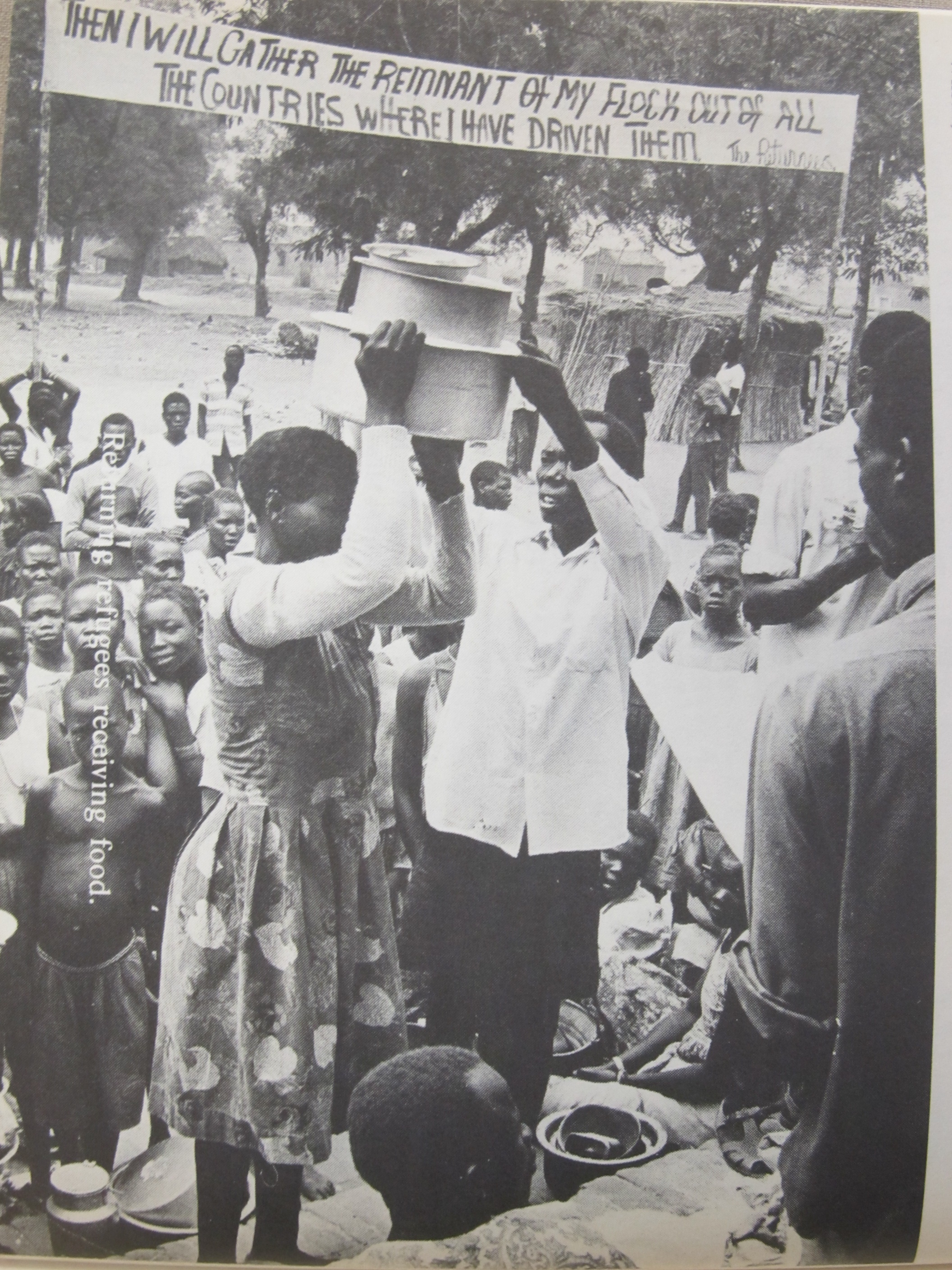
IMG_6558.JPGDuring Sudan’s first civil war, from 1955 to 1972, hundreds of thousands of people were displaced from their homes in the Equatoria region in the far southern part of the country. Some ended up in refugee camps in Uganda, Zaire, and the Central African Republic. But most were displaced within the country. They fled away from the unsafe roads and deep into the bush. Whether externally- or internally-displaced, one thing these refugees did was re-create the church in their new homes. Towards the end of the war, one Sudanese pastor wrote to his British bishop from the bush: “Do not be sad for us. We are still going on with our work, and the Church is still growing in this area. We have no leader or bishops to help us but here we have our great Bishop. He is leading us in the great difficulties of our work.” When the war ended, people began to return home. They interpreted their experience in Biblical terms. The picture on the left shows returning refugees with a banner quoting Jeremiah: “Then I will gather the remnant of my flock out of all the countries where I have driven them. The returnees.”

Sudan’s second civil war, from 1983 to 2005, similarly displaced hundreds of thousands of people, though many were from the middle band of the country, places like Jonglei, Lakes, and Bahr el Ghazal. Again, whether displaced in refugee camps in Ethiopia, Kenya, or Uganda, or within Sudan, these people re-created the church where they were. In the Ethiopian refugee camps in the late 1980s, there were multi-day services where thousands of people were baptized. In Kenya in the 1990s, one bishop confirmed several thousand over the course of a three-day service. In Ugandan refugee camps, a committee laboured to create a new hymnal to share with others some of the huge number of hymns that were being written by new converts during the war. (I wrote about this in an earlier post as well.)

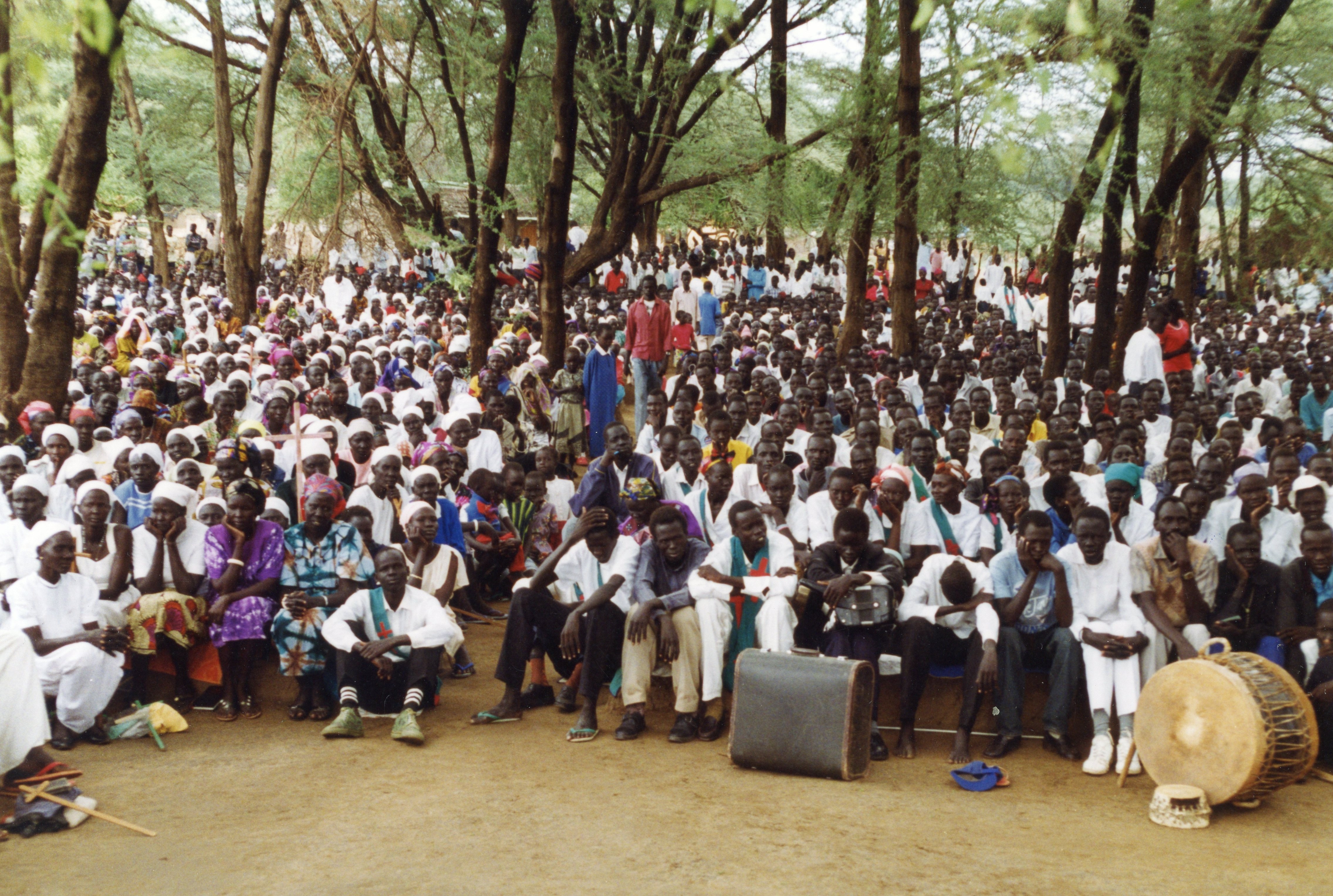
A church service at Kakuma Refugee Camp, Kenya, c. 1995

Many people were displaced within the country. In the centre of the country, some Anglicans founded a Bible school at a place deep in the bush called Dhiaukuei. It became a place where Christians came for Bible training, literacy education, and mutual support. Every year between Christmas and New Year’s, thousands of internally-displaced southerners would gather for a giant celebration of the nativity. It was a chance to be strengthened by the bonds they shared as one people in Christ before returning to their villages and the uncertain future that awaited them.

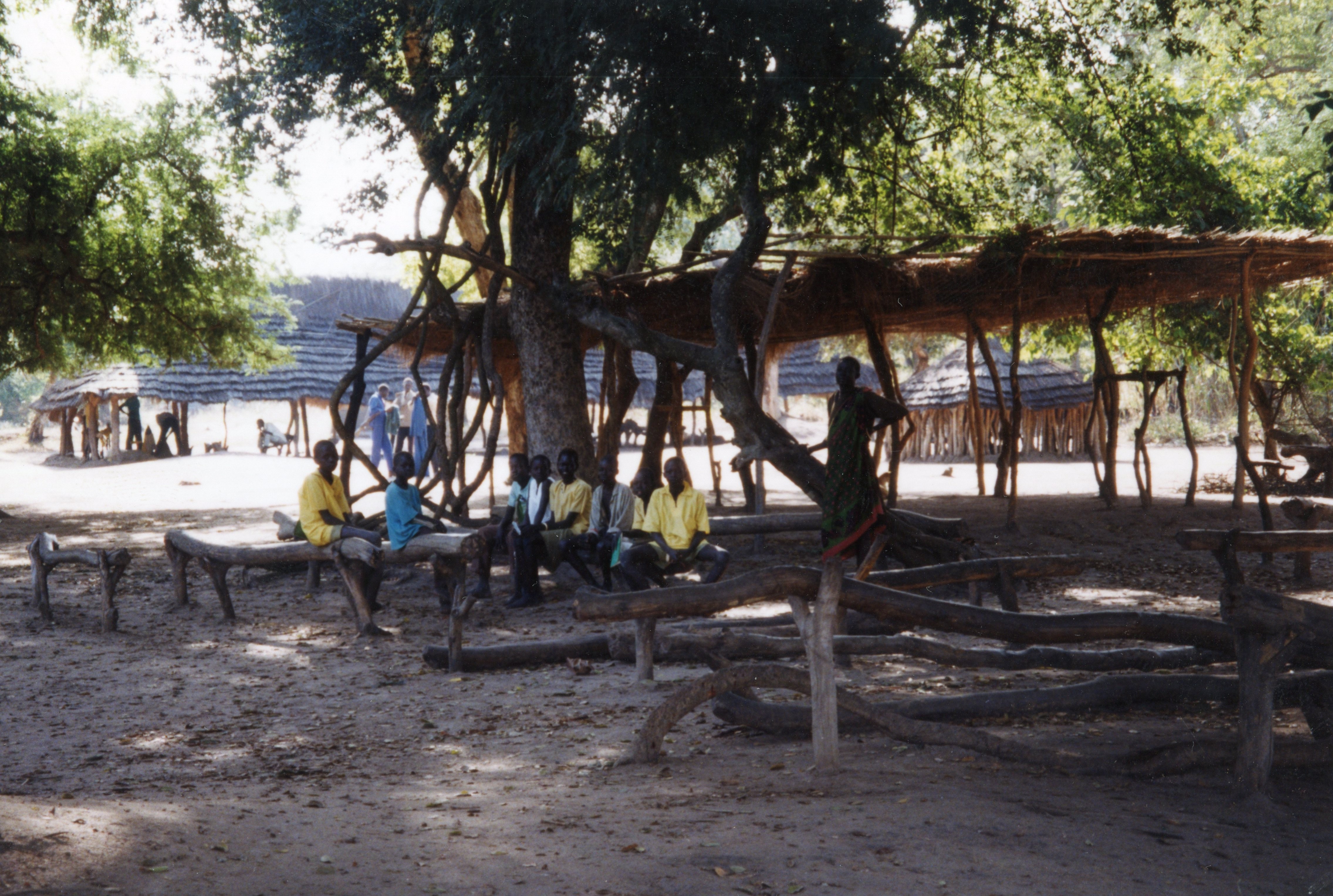
A quiet moment at Dhiaukuei Bible School, c. 1995

I know this because this is the area of research for my doctoral dissertation. These are stories that I have been privileged to hear in the course of my oral history interviews. But there’s also another theme I have heard repeatedly: when displaced, these church members felt like the rest of the church around the world had forgotten about them. Time and time again I have seen in the letters that survive from this period the theme, “We are all members of the body of Christ. But how come you Christians around the world are ignoring us?” For instance, between 1983 and 1991 over 400,000 southern Sudanese sought refuge in camps in Ethiopia. In that time, a single British pastor—a man named Tim Biles—came to visit Anglicans there. In April, I interviewed the southern Sudanese pastor in charge of one of the camps. Out of the blue, he asked me if I knew Tim Biles. I said I did. The Sudanese pastor looked straight at me: “You tell Tim Biles we still remember him. Of all the world, he was the only one who remembered us when we were suffering in Ethiopia.” Tim Biles visited the camp for one day twenty-five years ago. By embodying the reality of the body of Christ, he had an incredible impact on the church.

When he was archbishop of Canterbury, George Carey visited Dhiaukuei. I have spoken to many people who remember that visit. It is clear the memory of it has not dimmed one bit in the intervening twenty years. One woman told me that when he came, “We thought, ‘OK, if part of our body from a different part of the world came to visit us, then the message of Jesus Christ which said, “We are all parts of the same body,” is true.'”

As I have read the news in the last week from South Sudan (not to mention in the last month from the Central African Republic), I have been struck—and disturbed—by how similar it is to reports from Sudan’s two previous civil wars. This week, I have been trying to contact Daniel, the priest who translated for me on a recent visit to South Sudan, but have learned only that he is one of many people who have fled into the bush. Those of us who rely on computers for communication know little about what is going on. But if past experience is any guide, we can be sure of one thing: the church is there, interpreting the experience for its members and, in turn, being shaped by the experience.

To use the Biblical term, the church in South Sudan is an exilic church. It is a church whose members know both what it is like to wander in the wilderness and what it is like to have been driven from their Jerusalem and into foreign lands. I wish it weren’t so. I wish that Sudan had known more peace in the last fifty years. But exile is part of life in our fallen world, though its burden falls more heavily on some than on others. For those of us who do not share the experience of exile, the question is: how do we embody the reality of our relations as one body in Jesus Christ and help bear the burden of exile?

(Some of the photos in this post have been collected from private individuals in the course of my doctoral research. Please do not use them without first contacting me. The themes in this post are adapted from my chapter in the forthcoming Oxford History of Anglicanism and from my new book, Backpacking through the Anglican Communion.)

Bor and Jonglei, the church and state—a history of deep inter-connection

As violence continues in South Sudan, attention has come to be focused on Bor and Jonglei state. It is not surprising. This is a region that has played a key role in the history of the country—and the church. As events continue to unfold there, they are sure to continue to shape the country and the churchThe region that is now Jonglei state has long had a variety of ethnicities—Dinka, Nuer, Murle, and others. While it is tempting for outsiders to see these as fixed, concrete, “tribal” identities, it seems more likely that before the colonial period the boundaries between ethnicities were fluid and shifting. Dinka and Nuer, for instance, had much in common in terms of religion, language, etc. It was the British colonialists who insisted on fixing identities more firmly because it made them easier to rule.

Sudan’s second civil war more or less began with an army mutiny at Bor in 1983. In 1991, the rebel Sudan People’s Liberation Army, which had grown out of that 1983 mutiny, split. The leader of the breakaway faction was Riak Machar, who has become a key player in the confusing events of the past week. In November 1991, with the support of the Khartoum government, his forces unleashed what became known as the “Bor Massacre,” in which several thousand Dinka around Bor were killed and hundreds of thousands displaced into an international Dinka diaspora that persists to this day. This event, more than any other, politicized ethnic identities in Jonglei and resulted in factional violence that was the most catastrophic part of the civil war.

Nathaniel Garang Anyieth, first Anglican bishop of Bor, c. 1992

The church has been present in the midst of all this history as well. The first Anglican mission station in southern Sudan was founded about six miles south of Bor, at a place called Malek, in 1906 among the Dinka. For a variety of reasons, the missionaries didn’t have much success. It wasn’t until 1984 that an Anglican bishop was consecrated for Bor. His name was Nathaniel Garang Anyieth and shortly after his consecration, Bor was attacked by the Khartoum government. Bor essentially emptied, as its residents fled for safety to their home villages or into the deep and inaccessible marshes along the Nile River.

Bishop Nathaniel was among those who fled. For the next five or six years, he moved among his people in these rural areas, cut off from the world but ministering all the same. At Lambeth 1988, he was referred to as the “Lost Bishop” because no one knew what had happened to him. Finally, in 1990, he was able to re-establish contact with the outside world—and he had quite the story to tell. The Dinka had turned to Christianity in great numbers and he had been baptizing, training, and ordaining just about as fast as he could.

In the 1990s, the church began what was known as the People-to-People peace process. Only the church was trusted to bring together grassroots Dinka and Nuer leaders to address conflicts and work towards reconciliation. These conferences are widely recognized as significantly reducing inter-communal violence and setting the stage of Riak Machar’s eventual reconciliation with the SPLA and his integration into the government of the new country.

All of this is background to the events of the past week. I spent much of April in Bor and Jonglei and have this week been trying to call people I know—with little success, as cell phones batteries appear to have run out. I have, however, managed to speak with people not in Jonglei but who have heard from those who are there. People are reported to be fleeing Bor to their villages and across the Nile—just as they have done in the past.

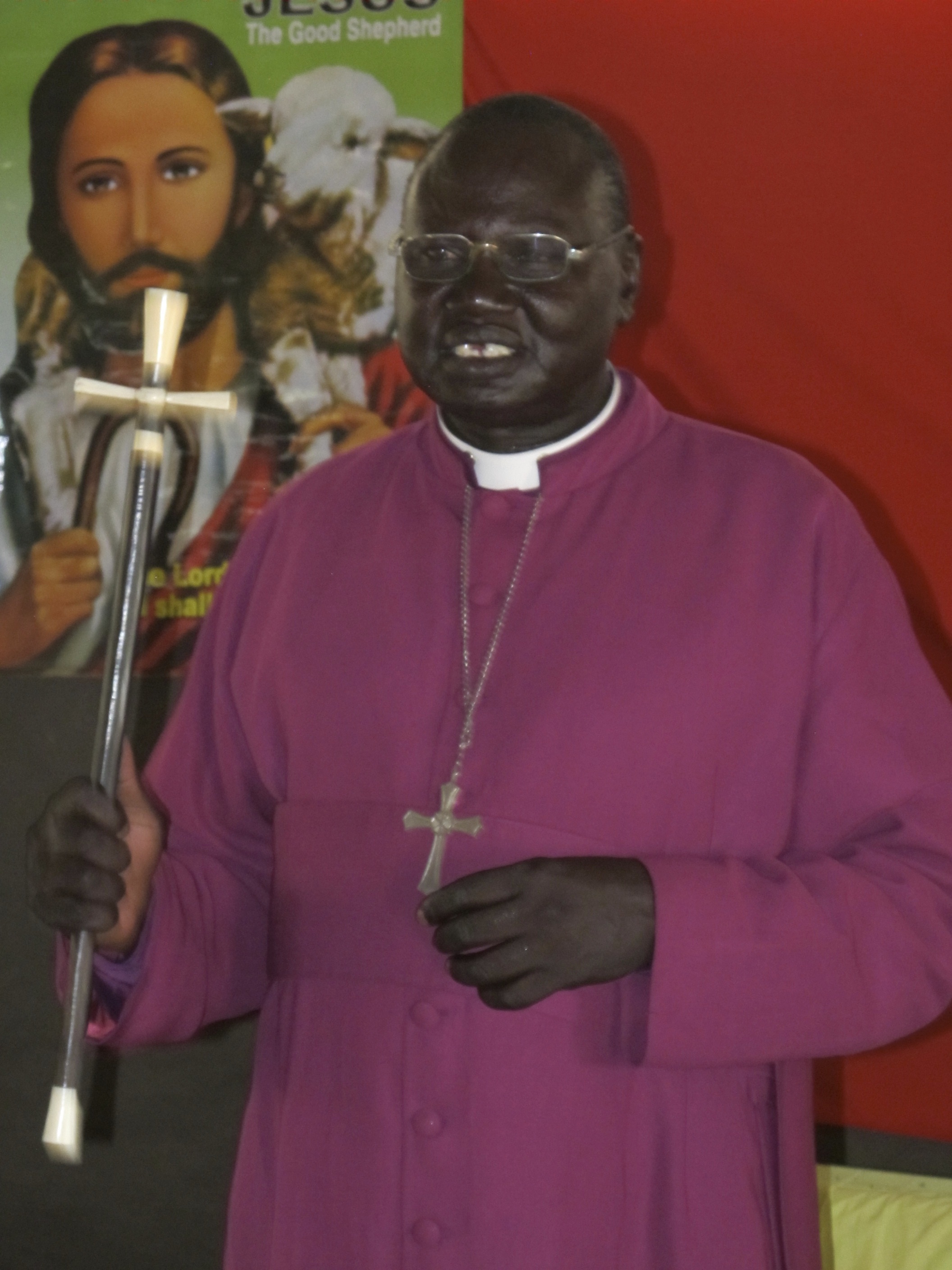
Ruben Akurdit Ngong, bishop of Bor
Ruben Akurdit Ngong, bishop of Bor, April 2013

Bishop Nathaniel’s successor, Ruben Akurdit Ngong, is reported to be in the UN compound just outside Bor. He, along with an unknown—but large—number of other people are seeking refuge there. Again, this is what bishops in this part of the country do. They go to where the people are and stay with them. During the civil war, some bishops were forced to seek refuge in Juba, Khartoum, or abroad. I once asked Nathaniel Garang why he went into the bush with his people, rather than to a city. He looked at me like the answer was the most obvious thing in the world: “Because I was there with the people. If I leave them, the church would not happen. My staying with the people, that’s how they received the gospel.”

What we desperately don’t want is another civil war with Bor at its centre. The Anglican archbishop, Daniel Deng Bul (who is from Jonglei), this year was appointed to chair a national peace and reconciliation commission. Shortly before this week’s violence broke out, that commission released an exciting update on their work. Given the church’s history of peace-building, it seems like they have ever chance of succeeding—if supported and given the opportunity. But South Sudan’s leaders seem intent on ruining the chance for reconciliation before the work can even begin.

Just as I was finishing this post, I came across this video from the UN compound in Bor.

It is situations like these that are the setting for the profoundly incarnational ministry of the church in South Sudan.

(Some of the photos in this post have been collected from private individuals in the course of my doctoral research. Please do not use them without first contacting me. My new book, Backpacking through the Anglican Communion, contains much more about the history of the church in South Sudan. I have followed this post up with a second with more gleanings from South Sudan’s history relevant to the current moment.)

South Sudan church leaders respond to recent violence

Readers of this blog will know I have more than a passing interest in the goings-on in South Sudan. So it is with some alarm that I have been hearing of the violence in Juba and elsewhere this week.

Church leaders in South Sudan have issued two statements recently in response to the violence—both models of Christ-like reconciliation at a deeply uncertain and precarious time.

The first is from several senior clerics:

MESSAGE OF PEACE AND RECONCILIATION

FROM CHURCH LEADERS IN JUBA, 17th DECEMBER 2013

So the king said, ‘Bring me a sword’, and they brought a sword before the king. The king said, ‘Divide the living boy in two; then give half to one, and half to the other.’ But the woman whose son was alive said to the king—because compassion for her son burned within her—‘Please, my lord, give her the living boy; certainly do not kill him!’ The other said, ‘It shall be neither mine nor yours; divide it.’Then the king responded: ‘Give the first woman the living boy; do not kill him. She is his mother.’All Israel heard of the judgement that the king had rendered; and they stood in awe of the king, because they perceived that the wisdom of God was in him, to execute justice. (1 Kings 3:24-28)

Whatever has happened in Juba over the last few days, we are concerned about the consequences.

There is a political problem between leaders within the SPLM. This should not be turned into an ethnic problem. Sadly, on the ground it is developing into tribalism. This must be defused urgently before it spreads.

Reconciliation is needed between the political leaders. Violence is not an acceptable way of resolving disputes. This must be done in a peaceful and civilised manner. Reconciliation is at the heart of the Church’s ministry, a key Gospel value, and so we offer ourselves as mediators.

The way this incident is handled will have an effect on the future of our nation, whether positive or negative, both internally and in terms of international relations.

We are concerned about ongoing insecurity. Today was supposed to be a normal business day, but that was not the case. Fighting, killing and looting continued. The army must be controlled. We appeal to the security forces, who are our brothers, our sons and our parishioners, to exercise restraint and responsibility and to respect civilians.

We urge the civilians to remain calm and to stay somewhere safe. The government should give information to civilians when there are security operations and direct them where to go for safety.

We wish to see assurances for the safety of our international friends, including those from neighbouring countries, who are here to help us.

We urge the government, UN and NGOs to provide humanitarian assistance to the displaced civilians in Juba, and to ensure that water and food are available for the population.

We are in the season leading up to Christmas. This year’s Christmas may not be what we expected, but it is what we have been given and we must accept it as it is. As we celebrate the birth of the Christ-child, let us remember that God is with us, and pray for the strength and courage to bring peace, reconciliation and healing to our new nation.

Text of message given to TV and radio media on 17th December 2013 by Archbishop Paulino Lukudu Loro on behalf of the following Church leaders:

Archbishop Paulino Lukudu Loro, Catholic Church
Archbishop Daniel Deng Bul, ECSSS
Bishop Arkangelo Wani Lemi, AIC
Moderator Rev Tut Kony Nyang, SSPEC
Rev John Yor Nyiker, Secretary General PCOSS
Bishop Emeritus Paride Taban, Catholic Church
Bishop Michael Taban Toro, Chair SSCC
Rev Mark Akec Cien, Acting Secretary General SSCC

As these leaders make clear, the violence is first and foremost the result of a political conflict—though media representations tend to highlight the ethnic elements.

In response to that, Dinka and Nuer church leaders have issued this statement, showing that reconciliation is not only possible, but happening even now.

December 18, 2013

We, the Archbishop, Moderators, Overseer, and clergy from various denominations of the churches in South Sudan, and native members from the Dinka and Nuer Communities:

Identify ourselves not as representatives of tribes or denominations but as leaders and representatives of one church and one body of Christ.

We are gathered, united and speaking in one voice that peace and reconciliation must prevail in our country.

We are saddened of the conflict which has happened in Juba and ongoing in other areas like Bor in Jonglei State. We are concerned about the consequences. It is unfortunate many lives have been lost, many more wounded while many others displaced in their own country. We condole with the families who have lost their loved ones and those separated from their families by the conflict in Juba, Bor and other areas

We condemn the clash and acts of violence which have happened within the barracks of the Republic of South Sudan.

We condemn and correct the media statements and reports that refer to the violence as conflict between the Dinka and Nuer tribes. Whatever has happened should not be referred to as ethnic conflict and not between the Dinka and Nuer communities. These are political differences among the Sudan People’s Liberation Movement (SPLM) Party, political leaders of the Republic of South Sudan.

Therefore, we appeal to the two communities of Dinka and Nuer not to accept that the conflict is between the two tribes.

We appeal to the army and security organs of our Government of South Sudan to take control of the situation and protect its citizens. Our citizens are running for refuge in UN Compounds because they do not feel safe from their own security forces.

We are concerned about the reports of abuse, harassment and killing of individual citizens based on their ethnic affiliation. These are happening and witnessed for the last three days. Soldiers are asking civilians to identify themselves by tribes and we cannot accept to be identified by our tribes as we are all South Sudanese. We condemn such acts of abuse and hope that no more human lives should be lost.

We appeal to our Government to ensure safety of leaders under arrest and ensure speedy justice for any criminal act but most importantly reconciliation for political differences.

We appeal to our political leaders to refrain from hate speeches that may incite and escalate the violence. We urge to initiate dialogues and resolve issues amicably.

We appeal to the international community to respond fast and positively to the humanitarian crisis which has developed in the last three days particularly in Juba and Bor.

We appeal to our President of the Republic of South Sudan, His Excellency Salva Kiir Mayardit to continue to calm and ensure safety for our nation.

Most Reverend Daniel Deng Bul, Archbishop of Episcopal Church of South
Sudan and Sudan (ECSS)
Rev. Tut Kony Nyang, Moderator of the South Sudan Presbyterian
Evangelical Church
Bishop Dr. Isaiah Majok Dau, Overseer, Sudan Pentecostal Church
Rt. Rev. David Akau Kuol, Bishop of Diocese of Awerial, ECSS
Bishop Michael Taban, Chairperson of South Sudan Council of Churches
Rev. Mark Akech Cien, Acting General Secretary of South Sudan Council
of Churches
Rev. James Yout Chuol, ECSS, Diocese of Akobo
Rev. Daniel Deng Anhiany, ECSS, Diocese of Malakal
Rev. Samuel Galuak Marial, ECSS Diocese of Twich East
Rev. Peter Adum Deng, ECSS, Diocese of Twich East
Rev. William Mou Deng, ECSS, Diocese of Wau and Aweil
Rev. Philip Aduong Thiong, ECSS Diocese of Juba
Rev. John Chol Daau, ECSS Diocese of Bor
Rev. Yat Michael Ruot, South Sudan Presbyterian Evangelical Church
Rev. Gatkuoth Chuol Bul, South Sudan Presbyterian Evangelical Church

The list of signers includes Samuel Marial, principal of Bishop Gwynne College.

For me, the key unknown at this point is the situation in Jonglei, one of South Sudan’s states and a key site of inter-ethnic violence during the civil war. I hope to hear more from there soon.

With prayers for peace in South Sudan!

The church’s mission: helping the world live with complexity

Last spring, I wrote a review essay of two books by Presiding Bishop Katharine Jefferts Schori. In it, I found reason for praise and reason for critique. In the 1500 or so words, I tried to present a well-rounded understanding of what she had written, as well as make an argument about some of the current thinking about mission in the church.

An author for VirtueOnline, the premier source of conservative Anglican polemic, used my article to make an entirely different case:

The Christianity of liberal Pecusa leaders rings hollow as they not only violate the teachings of Scripture on human sexuality, but they do so on other fronts as well like not suing fellow Christians. Now, this injunction would only be a problem for liberal Pecusa leaders if they are, in fact, Christians. So, I ask you, what does their practice suggest about their standing with the Almighty?

This led to a string of comments about whether or not the presiding bishop was Christian, even though my review contained the sentence—conveniently overlooked by the author and his commenters—that “The reader is left in no doubt of Jefferts Schori’s strong, lucid, and passionate faith in God in Christ.”

I thought of that when I read this week Robert Hendrickson’s critique of the Presiding Bishop’s Christmas message. He takes her to task for not referring to Jesus often enough:

Whether it is time to consider the Incarnation or the Resurrection, the Presiding Bishop is consistent in her unwillingness to mention the person in whom our whole faith and hope rests.  It takes some effort to avoid using the name of Jesus in an Easter or Christmas message – multiple times.

He even offers a word cloud that shows the absence of the J-word.

Then, yesterday, I got my weekly update from the American Anglican Council, a conservative organization that has broken away from the Episcopal Church. The lead story was nothing more than a link to Robert’s post, the word cloud image, and this text:

Notice anything missing in the Presiding Bishops’ sermon? Jesus! How could a Christian leader forget to specifically mention Christ – especially at Christmas?

The author then carries on in a familiar vein for a bit longer. (Incidentally, I don’t particularly enjoy the AAC weekly updates but I started subscribing after they attacked me for my travels in Nigeria some time ago and it was only a kind stranger who brought it to my attention.)

What to make of all this?

First, the obvious: some people will read into your writing whatever they want to see, regardless of what is there.

Does that impose any obligations on those of us (and I think I can include Robert in this category) who are members of the Episcopal Church, not planning to go anywhere, but who, from time to time, feel it necessary to point out how we think things could be different? Does it impose an obligation on us to toe the party line?

I think not. As Robert himself says in a follow-up post, he loves the conversation his initial post generated. He sees it as characteristic of the church he loves. I appreciated the feedback some people sent me on my book review and the way they challenged me to explore further what I was arguing.

Perhaps the real lesson we can take away from this is that the Anglican world is not divided into sharp black and white camps, with the liberals on one side and the conservatives on the other. When the Presiding Bishop speaks, not every member of the church agrees with her, though places like Virtue Online and the AAC would love for you to think otherwise.

Likewise, when the primate of the Church of Nigeria speaks, not every member of his church agrees with him (as I demonstrate, incidentally, in case after case in my new book Backpacking through the Anglican Communion). Yet I know more than a few Episcopalians who have tried to argue precisely this.

There is no shortage of polemical material in the world today. Just turn on the television or visit your favourite web sites. People don’t write to change other people’s minds but to make their point while brooking absolutely no dissent or uncertainty. Frankly, it all gets kind of boringly predictable after a while.

I wrote some months back about the increasing “Congressification of the church”—interestingly, in response to criticisms of another comment by the Presiding Bishop—and I still wonder if the church can help the world deal with complexity. Can we live in a world that doesn’t insist on a black-white, with-us-against-us model of thinking? It would be a powerful witness to the world.


“moving, eloquent and theologically grounded”: first Backpacking review

The book hasn’t even been shipped yet, but the first review of Backpacking through the Anglican Communion: A Search for Unity is hot off the press—or “press,” I should say, since it’s online, though none the less thorough, thoughtful, and complete for that.

You can read it online at the Episcopal Digital Network, but here are a few excerpts:

Zink is a great storyteller. His writing is clear, engaging and accessible, and you are drawn into the lives of the people he met – from huge, wealthy, almost-mega-churches in Nigeria to a tiny church in the Andes of Ecuador and a diocesan cathedral in Sudan made of cinder block with three plastic chairs, total, in the nave….

The book is an excellent means, especially for Anglicans from the wealthy part of the world, to understand the very difficult economic and social contexts of global Anglicanism – especially in Africa. We learn about the challenges posed by Pentecostalism, along with the way poverty and war shapes the issues that a church finds important. This book would be excellent in a study group on global Anglicanism. Indeed, each chapter can stand alone, and the book could be used in a variety of Christian education contexts….

The last chapter is Zink’s moving, eloquent and theologically grounded plea for Anglican unity. He doesn’t have a lot of optimism, and I’d have to agree that our track record of late hasn’t been good. Nonetheless, his case for finding a way to be together and do God’s work in spite of differences of opinion is desperately needed, and I agree with his assessment that Anglicans, of all people, should be able to do this.

I don’t know about optimism, but I definitely have hope for the future of the Anglican Communion—it is hope that is at the core of this book.

Read the whole review and then go order the book for yourself (Cokesbury, Amazon, .ca, .co.uk, or your local bookstore with this information).

What does it mean to be counter-cultural?

The release of the Pilling report on human sexuality in the Church of England brings up the issue of what it means for the church to be counter-cultural.

The Bishop of Birkenhead, for instance, in his dissent writes that the report, if adopted, will deprive the church “of a prophetic vision, [and] allow her to be swept along by the currents of contemporary Western culture.” (para. 468). Therefore, he concludes, the church must reject steps towards blessing same-sex relationships because such rejection would be counter to dominant culture. Others will argue that cultures around the world tend to reject and exclude gay and lesbian people. Therefore, for the church to be counter-cultural, it must be a welcoming and inclusive place.

There are some ways in which we don’t want the church to be counter-cultural. Churches accommodate themselves to culture in a whole number of very good ways. It’s a good thing, for instances, that Christians around the world use a word in their local language for God. (If you think this is a trivial example, consider Islam’s universal use of Allah.) I’ve written about the way the church in Nigeria has accommodated itself to fundraising practices that seem counter to the teachings of Jesus, but in line with Nigerian culture.

These examples aside, being counter-cultural is a strong theme in the Bible. Jesus told his followers that they “do not belong to the world” (John 15:19). St. Paul told the Romans, “Do not be conformed to this world” (12:2). But it is quite another thing to figure out just what that means. There are a bewildering array of cultures and sub-cultures in the world, which proclaim and embody different values, ideas, and intuitions. How do we decide what we are to be counter too?

The Bible makes clear that the most significant way in which Christians demonstrate their distinctiveness is in the nature of their life together. How the Christian community’s members interact with one another, engage in discourse, and welcome others, for instance, are all part of their witness to God. This is what Jesus was getting at when he told his followers that “by this everyone will know that you are my disciples, if you have love one for another” (John 13:35). The apostolic church was noted for its distinctive relationships. The life of the early Christians—“all who believed were together and had all things in common” (Acts 2:44)— was countercultural in the context of a Roman society stratified by divisions of wealth. A central part of St. Paul’s teaching to the Corinthians is that, if they want to follow Jesus, all Christians actually need one another—no matter how unlikely that may seem and how much the world presses them to think otherwise.

Interdependence, relatedness, community: these are ideas that strike me as pretty counter-cultural in our contemporary society. Look to Congress, where compromise has become a dirty word. Look to the increasing fracture of our communities, in which we spend more and more time with people more and more like ourselves. Look at our global world, where we are thrown ever more closely together but with no ability to manage this interaction in any meaningful way.

Perhaps, then, the truly counter-cultural idea is the one that is at the heart of the Pilling report—honest, mutual, open conversations across lines of difference that seek to understand where the other person is coming from and what we can receive and give to one another.

What if the church were to become the one place in the world where such conversation actually happens? If it did, we might find that we are at last being counter-cultural in a way we can all agree on.

Minority Report: Anglican Communion edition

Some years ago, Tom Cruise starred in a movie called Minority Report. The plot revolves around three human “pre-cogs” who can tell when a murder is about to happen. Cruise and company swoop in, arrest the murderer before he or she can commit his crime, and save the day. Things begin to unravel when—to give away the ending—it turns out that three pre-cogs are not always in unanimous agreement but that the dissenting, minority reports are suppressed.

The phrase “minority report” has been stuck in my head lately—but in the context of the church in 2013, not Tom Cruise in 2054. A clear majority of Anglicans are female—yet three weeks worth of reporting in The Church Times about the GAFCON II conference in Nairobi quoted precisely one woman and allotted her one word: an unnamed Ugandan priest was to said have voted “No” on the final communique.

This is not to pick on either GAFCON or The Church Times. The four Anglican Instruments of Communion—the Archbishop of Canterbury, the Primates Meetings, the Lambeth Conference, and the Anglican Consultative Council—are all dominated by men. (In part, this is because they are dominated by bishops, who tend to be male.) The people who are the primary drivers about debates about global Anglican futures tend to be male as well.

Anglicans have been led to believe that there are two sides in debates about our future: the liberals and the conservatives, each presenting unified and diametrically opposing views. But just as Cruise et al. had to learn that the unanimity of their pre-cogs was not what it seemed, so too Anglicans have to learn that we are dealing with more diversity than we may have imagined. Part of the purpose of my writing a book about the Anglican Communion that tries to move beyond bishops and describe life at the grassroots level in different parts of the world was to demonstrate that the loudest voices in the Communion are rarely the most representative—no matter how strenuously they claim they are.

All of this is to say something obvious: the church has a long way to go before we start reflecting the reality of the body of Christ in which we are joined.

This is not to say that the wounds of the Anglican Communion would be healed if we put women in charge. As I show in Backpacking through the Anglican Communion, my experience does not show that women somehow believe in unity and reconciliation in a way that men do not. But it is to say that the model of communion that has been put forth in the last several years has been one that has privileged a handful of voices and disregarded (suppressed?) a huge number of others.

So when we read reports foretelling the death of the Anglican Communion that are authored solely by men, we should label those minority reports—for that is precisely what they are.

What the church has that the Sunday Assembly doesn’t

What, no cassock?

The Sunday Assembly—an atheist, churchlike organization based in London—has received a bit of press lately, first in the Economist and then on the BBC.

On the one hand, I think the apparent success of the Sunday Assembly points to the deeply felt need in the Euro-Atlantic world for community and togetherness. So much of our lives is pulling us apart these days (or bringing us together in unhelpful ways) that I think lots of people are looking for a safe place simply to be with one another. If, for one reason or another, they can’t find it in church, they might look for something like the Sunday Assembly. That they have to look to the Sunday Assembly for this is an indictment of the church, not a critique of the Sunday Assembly.

But as I was listening to the BBC story—lots of upbeat, encouraging chatter, like “who’s ready for another song?”—I could think only of one thing: my many years as a summer camp counselor. In that line of work, the keys to success are enthusiasm and energy—the more the better. I have convinced scores of children to sing inane songs by acting like it was the most wonderful, best, coolest thing ever—my enthusiasm led to my success. The way these Sunday Assembly folks were whipping up their congregation was, I thought, more than a little similar.

But there are problems in this world—illness, addiction, death—to which more enthusiasm is not the answer. The Christian tradition, however, addresses these issues by speaking of sin, grace, repentance, forgiveness, mercy, and so on. I hope people go to church when they are feeling good about life. But it is when people are struggling with life that they should feel especially welcome. Church is the place you go when things aren’t working out. (That it is not always seen this way is another indictment of the church.) It is hard to see how a new widower grieving the loss of his wife would find comfort or solace in singing “Celebration” but hopefully in the celebration of the Eucharist he finds the reminder of Christ’s ultimate triumph over death. And even my energy and enthusiasm as a camp counselor could give way to pastoral attention when the situation called for it.

(I grant that my knowledge of the Sunday Assembly is limited and perhaps they have ways of addressing these concerns I do not know about. Still, it’s hard to see a moment of silence compares to the triumphant victory of Christ.)

Church people don’t always like to admit this, but churches exist in a competitive marketplace—whether it is the Sunday Assembly, soccer games, or simply morning television, there are lots of other activities out there competing for people’s attention. But one thing about competition is that it can force organizations to refocus on their core competencies, their competitive advantage.

I wonder if the Sunday Assembly can help churches return to the central themes and traditions that have carried it the past 2000 years.

BE-Renk

There’s a lovely article in Glencoe News about Noah Hillerbrand, a young, lay Episcopalian, who has just begun working with the Diocese of Renk in South Sudan:

After the family joined Christ Episcopal, Hillerbrand became even more deeply involved in that community. It was his dad Eric who first suggested he meet with Bishop Joseph last fall, when he made one of his many trips to Chicago.

“My first thought was that it sounded really cool, but I thought I’d probably find something else to do,” Hillerbrand said. “But when I asked Bishop Joseph what I could do there, right away he said, ‘Teach English.’ There was no hesitation, and he said he could find plenty for me to do. That was when I felt this was something important.”

I’m particularly delighted that he found my book, Grace at the Garbage Dump, so helpful as he prepared for his time in Renk:

Hillerbrand finds inspiration from a book by Episcopal priest Jesse Zink, who served for two years in a South Africa slum neighborhood’s medical clinic.

The book Zink wrote about his experience ”really spoke to me,” Hillerbrand explained. “When he first arrived, he didn’t know the language, he wasn’t trained to do anything at the clinic. He had to be content with being with these people. He called it a ministry of presence. Realizing the ministry of presence is something that I’ve kind of trained my trip around.”

You can follow Noah’s work on the Facebook page he has set up for his trip, facebook.com/BERenkSSudan.

When we shift our focus in the Anglican Communion away from bishops, it’s amazing what kind of stories we find.