A time for talking and a time for not talking—or do we all just need more time?

imgfullsize

In February of my final year of university, the faculty went on strike. The dispute had been brewing for the entire academic year and provoked plenty of fodder for debate. I have always remembered how discussions seemed to continually circle back to one question: when do you decided that dialogue has failed and opt for other strategies? In other words, when do you walk away from the negotiating table?

I can remember rehearsing the various answers. On the one hand, how can anyone be opposed to something as reasonable as dialogue and negotiation? On the other hand, it is clear that there are ways in which dialogue can be used to perpetuate an unjust status quo and in which at some point one party is justified in declaring that it no longer makes sense to continue in the conversation.

In one way or another, I have had these debates in my head ever since that strike. These issues about the importance of dialogue, conversation, and negotiation have deeply influenced me. Indeed, my reflection on them is a critical part of my new book, Backpacking through the Anglican Communion.

I thought of all these issues again recently when I read two competing essays on the topic. On the one hand, there is Phil Groves, of the Anglican Communion Office, who reflects on the case of Euodia and Syntyche to conclude that

We also need to remember that when disunity appears facilitated conversations are the Biblical way forwards.

For someone who leads the Continuing Indaba project, this is perhaps, not a surprising conclusion.

In response, comes a much lengthier article from Phil Ashey of the American Anglican Council who—never one to shy away from hyperbole—says Ashey “misses the mark by a longshot.” He then proceeds to call reconciliation—a central Biblical concept—some kind of “new religion.” You can read these articles and make up your own mind.

But what neither of these articles addresses is the question of time. “Time all heals all wounds,” it is often (wrongly) said. How does the question of time influence our understanding of conflict transformation?

We might first note that Jesus was not afraid of taking time—it took him thirty years on earth before he began his ministry. So when people start making claims about how much time has elapsed as a reason for determining that dialogue no longer is an option, we can all stop, take a deep breath, and remember that God’s time is not our time.

The other thing is that Jesus invested a lot of his time in people that others thought were hopeless or lost causes. My favourite example of this is Jesus’ encounter with the Samaritan woman at the well in John 4. Jesus takes a break at a well in the middle of the day, meets a woman who has been pretty comprehensively cast out of her society (that’s why she was getting her water in the heat of the day when no one else would be there), and engages her in conversation, even though, as John tells us, “Jews do not share things in common with Samaritans.” (4:9)

I’m not sure if this qualifies as a “facilitated conversation”—there doesn’t seem to be a facilitator at the well—but it does seem to me to be a pretty dramatic example of the fruits of patient engagement with difference. The woman’s life in transformed and she becomes one of the first evangelists, running into town to tell everyone about what she has learned.

When I think about conflicts in the world, whether in the Anglican Communion or beyond, I often think about this story about Jesus and the Samaritan woman. I find myself asking a question. What would happen if we did what Jesus did? Show up where no one expects us to be and taking the time to talk to people who are different than us?

UPDATE: Corrected mistaken reference to Phil Ashey which came out as Phil Groves. A case of too many Phils!

Connection to the outside world

Justin Welby is on a flight to Juba, South Sudan.

(Well not directly. I yearn for the days when you can fly from Heathrow to Juba direct.)

It is easy to underestimate the power of archiepiscopal visits. At least in England, people are used to seeing the archbishop pop up all over the place—preaching at this college, visiting that church, giving an interview to this reporter—that we can get inured to the significance of his presence. Moreover, some people—especially in the media—want action they can report. Think of the headline: “Archbishop brings peace to South Sudan.” But that’s not what the archbishop is going for. In his pre-trip interview with the BBC, he says that the purpose of the trip is, essentially, to be with people.

There is ample precedent for archiepiscopal visitation to what is now South Sudan. George Carey, archbishop in the 1990s, made two visits to Sudan during his tenure. These are vividly remembered by Christians, even today, twenty years later. On one visit, he spent time in Dhiaukuei, a remote community that had become a safe haven for Christians and a centre of learning and evangelism for them. One woman there, remembering his visit, told me that when he came, “We thought, ‘OK, if part of our body from a different part of the world came to visit us, then the message of Jesus Christ which said, “We are all parts of the same body,” is true.’”

Carey’s successor, Rowan Williams, visited South Sudan in 2006. He spent time in Malakal, a town that has been the news recently because it has been one focus of the recent violence. When I was in Malakal in September, people unpromptedly told me about his visit and how everyone—Anglicans and non-Anglicans alike—turned out for his events.

Given all that South Sudan has been through in the last six weeks, I imagine that Archbishop Welby will have a similar welcome—if he allows himself public events—and his visit will have similar significance.

Later in this visit, Archbishop Welby plans to visit the church in the Democratic Republic of Congo. The DRC has its own complex problems of violence and societal fracture. I recently read this from a bishop of the church in the DRC:

The poor infrastructure and lack of communication systems ensure that the church is internally disconnected and lacks sustained contact with the Anglican Communion… [The church] has felt proud to be part of the Anglican Communion but feels unable to fully contribute to the communion or to understand entirely its debates. Many of the problems of poverty, war, hunger, and sickness that are so pressing for the Congolese nation do not appear to be prominent in inter-communion discussions.

(That’s from the chapter by Bishop Titre Ande and Emma Wild-Wood in the new Wiley-Blackwell Companion to the Anglican Communion.)

For many Anglicans, the archbishop of Canterbury is important for what he embodies—connection to and concern from the outside world. This is what many people in conflict zones are yearning for, the assurance that someone, somewhere out there is thinking about them. By simply showing up and listening to the real concerns of real people, the archbishop of Canterbury performs a hugely important ministry.

That’s hard for reporters (and others) to grasp. But the lesson of history is that is hugely significant for the people on the ground. And in the end, that’s probably what matters.

Minority Report: Anglican Communion edition

Some years ago, Tom Cruise starred in a movie called Minority Report. The plot revolves around three human “pre-cogs” who can tell when a murder is about to happen. Cruise and company swoop in, arrest the murderer before he or she can commit his crime, and save the day. Things begin to unravel when—to give away the ending—it turns out that three pre-cogs are not always in unanimous agreement but that the dissenting, minority reports are suppressed.

The phrase “minority report” has been stuck in my head lately—but in the context of the church in 2013, not Tom Cruise in 2054. A clear majority of Anglicans are female—yet three weeks worth of reporting in The Church Times about the GAFCON II conference in Nairobi quoted precisely one woman and allotted her one word: an unnamed Ugandan priest was to said have voted “No” on the final communique.

This is not to pick on either GAFCON or The Church Times. The four Anglican Instruments of Communion—the Archbishop of Canterbury, the Primates Meetings, the Lambeth Conference, and the Anglican Consultative Council—are all dominated by men. (In part, this is because they are dominated by bishops, who tend to be male.) The people who are the primary drivers about debates about global Anglican futures tend to be male as well.

Anglicans have been led to believe that there are two sides in debates about our future: the liberals and the conservatives, each presenting unified and diametrically opposing views. But just as Cruise et al. had to learn that the unanimity of their pre-cogs was not what it seemed, so too Anglicans have to learn that we are dealing with more diversity than we may have imagined. Part of the purpose of my writing a book about the Anglican Communion that tries to move beyond bishops and describe life at the grassroots level in different parts of the world was to demonstrate that the loudest voices in the Communion are rarely the most representative—no matter how strenuously they claim they are.

All of this is to say something obvious: the church has a long way to go before we start reflecting the reality of the body of Christ in which we are joined.

This is not to say that the wounds of the Anglican Communion would be healed if we put women in charge. As I show in Backpacking through the Anglican Communion, my experience does not show that women somehow believe in unity and reconciliation in a way that men do not. But it is to say that the model of communion that has been put forth in the last several years has been one that has privileged a handful of voices and disregarded (suppressed?) a huge number of others.

So when we read reports foretelling the death of the Anglican Communion that are authored solely by men, we should label those minority reports—for that is precisely what they are.

“I’m not dead yet.” -The Anglican Communion

I have been staying up late several nights this week finishing the proofs of my new book about the Anglican Communion. It is a book that argues that not only is unity in a world communion possible, it is a vital part of that communion’s witness to the world.

Then I woke up this morning to read that Andrew Brown (“England’s most sanctimonious atheist,” in the words of one Church Times letter to the editor) thinks the Anglican Communion is dead.

Wow. Poor timing on my behalf.

But then I started reading the article and wondered just what grounds Brown had for making his case.

We might notice that his article commits more or less all the errors I outlined in a previous post about writing about the Anglican Communion—he doesn’t travel anywhere, he relies mostly on bishops and men as sources, etc., etc.

He writes, for instance of the Church of Nigeria, that it doesn’t matter how “many Anglicans there are there and however sincerely they seem to hate gay people.” I read that and I think, “Has he ever actually been to Nigeria? Are we talking about the same church?” Were people who write about the Anglican Communion to start moving from behind their computers and instead spend their time and money visiting with Anglicans, I think the story they would find is different. Instead, everyone sits comfortably in their prejudices and certainties and shows little desire to change that situation.

On the other hand, perhaps the Anglican Communion is dead. Perhaps the days when our understanding of the Communion was constituted almost solely by what bishops and other men had to say are coming to an end. Perhaps we can now start listening to the voices of the young, the female, the non-ordained and see that they are hardly in lockstep agreement with what their bishops have to say.

The core of my faith is the belief that death is not the end. Maybe we can pray that the death of our current forms of relationship will lead to a resurrection in newness and fullness of life.

Maybe.

But it’s going to take a willingness to move beyond the same old ways of doing business.

Supporting theological education in South Sudan

In a recent post, I suggested that if we wanted more women bishops in the Anglican Communion, we needed to support theological education. That comment sparked some conversation on Twitter as people asked just what that might mean.

"Evangelism is one blind beggar showing another blind beggar where to find food." -D.T. Niles
“Evangelism is one blind beggar showing another blind beggar where to find food.” -D.T. Niles

Here’s the first thing to say: South Sudanese Christians are eager/enthusiastic/desperate for further education. One reason so many South Sudanese converted to Christianity during the civil war was that they realized their lack of education was hampering their ability to assert themselves against northerners. Education and Christianity had always been linked so as they sought education, they sought baptism as well.

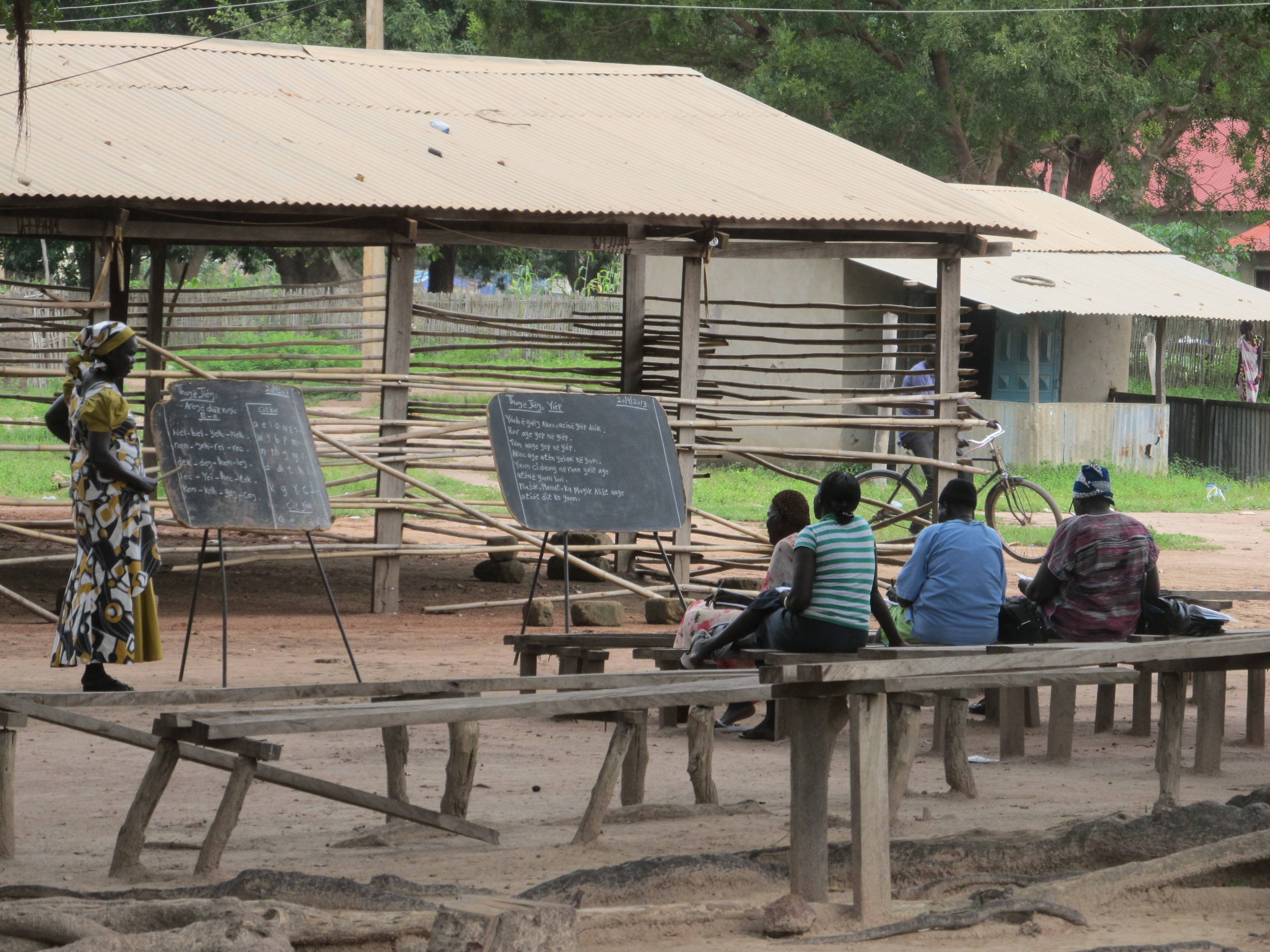
Afternoon literacy class, Diocese of Rumbek, South Sudan

That enthusiasm continues today. Teaching and education is a huge part of what the church does. On a local level, that means, for instance, literacy lessons for women. On a broader level, it means that I am continually meeting people who want me to find them “sponsors” abroad who can pay their school fees for further study, whether at the Episcopal Church of the Sudan’s seminary, one of South Sudan’s overmatched universities, or at some place abroad.

There have been a variety of efforts to respond to this need. Thirty years ago, a Theological Education by Extension program was created in which courses were designed, published, and then circulated to be offered in small groups in various dioceses. In the time since, they have not been updated, revised, or augmented, and translation work into South Sudan’s many languages has been sporadic. But in a measure of how important education is—and how few the resources are—I still see these books in use in dioceses. When it’s all you have, you’re going to use it, even if it’s imperfect.

But the major message I get from South Sudanese is that they know they don’t have the resources to do a sufficient job of education; they can’t meet the need themselves. I remember meeting a bishop two years ago. Within—literally—seventeen seconds of meeting me, he said, “My clergy need better education. Can you come start a Bible college in my diocese?” On this recent visit to South Sudan, I spent time at Dhiaukuei, a village that became an important clergy training site during the civil war. The training has dwindled, but people are eager for it to start again. When I visited, I was repeatedly asked if I had come to be its principal and when I would be starting courses.

So how to move forward?

There is, of course, the need to finance scholarships for people to study at existing institutions in South Sudan and abroad. But the vast majority of Christians in South Sudan will never be able to do that. They’re too busy living a subsistence agriculture life that doesn’t allow for time off.

Instead, I have become convinced that there is an enormous unmet need for regional clergy training sessions. I did something like this on a very small scale two years ago. During the dry season when people aren’t busy cultivating, clergy, Mothers Union members, and youth leaders could come to a central point for a week or two for lectures, Bible study, group work, etc. on particular topics.

Lest you think that the teachers of these sessions have to be super-educated, extensively-published, multiple-degree-holders, remember how great the need for education is. I offered clergy trainings as a seminarian. When I did, the students eagerly welcomed everything I had to offer, no matter its imperfections. When I was finished, they asked for more—not only of what I had been teaching, but also of more practical issues, like parish administration, stewardship, etc. You don’t even have to be ordained to teach those topics! In fact, it probably helps if you are not.

I am convinced that trainings such as these would be eagerly welcomed in a place like South Sudan. What’s more, they would introduce Christians from the Euro-Atlantic world to day-to-day life in an inspiring and fascinating part of the Anglican Communion—but one that is also struggling under the burden of ministering in the world’s newest nation. When it comes to building relationships with fellow Christians, there is no substitute for gathering around the Bible together and trying to figure out what it means. The incarnational aspect of these trainings remains their most important aspect.

St. Paul writes, “Let us then pursue what makes for peace and mutual upbuilding.” (Romans 14:19) Theological education is a route to that goal.

(I would be remiss if I did not note that many of these ideas are developed in much greater detail in my forthcoming book, Backpacking through the Anglican Communion.)

Hidden Obstacles to Women in the Episcopate

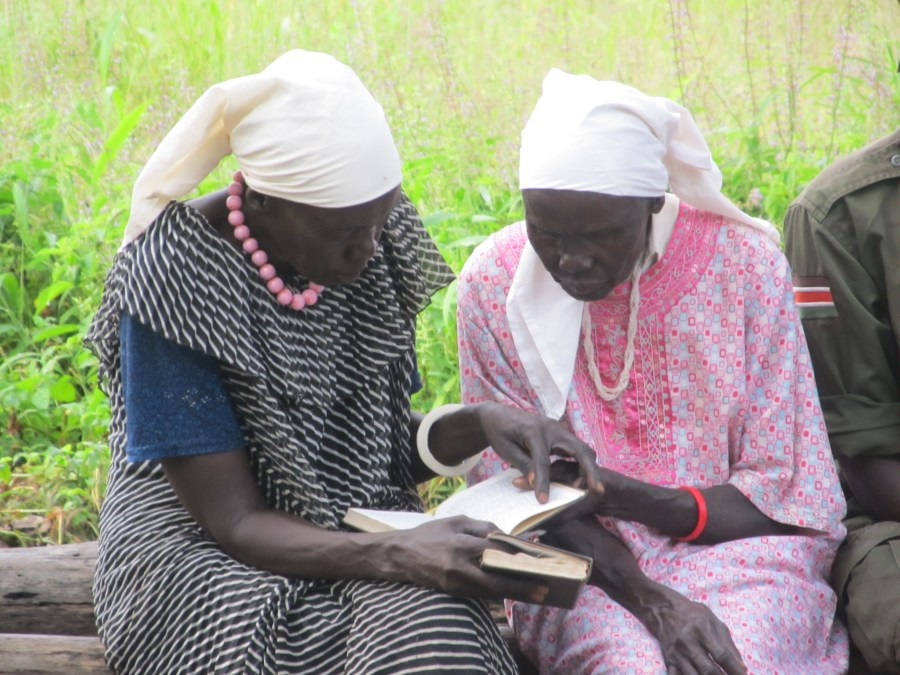
IMG_0239The woman on the left is Martha Yar Mawut, the archdeacon of Akot in the Episcopal Church of the Sudan. Akot is a see city, so it’s a pretty important role. She was an important lay evangelist during the war, was later ordained, and now, by all accounts, performs her job with admirable skill and talent.

If you believe, as I do, that having women bishops is part of the Anglican charism to the wider body of Christ, then women like Martha matter. Archdeacons are among the prospective bishops of the church. The more women like Martha there are in South Sudan, the greater the chance that one of them will become a bishop.

But I don’t think Martha will ever be a bishop. And thinking about her helps us think through some of the obstacles to women bishops in the Anglican Communion.

The topic of women as bishops came up frequently on my recent visit to South Sudan. Everyone I spoke to—male bishops, male and female priests, lay people—were in favour of the idea. It makes sense. Women played a huge role in the growth of the church during the civil war. Male church leaders know that the strength of their church is in the women.

The Episcopal Church of the Sudan has ordained women for about a dozen years. A few are archdeacons, canons or, in one instance, a cathedral dean. In fact, on a rough estimate, I’d say the proportion of female clergy in ECS compares favourably to that in the Church of England, given that the C of E has ordained women as priests for roughly twice as long

Nor is there any canonical impediment to women bishops in South Sudan. When ECS made the decision to ordain women as priests and deacons, they (sensibly) concluded that it did not make sense (theological or otherwise) to deny women to be ordained as bishops.

So there are women like Martha in leadership in dioceses—not many, but some—and there is a path towards women bishops. So why aren’t there any?

The answer I heard, time and again, is education. Given the civil war and the lack of resources in South Sudan, training for ordination is of a necessarily ad hoc and contingent nature. Some people go for a few months to a vernacular Bible college or a diocesan training course, others are fortunate to attend ECS’ English-language seminary, a very small handful have studied abroad. For a variety of reasons, women clergy, by and large, are less educated than their male counterparts.

But ECS has a de facto requirement that its bishops be able to speak English so that they can take part in churchwide meetings. They also have to have some kind of diploma or degree. These are good requirements to have, but it means that many women who perform faithful, important ministry in their local context are unable to be considered when it comes time to elect bishops. Martha could greet me in English, but all my conversation with her was through a translator.

None of this is to minimize the unique array of cultural obstacles women in South Sudan face in pursuing leadership. But to people who know only about the “African church” that it is some kind of misogynistic institution, you would be surprised how much support I heard for women bishops in ECS.

There has been good news of late for supporters of women bishops: the first woman bishop in the Church of Ireland and the Church of South India, the first woman ordained in the Church of England elected bishop (albeit in New Zealand), and canonical changes in Wales to permit the possibility of women bishops.

So much of the debate about women bishops focuses on the canonical changes necessary. That’s good, but it’s not enough. The lesson of my recent visit to South Sudan seems to be that if you want more women bishops, support theological education.

UPDATE: Conversations sparked by this post led to a second post laying out ways to support theological education in South Sudan.

MRI, Fifty Years On

Fifty years ago this week, Anglicans from all over the world gathered in Toronto for the second post-war Anglican Congress. The meeting was fruitful in a whole variety of ways, but what it is especially remembered for is “Mutual Responsibility and Interdependence in the Body of Christ,” a manifesto that set forth a new way of being the worldwide body of Christ.

In a Church Times op-ed this week, I argue that the vision set forth in MRI is as valuable and relevant to Anglicans now as it was fifty years ago:

In its emphasis on the patient work of building genuine relationships across lines of difference, the importance of genuinely coming to know one another in the context in which each lives, and above all in its recognition that God is always calling us to something greater than ourselves, MRI has much to teach us.

It is risky to reach out to those who are different from us, and daring to ask what we might learn from someone from a different background. But it is precisely these things that are at the heart of what it means to be God’s people in the world – a fact that is no less true today than it was in August 1963.

(Read the whole article here.)

By chance, the anniversary coincides with the news that Bishop James Tengatenga’s appointment at Dartmouth University has been rescinded. I have nothing to add to this depressing piece of news that has not been said elsewhere—particularly by Bishop Michael Ingham—except to note that the controversy over the appointment sadly demonstrates the point I was trying to make: it truly is challenging to reach out and encounter those who are genuinely different than us and see what it is we can give and receive from them.

The Church Times article on MRI is the first of two I’ve written about the anniversary. Look for a separate article coming soon in The Living Church.

And if you never have, why not take the time to read the text of MRI?

The Congress-ification of the Church, Part II

In February, the Anglican Church in Tanzania elected a new chief bishop (or primate, as Anglicans call them). It was a close election, in which the incumbent was narrowly defeated. Jacob Chimeledya, a diocesan bishop, won.

So far, so good. Different provinces have different rules for primates. Some are elected for a single, fixed term (the United States, Sudan), some are appointed for life (England), and some are allowed to run for a second term when the first ends, like Tanzania.

Unfortunately for Tanzanian Anglicans, a handful of conservative Anglicans got a bee in their bonnet about the election. It turns out the defeated incumbent was a more reliable supporter of their causes. So—briefly—they began to raise holy hell, denouncing the election in just about every form imaginable—despite the fact that none of those raising these charges appears to have been on hand for the election, nor had any special insight into the local dynamics that produced the outcome.

The vitriol became so significant that the Tanzanian provincial secretary was forced to issue an unprecedented statement explaining the election. For me, the key paragraph was this:

The internet can be used to develop relationships, but it can also be used to spread gossip and destabilize the church. None of those writing these false stories sought to confirm them with us. It is very sad that someone who did not attend the election would spoil what was confirmed by all our bishops as a fair and transparent election.

This has not stopped the vitriol, which continues in various corners of the Internet to this day.

The question this raises for me is this: is this what we really want to be as a world church? A global group of people on a perpetual witch hunt, determined to find enemies where none exist, see every situation through the lens of what matters most to us, and create conflict as a means of perpetuating our existence? That may be fine for a cabinet or Supreme Court nominee on Capitol Hill, but surely the church can model something a little different?

(Not incidentally, the faux-controversy over the election shows the mistake of placing so much emphasis on primates’ meetings, as Anglicans have increasingly done in the last decades. Primates are important—but not that important.)

In this context, Justin Welby’s attendance at the enthronement of now-Archbishop Chimeledya seems to me one of the most significant acts of his young archiepiscopacy. His presence said, essentially, “I believe you. I am with you.” In a needlessly controversial situation such as this, the power of that affirmation cannot be underestimated. Wouldn’t it be great if Tanzanian Anglicans heard a little bit more of that from their sisters and brothers around the world, rather than the vitriol and invective to which they have become accustomed?

Patiently living with difference

Rowan Williams is no longer archbishop of Canterbury but that doesn’t mean we can’t still write about him! I was struck by the conjunction of two things: that Williams was a theologian whose work always emphasized ecclesiology and that he served as archbishop in the middle of what might be called an ecclesiological crisis. That interest gave rise to the recent article published in Ecclesiology titled, “Patiently Living with Difference: Rowan Williams’ Archiepiscopal Ecclesiology and the Proposed Anglican Covenant”:

“…we have reviewed Williams’ goal of mature, trust-full relationships in which people recognize that they must receive from those who are different to them even as they acknowledge their inability to do so. This is a compelling vision for the world of the twenty-first century, and a deeply prophetic one that deserves to be preached and made the basis of the church’s existence. The way to do so is not, I think, to insist upon adoption of a particular document and limited set of principles. Rather, the solution seems to be to articulate this vision while patiently honoring its process, a Williamsian solution if there ever was one. This will not please all Anglicans nor will it necessarily diminish the damaging rhetoric that abounds on all sides. But Williams’ own words seem pertinent here: ‘Even in local and prosaic settings, how very tempting it is to say that we want our results now, before the end of the year. We have to justify what we’re doing in the shortest of short terms and that is a curse for churches, universities, charities, community regeneration projects, all sorts of things in our society. And we need deep breaths and long views again.’ Ultimately, perhaps, as the covenant dies, the Communion can take a few deep breaths and return to the long view embodied most compellingly in Williams’ own work.

Separately, I reviewed the new book, Rowan Williams: His Legacy for The Living Church. That review is also online:

Williams’s tenure was marked by an inability to say “I have no need of you” — even and especially when so many others were demanding that he do precisely that. This deeply biblical position is surely at the root of any legacy Williams leaves and is, moreover, the place to begin building a church that is “more truly itself.”

There’s no shortage of writing by and about Williams, and for that I am grateful—even when I contribute to that list!

“A safe place to do risky things”

I’ve just finished Andrew Atherstone’s brief biography of the new Archbishop of Canterbury, Justin Welby. For a book that was produced on such short notice, it is excellent. Atherstone does a terrific job of trawling through Welby’s publicly-available writings to paint a picture of the interesting, intriguing, and complex person now in the see of Canterbury.

Some of the interesting bits of the book have been quoted elsewhere. One bit that stuck with me, though, which I have not seen elsewhere is Welby’s emphasis on risk as a Christian virtue. When he was at Liverpool Cathedral, he encouraged members of the congregation with the phrase, “This Cathedral should be a safe place to do risky things.” It is a view, Atherstone argues, that has informed Welby’s ministry.

So I’ve been thinking about risk and the church lately. And to that end, I am off on a visit to the church in South Sudan that begins this evening. I’ll be bringing my copy of Atherstone’s biography to donate to the library at Bishop Gwynne College so students there can also reflect on our new archbishop. Stay tuned for posts from South Sudan (and in the meantime, read about my past visits there).