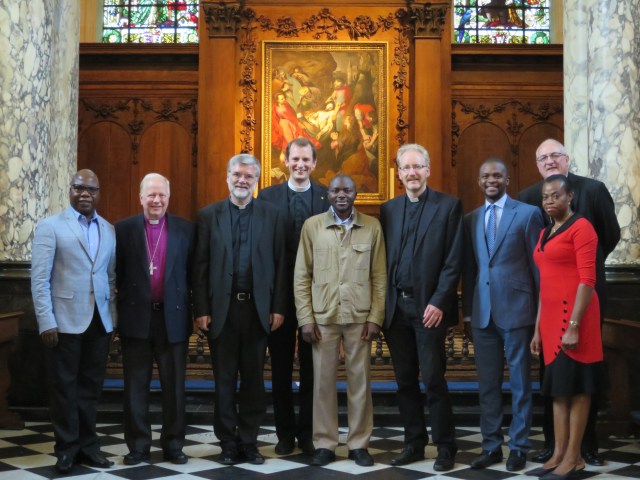
Cambridge Church Leaders Dinner

img_7815-1Last week, I attended a dinner in Cambridge that brought together the two bishops of the Diocese of Ely with about seven or eight leaders of black Pentecostal churches in Cambridge. (Picture above taken before everyone arrived.) You may have heard of these churches: denominations like the Redeemed Christian Church of God or Kingsway International Christian Church that were founded in non-western countries but are gradually establishing a presence in the U.K. and other western countries. There are two RCCG congregations in Cambridge, for instance. The idea was to eat, talk, and pray together so that in learning more about one another we could see where we were being called to work together.

One thing that often strikes me in meeting leaders of diasporic churches is the nature of ministry. Every one of the black Pentecostal leaders at dinner was in what, in C of E parlance, we would call self-supporting ministry. In the U.S., the word would be bivocational. Every one of them had a full-time job to which the church leadership role was additional. One was a nurse, one a software engineer, one a solicitor, and so on and so forth. (They are, of course, not alone in this: the Latter Day Saints have an almost exclusively non-professional leadership class.) By contrast, the Anglicans at the dinner all earned their living working in the church.

Listening to their stories of leadership, I was struck how they seem to do as much or more with their congregations as many full-stipend clergy: Sunday services, Bible studies, collections for the poor and needy, and large festival celebrations. They also plant new churches. One difference we noted in our conversation was that the black Pentecostal churches are more active in church planting than the Diocese of Ely. They certainly do more of it. Not all of the church plants of the main RCCG congregation have been successful, but a couple have been.

I began to wonder if there’s a connection between their approach to ministry and their ability to plant churches. In the C of E, we have this idea that you need a fully-trained cleric to lead or plant a church. In the RCCG if all you’re looking for is a committed lay person, the task becomes easier. It was easy, sitting in that dinner, to think that the requirements of the priestly class of the C of E are actually stifling the church, not enabling it. It takes a long time to make a priest in the C of E (sometimes not long enough, I think) and I am deeply committed to that process. But still.

But there was a flip side to our conversation. Many of these black Pentecostal leaders wanted further theological education themselves. Some of these denominations have training colleges that they may have attended but this is more in the way of continuing education. These people wanted to study for degrees to fill in what they felt they were lacking. I can’t speak for them but from their perspective I sensed that an educated leadership class seemed like an asset they wanted to develop as well.

Perhaps there is a way to square this circle: on the one hand, theological education remains vitally important. The church should support it in every way possible. On the other hand, ministry cannot be seen as the preserve of an elite professional class. Lay people are leaders in ministry just as much as those who get paid for it.

The word that I left the dinner with was this one: permission. These black Pentecostal churches give permission to their members to fully engage in ministry as they are called. They experiment with new approaches. Sometimes they don’t work. Sometimes they do. But it’s a low cost approach. How can we create a culture of permission-giving in our churches?

It was a great dinner—and this is only a small piece of the puzzle. There are diaspora churches from Asia, eastern Europe, and many other places all active in Cambridge and we want to expand the network of relationships as we go forward.

One bishop without a home, and one bishop with two

In January, there was an odd story from the Episcopal Church of South Sudan and Sudan: Precious Omuku, an Anglican priest from Nigeria who currently works in Lambeth Palace for Archbishop Justin Welby, was made a bishop in ECSSS.abpandbps

He’s not a diocesan bishop, but has rather a roving, ambassadorial role.

According to the Revd. Dr. Joseph Bilal, a board member of the Justice, Peace and Reconciliation of the Province of ECSS& S, Bishop Omuku will continue to work in his base at the Lambeth Palace as special adviser of Archbishop of Canterbury on Anglican Communion Affairs. “He will not necessarily be move out from his base at Lambeth Palace, but he will continue with his duties as adviser of the archbishop of Canterbury on Anglican Communion affairs. He will be keenly involved on issues of sustainable development, justice, peace and reconciliation in South Sudan and Sudan,” Dr. Bilal explained.

What’s odd about this? It’s not odd that a person ordained in one country became a bishop in another country. (The bishop of Waikato in New Zealand was ordained in the Church of England. Desmond Tutu was once the bishop of Lesotho.) It’s not odd that a bishop is doing a non-diocesan role. (The bishop of Algoma is about to become the principal of a theological college. There is a “bishop at Lambeth.“)

The oddity has something to do with place.

For Anglicans, geography shapes the church. The Church of England, for instance, divides the entire country into parishes, groups parishes into deaneries, deaneries into archdeaconries, archdeaconries into dioceses, and dioceses into provinces. The bishop is the head of a diocese and an archbishop is the head of a province. Other Anglican churches do things in various different ways but all still maintain in one way or another that a bishop is linked to a particular place, called a see. You can give up that see later on and still remain a bishop, but to become a bishop you need to be linked to a place.

So it’s odd, then, that the church in the Sudans should consecrate someone to be a bishop without a place but rather with a role.

I probably would have let this oddity pass me by except I then read another odd story about bishops and place recently: the suffragan bishop of the Diocese of Virginia, Susan Goff, has now become an assistant bishop in the Diocese of Liverpool. The oddity here also has to do with place: a bishop is to be linked to a place, as Bishop Goff, already is, but it is to be one place. Now Bishop Goff is a bishop connected to two places. I have no doubt that the link between Liverpool and Virginia is strong and important to both dioceses. I want to take nothing away from that relationship. But in ecclesiological terms, this particular move doesn’t make much sense. (And, indeed, Bishop Goff had to post a video clarifying that she’ll only be in Liverpool up to two weeks a year.) To ask one particular question: who is Bishop Goff’s metropolitical authority? Is it the Archbishop of York (through the bishop of Liverpool), as it is for other bishops in the northern province of the C of E? Or is it the rather diffuse metropolitical authority of the Episcopal Church (through the bishop of Virginia), as it is for other Episcopal bishops?

The church is full of oddities, ecclesiological and otherwise, and I’m usually content to let them go unremarked upon. But these particular oddities reveal some deeper confusion in our Anglican thinking about bishops. There are many voices (with which I heartily agree) that tell us about the importance of all orders of ministry, about the need for priests and lay people to take an active role in governance and decision-making, and so forth. In the Anglican tradition, bishops are not the sole locus of authority. Readers of this blog and my books will know how frequently I have nattered on about the importance of involving more voices in determining the direction of the church, rather than just those that wear purple shirts.

Yet at the same time we have this fixation on bishops: who they are, what they do, what they say. We develop fancy ways of referring to them (+ or ++, which is an oddity for another time). We struggle to call them by their first names. We surround their visits with a kind of aura. The result of all this is that we are developing this unstated assumption that the only things that matter in the church are what bishops say. There’s no reason that ECSSS could not have appointed a priest or lay person as its roving ambassador. If the Diocese of Liverpool wanted to cement its ties with Virginia, the bishop could have made a priest or lay person from Virginia a canon in his cathedral. But in each case, it was decided the role needed to be filled by a bishop—a response to and a furthering of this over-emphasis on episcopal ministry. And that emphasis has real world impacts, not least the proliferation of bishops and dioceses in a church like ECSSS so that ever-smaller regions of the country can feel like they have an adequate voice at the table.

If you’ve read this far, then you’re probably as far into the weeds of Anglican ecclesiology as I am. These situations are not the most pressing issue facing the church or the world. But they are odd. And in their oddity, they reveal a rather worrisome trend in the life of our churches.

George Bell, prophet for peace and pedophile

As it happens, this week I am correcting the proofs of my new book. In a section on the communion of saints, I write: “Saints are not saints because they are perfect people. None of them were.”

This evening, I turned away from the proofs and came across a piece of news that devastatingly confirmed this: George Bell, an Anglican bishop and prophet for peace in World War II, sexually abused a young child during his ministry. The Church of England has recently settled a legal claim relating to this abuse.

Bell is someone I have admired through the long gaze of history. He is not a “saint” in the conventional, Catholic sense of the term, but he is commemorated in the calendar of the church. He spoke out against the carpet bombing of Germany in the House of Lords, doing in the (very credible) chance he had of becoming archbishop of Canterbury. He was later deeply concerned with the reconstruction of Europe after the war. Three years ago, I wrote this short post about him. I’m hardly the only one: Paul Zahl, an Episcopal priest, wrote a really excellent reflection some years ago remembering Bell in the context of drone warfare. Rowan Williams preached a sermon on Bell’s consecration in 2008. Re-reading it now is heart-breaking.

To have lived in England for the last several years is to have lived in the midst of a constant stream of sexual abuse allegations against figures in the establishment: media, politics, and church. A retired bishop was recently jailed for sexual offenses. Bell, were he alive, would no doubt be joining him. This is clearly a time of reckoning that is not coming to a close anytime soon.

We can and do pray for those who were assaulted by those in power. We affirm with the bishop of Chichester and others the truth (so often occluded in the church) that “the abuse of children is a criminal act and a devastating betrayal of trust that should never occur in any situation, particularly the church.” We make sure we listen carefully (in a way that has not always happened in the past) to their stories of pain and woundedness and praise them for speaking up over many decades. We work to prevent it from ever happening it again.

In my book, I write that rather than saints being perfect people, saints are people whose lives pointed beyond their current existence to the future God will fulfill. George Bell is commemorated because in some small way a part of his ministry did this. But we know now that even as he did that, he was hopelessly, inescapably rooted in the fallen, sinful present.

I hardly know what to think, except to return to the Bible: “All have sinned and fallen short of the glory of God.” (Romans 3.23) It is a tragic reminder of that central Christian truth.

The long journey to women bishops

Some people—including the archbishop of Canterbury—said yesterday that the vote in the General Synod of the Church of England to allow women to be bishops is “the completion of what was begun over 20 years ago with the ordination of women as priests.”

In fact, the journey began long before that—and many women in the church have lived every moment of it.

profile59Take, for instance, the biography of Vivienne Faull, the current dean of York Minister. As a young women, she worked overseas as a missionary. She returned from that experience to train for ordination. Then she was “ordained”—but as a deaconness, which at the time was as far as women could go. When women could become actual deacons in 1987, she was so ordained. Then in 1994, when women could become priests, she was priested. And now she is tipped to be one of the first women bishops. Along the way, she held some great positions—Cambridge college chaplain and fellow, cathedral canon, and now dean.

What strikes me about her story is the parallels with mine a generation later—worked overseas, came back to study for ordination, Cambridge college life. But there is one crucial difference: no one ever questioned that I should be anything other than a priest. I didn’t have to spend years labouring in orders created especially for my gender. My call to sacramental ministry didn’t have to feel daily frustrated by the fact that I couldn’t celebrate the sacraments. When women were ordained priests, many were told not to make a big deal out of it for fear of offending others. When I was ordained, the church threw a big party and I went on a local radio station to talk a bit about vocation and ministry.

Nor, as a priest, have I ever had to deal with the daily questioning of my vocation by people who don’t think I should be doing what I am doing. Maggi Dawn has written powerfully about what the challenges of training for ministry as a woman in 1994. Vivienne Faull, for a time, had a priest colleague at York Minster who would not receive communion from a woman. No one has ever turned down the host I offered them.

I remember talking with a women priest in the Church of England who was ordained as a deaconness in 1987. She did the customary two curacies as a deacon but it wasn’t clear what the next step was going to be: “It’s a good thing they allowed women to be priests so I could be ordained in 1994 and move to be an incumbent.” At the time, the statement struck me as so odd—why was there a bar that was going to prevent her from doing what all her male peers ordained in 1987 would be doing as a matter of course?

As it is, the journey is not yet over. I don’t understand the ins and outs of canon law but the legislation passed yesterday does make space for people who object to women as bishops, which can be seen to detract from women as bishops.

This is not the post of a naive young male priest all of a sudden discovering that gender discrimination exists in—of all places!—the church. Nor does it say anything that isn’t already well known. This post is simply to say—in a church whose historical memory is often weak—that the church is abundantly blessed with many, many women who have for so long borne the burden of the church’s conflict over gender—and they have borne it with consistently good grace, charity, and love. And as I read the news of the Synod vote, that is what I am most grateful for.

Now, let’s make some of them bishops.

What does it mean to be counter-cultural?

The release of the Pilling report on human sexuality in the Church of England brings up the issue of what it means for the church to be counter-cultural.

The Bishop of Birkenhead, for instance, in his dissent writes that the report, if adopted, will deprive the church “of a prophetic vision, [and] allow her to be swept along by the currents of contemporary Western culture.” (para. 468). Therefore, he concludes, the church must reject steps towards blessing same-sex relationships because such rejection would be counter to dominant culture. Others will argue that cultures around the world tend to reject and exclude gay and lesbian people. Therefore, for the church to be counter-cultural, it must be a welcoming and inclusive place.

There are some ways in which we don’t want the church to be counter-cultural. Churches accommodate themselves to culture in a whole number of very good ways. It’s a good thing, for instances, that Christians around the world use a word in their local language for God. (If you think this is a trivial example, consider Islam’s universal use of Allah.) I’ve written about the way the church in Nigeria has accommodated itself to fundraising practices that seem counter to the teachings of Jesus, but in line with Nigerian culture.

These examples aside, being counter-cultural is a strong theme in the Bible. Jesus told his followers that they “do not belong to the world” (John 15:19). St. Paul told the Romans, “Do not be conformed to this world” (12:2). But it is quite another thing to figure out just what that means. There are a bewildering array of cultures and sub-cultures in the world, which proclaim and embody different values, ideas, and intuitions. How do we decide what we are to be counter too?

The Bible makes clear that the most significant way in which Christians demonstrate their distinctiveness is in the nature of their life together. How the Christian community’s members interact with one another, engage in discourse, and welcome others, for instance, are all part of their witness to God. This is what Jesus was getting at when he told his followers that “by this everyone will know that you are my disciples, if you have love one for another” (John 13:35). The apostolic church was noted for its distinctive relationships. The life of the early Christians—“all who believed were together and had all things in common” (Acts 2:44)— was countercultural in the context of a Roman society stratified by divisions of wealth. A central part of St. Paul’s teaching to the Corinthians is that, if they want to follow Jesus, all Christians actually need one another—no matter how unlikely that may seem and how much the world presses them to think otherwise.

Interdependence, relatedness, community: these are ideas that strike me as pretty counter-cultural in our contemporary society. Look to Congress, where compromise has become a dirty word. Look to the increasing fracture of our communities, in which we spend more and more time with people more and more like ourselves. Look at our global world, where we are thrown ever more closely together but with no ability to manage this interaction in any meaningful way.

Perhaps, then, the truly counter-cultural idea is the one that is at the heart of the Pilling report—honest, mutual, open conversations across lines of difference that seek to understand where the other person is coming from and what we can receive and give to one another.

What if the church were to become the one place in the world where such conversation actually happens? If it did, we might find that we are at last being counter-cultural in a way we can all agree on.

C of E vs. TEC

English bishop Nick Baines has posted about the differences between the Episcopal Church in the U.S. and the Church of England. After a year in the C of E, I thought I’d do the same from the perspective of an American in England, with the proviso that I am writing in broad generalities and, of course, from my own experience of the church.

  • In England, it is quite common to have baptisms outside the regular Sunday-morning service. In fact, I’d say this is when the majority happen. People request a “private” baptism. Often, huge numbers of friends and family attend these services. This takes place without a Eucharistic service. All of these things are exceptionally rare in the United States. I have very mixed feelings about the English practice.
  • Clergy stipends are standardized across dioceses in the Church of England. That means what a vicar of a hugely successful parish gets paid is not different from what the vicar of a struggling, multi-point benefice down the road gets paid. This is hugely different from the U.S. where one’s compensation is tied to the size of one’s church. I have this sense in the C of E that there is less ladder-climbing and competition among clergy, and more collegiality. I like it. For one thing, it ensures rural ministry is given adequate attention.
  • I came to England as a skeptic of Establishment and especially of the parish system, whereby every square inch of the country is under the care of some priest somewhere. But it is quickly growing on me. The default orientation of clergy here is towards their entire community, and not just towards that portion of it which darkens their doors on Sunday morning. There are American clergy who have this orientation too, of course, but I don’t get the sense it as widespread there as it is here. Here, it just has to be. Every soul in the parish is in your cure.
  • One result of the parish system is that priests mostly live where their people do—no matter if the socio-economic background of the parish is such that an educated professional might not usually chose to live there. In the United States, I know lots of commuting priests. There are fewer here.
  • In England, dioceses are larger (in terms of number of clergy and parishes, not geographic size, of course), which means bishops are more distant from their people, their ordinands, and their clergy. What’s more, to the best of my knowledge, there is no canonical requirement for a bishop to visit his parishes. In the American church, bishops have to visit every parish once every three (I think) years. Bishops (and archdeacons) only visit parishes when invited. This only makes the bishop seem more distant, if the only time you have seen him (and it is, sadly, only a him) is when he is presiding in his finest vestments in his ancient and towering cathedral.
  • The Church of England strikes me as much more heavily bureaucratic than the American church. I’m not quite sure how to illustrate that claim, but I think it has to do with Establishment and the larger size of the church relative to the population of the country.
  • On the other hand, the C of E has a pretty good system of raising up lay ministers—readers, licensed lay ministers, etc.—that some American dioceses could really learn from.

I’m sure there’s more, but those are a few that stick out. I’ve spent lots of time with the church in places like Nigeria, Sudan, China, Ecuador, and others, and know what it’s like to be in a church that challenges all my assumptions. But I don’t think I expected quite so many major differences between the American and English churches. And I’m sure there’s much more to learn in the years to come!

UPDATE: I realize I didn’t write a thing about Common Worship and the 1979 Book of Common Prayer! Will have to be a separate post altogether.

Justin Welby pleases no one

The Archbishop of Canterbury, Justin Welby, spoke today in the House of Lords on the legislation that could legalize same-sex marriage in England. It is noteworthy that he even spoke. There was some thought that the bishops in the House of Lords would just abstain, though I think that would have generated as much comment as anything they could and did say. It is the perils of Establishment that the archbishop should be compelled to speak on this issue and at this time.

Given what was known about him when he took office—namely, that he is a self-described “conservative evangelical”—he said some things that were surprising:

It is clearly essential that stable and faithful same sex relationships should, where those involved want it, be recognised and supported with as much dignity and the same legal effect as marriage.

But then he expressed his ultimate opposition to the legislation, for reasons that have much to do with the nature of the particular legislation under consideration.

It is this opposition (creatively reinterpreted by some headline writers) that has seized the initial headlines and has already light up my various social media streams with negative comments. But I imagine that in the not very distant future there will be people from the opposite end of the spectrum who start hitting him for what seem to be positive comments about same-sex relationships.

The end result? I think this is a speech that will please no one. Neither liberals nor conservatives in the church will have to look hard to find reason to be outraged. (Being outraged has lately become a cottage industry in the church, as in our politics.)

As I read the speech, I thought back to Rowan Williams, who similarly managed to please no one during his tenure in Canterbury. Perhaps that’s just the nature of the job and the peculiar nature of episcopal ministry, in which you are not just attempting to advance an agenda (as political leaders are) but serving as a “focus of unity” in the body of Christ, an entity that is like nothing else that exists in the world. But when these exigencies meet the real world of politics, the result is the vitriol that is quickly sprouting around the Internet.

It made me think back to this sermon the archbishop gave some weeks ago.

He concludes by saying:

In the end it is not up to us. We put everything we can into it but in the end it’s God’s call. And that’s very, very good news. So we don’t have to believe in ourselves, in our processes, in our inspiration, let alone in an archbishop of Canterbury.

Amen to that.

The Power of Establishment

On Monday, I did something I rarely do: I read The Daily Mail, one of England’s leading newspapers (by sales). It’s a tabloid that makes it money by plastering screaming (and arguably distorting) headlines across its pages.

I read the paper because a) it was in a waiting-room I was in and b) the front-page headline was about Justin Welby, archbishop of Canterbury, and a letter he (and about 40 other bishops) signed opposing the government’s proposed changes to welfare. The article (and the accompanying op-ed column) was not positive about the archbishop’s move. Welby himself thoughtfully responded on his blog.

Leaving aside the merits of the dispute (which, as a non-voter in this country, I don’t entirely understand but on the surface it seems Welby et al. have a point), let’s talk about the media coverage. England is supposed to be an ever-increasingly secularized country, with fewer and fewer people attending church and fewer and fewer people believing in God. So why all the attention for a letter the archbishop signed?

For me, it’s a reminder of the power of Establishment: no matter what people might think about religion in England, the Church of England still has a privileged role. When its leaders speak, they get attention. Not always, and not as much as they would like, I am sure, but attention nonetheless. As I read about this debate, I am reminded of bishops in some African countries I’ve visited, whose public utterances are closely watched. When I was in Nigeria, bishops (of a number of different denominations) regularly featured in news reports. Ditto for South Sudan.

At the same time as this flare-up over the bishops’ poverty letter in England, the American House of Bishops released a letter about gun violence. Also this week, some faith leaders—including Episcopalians—have spoken out against the proposed Republican budget. I will be stunned if any of these statements makes the cover of any major newspaper in the United States, or is even mentioned. That’s not how the media market works in the United States. Katharine Jefferts Schori and American Episcopal bishops are not media figures in the way English bishops are. (A few have succeeded in getting into the news cycle with statements about same-sex marriage, but these are exceptions that prove the rule.)

All of which is to say what I’ve said many times on this blog in one way or another: context matters. Anglicans around the world minister in a huge variety of contexts that shapes their actions and statements. We do well to remember that.

How the One China policy provides a model for thinking about women bishops and Christian reunion

Back when I studied International Relations—before I was introduced to the glories of theology—there was an aspect of American foreign policy I found perplexing: the U.S. supports democracy in Taiwan, arms the country, and makes it clear that a mainland take-over of the island is unacceptable. At the same time, the U.S. officially supports a One China policy. That is, the U.S. supports the reunion of Taiwan with the mainland. How can this be? How can a democratic Taiwan reunite with a Communist mainland?

It took me a while but I eventually realized that reunion can happen when the mainland becomes democratic. For the two to be reunited, both have to change: Taiwan by sacrificing its independence from the mainland, China by changing its political system. Such changes may seem a long way off, but the policy is at least minimally coherent.

One of the arguments catholic-minded types use in opposing the Church of England’s move towards women in the episcopacy is that it would harm chances of reunion with Roman Catholics. Basically, the argument goes, if we have women in the episcopacy, Rome will never talk to us again.

Readers of this blog will know that I take the unity of church seriously, and I take this objection seriously. There are profound historical, theological, and spiritual reasons why Anglicans should be seeking closer relationship with Roman Catholics, and ecumenical reunion is something for which all Christians need to pray.

But I’m not convinced by this catholic-minded argument against women in the episcopacy. There is an important and deeply true argument for having women in all orders of ministry, which I won’t rehearse here. It is one that needs to be affirmed by the church. Let’s do it already!

But what about Rome? Well, it’s kind of like China and Taiwan, Rome being China, and Anglicans being Taiwan. Reunion will come, but it will come when Rome comes to accept the validity of the argument about ordaining women. It’s not that the Anglicans need to knuckle under, sacrifice their principles, and reunite with an unchanging monolith. That monolith needs to change to make the reunion possible.

This points to a larger objection I have to the catholic types in Anglican circles, a tendency to deny the charism of Anglicanism. I don’t see the role of the Anglican churches to be to emulate Rome as closely as possible in the hopes we can rejoin them. Instead, I see that Anglicans have a unique role to play in the family of churches, one that, for instance, upholds a middle way between Roman Catholicism and Protestantism and combines a catholic ecclesiology with an evangelical commitment to the faith. Ordaining women as bishops is part of that role and helps churches around the world see larger truths of the gospel, just as Anglican learn others of these truths from other Christians.

Some people see Anglicans as little more than warmed-over Roman Catholics. Rather than acquiescing to this view, I’d like to see Anglicans fill their role in the body of Christ and share their gifts with the greater church—Rome first among them. That way, we can all as Christians move towards a greater embrace of Gospel truths, first among them “that they may all be one.”

Remembering George Bell

The Church of England today commemorates George Bell, Bishop of Chicester during World War II. Bell is remembered, inter alia, as a bishop who opposed the Allies’ bombing campaigns in World War II and, it is thought, was passed over for the see of Canterbury as a result. You can do worse than read the Wikipedia entry for more on Bishop Bell.

Today I’ve been reading reflections from Paul Zahl and Rowan Williams about Bell. Both are brief and both worth reading, particularly for the way they connect Bell’s opposition to the war to elements of Christian witness in today’s world. Here’s a bit from Williams’

But Bell also knew that we could only be who we are at home with ourselves and with God, if we knew where our homeless and displaced brothers and sisters were; hence his concern for the refugees and the landless. And God’s challenge to us once again—’Where are you? Where are your brothers and sisters?’ —is a challenge about how we as believers in Jesus Christ answer for the lives of those who are being driven from their homes, their livelihood and their security by the terrible violence of our age.

At a previous commemoration of Bell a year or two ago, I remember mentioning him to a senior priest in the church. “Who’s that?” this priest responded.

So today I’ve been thinking about those who have gone before us, who (for whatever reason) were passed over for career advancement, and have now gone into obscurity. George Bell was a faithful minister of the Gospel in his context. How can we do the same?

It is appropriate, perhaps, that Bell’s commemoration falls as the Crown Nominations Commission makes it final deliberations as to who the next archbishop of Canterbury shall be. When that name is unveiled (whenever that may be), quite a lot of attention will focus on the person chosen.

But I hope that we also remember the long list of people who were considered and not selected, and, even more importantly, the long list of people who were never in a position to be considered. There’s lots of faithful witness at all levels of the church, forgotten, overlooked, and passed over for a variety of reasons. We do well to remember it.