Doctoral Research, accompanied by a Greek Chorus

On the surface, the purpose of my visit to South Sudan is pretty straightforward. Since I am writing a dissertation about the history of the church here during the 1980s and 1990s, and since that was a period of civil war from which few written documents survive, my primary goal is oral history interviews with the men and women who were central to the church during that period. It’s relatively recent, so many of them are still alive and active in ministry.

Sounds easy, right?
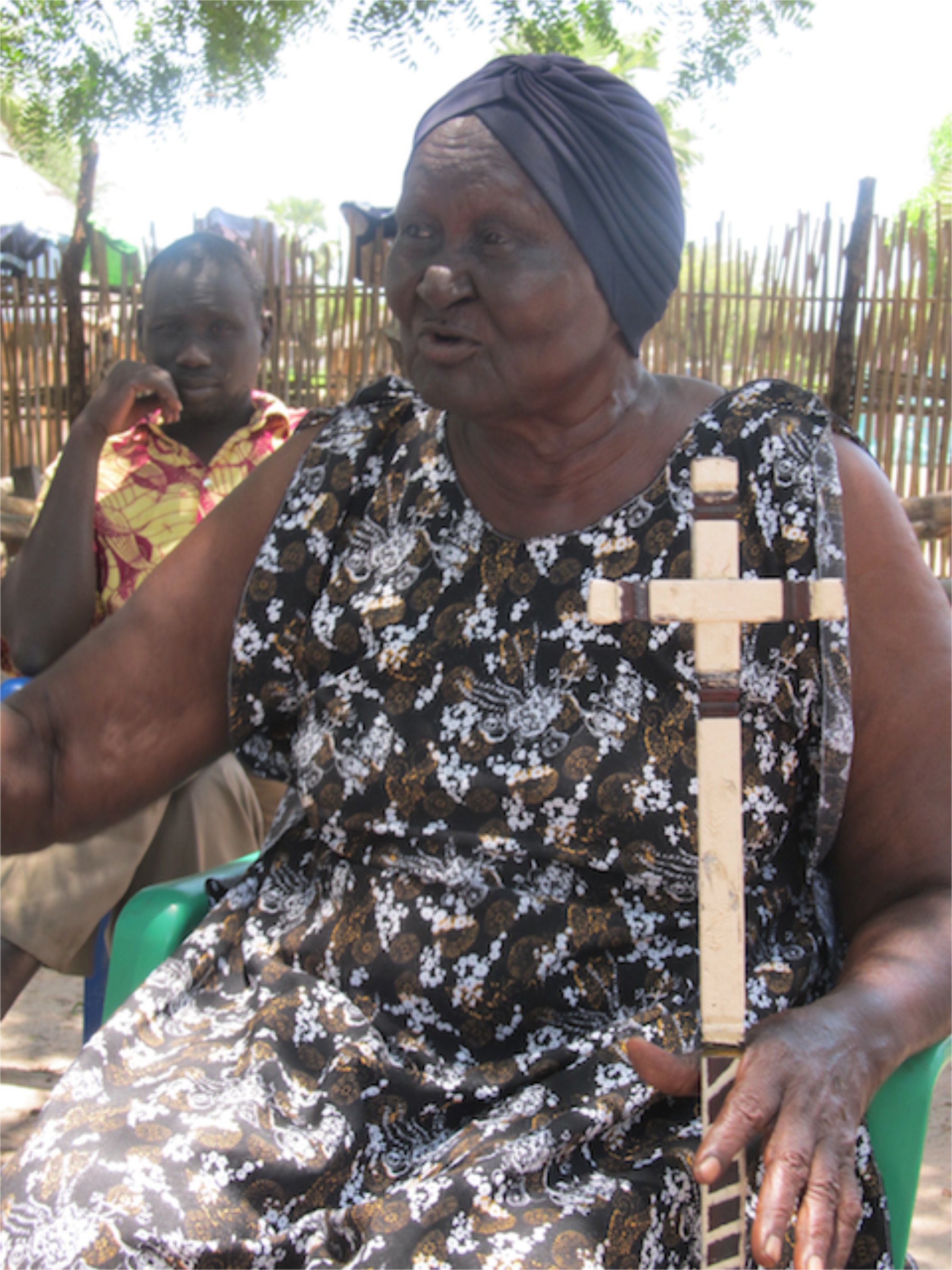
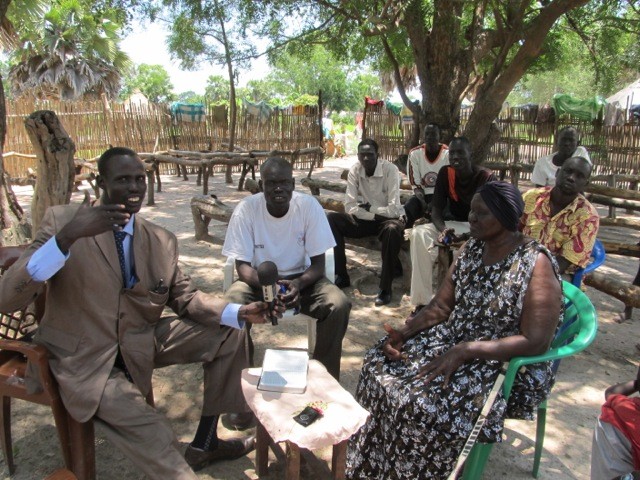
IMG_0017Last week, I was trying to find a woman named Mary Aruay. During South Sudan’s civil war, she was a critical evangelist who travelled all over her county, founding about two dozen churches, mentoring hundreds of young people, and ultimately laying the foundations for her home area to be turned into a thriving archdeaconery where before it had no churches of any kind. It is an accomplishment all the more remarkable for the fact that she was a single, childless woman in a society in which marriage and children are prized.

The first thing was to locate her. Aruay is now retired and living in Rumbek, where I am staying, so it spared me a trip to her home county. But it’s not like South Sudan has many street names or numbered houses. You just kind of have to know where a person lives and then start heading in that direction and ask for the person as you go along. This means I was traveling with John, the bishop’s assistant, who was also doubling as my translator. We only had to ask once before we found our way to the church near Aruay’s home.

While we waited for her to arrive, a stream of other people came to see us. It’s not often a khawaja makes it to this part of town, so there were lots of young children. But several older people came as well—clergy, youth in the church, the archdeacon of the area—who wanted to know just what this khawaja thought was so interesting in Aruay to come all this way to see her.

Eventually, Aruay herself arrived and we launched into the interview. I used to be a reporter. Most of the interviews I did for that job involved pulling people to the side of a room or talking to them in a sound-proof studio. That is, they were more or less private affairs. Not here. To have a khawaja ask an older woman questions about her life was just such a strange and mysterious event that the crowd we had gathered decided to stay. Their contributions were various. One child fell asleep and started snoring. Another fell off the bench he was sitting on and started crying. A few of the youth spoke English and at a few moments decided John’s translation was not good enough and so offered their own. Some of the other clergy occasionally thought that they had a good answer to my question—or that Aruay’s answer was missing some crucial detail—so they freely volunteered their own answers. So much for the private interview. It was like having a Greek chorus peering into my conversation.IMG_0022
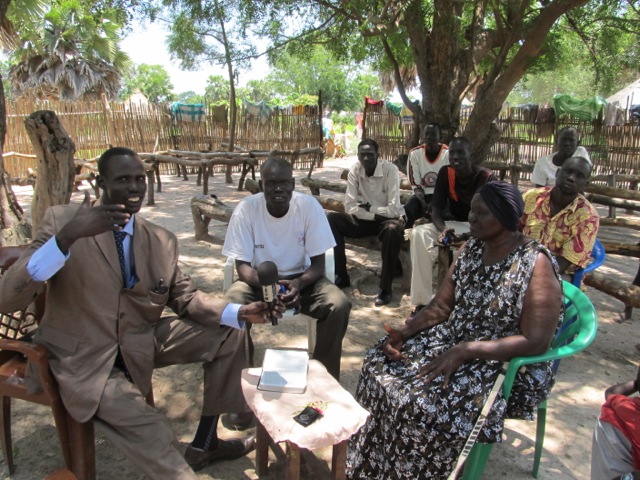
To them I am not just a doctoral student (which is a hard concept to communicate in a place where so few people even graduate from high school) but a priest and a fellow Christian. When I was done asking questions about the past, they wanted to tell me about the present and the future—their plans to turn their archdeaconery into a diocese, the challenges they currently confront, and how important it was to them that I had come to visit. We finished in prayer.

My understanding and expectations of my research are shaped by knowledge of a certain cultural form—the private, one-on-one interview. But that’s a cultural form that is largely foreign in South Sudan. Much more common than one-on-one conversation is the group conversation of everyone sitting around together under a tree. What I perceive as people butting in to my conversation is really just them doing what they always do.

And in the end, it didn’t matter. I got some great information from Aruay—and some of what other people said will be helpful too. And they seemed to appreciate my presence. Over the weekend, she sent a message to the bishop: “Thank you for sending that khawaja to see me so I could tell him my story. I now feel like I am leaving something behind for others.”
News from Abyei

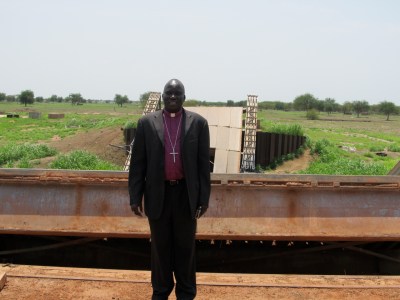
Here’s a picture I took a year ago:

That’s Bishop Abraham Yel Nhial, bishop of the Diocese of Aweil in Sudan. I took the picture when Abraham and I were in Abyei, the contested border region between north and south, which is part of his diocese. The bridge behind him was destroyed in attacks in May 2011 by a northern-allied militia. Its destruction meant, at the time of our visit, that Abraham was unable to visit all parts of his diocese, including the town of Abyei, the centre of the region. Instead, we went to Agok, a town in the southern part of the region where a huge number of people displaced from Abyei had sought refuge, many in a church school.

I just heard from Abraham that he made it to Abyei, this time with the Archbishop of Sudan, Daniel Deng Bul. They have only just returned and have—to date—a very short report to share. Nonetheless, it is devastating to read:

An Episcopal Church of Sudan delegation led by Archbishop Daniel Deng Bul has just returned from a visit to Abyei. They were shocked at what they saw. The town is deserted apart from “a few stragglers”, and has been completely destroyed. One eye-witness from the delegation described it as reminiscent of World War II photos of the aftermath of the atomic bombs dropped on Japanese cities. Only the mosque was untouched. The Catholic church, Catholic and ECS schools, boreholes, administrative offices, government houses, power station, shops, even the latrines, have all been destroyed. The UN forces are perceived as being biased against the Dinka. There appear to be no humanitarian agencies working there, as apparently it is consider part of Sudan and they do not work cross-border. A huge number of refugees from Abyei, perhaps as many as 100 thousand, are in Agok with very few basic services. The people simply ask for what is their right under the Abyei Protocol of the CPA, agreed by both parties: a referendum in which they can choose their destiny.

The Church will be releasing a full report, with pictures and video, in the near future.

Details to follow. In the meantime, an item for your prayers.

The “law of homogeneity” in the church

One of the (possibly the only) downsides of the high profile Desmond Tutu had in the 1980s and 1990s is that other eloquent, faithful, and prophetic African Anglican leaders were overshadowed.

I thought about that as I was preparing for my class on Sudanese church history last week. Bishop Francis Loyo of Rokon has been bishop of his diocese through the long years of civil war. He’s seen the Episcopal Church of Sudan in all its glory—and its pain.

In 1999, he wrote an article called “The Church Today As I See It.” A (rather long) excerpt is below, which I gave my students on Saturday. As the new nation of South Sudan continues to be confronted by tribalism (and churches in the U.S. increasingly mirror the partisan division of the country at large), I find his words to be important, more than a dozen years after they were first written:

Will the church languish in conformity and accommodation? Or will the Church bring the power and presence of Christ to bear on the Sudanese national crisis? The Church in Sudan must apply the test of practical Christianity. In the present situation both the Christian faith and freedom are being destroyed. Therefore, the Church in Sudan must do everything possible to overcome this false alternative. Christians can only overcome this when the Church becomes radical again and seriously considers who it is that they believe in and what the authentic experience of God actually is. To achieve this the Church in the Sudan must rediscover the long forgotten subversive traditions of freedom in the Bible. To believe in God means nothing less than to experience one’s own liberation. The name of the true God means freedom. Only be experience of the true God can the Church in Sudan know true freedom. The truth of human freedom is love. It leads to unrestricted, solid and open communities. Only this freedom in our communities can heal the wounds which oppression has caused and continues to cause in Sudan and in its Churches.

The Church in the Sudan is seen as the “Church of hope” despite the difficulties which the Church is undergoing. The Church in Sudan advocates a human community that is not only based on the similarity of its members—the same race and same language, the same class, the same views and the same morals. These are the things that always bind people together. We find people who are different from us disturbing. That is why we love our friends and hate our enemies and despise strangers. People have built up societies based on class, or caste or systems of apartheid according to the laws of homogeneity. The power which drives these societies is self-righteousness.

The Christian Church lives quite differently to this law of homogeneity. It lives in recongition of other people in their otherness, and that means reconciliation. “Here there is neither Jew nor Greek, there is neither slave nor free, there is neither male nor female, for you are all one in Christ Jesus. If you are Christ’s, then, you are Abraham’s offspring and heirs according to the promise.” (Gal 3:28-29) This is the peace that the Church in the Sudan advocates—a peace in Christ who has broken down the dividing wall between us, taking the hostility through his flesh. (Eph. 2:14)

The driving force behind the Church in Sudan lies in the righteousness of faith which is founded on reconciliation through God. The Christian community in the Sudan begins at the very point where fences and walls are set up between human beings, where nations are divided, countries are separated, and families are split.

The Church in the Sudan must resist every kind of separation if it wants to remain the community of the Church and to minister to people. But even in the Christian Church the law of homogeneity prevails again and again. There are national Churches, Churches of particular races or ethnic groups, middle class Churches, Churches in different social classes. All these are heretical in their practical behaviour, for they spread enmity not reconciliation and their effect is to exclude and not to invite. It is only when congregations can be made up of Black and Arab, poor and rich, uneducated and educated, handicapped and non-handicapped, that there will be a witness to divine reconciliation in this hostile Sudan.

Congregations like this will have a difficult time. They will be despised and pushed aside. They will become congregations under the cross. But they are the sign of hope for the Church in the Sudan because what they do in their divided society is reconciling and healing. The Church in the Sudan must encourage policies of reconciliation always and everywhere. It is only through reconciliation to self and one another that the vicious circle of revenge is broken among Christians. It is only through reconciliation that the law of retaliation is abolished. It is only through reconciliation that hostility is overcome. But Christ teaches us that there can only be reconciliation on the foundation of the sacrifice of oneself and on the basis of righteousness and justice. It can never be at the expense of other people and on the ground of injustice.

The hatred seen in the divided Sudan has eaten its way deep into the Sudanese thinking in both North and South. It is always fear which teaches people to hate their opponents, and the person who preaches hate spreads fear. Politically, Christ is not against the Muslim in the Sudan. He died for them too. God reconciled “the world” to himself and that includes the other religious or political parties. That is why a Christian cannot become the enemy of his/her enemies. Christians in the Sudan need to see Christ in those who hate them.

But loving one’s enemies does not mean being subjected to the system of one’s enemies. Or saying nothing about their hostility. Love of one’s enemies presupposes immense assurance and liberty. It has to be intelligent so that it can understand the fear that makes the enemy hostile, and it has to become inventive in order to change the situation so that enmity becomes unnecessary.

I took this text from But God is Not Defeated! Celebrating the Centenary of the Episcopal Church of Sudan, 1899-1999 (Nairobi: Paulines, 1999), pp. 39-40.

“You converted because of the songs”

My class of Sudanese Episcopalians last Saturday considered the rapid conversion of many Dinka to Christianity in the 1980s and 1990s. For the teacher, this raises an interesting conundrum: how to teach about something which the students experienced firsthand. The solution? Prompt them to talk about their experience and try to provide some concepts to frame the experience in terms of mission and how and why people convert.

What is so fascinating about the conversion of the Dinka is that for many decades European missionaries tried—to no avail—to convert the Dinka. What happened when the missionaries left, however, is that the Dinka were able to encounter Christianity on their own terms and in a way that was coherent with their culture.

I got a lesson in this in my class on Saturday when one student told me about how he converted. Singing has long been important to Dinka culture; indeed, in many ways, it is the chief artistic expression. Before war decimated the Dinka homeland, young men would tend cattle in camps. They’d wrestle, talk about women, tend their prize bull, and, in the evenings, write songs about all of it. If it was a good song, it would be sung by others and passed around.

When the Sudanese civil war sent many of these young men into exile, they did the same thing: composed songs about their experience. Only this time, the experience of displacement had (for a variety of reasons we can talk about in another post) introduced Christianity to their mix. In one refugee camp of tens of thousands in Ethiopia, there were two Sudanese pastors. These pastors held services under the trees and taught the boys songs about Jesus. The boys would learn the songs and go back to their shelters and teach others. As they learned more, they began to compose new songs about Jesus. The good ones began to spread. The Gospel was being transmitted to the culture in the most culturally-appropriated medium. As the student said on Saturday, “You converted because of the songs.” The message they were transmitting was appealing and it was unencumbered of the culture of the European missionaries.

This, for me, is a textbook example of the way in which Gospel and culture can come together and lead to the mass conversion of a people. It’s one thing to preach the Gospel. It’s entirely another thing to preach it in a way that people can interpret in light of markers they already know.

So Saturday’s class got me thinking: what’s the equivalent in American culture? North Atlantic culture, we are often told, is moving away from Christianity. In some places, it is outrightly hostile to the faith. This part of the world is now a chief “mission field.” So how do we speak to non-Christians in this part of the world in a way that will be understood?

One challenge, of course, is the fracturing of culture and media. There are now so many sub-cultures (in a way there weren’t necessarily in Dinka culture) that to think about hitting on one method is probably foolish. Still, the reason I’m so fascinated by mission history is that I think it has lessons for us today.

So… in our own time, what’s the equivalent of converting people by song?

South Sudan, one year on

One year ago today, I was in Juba, South Sudan for the independence celebrations of the world’s newest country. It was a huge event, and I shall not soon forget it, even if my friend here was holding his flag in the wrong spot.

It’s been a hard first year for South Sudan. Not only are there serious unresolved issues in its relationship with what remains of Sudan, it has been beset by inter-tribal violence, plagued by corruption, and unable to address the many pressing social needs of its people.

But when people ask me, as they often do, what I think about South Sudan, my reply always includes the lines, “I have a lot of hope for the future.” And I do. My visits to Sudan have convinced me that the potential in that country is huge.

I am particularly convinced of this because of the continued and powerful witness of the church in Sudan for peace and reconciliation. When Jonglei state was plagued by inter-tribal violence earlier this year, the government turned to Archbishop Daniel Deng Bul of the Episcopal Church of Sudan. He negotiated a peace deal that has held and has created the space necessary for long-term peace-building to get underway. Archbishop Daniel and his Catholic counterpart Paulino Lukudu Loro have issued a statement on their continued hopes for the future of South Sudan.

So when you read the truly horrific news that the continued violence along the border is producing another “Lost Boys”-type situation or the awful conditions in some new refugee camps, I hope that a gasp of horror won’t be your only response. On this July 9—and every other day—I hope you’ll join in prayers for this new nation, read the letter from the archbishops, and think about ways in which you and your church can support our sisters and brothers in Christ in South Sudan.

Together, perhaps, the enthusiasm displayed by this young man can soon become a reality shared by all.

“The Dinka national characteristic is laziness.”

The title of this post is taken from an article in the Church Missionary Society’s Gleaner newspaper in 1906. Missionaries of the new CMS mission among the Dinka people of southern Sudan were reporting back on what they were learning. As you might guess from this extract it’s not all that positive.

I gave this article (which I found while doing research at school this spring) to my class of Dinka students in the Sudanese American Theological Institute that I’m teaching at in Phoenix this summer. We were talking about the early years of the European mission effort in southern Sudan. Here are some other extracts from the article:

The value of the medical mission in breaking up the fallow ground is again receiving marked demonstration in the Dinka Mission. Illness is naturally prevalent owing to the fact that the Dinka will use the same water hole for drinking, washing himself, and watering his cattle! As the benefit of proper treatment is appreciated the pioneer doctor’s hands are kept full.

Contact with clothed Europeans is also having an excellent civilizing effect. Clothes are desired, and the possession of cloth leads to the need of soap. Clothing does not harmonize with the daubing of grease, red ochre, and ashes, and so the civilizing process goes on.

(This is actually not true. In separate letters home, the doctor and others complained about not having enough to do because the Dinka basically ignored them. But facts never got in the way of anyone’s fundraising appeal!)

The article makes me wince when I read it. It reeks of the late Victorian, noblesse oblige that so characterized mission efforts of that time. The way the word “civilization” is used constantly is a reminder that missionaries saw it as their job not just to spread the good news but also to bring with them their cultural suppositions.

I gave it to the students and I wanted to know what they thought. Right off the bat, one male student read it and said, “That’s accurate.” A female student agreed and said that it was the women who do all the work in Dinka culture. That prompted a male student to say, “They didn’t understand what men do in Dinka culture.” And the conversation took off from there. (For what it’s worth—and I noted this in class—I’ve read lots of ethnographies of Dinka from various points of the last 150 years and it’s amazing how often the word “lazy” crops up.)

We ended up talking at length about how—if at all—missionaries can separate their own cultural background from the gospel they are seeking to share. Ultimately, the answer is not entirely. The gospel is always enculturated. Missionaries share the way they understand the gospel and then it is received and transformed as it enters a new culture. The question for missionaries to ask, then, is what parts of what I am sharing are essential to the gospel and which are not?

This is all pretty obvious stuff for folks who’ve been engaged in cross-cultural mission. But it’s worth reading wince-inducing mission histories because it reminds us of this central dynamic in Christian mission between gospel and culture.

Mainline Protestant denominations have, in the past several years, moved away from explicit evangelism to a partnership model of mission that stresses the development of relationships. There is much to commend to this model and I’ve written a book that essentially endorses it without, of course, losing sight of the kerygma of Jesus Christ.

Even as we do so, however, I think it’s still important to step back and ask ourselves the question: what is gospel and what is culture? In working with other cultures—even in partnership—we still bring with us cultural suppositions as deeply rooted (if less obviously offensive) as those the first CMS missionaries brought with them when they went to southern Sudan.

Learning from the past

This is the first summer in five in which I will not visit some part of Africa and spend time with our sisters and brothers in Christ in that part of the world.

But I’ve found what is, perhaps, the next best thing.

St. Paul’s Sudanese Mission in South Phoenix is an Episcopal church like no other in the country: it’s the only free-standing Sudanese Episcopal church in the country. The congregation is primarily what are often called “Lost Boys”: some of the thousands of children who walked into refugee camps in Ethiopia and Kenya twenty or more years ago and were resettled in the U.S. a decade ago.

On past trips to Sudan, I’ve done a fair amount of teaching: in dioceses, and in seminaries. (I’ve also done much more learning than I’ve done teaching.) St. Paul’s has a Saturday school for lay people that they call the Sudanese American Theological Institute. Thanks to a generous grant from the Evangelical Education Society of the Episcopal Church and building on a course I did at Yale this past spring, I’m teaching a course this summer on Sudanese Church History. Here’s the first class.

Now, at first glance, you might think it a bit odd that an American should be a teaching a bunch of Sudanese about their own church history. In fact, however, many Sudanese, particularly many of the Lost Boys, became Christian after they were forced to leave southern Sudan. Their conversion happened in places like Kakuma Refuge Camp and Khartoum. Church history is not something that is widely known.

So on Saturday we began at the beginning, with the so-called Ethiopian eunuch of Acts 8 (Really, he was from the Meroitic empire in what is now northern Sudan) and the Nubian Christian empire that withstood an Islamic invasion and was a flourishing Christian kingdom for centuries on the Nile River. We talked about what we can learn about the enculturation of the Gospel, missionary strategies, Christian-Muslim relations, and much more.

I had them read extracts from the sixth century writer, John of Ephesus, who documented the work of missionaries to the Nubian kingdoms.

Then we talked about the pros and cons of a missionary strategy that focused on converting kings and nobles and discussed how relations between the Nubian kingdoms changed from enmity to friendship when the kings became Christian.

You get this sense, sometimes, that westerners think Christianity is a relatively recent import to Africa, brought by Euro-Atlantic missionaries in the last century or two. That’s obviously not true. After Pentecost, the Gospel radiated in every direction from Jerusalem—not just to the north-east—and we do well to remember that. Christianity is part and parcel of African history. Studying that history seems like a good idea to me, both for what we learn about what happened and for what it can teach us about our own time.

Next up: the beginning of the European mission era. Why did European missionaries—who had so much success elsewhere in Africa—fall flat on their face when they encountered the Dinka people? And what does that tell us about mission and evangelism in our own time?

“We too have a dream…based on the Church’s prophetic stance on justice and peace”

Folks who know I’ve spent some time in Sudan have lately been in habit of beginning conversations with me like this: “Isn’t the news from Sudan awful?!”

I never quite know how to respond. On the one hand, yes, it is true: what filters out in the wider world—and onto top-of-the-hour NPR newscasts—is pretty bad. On the other hand, Sudan and South Sudan are both hugely complex places that make me uncomfortable rendering sweeping judgements. Yes, it seems renewed war between north and south is a real possibility. On the other hand, there’s news of a (church-led) peace conference in Jonglei, a separate, non-border part of South Sudan, which, before the doings of the last few weeks, has been a source of awful news. At the same time, a conflict that has been going on for nearly a year continues in the Nuba Mountains and elsewhere along the border.

So when people ask me this question, I—who have no special insight or knowledge beyond what is publicly available to all—usually say, yes, there’s been some bad news but I have a lot of hope about the future.

One reason for hope centres on the ongoing role of the church in peace-building. Several Catholic and Episcopal bishops recently met in Yei and articulated some of their hopes for the future. The statement is worth reading in its entirety but here are a few extracts:

The Church is not only for Christians nor for South Sudanese. The Church identifies with the poor and oppressed of any creed, ethnicity or nationality, wherever they are…. We bring to the world not the voice of politicians, parties or movements but of the people on the ground, who are suffering a humanitarian tragedy and whose human dignity and human rights are not respected by their own government.

Martin Luther King famously said, “I have a dream”. We too have a dream, a vision, a conviction. Our dream is based on Gospel values; on the Church’s prophetic stance on justice and peace; and on the dignity of each human being, created in the image and likeness of God. Where others see problems, we see the presence of God and the opportunities which God’s presence opens up for us. The Spirit of the Lord is upon me, for he has anointed me to bring good news to the afflicted (Luke 4:18). Our dream is an expression of this Good News….

We dream of people no longer traumatised, of children who can go to school, of mothers who can attend clinics, of an end to poverty and malnutrition, and of Christians and Muslims who can attend church or mosque freely without fear. Enough is enough. There should be no more war between Sudan and South Sudan!

Blessed are the peacemakers; they shall be recognised as children of God (Matthew 5:9). We take this very seriously, and we stand committed to do all in our power to make our dream a reality. We believe that the people and government of South Sudan desperately want peace. We believe the same is true of the people and their liberation movements in the Nuba Mountains and Blue Nile. We do not believe, however, that a lasting peace will come unless all parties act in good faith. Trust must be built, and this involves honesty, however painful that may be. We invite the International Community to walk with us on the painful journey of exploring the truth in competing claims and counter-claims, allegations and counter-allegations. We invite them to understand the peaceful aspirations of the ordinary people, and to reflect that in their statements and actions.

So, get involved in Sudan. Pay attention. Become an advocate. Do what the bishops are asking and walk with Sudanese on “the painful journey of exploring the truth.”

Is the news awful? In many places, yes. Is the situation without hope? Absolutely not.

News from Sudan

If you have been reading the news from Sudan lately, you will know that it is not good, and that the two countries are teetering close to all-out war.

Here is this, from Bishop Abraham Nhial of the Diocese of Aweil, with news from his diocese on the border between north and south. (I travelled with Abraham to one of the critical border regions last July.)

Dear all,

This letter is to update you all about the current war situation in South Sudan, as many of you have seen it in television and it read it in the newspapers, the war is back to us. As we are watching television and reading about what going on through the newspapers, we learnt that many people are killed, wounded, displaced and their properties are looted or destroyed by the soldiers from Sudan government leaving them in horrible situation.

As I write this letter many of displaced people go to bed everyday without food even one meal in a day is not there, leave alone shelters to protect them from the rains and no clothing to cover their skinny bodies. The displaced persons have experienced great trauma and great suffering now more than ever because no one was affecting war again soon. In fact, people were preparing to cultivate their farms and they were working hard to start new life the new nation.

This letter is to inform you friends of the Diocese of Aweil that two thousand eight hundred and sixty people are displaced by the recent fight in the North Barh el Ghazal State. Therefore, I am appealing to you all, individually, a church and a community to pray for us, advocate on our behalf and consider to support if you can to save the lives of your brothers and sisters in Christ from dying of hunger. Please may you all show them the love of Christ the need now at this difficult time in their lives. I will becoming to USA on May 08 and I would love to visit some of you if you want me to speak in your church, business, school or community  gathering etc.

As usual, I am truly thankful for everything you do every single time. There is no bigger blessing than friends like you always stand with us in time of trouble like this; may God bless you and reward you all for your services.

With love always!

Bishop Abraham Nhial
ECS Diocese of Aweil
South Sudan

It’s worth underscoring that advocacy really does matter and that the United States can play a significant role in this situation in preventing the outbreak of what would be an incredibly disastrous war. Have you talked to your senators or representatives lately? Now’s a good time to start.

House of Commons Report Calls for More Support for Episcopal Church of Sudan

From time to time on this blog, I go on about how in many parts of the world, it is the church that is the main organization in society able to deliver goods and services to the people. I’ve found this to be true, for instance, in South Sudan where the weak government struggles to make its presence felt while the church is in every last village and community.

The church isn’t perfect but at least it’s there and provides a basic sort of social infrastructure. It was a view best summarized for me by a Sudanese priest who told me last summer: “We are the church. We are always on the ground!” Unfortunately, as I’ve noted before, western media seem incapable of understanding what a different role the church plays in a non-western context.

There’s a new report from the British Parliament’s International Development Committee that reaches this same conclusion and calls for its own Department for International Development to be more intentional about partnering with the church.

This is particularly true on education, say the report’s authors:

When allocating funds for its development projects, DFID should as far as possible seek to strengthen and complement the limited internal capacity that already exists within South Sudan. We have some concerns that DFID’s decision to fund the United Nations rather than the Episcopal Church of Sudan to deliver its school construction programme misses an opportunity to do so.

The same is true for the important work of peace-building and reconciliation that is going on in South Sudan. The report highlights the role people like Archbishop Daniel Deng Bul of the Episcopal Church of Sudan have played in negotiating peace in some very difficult situations:

It will clearly take time to build the capacity of the GRSS, army and police to take on primary responsibility for peacekeeping and mediation. In the meantime, DFID must not disregard the constructive role that the Sudan Council of Churches can play in this area.

Reports like these are easily lost in the swirl of government paperwork and I don’t expect any major changes in policy. And it’s worth noting that the report has a bleak outlook on the immediate future in the world’s newest nation—that is probably the major take-away here. Still, it’s nice when the government can start pointing out what has long been obvious to all involved, and maybe begin to shape policy in new directions.