The Achilles Heel of Christianity

I recently heard sex described as the “Achilles heel of Christianity.” Christians just can’t seem to come out of conversations about sex looking good. Sex is complicated and the (stereotyped) Christian response has often been too facile: don’t have it. A young woman told me the other day that “the greatest sin is immorality” (she meant sexual immorality). I wanted to protest – what about the Bible’s repeated condemnation of economic injustice? What about structural sin? – but it was clear she would not budge from this position. It was what she had been taught.

A few posts back, I pointed to an example that suggested that fidelity to the Bible is not actually what is driving opposition to homosexuality among Nigerians and others similarly opposed. (You should read that post if you haven’t because you won’t understand this one without it.) If fidelity to the Bible mattered, then the practice of giving in the Nigerian church might be different. So what might underlie this opposition?

In the Greco-Roman world, one reason Jewish people were misunderstood or discriminated against was the practice of male circumcision. For the Jewish, this was and is a sign of their membership in the covenant. For the Greeks and Romans, it was a difficult practice to accept. Intentionally “mutilating” the body was hard enough to accept. But to mutilate THAT part? Well, that was just too much. The Greeks and Romans, I think it is fair to say, reacted with disgust and horror at a practice they didn’t understand.

It strikes me that in the conversations I’ve had with many Africans about homosexuality, disgust is always present. We can talk the issue round and round, from cultural differences to Biblical interpretation. At some point, however, my interlocutor will say something like, “OK, fine. In our culture we have close friendships between two men and there is nothing wrong with that. But to have sex? That is not OK.” You see the same thing in people who agree homosexuality is fine so long as people are celibate and do not “practice” it. There was one moment in my conversations in Sudan last year when I was asked, “How do two men or two women actually have sex?” I didn’t answer because they didn’t need me to tell them. They were already revolted and disgusted at the thought.

I think there’s a good deal of similarity between the Greco-Roman reaction to Jewish circumcision and the conservative Christian reaction to “practicing” homosexuals. Men – and it is men driving this conversation – just can’t handle the thought of gay sex. (Women are maybe the same way but, for various cultural reasons, I haven’t been able to talk to as many of them about this.) There are many possible reasons for this – I think the most likely is that it relates to a particular idea of what it means to be a man – but the reaction is, to judge from my experience, disgust.

I’m not a psychologist but it’s easy to see that disgust is a pretty powerful emotion. It can lead to involuntary physical reactions. I used to dry heave just when I looked at the cooked carrots my mother put on my plate. (She made me eat them anyway.) Disgust can also lead to all manner of attempts to rationalize, justify, and provide a framework to explain the disgust. The Bible provides a handy tool for doing just that.

If there’s one thing I learned in CPE, it is that feelings matter. Indeed, they often precede the thoughts we have, often without us even realizing it. I think disgust is one possible explanation for the (one might argue) excessive fidelity to the Bible on the question of homosexuality but not on other counts. No one gets disgusted when you give money publicly.

If I’m right about disgust, the work of reaching consensus on homosexuality, then, will not be done by lengthy conversations about the Bible or culture or biology. That has been done, many times over, and has amounted to almost nothing beyond preaching to the choir. It will require addressing some pretty serious emotions and feelings surrounding sex, sexuality, and gender, especially, I think, masculinity.

Unfortunately, history shows us that the church has continually failed to talk about these subjects in a way that befits their importance.
What is Peter Akinola afraid of?

In the introduction to Christ and Culture: Communion After Lambeth – which is on a book shelf in the Bishop’s Court in Yola – Mark Chapman looks at the theology of communion laid out by Rowan Williams at the 2008 Lambeth Conference. Chapman concludes that what is needed most in the Anglican Communion is a “Christ-like…ability to listen to and to love the other person.” But he adds that this will not be acceptable to all.

Naturally, there are many for whom this form of authority is an evasion of leadership and a betrayal of the gospel. But perhaps this is based on a fear of opening themselves up to the deep listening that comes with Christ-like vulnerability.

Reading those sentences in Nigeria, I’m struck by its truth. Nigerian church leaders – former primate Peter Akinola prime among them – are exactly the sort of people who would condemn this listening as a betrayal of the Bible. The vehemence of the reaction these last ten years or so makes it clear that there is something deeper going on. I think fear is a good explanation.

So the question is: what are opponents of the American and Canadian churches who reject even dialogue – Peter Akinola was one but there are many others – afraid of?

I’ve already written about how important the Pentecostal influence is in understanding Anglicans in Nigeria. There is a fierce rivalry between the mainline denominations and the “new generation” churches. Rivalry is one thing and may even be good for the church. But the more I talk with people about this, the more convinced I am that Anglicans fear the Pentecostal churches.

The rich and powerful in communities have long been either Catholic or Anglican. These people are critical for the church. They tithe the most and so generate the income that allows the churches to continue to improve themselves and continue to attract new members. (When you don’t have an endowment, what comes in in the offering plate Sunday after Sunday is crucial to your success.) But increasingly, the younger generation of rich and powerful people are not Anglicans or Catholics but Pentecostals. A bishop I met recently told me, “The next twenty years will be very significant for the Anglican church,” emphasizing “very.” The way he was talking, he made it sound as if the survival of the church was at stake as older rich people die and are not replaced.

This may be a bit of an exaggeration. The Anglican church in Nigeria is too well-established to just vanish in a generation. But the style of living, the position in society, and the status the church and its leaders currently enjoy may definitely be threatened by the Pentecostal explosion in Nigeria. As I’ve written, the Anglican church has become more like the Pentecostals so as not to lose members – in style of worship, preaching, etc. It goes without saying that as the Bible is centrally important to Pentecostals, so too will Anglicans be forever faithful to it. (“Faithful” being somewhat of a loose term, as we have seen.)

Into the mix comes the Nigerians’ global Anglican partners who all of a sudden – or so it seems – decide that they can be wobbly on the Bible, “ignore” bits of it they don’t like, and generally be a complete embarrassment to Nigerian Anglicans. The actions of Americans or Canadians hurt the church because it makes the Pentecostals able to say, “See, those Anglicans don’t really believe the Bible. They’re a gay church. Come to us.” Again, it is worth remembering just how many people here – Anglicans and not – know about the Anglican Communion. This is why there was a proposed amendment at Lambeth 1998 that said, “homosexuality is a sin which could only be adopted by the church if it wanted to commit evangelical suicide.” (To which Catherine Roskam of New York responded, “to condemn it is evangelical suicide in my region.”)

Moreover, the proposed response – listening – will never work in this competitive context. You can say all you want, “That’s what Jesus did” or “Jesus never cared about status” or whatever you like. The message won’t work here. I’ve also been looking at a little book lately called Religion and the Nigerian Nation: Some Topical Issues. One of the points it makes is that in the context of Nigerian Christianity, size and strength matter. People aren’t going to church to feel weak. They’re going for strength and security in the face of societal uncertainty. So if a Nigerian Anglican were to say, “Oh, no harm can come from talking and listening to our Anglican friends,” well, let’s just say, it wouldn’t go over very well. (In fact, a Nigerian archbishop did suggest just that. He got demoted.)

I don’t want to press this too far. Fear of lost status does not explain everything that is going on in the Anglican Communion. But I think it explains something. Just last night at our evening Bible study, we looked at Exodus 1 where pharaoh, in his fear of the Israelites, engages in some remarkably destructive behaviour. Fear is a powerful motivator to destruction.

How ironic that the most repeated message of the Bible is “fear not.”

Books, books, books


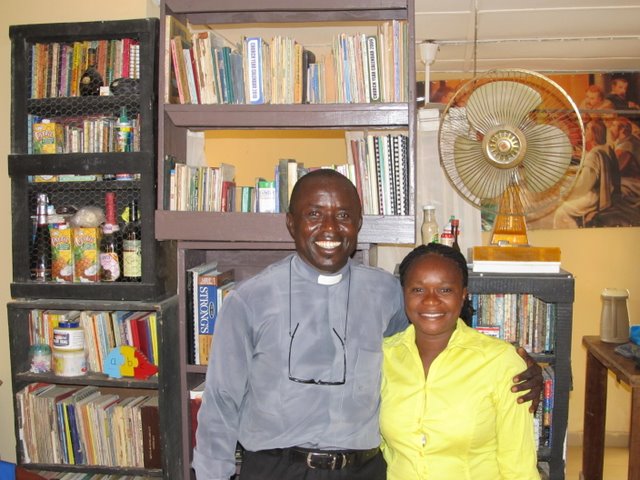
This is a picture of Samuel, a really lovely priest in Yola, and his wife, in their living room. Samuel doubles as sole vicar of a growing church and principal of the diocesan secondary school. He also raises turkeys and chickens on the side to pay his children’s school fees.

All of that is very interesting but I want you to look at what is behind him: lots and lots of books.

All the priests I know in the U.S. have lots of books in their homes. It’s a natural part of the job. But in my experience in Africa, this is unusual. In Sudan, priests owned no books but the Bible and sometimes not even that. Even in South Africa, there weren’t a lot of books because the cost of the books put them out of reach.

But in Nigeria there is a vibrant publishing industry. The books are riddled with typos and layout mistakes but no one seems to care. They are inexpensive and widely available. Many even have ISBNs so they can be officially registered. Some of them are little more than pamphlets, some extensively-footnoted academic works. My luggage has gotten much heavier than I anticipated in Nigeria because so many priests I meet want to give me autographed copies of their books. Here are some titles: Purity & Power, The Mission of the Church in the 21st Century, Putting the Igbo Woman in Her Place: An African Perspective on The Interpretations of the Household Codes, Where is the Lord God of Elijah? A Prophetic Outcry for Revival, The War Within: Christians and Inner Conflicts, and so forth.

(I wonder if this is what it was like during the American Revolution when people like Thomas Paine could publish pamphlets that made such an impact.)

Seeing all this material, I’ve realized again something I realized in China – it’s out of “our” control. The development of Christianity and Christian theology can no longer be controlled by people who look like me and have for so long written the books that have shaped theological education not just in the west but around the world. According to mission theory, the fourth step in the formation of a church is that it become self-theologizing. These books represent that work in the Nigerian church. I, for one, celebrate it. (I also get really jealous. The religious publishing in the U.S. is in such bad shape. Wouldn’t it be great to have an equally vibrant conversation in the U.S.?)

But here’s the other thing: a lot of these books are, well, wrong. There are countless books about Anglicanism here – have I mentioned that people care about being Anglican here? – and I’ve read many of them. Not only are there interpretations of difficult issues that I disagree with, there are incredible factual mistakes. I read one history of the creation of the Anglican Consultative Council that was totally, comically wrong. Another, in discussing resolution 1.10 from Lambeth 1998 – the one that said homosexuality is “incompatible with Scripture” – said that Lambeth is the Communion’s “highest policy-making body.” It’s not. Bishops at Lambeth have never been able to set policy (to the chagrin of many, we should add).

But you see those books behind Samuel in this picture? Almost all of them were published in Nigeria. As I read these, I not only celebrate the indigenizing of theology, I also worry that Nigerians and Americans are creating two different sets of facts about the current debates in the Anglican Communion. If that happens – perhaps it already has – it will be even more difficult to reach common ground. (It’s analogous to the way I saw China and the U.S. operating with two different narratives.)

So how do we create a genuinely international and cross-cultural academic dialogue? There are books that seek to do that but I’ve seen none of them for sale in Nigeria. Perhaps it takes more people, more visits, more conversations going in all directions.

Unfortunately, there’s little sign of that happening.

Keeping up with the Pentecostals

Bishop Marcus of Yola was explaining to me the other day all the work he had done on the cathedral in the last five years – new roof, new generator, new flooring. His next project, he said, is adding air conditioning, which will require a larger generator. I was a little curious why he would be so obsessed with making his cathedral so nice when he has a number of other projects on in the diocese – schools, clinics, farm – that could use the money.

We were driving past a new pentecostal church under construction as I asked. “See that church?” he said. “I’m sure when it is finished that it will have a big generator and air conditioning. If we don’t have air conditioning, people will go to that church instead.”

The competition between churches for members is intense in Nigeria. Anglicans have long had a position of prominence. The “big men” in a community have often been Anglican. (We can talk about the mixed blessings of this legacy in another post.) When they tithe, that makes the churches rich and enables them to run good schools and offer good programs. But now there’s a fear – and I’ve heard it from many people – that those people are aging and that the new generation of business people is going to the “new generation churches” – the catch-all term for the pentecostal/charismatic churches that are flourishing here.

So it is a perpetual competition for nicest church, best pastor (defined as the one who visits you at home the most and brings you the nicest gifts in the hospital), choicest location, largest sign, etc. I visited one church that has laid the foundation for a bigger building. But they don’t have money to complete the project. So they’re in a Catch-22. They need more members to raise the money to finish the church. But no one will come to their church until it is complete because they know they’ll be asked to contribute to its construction. So they go to the church across the street.

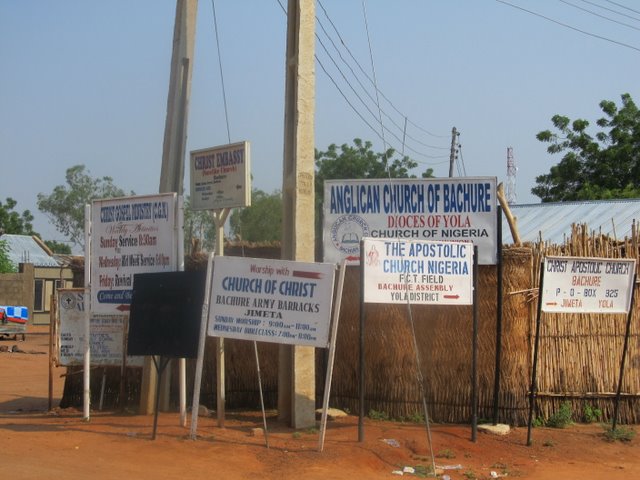
(Competing church signs at entrance to a neighbourhood in Yola.)

This competition helps explain the influence of the prosperity gospel in the Anglican church (we’ll tell you what you want to hear so you come to our church), the changing worship styles (we can out-pentecostal the pentecostals), the rapid growth of the church (so many pastors entreating people to come to church that they eventually do), and even the fierce opposition to homosexuality (if the Anglican church is “tarred” as being unfaithful to the Bible, everyone will go somewhere else).

For me, this raises all kinds of interesting questions. What does it mean to be an Anglican (or Lutheran or Methodist) if one’s church choice is determined by what one gets out of it? This is clearly not true for all people but it is for some. What can the Anglican church uniquely offer in this context?

But what I have been thinking about most of all is what weakness as power would mean in this environment. What if the Anglican church, in keeping with its heritage of incarnational theology, “emptied itself” (Phil. 2) and stopped caring about this competition and focused on its faithful witness to the Gospel, regardless of its size? Is that even possible? What impact would it have?

When Anglican unity looks like a press release

A few posts back, I said Anglican unity “looks” like a pineapple. But it looks like other things too.

Hopefully, you’ve been reading about the devastation in South Kordofan, Sudan, especially in the Nuba Mountain region, that has been going on for the last several weeks. What has struck me about the coverage is just how critical the church has been in publicizing what has been going on. The bishop of the region, Andudu Elnail, has given many interviews to the media. But all this is to be expected when disaster strikes a region. Of course the bishop would be speaking out for justice and peace.

But there was one development early on – when most of the world was ignoring the killing – that I think is significant. Rowan Williams, the archbishop of Canterbury, issued a press release calling attention to the violence. (This is just one small part of Archbishop Williams’ work for peace in Sudan. I attended a press conference at Lambeth Palace last semester at which he spoke in great detail and showed a deep knowledge of the ins and outs of the conflicts in Sudan.) Because he has a much bigger megaphone than a bishop in Sudan, that press release garnered the attention of – and was quoted in – the news coverage of the event that finally began to emerge more than a week after the violence began.

I don’t want to overstate this – there were lots of people calling attention to the violence – but I think this is one more instance of Anglican unity. The relations between members of a church family that span the globe are being used to call attention to the need for peace. Sometimes Anglican unity is as simple as a press release.

Throughout the north-south conflict in Sudan, church members around the world have played an important role in ending the conflict. The Bush administration envoy who negotiated the Comprehensive Peace Agreement that ended the war was John Danforth, an Episcopal priest. (And former senator and ambassador to the U.N….)

I’ve been thinking about this in Nigeria, where people are in a tense mood – kidnappings and random violence in the East, Islamic terrorism in the North. It’s not nearly at the level of the Nuba Mountains. But it is significant. How could Anglicans around the world contribute to the church’s witness for peace here?

Of course, Anglican unity isn’t a panacea for the world’s problems, as the ongoing violence shows. Let’s not overstate what it can do. But let’s recognize these moments of unity in the cause of peace as they occur and pray that there will be many more.

It is worth emphasizing how many of the news stories about the violence have quoted church representatives. When the going gets tough – and it is very tough in South Kordofan right now – it is the church that remains in place when there is no one else left.

Who says the church is irrelevant in the 21st century?

Gleaming Moon School

One theme that emerges again and again as I travel Nigeria is just how talented, hard-working, and smart so many Nigerians are. I met a Cameroonian woman in the airport last week and she was lamenting how “lazy” her people seemed next to Nigerians. Unfortunately, the Nigerian government is not worthy of its people. I have repeatedly seen the ways in which an ineffective and corrupt government holds back the country’s development.

A primary way this happens is in education, where government-run schools are abysmally bad. As a result, there are a huge number of private, independent, or religious schools. (Many of these call themselves “Montessori” not because they have anything to do with that movement but because they know that Montessori is supposed to be good and they want to associate themselves with that.)

It is in this context that I visited Gleaming Moon School in Umuahia. This school was founded by a husband-and-wife team, who were educated in England and have returned to Nigeria. Oliver, the husband, teaches at the local seminary. In his “spare time” (ha!), he makes sure the school keeps ticking.

But it is really his wife, Edith, who is the driving force behind Gleaming Moon. She did an education degree in the U.K. and is now determined to put those lessons into practice in a Nigerian context. But the resources in Nigeria are clearly not the same as in the U.K. So Edith writes all the textbooks and resources for the students and then has them published in Umuahia. (She was in England when I visited doing more training so I sadly was not able to meet her.)

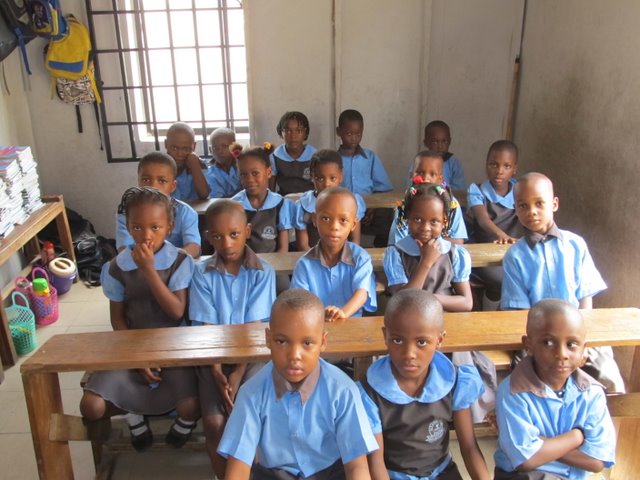
(Small class sizes at Gleaming Moon – an average of 15, compared to 40 to 50 in government schools)

Both of them are motivated by the desire to give back some of what they’ve been given in life. Oliver had to work through high school to pay his fees. (All schools in Nigeria, like much of Africa, require students to pay fees. People marvel when I tell them how I graduated from high school without paying a penny in fees.) He was then supported by his church in his university degree. He did so well in those studies that he was able to study in the U.K. Now he wants to build up some of the next leaders of Nigeria. A handful of the students at Gleaming Moon come from quite poor backgrounds and are supported by donations from overseas. There could be more of these students if there was more funding.

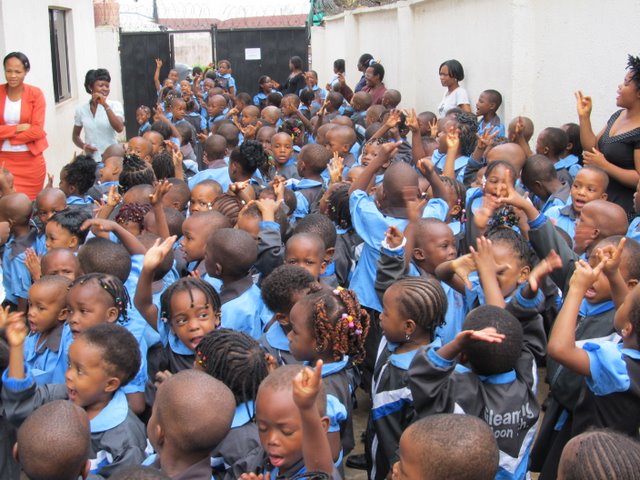
(Students at morning assembly – ranging in age from 2 to 12 years)

I visited the school on two different days and was very impressed by both the students and teachers. One interesting fact is that many officials in the Department of Education send their children to Gleaming Moon. They have to make the rounds of schools to ensure they’re meeting the standards and they clearly know which is best.

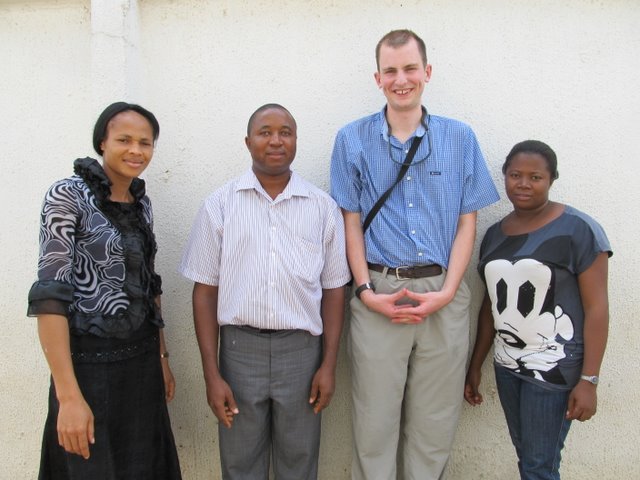
(With Oliver and some of the school’s senior administrators)

It is unimaginable the amount of dedication and work it takes to start and keep a school running. How wonderful that people like Oliver and Edith can dedicate themselves to this project. But how sad that the state of the country requires this.

“The stone that the builders rejected…”

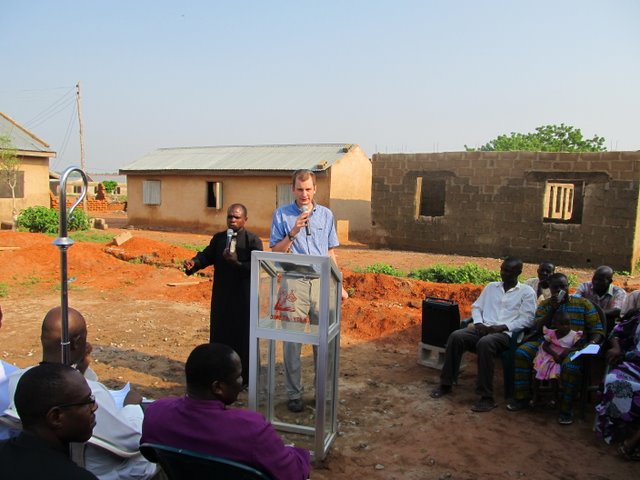
I preached this morning at the service laying the foundation for a new church in the Diocese of Yola. The text was Zechariah 4:1-10 with a little Matthew 16:13ff. and Psalm 118:22 thrown in for good measure. What does the Bible tell us about why we build churches, how we build churches, and who builds churches were my questions.

Bishop Marcus got not a speck of cement on his cassock.

“When you give…”

There’s a practice I’ve observed in the Nigerian church several times. I’ve asked around and it seems like it is pretty common. At some point in an event, there is a time for the “appreciation.” For instance, after the bishop gave his keynote address at the fathers’ conference in Owerri, envelopes were distributed, a big bucket was placed in the chancel, and men came up and put their envelopes of money in the bucket.

Here’s the thing: as they did so, each person took the microphone, said their name, gave a little speech thanking the bishop, and announced how much they were giving. (The money goes to the fathers’ organization by the way, not the bishop.) There was applause based on how much money it was. At one point, the MC said, “No more speeches, please, we don’t have time. Just tell us how much and put it in the bucket.”

As I watched this and other similar events, I couldn’t help but think of Jesus’ instruction in the Sermon on the Mount: “When you give alms, do not let your left hand know what your right hand is doing so that your alms may be done in secret; and your father who sees in secret will reward you.” (Matthew 6:3-4, NRSV)

This practice of appreciation is clearly in direct contravention of an important teaching of Jesus Christ himself. Yet when I’ve brought this up with several Nigerians, I’ve gotten a shrug and the comment – repeatedly – “It’s our culture. That’s how we give.”

I don’t think there is anything necessarily wrong with this public giving. Maybe it encourages people to give more. Maybe it is necessary in a culture where corruption is rampant and the church tries to be as transparent as possible. But then I go and read something like the Jerusalem Declaration, the rather portentous statement that came out of the Global Anglican Futures Conference (GAFCON) in 2008. (It is printed in the Nigerian prayer book.) The second point says, “The Bible is to be translated, read, preached, taught and obeyed in its plain and canonical sense, respectful of the Church’s historic and consensual teaching.” At the 2008 all-Nigeria clergy conference, there was a session on human sexuality where the presenter said that in regards to Biblical interpretation, “our position is the position of the child who is literal and very objective.”

Given that, I cannot possibly see how Matthew 6 can be reconciled with the practices of the Nigerian church. Perhaps, however, the Jerusalem Declaration is wrong and that there are more factors at work in Biblical interpretation. I’m open to the idea that one could make an exception to this teaching based on Nigerian culture and the way the practice of giving has evolved in the church here.

Of course, you’ll see where I’m headed on this one. The American church finds itself, arguably, in a similar position as regards same-sex relationships. But, of course, there is not a similar leniency shown on that issue.

I bring this up when I talk to Nigerians about the practice of public giving. One person just shrugged and said he didn’t know why Nigerian church leaders couldn’t be similarly lenient on interpreting the sexuality passages. “But,” he said, “being opposed to homosexuality has become a test of whether you believe the Bible or not.”

“Why that issue,” I asked, “instead of public giving?”

He shrugged. “That’s just the way it is.”

What this shows, I think, is that the opposition to same-sex relationships is not based on fidelity to the Bible. That is merely a nice cover for something deeper.

What is that something deeper?

I have an idea but I’ll wait to roll it out until a later post.

Alleged Anglican Disunity Blocks the Mission of God

I spent Saturday at the diocesan council meeting of the Diocese of Yola. Yola is the capital of Adamawa state – “the Sunshine State” – and is in north-east Nigeria, not far from the border with Cameroon. Northern Nigeria is more Muslim, poorer, and less populated than the rest of the country so I knew that Yola would give me a different perspective on the church than I’ve had in my first weeks in the East. This meeting confirmed it.

A major topic of conversation was the purchase of a second car for the diocese. Right now, they only have the bishop’s car and it is used for everything, from travels around the diocese (the farthest church is five hours away on bad roads) to errands in town. They need another vehicle not only for back-up but also because there is just too much demand for the one vehicle.

The trouble is that they can’t afford it. The car they want – a 2002 Camry or a 2001 Peugeot 406 – costs about $11,000 and so far the diocese has saved about two-thirds of that. There was a lengthy discussion on whether to keep saving or buy something cheaper. That turned into a conversation about maintenance and which mechanics could care for which brands of car. It is clear that the diocese is taking this quite seriously, as I could tell by the way the conversation reached mind-numbing levels of detail.

The next topic after the car was completing construction on the new site for the diocesan secondary school. (I haven’t written about this yet but the government in Nigeria has essentially abdicated responsibility for education so the church plays a huge role in this.) They need 400 bags of cement to finish the next phase of construction. Each bag costs about $15. Again, they just don’t have the money so they brainstormed about how to raise that money – ask each deanery to contribute? approach richer members of congregations?

I had two thoughts on listening to these conversations. The first is how different it is to Owerri, where the diocese has about four cars, many parishes own vans, and 400 bags of cement would be nothing.

(Bishop Marcus as he introduces me to the cathedral congregation this morning.)

The second was how clear a need there is for international partnerships in a place like Yola. They have hard-working clergy here, who speak good English and manage their finances transparently. Bishop Marcus Ibrahim is young, smart, energetic, and educated in the U.S (and on Facebook). Yet not a penny of the money the diocese has spent in his six years as bishop has come from abroad. (Some of it comes from other Nigerian dioceses, including Owerri, however.) He has looked and looked for partnerships and had no luck. The reason? The divisions in the Anglican Communion. Mainline Americans (and others) are conditioned to think that Nigeria is closed territory to them. (It’s not, as my presence here demonstrates.)

But surely, you say, those conservative Episcopal/Anglicans in the U.S. and elsewhere that have made such a big deal of their support and concern for the “orthodox” church in places like Nigeria are helping out? Nope. GAFCON folks are nowhere to be found in Yola or any of these other dioceses that have serious needs. It seems like they confine themselves to the big cities, where the rich dioceses and senior bishops are.

The way in which artificial divisions among leaders are causing serious headaches – and creating serious obstacles to the mission of God – in a place like Yola infuriates me. Nigerian after Nigerian is telling me that while they disagree with me on some issues, there is no reason we cannot still work together. Yet that is not the narrative that is propagated at the highest levels of Anglicanism – and to which most people, unfortunately, seem to be listening.

Yola’s annual budget is approximately equal to that of a mid-sized Episcopal Church in the U.S. Yola – and other similar dioceses – present a terrific opportunity for mission-minded congregations throughout the Anglican Communion to form path-breaking new partnerships that would not only do important work in an important area of the world but also helpfully shake up the rather-stale discourse on alleged Anglican disunity.

“I am a true Nigerian!”

Apparently, the state of New York has approved same-sex marriage legislation.

Even if I had missed the news online, I would have heard about it this morning when I attended church at the chapel in the governor’s office. (It’s just down from the mosque.) The bulletin contained a message from the chaplain thanking the congregation for their support at his daughter’s wedding yesterday. It added that the “perversion of the world has distorted God’s concept of marriage,” citing New York as an example. “This is a sign of the last days and as Christians we need to be cautious of these times.”

I was at the government chapel because Bishop Marcus was preaching. New York was on his mind as well. He was especially concerned with what it would make the congregation – the movers and shakers of state government – think of him. They all know about the issues in the Anglican Communion. He reassured the congregation that he thought homosexuality was wrong and that they could be sure he would not allow same-sex marriages in his church. He wasn’t polemical or offensive about it. He just said he thought it was wrong. He concluded with an emphatic, “I am a true Nigerian!” as if opposition to homosexuality is part and parcel of Nigerian identity. (It may well be.)

Later, I was introduced as a visitor from America who was “brave” enough to come to Nigeria when bishops and priests refused to. The chaplain thanked me for coming and prayed for me, making some serious assumptions along the way. “We send you as a missionary to your country to quench this fountain of sin that has welled up in your society, this menace that threatens your country. We pray for righteousness to spring up in your land and for true followers to gather around you.” I was left feeling more than a little uncomfortable but there was no chance for me to speak, nor, if there had been, was I sure what I would have said.

Lest Americans forget (and we often do), the rest of the world is watching us all the time. Our actions have impacts around the world. I saw this in Sudan last year with priests who told me how people accuse them of belonging to the “gay church.” That doesn’t change the rightness or wrongness of our actions. But I hope we spare a thought for how our actions affect our brothers and sisters around the world, who have to spend lengthy sermon minutes defending themselves.

At the same time, I regret the assumption by the chaplain that only certain kinds of Americans would bother to visit Nigeria. Why does he think that only people who toe the line on one narrow issue are worthy of visiting? The answer is clearly that this issue has become a short-hand test for fidelity to a certain Biblical “orthodoxy.” Why is that? I think that’s a question for another post.