The TREC rubber hits the TEC road

600426_573991912619954_1695884243_nTwo years ago, the General Convention of the Episcopal Church passed—unanimously!—a resolution to establish a “super-committee” to propose changes to the structure of the church. There was so much enthusiasm about the idea the passage of the resolution that at one point it was greeted with song.

Remember that?

At the time, I wrote:

The way ahead for this super committee is hugely difficult. Committee members…have to learn the ins and outs of the current governance structure to figure out what to change or whether and how to start over. They’ll need to think and dream about what is needed from a national church structure in the twenty-first century. And they have to do all this (and much more) in just under two years, with uncertain staff support and while all of them have jobs and lives elsewhere that are competing for their attention.

At the same time, the hundreds of deputies who passed this resolution will be headed home. The enthusiasm will naturally dissipate as they re-engage with the work of ministry in their local contexts. When actual changes begin to be proposed, there will no doubt be stout opposition from defenders of the status quo.

Some of those predictions now seem to be coming true. The energy of that unanimous resolution seems to have rapidly dissipated. The super-committee, now acronymized as TREC, has gone about its work, issuing letters and now beginning to unveil its proposals. The most recent effort is a letter this week laying out in broad detail some of what it hopes it can accomplish.

I don’t claim to be knowledgeable about the ins-and-outs of the workings of the governance of the Episcopal Church and I think there is more thought and energy behind these letters than TREC is often given credit for. Lots of other people have written about TREC. I am no expert. But I do care about the future of the church so, in the spirit of continuing the conversation, here are three points I haven’t seen elsewhere and that I think could usefully broaden some of TREC’s proposals.

Separate the ministry of primacy from the governance of the church. In the Church of England, Lambeth Palace (the home of the archbishop of Canterbury) and Church House (the home of the executive functions of the church) are on opposite banks of the Thames River. Other provinces of the Anglican Communion might combine these functions in the same building but still make a distinction between the primate and the organs that are needed for the functioning of the church. This is not to say that there is not cross-over and staff jointly appointed but I think the Episcopal Church needs a clearer separation then we currently have.

On the one hand, it would allow the church to think about what we want out of a presiding bishop—a prayerful leader, a charismatic prophet, or a gifted administrator; a free-ranging bishop without a diocese or a senior diocesan bishop—and allow him or her to shape the office to his or her gifts, rather than imposing certain (onerous) governance requirements up front. On the other, it would also allow the church to think clearly about what we want (and can afford) a central church office to do, independent of the aims and agendas of any particular individual. It would also address concerns about democracy in church governance.

Sure, separating the presiding bishop and church governance is messy—the relationship between Church House and Lambeth Palace is not always easy—but it means there’s no overwhelming centre of power in one person. The head of the central church governance—call him or her the provincial secretary, as so many other Anglican provinces do—could come from any order of ministry and be hired in such a way that the presiding bishop has a voice but not the only one.

Separate the work of governance from evangelism and mission. Earlier this year, I spoke at the Diocese of Connecticut’s annual mission conference. I’m pretty sure that not a single member of Connecticut’s General Convention delegation was there. I don’t say that to fault them or pick on anyone. Saturdays are busy days for every one. I simply want to point out that the evangelists and missionaries in a church are not always the people who feel called to the work of church governance. This is pure body of Christ theology here. Gifts are distributed differently.

The TREC letter, building on ideas previously proposed by member Dwight Zscheile, calls for the convening of a churchwide “missionary convocation” in tandem with or possibly in place of a General Convention. I’m just not convinced that this works. The people who are elected as General Convention delegates—largely those with experience, who can take time off during the summer, have few child-care needs, etc., etc.—are not necessarily the same people who could make a missionary convocation a truly thriving event. Again, this is not a criticism. We need governance. We need resources for evangelism and mission. Those are not the same thing.  (True, sometimes there is overlap.)

I’m all in favour of a both/and event—governance and mission/evangelism convocation at the same time—but some dioceses have a hard enough time sending a full deputation as it is. Part of the reality that TREC is dealing with is that the church is no longer in a both/and situation. Instead of beginning with a churchwide missionary convocation, I’d like to see more focused, regional events, whether those organized by congregations/dioceses/provinces or those by para-church organizations, such as the really successful series of conferences organized by the Global Episcopal Mission Network in recent years.

Listen to other churches. To date, I don’t see any acknowledgement in the TREC material that they have studied parallel process of re-structuring that are taking place or have taken place elsewhere. The United Methodists have debated similar issues in recent years, as has, in the Anglican Communion, the Church in Wales, which issued an incisive report (from a committee of three) not long after TREC was created. I have written about—and critiqued—that report in other places. But I always remember one comment in it:

A number of people have said to us that the Church in Wales is still characterised by a culture of deference and dependence…. What this means in practice is that people look to the Bishops and clergy to take initiatives and it has been suggested to us that nothing much happens without this. (p. 6)

Beyond issues of structure, there are issues of culture that the Episcopal Church is going to have to tackle as it moves into a new future. Aside from whatever canonical and constitutional proposals it will make, I think the most important legacy of TREC—as it hints in this recent letter—may well be the areas it highlights for further conversation in the church: number of dioceses, formation for ministry, etc. Among those, I hope, are issues of the culture of the church and how it conditions our work. It is these conversations—already happening all over the church—that will do much to determine how we move into the future to which God is calling us.

TREC is inviting dialogue with church members. I’ll be sending these thoughts to them at reimaginetec@gmail.com. I hope you engage with them as well.
Can a Starbucks barista find a place in the Episcopal Church?

Number 41 is an Episcopalian

It’s no secret that the Episcopal Church has historically been associated with a particular stratum of society—white, educated, socially connected, middle- to upper-class. The Presiding Bishop used to live in Greenwich, Connecticut—and now lives (or could live) in a Manhattan penthouse. We are a church that can count the number of presidents who have been members and can cite the large number of elected officials who belong. There has always been a number of African-Americans in the Episcopal Church but by and large in majority-black congregations. Power—thanks to the church’s abysmal history of race relations—has remained with the church’s white (and usually male) members.

In recent years and decades, this has begun to change. There are now several African-American bishops, including two of dioceses south of the Mason-Dixon line. There is a growing interest in Spanish-language ministry. We ordain priests from immigrant and Native American communities. Above all, there is the recognition that simply being the church of the white elite is no longer an option—not if we are serious about thriving in the wonderful hetereogeneity of 21st-century America nor, for that matter, if we are serious about being the body of Christ.

At the same time, the church has come to be dominated by a theology that centres on the “mission of God.” There is much to admire about this emphasis—indeed, I wrote a book about it. But I want to highlight one aspect of this emphasis. In the current theology of the church, the word mission is, as I have written at length elsewhere, often associated with a constellation of other words: task, job, do, work, labour, obligation. I once called this the Nike theology of mission: just do it. Get out there and do the work of God.

It is a truism that all theology is contextual and emerges from a particular community. Martin Luther King, Jr. and other civil rights leaders found a powerful parallel in Exodus and God’s deliverance from oppression. During a catastrophic civil war in southern Sudan, it is not surprising that people were drawn to Christianity in part because of the promise of eternal life. When your friends are dying, you begin to think about what comes after life.

The current emphasis on mission in the Episcopal Church can be seen in a similar way. It may not always feel like this but Episcopalians are, by and large, people who tend to have disposable time and disposable income. When we hear calls to volunteer at soup kitchens, start homeless shelters, donate to food banks, or whatever, it is not unreasonable for us to think about responding. In my experience of the Episcopal Church, Episcopalians are people who come from an action-oriented stratum of society that is used to exercising its own agency. When we hear calls to “mend the world,” we might think it’s a tall order but we might also think it’s not unreasonable to start making plans.

Spotted from time to time in an Episcopal church

All of this came to mind while reading a lengthy investigation in the New York Times recently about modern labour practices. The article focused on a young, single-mother who has no certainty in her work schedule from Starbucks and so ends up living a life of constant chaos, torn between child care, work, transit between the two, and with barely any time for any of her major life goals, like education or a driver’s license.

The article doesn’t say but I’d guess that this young woman is not a member of the Episcopal church. She may not be a member of any church, in fact. But let’s imagine she walks into her local Episcopal church on a Sunday morning and hears a sermon exhorting her to join in the mission of God, to get out there and build the kingdom, to do, to labour, to work. It’s not unreasonable to think that her response might be, “I can barely keep my head above water as it is. Why would I want to join a church that tells me I need to do more work?”

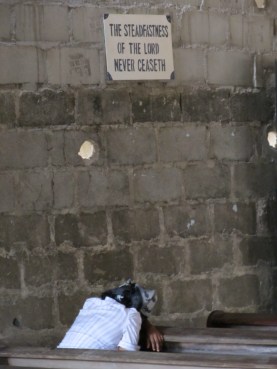
IMG_1768There’s a picture I once took on a weekday afternoon in a Nigerian church. There was a young woman, praying with her head bowed in a side pew. Over her was a sign that read, “The steadfastness of the Lord never ceaseth.” I was reminded in that moment of the deep well that is Christian theology with its themes of mercy, reconciliation, peace, redemption, truth, and so much more. This woman (I’m guessing) found her faith expressed at a moment of Christian consolation. You don’t have to do anything—just dwell in the love of God.

(As I write this, I am recalling a sermon I once preached on Matthew 11.28-30—”come to me, all you that are weary…”—and focused on how we were being called to take up the yoke of mission. All work, little consolation.)

The truth is, I can only tell you about what draws me to Christianity and to the Episcopal Church in particular. I can’t see inside the head of a Starbucks barista or a Nigerian church-goer. It is decidedly not the case that people from a lower socioeconomic background cannot mend the world or that they don’t want to try. Mission theology is not inherently misguided. But mission theology is, as all theologies are, particular to a particular community.

As Episcopalians think about our future as a church, one common theme seems to be that the main problem we face is that our message is not being heard broadly enough. We need to be better at evangelism, at church planting, and at communicating in the fractured media world of this era. All true. (And all steps that are action-oriented.) But I wonder if we might not stop and question not just how we communicate but what we communicate as well.

As Episcopalians look to transcend our historic membership patterns, we need also to think about the theology—or, more likely, theologies—that will be at the root of our new, broader community.

“So, Lord, please keep things broadly the same / Frankly, revival would drive me insane”

The Archbishop of the Church in Wales, Barry Morgan, last weekend addressed the Church’s Governing Body about the recent review the church commissioned to review its structure.

The actual review—which came out in July—is more detailed than the Archbishop’s speech. I looked at the review in July and had several thoughts on it then so I won’t write about it again.

But I did want to post the poem that the Archbishop ends with:

Lord, won’t ya keep things broadly the same

Frankly, revival would drive me insane

I’m busy, I’m tired so I’ll ask you again

Lord, won’t ya keep things broadly the same.


Lord, keep us from the unknown

I know that I’m damaged, but I’ll leave it alone

I’m busy, I’m tired and I’m injury prone

But Lord, please keep us from the unknown.


Lord, won’t ya keep us quite uninspired

At least, please wait till we’re all retired

I’m busy, I’m tired, to be quite so fired

So Lord, please keep us quite uninspired.


When we said ‘Lord, have your way

and change us so we follow’

Can’t you see it was irony

That’s now gone rather hollow.


So, Lord, please keep things broadly the same

Frankly, revival would drive me insane

I’m busy, I’m tired, so I’ll ask you again

Lord, please keep things broadly the same.

And then the Archbishop says:

And Jesus’ response to that is quite simple: “If you would be my followers, that just isn’t possible”.

Amen.

“Progressive Evangelism” and proclaiming the Gospel afresh in every generation

I was once in the customs and immigration line at Heathrow airport with the Rev. Otis Gaddis and watched as he struck up a conversation about faith with two other people in line. It was a sight to behold and I was filled with admiration for how skillfully he was able to do so. So it is no surprise that Otis—and several other of my former classmates—are among those profiled in a recent article about “progressive evangelists” in the Episcopal News Service.

“It [progressive evangelism] assumes that Christ is already present,” Gaddis said during a recent telephone interview. “The goal is not to bring people to church but to reveal the presence of church between you and the person you’re talking to.”

This line from Otis reminded me of something Max Warren, the former general secretary of the Church Missionary Society (and no “progressive” about evangelism or much of anything else) once said. He noted that the first thing a missionary should do when arriving in a new place is remove his shoes because he is standing on holy ground. That is, wherever we go, God has been there before us.

It reminds me also of Stephen Bayne, the first executive officer of the Anglican Communion, who once told a group of missionaries: “missionaries do not go out into the world to introduce the world to God or He to it. He is already there; He has been there from the beginning; He is standing waist deep in history, calling us to join Him. For the mission is His and not ours.”

I love that image of God being “waist deep in history.” God is already out there. We are going to join in. The progressive evangelists profiled in this story remind us that as much as we’d like we can’t do so on our own terms.

The ENS article provoked this comment from a Tom Swift:

Neither Jesus (“Go and make disciples of all nations”) nor Paul (“I preach Christ and him crucified”) would recognize this as evangelism. Christian evangelism is sharing the good news that sin and death have been overcome by the death and resurrection of Jesus. “Changing peoples’ minds and belief systems” is exactly the point! Such good news must be spoken with great love and respect for the other person’s values and beliefs, but it must be spoken to be evangelism.

This critique, I think, is helpful. I am reminded of Desmond Tutu’s line about the need to “share grace gracefully.” Particularly for Episcopalians—who have long made central our membership in the catholic church—a conversation about faith is not enough. A line like this

Progressive evangelism is not, however, about converting or getting people to church, he said.

can be a little worrisome, if you think about it. On some level, we believe that the grace that is in the sacraments needs to be shared broadly. Evangelism, at some point, has to be about “getting people to church.” (Or, even better, “converting” them.)

One of my favourite churchy slogans is “Proclaim the Gospel afresh in every generation.” The generation of which people like Otis and Adrian and Matthew and I and so many others are a part of bears this burden like every other generation prior to ours.

What’s interesting is the way in which the conversation started by evangelists in this article focuses so much on method: how do we proclaim? In this case, the answer seems to be by showing up in places where folks don’t expect the church to be. It’s also defined negatively, as in, not like those other, more conservative denominations.

I think what is missing from the conversation in the church these days is a focus on the third word in this slogan: Gospel. What is the Gospel we have to proclaim? What is the good news that people need to hear in this world? In what particular form does the good news of Christ’s death and resurrection need to be proclaimed? What is the kerygma—to use the word Paul uses—that we want to share?

These are the questions that still need to be addressed.

Flexibility and change in the Episcopal Church: The Commemoration of William Reed Huntington

In the debate over a potential covenant for the Anglican Communion, you might see mentioned from time to time the idea that Anglicans already have a covenant of sorts: the so-called Chicago-Lambeth Quadrilateral of 1886/1888. You can read all about it in your Book of Common Prayer (p. 876) but it has four elements:

  • Old and New Testaments as containing all things necessary for salvation;
  • The creeds as a sufficient statement of the faith;
  • Dominical sacraments (baptism and Eucharist) rightly administered;
  • Historic episcopate locally adapted.

The man behind the Quadrilateral was William Reed Huntington, whom the Episcopal Church commemorates today. Huntington was a parish priest, long-time deputy to General Convention, and advocate for ecumenical reunion in the United States. In fact, it was his desire to see the church united that led to the Quadrilateral. These were the elements Episcopalians had to see in another church to be reunited with them. The Quadrilateral remains a factor today, explaining why the Episcopal Church can be in full communion with the Evangelical Lutheran Church in America but not, say, the Presbyterians, who have a much different understanding of the ministry of the episcope. (Huntington was also a priest for many years in Worcester, Massachusetts. Although the Diocese of Western Massachusetts didn’t exist then, it’s more proof that it may be a small diocese but still one that punches above its weight.)

Efforts to use the Quadrilateral as the basis for intra-Anglican unity are a category mistake. The Quadrilateral is about ecumenical relations. And there’s good reason for this. If we say that the Quadrilateral is essentially a proto-Anglican Covenant, then we’re saying that our relations with the Anglican Church of Southern Africa or the Anglican Church of Canada are no different than our relationship with the ELCA or the Moravians. We may sometimes feel that way but the whole idea of the Anglican Communion, as I interpret it, is that those churches that have a historic relationship have some sort of special relationship that is distinct from that shared with other members of the one, holy, catholic, and apostolic church.

Now you may think, as I largely do, that the proposed Anglican Covenant is unnecessary. But don’t say that Anglicans already have a covenant. Huntington had something entirely else in mind when he was devising the Quadrilateral.

Sometimes the Quadrilateral is seen as a bit too firm and an obstacle to reunion, particularly the part about bishops. But what I like about Huntington was his advocacy for  flexibility and change in other parts of the church’s life to facilitate ecumenical reunion. He thought, for instance, the church could be a bit more open to liturgical change. To this end, he spent a lot of time on prayer book revision.

Huntington’s commemoration, then, poses several questions to the church in this time of change: what do we think is worth preserving about our church? What can we more readily compromise on?

Lessons from the Church in Wales

The meeting was notable for the number of contributions from members with a common message: “The Church cannot go on doing the same things in the same way; some things need to change and we are open to – and indeed encourage – that possibility.

Sound like a familiar sentiment? But rather than being from the just-concluded General Convention of the Episcopal Church, the sentence is how the new Review of the Church in Wales begins. The Welsh church commissioned the report two years ago and it was released earlier this week.

On the assumption that the Episcopal Church—which just created a super-committee to consider restructuring—has something to learn from our Welsh sisters and brothers, I had a look through the report.

The report spends a lot of time calling for larger Ministry Areas—something like deaneries, though it is careful not to call them that—in which the lead pastors would be both ordained and lay. “A radical change of perspective is needed,” the authors write, “from parish to a much larger area, and from a single priest, to a team with different gifts.” (p. 8) I think the report is to be commended for so highlighting the role of lay people in ministry. The call to move to the larger Ministry Areas is a sign of the straits the church is in that it feels it can’t keep the close connection to communities the parish system gives it.

Given the recent focus of this blog, the report’s commentary on ordination training was interesting, particularly the way in which it upholds residential training as a part of such training, even if combined with non-residential portions (p. 14). The report also acknowledges the increased need for non-stipendiary clergy (p. 17). We call them “bivocational” clergy in the U.S. but the idea is the same. Clergy need to start thinking about income sources independent of the church. The report suggests the church in a few years think about moving from six dioceses to three (p. 19). Since you need to have four dioceses to stay a province of the Anglican Communion, I’m not quite sure what that would mean for the Church in Wales status but that doesn’t seem to have been considered by the authors. (Perhaps Wales could get around that by having some missionary areas?)

The most interesting aspect of the report is its identification of a problem in the culture of the Church in Wales: “namely the respect in which the office of Bishop is held in the Church in Wales and the authority which he wields by virtue of his office.” The authors write:

A number of people have said to us that the Church in Wales is still characterised by a culture of deference and dependence. This is a model of leadership that is carried over into the parishes, where so often the complaint has been that it is all about the clergy, that there is a culture of “Father knows best”. What this means in practice is that people look to the Bishops and clergy to take initiatives and it has been suggested to us that nothing much happens without this. (p. 6)

I’d say there’s an element of this in the American church as well, though less than there used to be, perhaps, and less so than there is in Wales. Moreover, I think many bishops in both Wales and the U.S. would be happy to give up some of this authority if only we’d take it from them. I hope that this Review, as well as whatever process the Episcopal super-committee goes through, can start a conversation on what we expect of bishops and how we remain true to our Anglican tradition while remaining able to relate to the challenges of our time.

One thing that is clear, however, is that no structural change can change this cultural situation the Review identifies. And so what I think this report reveals most fundamentally is that we can tinker—even quite dramatically—with the structure of the church but it all means nothing if the people in the church don’t change as well. It’s one thing to (unanimously) establish a committee to investigate church structure (and sing it into being). It’s quite another to look in the mirror and ask how—independent of any structural concerns—each member of the church can become a more missional follower of God in Christ.

And that, I think, is the ultimate disappointment of this Review. It doesn’t go far enough. Perhaps that’s what you get when your committee is composed of three well-connected church personages. I get the sense that the report’s authors simply decided to shrink and combine the church’s functions in response to its diminished financial position. The Review does a good job at the beginning and the end of identifying what the purpose of church is —”to proclaim the Gospel and draw people into the life of Christ” (p. 37)—but sometimes I struggle to see how that goal is connected to some of its recommendations.

The annex of this Review is fascinating: a summary of all the other structure reports in the last generation in the Church in Wales. And yet here is the church, again calling for review and reform. Will this report end up on a similar list at some point in the future? It might, if we put all our energy into changing structure and none into changing the disciples we are forming.

Church structure reform: now the work really begins

For decades, Alaskan politicians have been looking for a way to develop the state’s natural gas resources on the North Slope. In 2007, the state legislature passed a piece of legislation called AGIA (the Alaska Gasline Inducement Act) that, it was believed, would at last lead to the building of the gas pipeline to transport the gas to market.

I can’t remember if I was in the legislative gallery at the time or not (I think not) but I do remember the palpable sense of excitement and enthusiasm that surrounded AGIA. Of the 60 lawmakers in the House and Senate, exactly one voted in opposition.

I’ve been thinking about AGIA in the wake of the General Convention’s unanimous approval of a resolution that creates a committee to overhaul the structure of the church. There is that same sense of excitement and enthusiasm that I remember from AGIA. People want change and they are pinning their hopes on this committee to bring it.

So perhaps it is time for a dose of reality: the way ahead for this super committee is hugely difficult. Committee members (whomever they may end up being) have a huge amount of work to do. They have to learn the ins and outs of the current governance structure to figure out what to change or whether and how to start over. It surely makes sense that committee members also explore how other denominations govern themselves. They’ll need to think and dream about what is needed from a national church structure in the twenty-first century. And they have to do all this (and much more) in just under two years, with uncertain staff support and while all of them have jobs and lives elsewhere that are competing for their attention.

At the same time, the hundreds of deputies who passed this resolution will be headed home. The enthusiasm will naturally dissipate as they re-engage with the work of ministry in their local contexts. When actual changes begin to be proposed, there will no doubt be stout opposition from defenders of the status quo. This could be difficult to overcome if people are no longer paying close attention.

Moreover, we can’t “save” the church simply by changing its structure. We need church members who are continually open to the transforming work of God in Christ upon them, people who are agents of God’s mission in the world, people open to following in the sacrificial way of Christ. If we don’t have that—and we don’t take our focus off it—the work of the super-committee will be moot.

All of this is to say that the resolution passed by this General Convention is not the end of anything: it is the beginning of what I hope is a process that transforms the church. While leadership of that process is about to be passed to a super-committee, the process itself  needs the continued care, support, and guidance of the whole church. That’s why a group like Acts 8 is so interesting. At their meeting last night, they talked about ways to spread this passion for church reform to all levels of the church.

All that enthusiasm for AGIA? It soon passed. Before too many months, those who had voted for it were running for office against it. Mutual recrimination followed. Alaska is no closer to a natural gas pipeline than it was before AGIA passed.

Let’s make sure the same thing doesn’t happen with this resolution. Let’s stay interested and engaged in this process, in the hope that the holy way of doing business so clearly exemplified by this Convention can be carried into the important work of the next three years.

Bring back the Church Congress Movement!

Proposals are flying around to restructure the Episcopal Church and it’s clear that the make-up of the church’s governing body, General Convention, is on the table. The bishop of Long Island wants to combine its houses. The bishop of Arizona wants to shrink it substantially. It has already, due to budgetary constraints, been shortened in recent years, though with no apparent reduction in workload. That, in turn, has led to calls for certain items—like resolutions calling for the government to do (or not do) something—to be jettisoned from Convention’s agenda. Across the board, there are calls for more collaboration across the church with more “sharing of resources.”

So here’s an idea—building on that same proposal from the bishop of Arizona: what if we brought back the Church Congress Movement?

The Church Congress Movement (about which there is no Wikipedia article so you know it’s really obscure; you get a whopping eight Google entries when you search for it) flourished in the Episcopal Church in the late nineteenth and early twentieth centuries. It was back when the Episcopal Church had pretensions to grandeur and thought it had something to say to the world around it (and that people were listening). Folks came together to debate the issues of the day in the world and in the church.

Why might this be a good thing to consider reviving?

  • General Convention is awfully focused on doing stuff: passing a budget, authorizing liturgies, etc. The Church Congress can be focused on exactly the kind of consensus-building and resource-sharing we need in the church—without getting distracted by the pressure of having to take care of the business of the church.
  • The Church Congress was an early example of what we now take for granted: networking. This is what makes the world go ’round (however you may feel about it) and a lot of it seems to happen at Convention. Why not de-emphasize Convention, though, where the focus is on the folks who happened to get elected as deputies, and open the door to a broader-based conversation with less hierarchy and more open participation.
  • The Church Congress separates the important business of governing our church from the equally important (but I think slightly different) business of figuring out where the church is going and what it should be. Let’s be clear about what’s important for governance and what’s important for the church as a whole.
  • The Church Congress is open to all comers, not just the kind of people who stand for and get elected as deputies to General Convention. As a result, there’s a wider slice of the church represented.

There are already plenty of signs of movement in the direction of a Church Congress-like organization. Gathering 2013 or the Gathering of Leaders are both groups that do similar sorts of things to what I’m describing here (with the important distinction that both are clergy-only affairs). But I think there’s something to be said for scale and regularity. The Church Congress was an event in a way that neither of these two Gatherings are.

The major obstacle, of course, is financial. We can barely fund General Convention. How can we fund another big meeting? In the twentieth century there were three Anglican Congresses that brought together Anglicans from all over the world. (Once we’ve brought back Church Congress, let’s bring back the Anglican Congress!) The Lambeth 2008 design team wanted to have an Anglican Congress but scrapped it for lack of money. I’m not sure I have an easy answer to the financial question, though a much-reduced Convention should help, nor am I going to let that stand in the way of an idea.

There’s one thing I’m not telling you about the Church Congresses: they actually represented a church faction (the broad church types) and so were not truly an equal meeting ground for all. Moreover, the movement foundered when consensus (in this case, over the creeds) began to break down in the church. The meetings were an expression of a consensus in the church rather than a tool for creating consensus. I’m not sure how that would translate to today’s church.

Still, the idea remains. De-emphasize the governing of the church and emphasize the being of the church. A movement like the Church Congress could be egalitarian, broader-based, and feature the kind of networking that leads to change.

Sounds a lot like the world around us that the church is so often encouraged to learn from and emulate.

“If you are not baptized, please sit down”

I was recently looking through my notes from my trip a year ago to China and I found this story I had forgotten.

One Sunday I visited one of the major, sanctioned Protestant churches in Beijing. The congregation stood while the pastor prayed over the communion elements. Then, just before the distribution, the pastor made an announcement. “If you are not baptized, please sit down.” About a third of the congregation did so. They watched while the rest of us received communion that was passed through the pews. None who sat down seemed offended. No one stormed out in a huff. This was how things were. They were not baptized yet but looked forward to the day when they were.

So what’s the difference between this church in Beijing and your average Episcopal congregation, where I can never imagine something like this happening?

One difference—and there are many—is that folks are beating down the door of this church in Beijing. I had to wait in line twenty minutes to get into that service. The sanctuary could probably hold 1000 people and it was standing room only that morning. In the Episcopal Church, perhaps, we’re so desperate for folks to come in, we don’t want to do anything that will turn people away.

I’ve written before about how the “open communion” conversation in the Episcopal Church is about much more than the relationship between communion and baptism. However that may be, I was struck to find this story in notes this morning.

What would we think about an Episcopal rector saying the same thing on a Sunday morning?

The distinctiveness of the Episcopal Church

Samuel Seabury asked a question on Twitter recently:

(Isn’t Twitter wonderful? Dead Episcopal bishops tweeting. Seabury’s old foe William White is online as well.)

I think Seabury asks a good question here. If I remember my history correctly, at the time the Episcopal Church was being born, there were no other churches in the new United States of America that had bishops. Congregationalists, Methodists, Quakers all stressed local governance.

In this context, naming the church “Episcopal” is something a bold move. “Look at us,” it says, “we have bishops and we are connected to the historic, true church. We are distinctive.”

So as the Episcopal Church once again struggles to find its way in a changing world, I wonder if asking Seabury’s question again is helpful: in the current religious marketplace, what makes the Episcopal Church distinctive?

Relatedly, is highlighting our distinctiveness the way to go? Or should we be stressing what we have in common, not only with other Christians but with all folks everywhere?