One bishop without a home, and one bishop with two

In January, there was an odd story from the Episcopal Church of South Sudan and Sudan: Precious Omuku, an Anglican priest from Nigeria who currently works in Lambeth Palace for Archbishop Justin Welby, was made a bishop in ECSSS.abpandbps

He’s not a diocesan bishop, but has rather a roving, ambassadorial role.

According to the Revd. Dr. Joseph Bilal, a board member of the Justice, Peace and Reconciliation of the Province of ECSS& S, Bishop Omuku will continue to work in his base at the Lambeth Palace as special adviser of Archbishop of Canterbury on Anglican Communion Affairs. “He will not necessarily be move out from his base at Lambeth Palace, but he will continue with his duties as adviser of the archbishop of Canterbury on Anglican Communion affairs. He will be keenly involved on issues of sustainable development, justice, peace and reconciliation in South Sudan and Sudan,” Dr. Bilal explained.

What’s odd about this? It’s not odd that a person ordained in one country became a bishop in another country. (The bishop of Waikato in New Zealand was ordained in the Church of England. Desmond Tutu was once the bishop of Lesotho.) It’s not odd that a bishop is doing a non-diocesan role. (The bishop of Algoma is about to become the principal of a theological college. There is a “bishop at Lambeth.“)

The oddity has something to do with place.

For Anglicans, geography shapes the church. The Church of England, for instance, divides the entire country into parishes, groups parishes into deaneries, deaneries into archdeaconries, archdeaconries into dioceses, and dioceses into provinces. The bishop is the head of a diocese and an archbishop is the head of a province. Other Anglican churches do things in various different ways but all still maintain in one way or another that a bishop is linked to a particular place, called a see. You can give up that see later on and still remain a bishop, but to become a bishop you need to be linked to a place.

So it’s odd, then, that the church in the Sudans should consecrate someone to be a bishop without a place but rather with a role.

I probably would have let this oddity pass me by except I then read another odd story about bishops and place recently: the suffragan bishop of the Diocese of Virginia, Susan Goff, has now become an assistant bishop in the Diocese of Liverpool. The oddity here also has to do with place: a bishop is to be linked to a place, as Bishop Goff, already is, but it is to be one place. Now Bishop Goff is a bishop connected to two places. I have no doubt that the link between Liverpool and Virginia is strong and important to both dioceses. I want to take nothing away from that relationship. But in ecclesiological terms, this particular move doesn’t make much sense. (And, indeed, Bishop Goff had to post a video clarifying that she’ll only be in Liverpool up to two weeks a year.) To ask one particular question: who is Bishop Goff’s metropolitical authority? Is it the Archbishop of York (through the bishop of Liverpool), as it is for other bishops in the northern province of the C of E? Or is it the rather diffuse metropolitical authority of the Episcopal Church (through the bishop of Virginia), as it is for other Episcopal bishops?

The church is full of oddities, ecclesiological and otherwise, and I’m usually content to let them go unremarked upon. But these particular oddities reveal some deeper confusion in our Anglican thinking about bishops. There are many voices (with which I heartily agree) that tell us about the importance of all orders of ministry, about the need for priests and lay people to take an active role in governance and decision-making, and so forth. In the Anglican tradition, bishops are not the sole locus of authority. Readers of this blog and my books will know how frequently I have nattered on about the importance of involving more voices in determining the direction of the church, rather than just those that wear purple shirts.

Yet at the same time we have this fixation on bishops: who they are, what they do, what they say. We develop fancy ways of referring to them (+ or ++, which is an oddity for another time). We struggle to call them by their first names. We surround their visits with a kind of aura. The result of all this is that we are developing this unstated assumption that the only things that matter in the church are what bishops say. There’s no reason that ECSSS could not have appointed a priest or lay person as its roving ambassador. If the Diocese of Liverpool wanted to cement its ties with Virginia, the bishop could have made a priest or lay person from Virginia a canon in his cathedral. But in each case, it was decided the role needed to be filled by a bishop—a response to and a furthering of this over-emphasis on episcopal ministry. And that emphasis has real world impacts, not least the proliferation of bishops and dioceses in a church like ECSSS so that ever-smaller regions of the country can feel like they have an adequate voice at the table.

If you’ve read this far, then you’re probably as far into the weeds of Anglican ecclesiology as I am. These situations are not the most pressing issue facing the church or the world. But they are odd. And in their oddity, they reveal a rather worrisome trend in the life of our churches.

South Sudan, four years on

It is July 9. Four years ago on this day, I was in Juba, South Sudan as the newest nation in the world was inaugurated. After decades of civil war, South Sudan at last had achieved its independence. It was a day that was palpably full of hope, expectation, and wonder.IMG_3318.JPGIMG_3322.JPG

Now, those memories seem like a terrible joke. In the intervening four years, South Sudan has fought brief battles with the north. Most cataclysmically, since December 2013, parts of the country have been consumed by civil war.

I am in the process of writing finishing a dissertation about South Sudan during its earlier civil war, the one between 1983 and 2005. What has struck me most powerfully in these last 18 months is the sheer number of parallels between the conditions on the ground now and what was reported two or three decades ago. You would have thought we could have moved past this but, no, unfortunately, it seems we cannot.

When this latest round of violence began, I had a lengthy series of posts reporting what I had heard in phone calls and e-mails from friends across South Sudan. In time, I ended that series not because I stopped caring but because it didn’t seem as if many people cared. I have continued to stay in touch with friends and church colleagues in South Sudan and abroad, continued to attend conferences related to the matter, and continued to keep the country and its churches in my prayers. Meanwhile, South Sudan’s spectacularly inadequate leaders participate in periodic “peace negotiations” in some of Africa’s finest hotels, make all the right noises—and then fail to effect any improvement in the suffering of their people.

So where does that leave us now, “us” here meaning people who don’t live in South Sudan but feel a great attachment to its people and its churches and so desperately want to see them succeed? On the fourth anniversary of independence, three thoughts come to mind:

  • First, while it is true that the effects of the violence in South Sudan are horrific, it’s not the case that these effects are equally spread across the entire country. The entire country is not equally consumed by civil war. This is important, if for no other reason than that we should not write off the entire place as beyond our help.
  • Second, the causes of this violence are deeply, profoundly complex. It has to do with the prevalence of small arms in the country, existing patterns of religious leadership, opportunities for young men, the lack of infrastructure in the country, and a whole lot else. One part of this is the division between two major ethnic groups, Dinka and Nuer, a division we should note that is largely due to policies pursued by the British colonial government. It is this division, however, that tends to get all the attention.
  • Finally, at one conference I attended, there was much despair about the present situation. But one person who has been involved in South Sudan for a very long time said at the end of his presentation that his grounds for hope came from the possibilities of working with and through small-scale, local institutions. He had largely given up on the existing national leadership and national institutions, but he did think there was lots of potential for working at a more grassroots level in various places of the country. He didn’t say this at the time but I immediately thought, “Oh, the churches.”

Speaking of the churches, many Christian leaders—under the leadership of the Anglican archbishop, Daniel Deng Bul—have come together to launch a National Platform for Peace and Reconciliation. One focus of this work has been training people for reconciliation work at a grassroots level. There are two short videos about this work.

It is very easy to lose hope when thinking about South Sudan. Christians, however, believe that new life follows moments of death and despair. The reconciling work of the church—however limited, local, and small-scale—remains the grounds of whatever hope I continue to have.

Stuck in the middle in South Sudan: on reconciliation and peace

IMG_3295Daniel Deng Bul, the Archbishop of the Episcopal Church of South Sudan and Sudan, and leader of South Sudan’s National Platform for Peace and Reconciliation, has written an important letter outlining the efforts of so many to bring about peace in South Sudan.
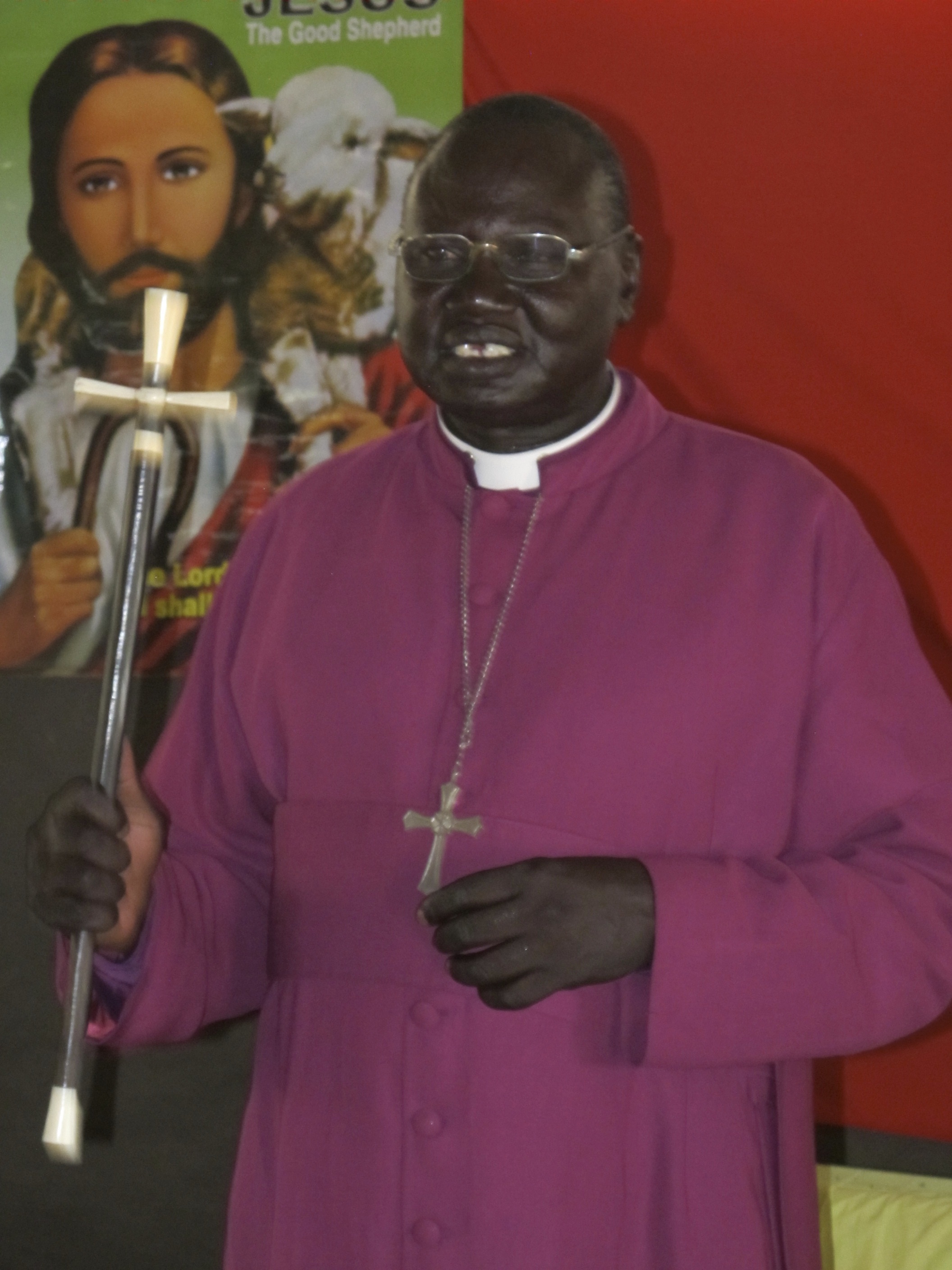
I have uploaded the letter here so that you can read it in its full, but here are a few excerpts that struck me.

Why is it so important at this point to raise an independent voice for peace and reconciliation? The war is dividing and polarising the people and communities of our country. The middle ground is eroded. When you listen to one side you are criticized as biased towards one or the other. Each side wants you to be with them. And if you are not with them you are against them. Tribal allegiance is expected and people labeled accordingly. This makes it very difficult for people and leaders to stand in the middle and reach out to both sides equally. Motives are questioned, actions are doubted and words are twisted. Reaching out to both sides requires courage and commitment to the ideal of a healed nation. This is why being independent and united is so important. Standing in the middle is necessary to reach both sides and to bridge the divide between people and political leaders, between divided communities. We serve the people and we serve our leaders. We are inspired by the courage of our people and guided by our belief in the Word of God. Independence does not mean you are against the government or the Opposition, against one or the other community. Independence for the [Reconciliation] Platform means we can listen to everyone equally, openly and inclusively to bring the voices of all the people together to advance peace and reconciliation.

To be a reconciler is to be stuck in the middle of deeply conflicted situations. I am reminded of the Latin word for priest, “pontifex,” which means bridge-builder. The trouble with being a bridge, however, is that you get walked all over. It is that holy work of bridge-building to which Archbishop Daniel and others are dedicated.

Reconciliation is not just about a cessation of hostilities between warring parties but involves actors from across society.

To start the journey for our healing, we have to come together and speak with one voice against this war that is tearing our nation and our people apart. The Platform is reaching out to all constituencies and groups. The role of women, youth, religious communities, traditional leaders, government and opposition and many more are recognized as equally essential if we want to build a broad coalition of people to stand up against the war and urge our leaders to find and implement solutions that stop the war and begin the healing and development we all need. The Scriptures have countless calls for us to be of the same mind and consider others better than ourselves.

Be of the same mind toward one another… And let us consider one another to provoke to love and to good works (Romans 12.16; Hebrews 10.24, NKJV)

In all that is happening in the world—you can read about the work of an Anglican priest in Iraq here—it is easy to lose sight of South Sudan, particularly as the onset of the wet season leads to a necessary diminution of violence (though not of suffering). But the need for reconciliation remains acute and we can continue to pray and support the work of Christians there.

A rejected visa application and the future of the Anglican Communion

Two stories in the Church Times in the last two weeks highlight the challenges facing the Anglican Communion.

The first, from the current week’s issue, was reporter Madeleine Davis’ commendable effort to track down South Sudanese bishops and ask them what they thought about the Archbishop of Canterbury’s recent comments on same-sex marriage. She also spoke to some people in the UK who disagreed with what the archbishop had to say. To me, the various voices (all male) quoted in the article seemed to be speaking past one another with no one showing much interest in engaging with the particular context in which the other ministered. Perhaps that wasn’t the point of the article or of the questions they were asked. But it jumped out at me nonetheless.

The second article, from a week earlier, was about a Sudanese priest who was planning to visit the Diocese of Salisbury to raise awareness of the ongoing violence in his home—but was denied a visa. In a sense, this is the farthest thing from news. Sudanese and South Sudanese get denied visas to the UK all the time. I have been in South Sudan when church members—including bishops—are in the process of applying for a visa and I see how nervous and uncertain they get. The UK border machine is seen by some as capricious and unpredictable. It favours those who can speak English well enough to do well in an interview and who have the resources to travel to Nairobi or Kampala and then wait there for a result as you can’t apply for a UK visa in South Sudan.

The one conclusion I return to time and again in my travels in the Anglican Communion is how little Anglicans in different parts of the world truly know about one another. I am convinced that the way to remedy this is the patient building of mutual, honest, incarnate relationships, particularly relationships that move past the level of bishops and truly engage Anglicans at all levels of the church. But the difficulty of getting visas continues to obstruct this holy work.

For me, the juxtaposition of the two stories is a reminder of the significance of immigration policy. The pressure British politicians feel on immigration needs to come not only from screaming tabloid headlines but from faithful Christians who say, “We need to welcome these people to our home. They enrich our life together.”

Connection to the outside world

Justin Welby is on a flight to Juba, South Sudan.

(Well not directly. I yearn for the days when you can fly from Heathrow to Juba direct.)

It is easy to underestimate the power of archiepiscopal visits. At least in England, people are used to seeing the archbishop pop up all over the place—preaching at this college, visiting that church, giving an interview to this reporter—that we can get inured to the significance of his presence. Moreover, some people—especially in the media—want action they can report. Think of the headline: “Archbishop brings peace to South Sudan.” But that’s not what the archbishop is going for. In his pre-trip interview with the BBC, he says that the purpose of the trip is, essentially, to be with people.

There is ample precedent for archiepiscopal visitation to what is now South Sudan. George Carey, archbishop in the 1990s, made two visits to Sudan during his tenure. These are vividly remembered by Christians, even today, twenty years later. On one visit, he spent time in Dhiaukuei, a remote community that had become a safe haven for Christians and a centre of learning and evangelism for them. One woman there, remembering his visit, told me that when he came, “We thought, ‘OK, if part of our body from a different part of the world came to visit us, then the message of Jesus Christ which said, “We are all parts of the same body,” is true.’”

Carey’s successor, Rowan Williams, visited South Sudan in 2006. He spent time in Malakal, a town that has been the news recently because it has been one focus of the recent violence. When I was in Malakal in September, people unpromptedly told me about his visit and how everyone—Anglicans and non-Anglicans alike—turned out for his events.

Given all that South Sudan has been through in the last six weeks, I imagine that Archbishop Welby will have a similar welcome—if he allows himself public events—and his visit will have similar significance.

Later in this visit, Archbishop Welby plans to visit the church in the Democratic Republic of Congo. The DRC has its own complex problems of violence and societal fracture. I recently read this from a bishop of the church in the DRC:

The poor infrastructure and lack of communication systems ensure that the church is internally disconnected and lacks sustained contact with the Anglican Communion… [The church] has felt proud to be part of the Anglican Communion but feels unable to fully contribute to the communion or to understand entirely its debates. Many of the problems of poverty, war, hunger, and sickness that are so pressing for the Congolese nation do not appear to be prominent in inter-communion discussions.

(That’s from the chapter by Bishop Titre Ande and Emma Wild-Wood in the new Wiley-Blackwell Companion to the Anglican Communion.)

For many Anglicans, the archbishop of Canterbury is important for what he embodies—connection to and concern from the outside world. This is what many people in conflict zones are yearning for, the assurance that someone, somewhere out there is thinking about them. By simply showing up and listening to the real concerns of real people, the archbishop of Canterbury performs a hugely important ministry.

That’s hard for reporters (and others) to grasp. But the lesson of history is that is hugely significant for the people on the ground. And in the end, that’s probably what matters.

Dinka Christianity: an exilic faith

It was not planned this way but the Christian Century this week publishes an article of mine about Christianity among the Dinka people of South Sudan, from the stuttering and failed efforts of Anglican missionaries in the first half of the twentieth century through two civil wars (and more recent violence) and into the vibrant faith it is today:

The Dinka church is a church of exile. When the civil war began there were only five Dinka congregations stretched along 150 miles of the Nile’s east bank. They were all that remained of the British Anglican missionary presence among the Dinka in the early and mid-1900s. Today that same 150-mile stretch is home to more than 300 Anglican congregations (and a handful of others in other denominations), not to mention innumerable preaching centers in cattle camps along the Nile. There are two dioceses in the area and plans to create more. Virtually every one of the villages on the roads leading out of Bor has a church—often a mud-and-thatch building.

The Christianity of today’s Dinka emerged out of the sorrow and deprivation of refugee life, a time of despair that led many refugees to turn to the church for support, nurture and growth. It’s no accident that the wooden church pews came back with the refugees. Today the cathedral in Bor is a center of South Sudanese life. On Sunday mornings the building pulses and shakes with the energy of up to 1,500 worshipers. The same is true in the churches scattered throughout the region.

Many of the people in Bor are now displaced, of course, by the violence of the last few weeks. I find myself wondering what role this faith plays in their displacement.

The article tells, in part, the story of Mary Alueel Garang Nongdit, who as a young, uneducated convert to Christianity began composing hymns of great theological depth and profundity.

The Dinka hymnal is a rich repository of theological reflection on many subjects, including the relationship between war and faith. Over a third of the hymns were composed by women, a remarkable achievement in a culture that traditionally has not valued women’s musical contributions. One of them, Mary Alueel Nongdit, began composing hymns shortly after her baptism in 1984. Her hymns are among the longest, most complex and most popular. They have a richness of expression and theological complexity that is unique.

In one hymn Alueel Nongdit writes that “the death that has come is revealing the faith”—an appropriate sentiment for a people who converted to Christianity during a war. She says that the hymn encourages the people to look to God. “When you are crying, instead of crying just divert that crying to prayers. Turn back to God and cry to him. He will see you. He will rescue you. You are not alone.”

Alueel Nongdit also wrote about the love of God and the ways that love can be expressed. In the book of Hosea, she says, God’s love is shown in ways that might not at first seem loving. The Dinka had a similar experience: it was only in the destruction of war that God’s love was revealed to her people. The Dinka were “a stiff-necked people,” she says, but “God cannot get tired. If there is somebody whom he likes, even if the darkness buries you, if God loves you, he can dig you out!”

Although I met Mary Nongdit after I had finished drafting my new book, Backpacking through the Anglican Communion, this article gives you a taste of the kind of stories that are at the heart of that book. Anglicans around the world live some incredible lives of faith. It’s time to learn more about them.

News from Bor

Ruben Akurdit Ngong, bishop of Bor, April 2013

The Anglican bishop in Bor, South Sudan is asking for prayers and assistance as his see city emerges from intense violence over Christmas.

I spoke on the phone this morning with the Rt. Rev. Ruben Akurdit Ngong, bishop of the Diocese of Bor in the Episcopal Church of Sudan and South Sudan. (Bishop Ruben was my host in Bor for most of the month of April.) The connection was poor and we only managed to talk for about ten minutes but I managed to gather some information.

Since December 19, Bishop Ruben has been seeking shelter in the UN compound in Bor, along with a reported 17,000 others. He reported that there is sufficient water in the compound but insufficient food.

South Sudan’s violence has enveloped Bor in recent days. Reports indicate that the SPLA/government forces pushed out forces that were loyal to a commander who defected from the SPLA. The only media reports I have seen from Bor so far are this disturbing video from Al Jazeera.

Bishop Ruben indicated that people were leaving the UN compound during the day and returning to see what had survived of their homes. St. Andrew’s Cathedral in Bor is reported to be still standing with minor damage.

The bishop’s primary concern was that as people look for assistance, they will be looking to the church. He expects that as people realize what they have lost, they may begin to gather near the cathedral. He is concerned that the diocese will be unable to meet people’s needs—food, water, shelter, and especially medicine—with its current resources. In many parts of South Sudan, people look to the church with expectation and hope because they know of the church’s international links with other Christians.

The challenge of offering relief and assistance is compounded by the fact that as rebels left Bor they took with them many of the vehicles in the town belonging to government officials, international organizations, and so forth. Bishop Ruben’s car is safe in the UN compound but he foresees a serious logistical challenge in making relief aid available.

The fighting has now moved north of Bor in areas around Baidit and Jalle, several hours north of Bor.

Women at the Anglican church in Baidit payam, April 2013
Women church leaders near Jalle, South Sudan, April 2013

Separate fighting is also reported in Malakal, about a day’s journey north of Bor. I have been unable to be in touch with Bishop Hilary Garang Deng, who hosted me in September.

Bishop Ruben asked me to convey the message that he is grateful for the prayers and support people have already offered. I hope that the phone connection may improve in coming days and I may actually post some of his own comments, rather than paraphrases of them.

I have written before about the deep links between Bor, the church, and South Sudan’s civil wars.

UPDATE, Dec. 27: Bishop Hilary Garang of Malakal is briefly interviewed by the BBC: “There is no government functioning, there is no light, there is no water and people are fleeing, are going away. The town is divided in two.” More on that conversation—along with background on the significance of Malakal—is here.

Disaster and Displacement: Sudan’s exilic church

In the last fifty years, the great shaping force for the church in southern Sudan has been displacement. This week, as some southern Sudanese have once again been displaced, I find myself wondering what the impact will be on the church.

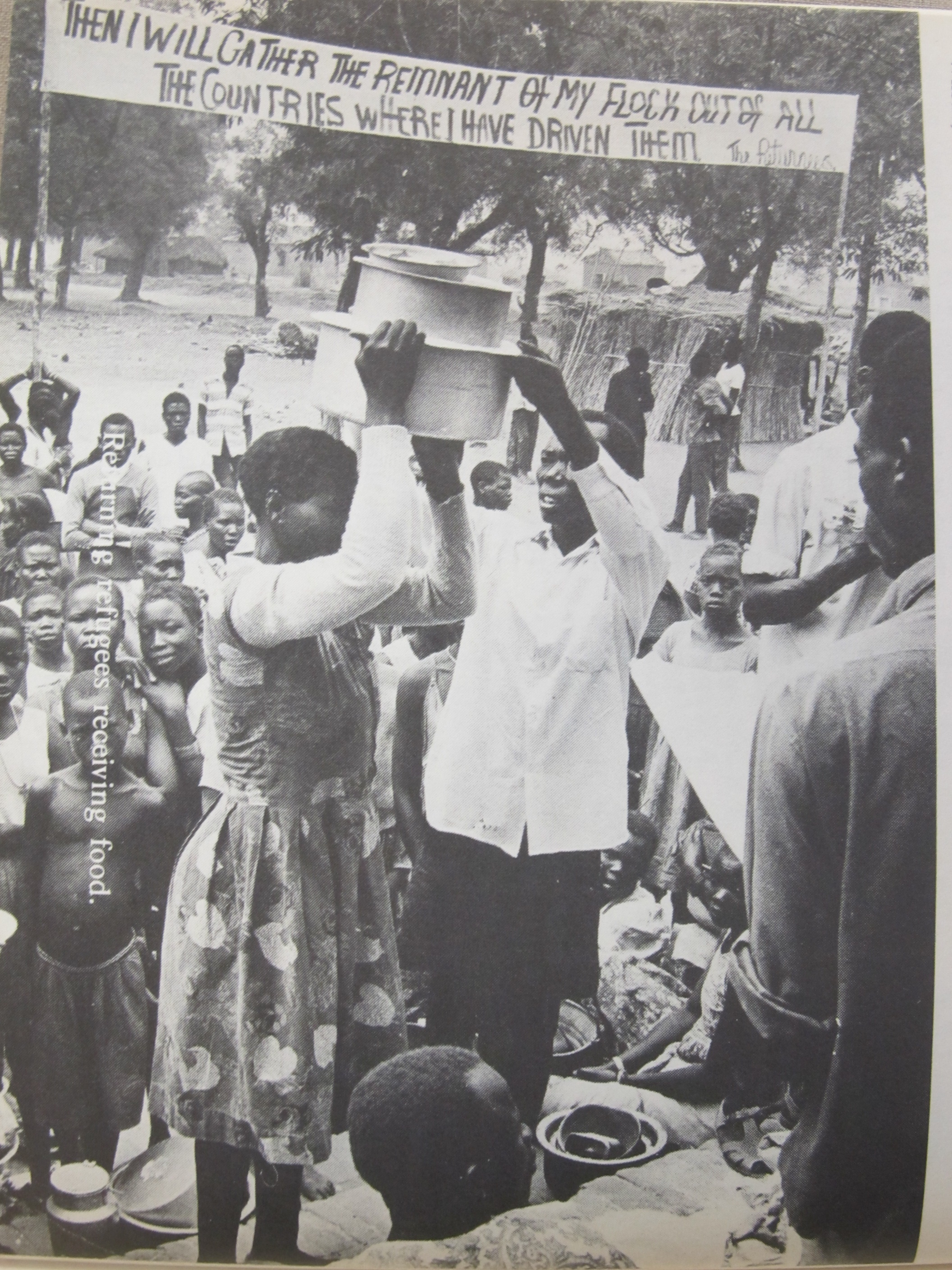
IMG_6558.JPGDuring Sudan’s first civil war, from 1955 to 1972, hundreds of thousands of people were displaced from their homes in the Equatoria region in the far southern part of the country. Some ended up in refugee camps in Uganda, Zaire, and the Central African Republic. But most were displaced within the country. They fled away from the unsafe roads and deep into the bush. Whether externally- or internally-displaced, one thing these refugees did was re-create the church in their new homes. Towards the end of the war, one Sudanese pastor wrote to his British bishop from the bush: “Do not be sad for us. We are still going on with our work, and the Church is still growing in this area. We have no leader or bishops to help us but here we have our great Bishop. He is leading us in the great difficulties of our work.” When the war ended, people began to return home. They interpreted their experience in Biblical terms. The picture on the left shows returning refugees with a banner quoting Jeremiah: “Then I will gather the remnant of my flock out of all the countries where I have driven them. The returnees.”

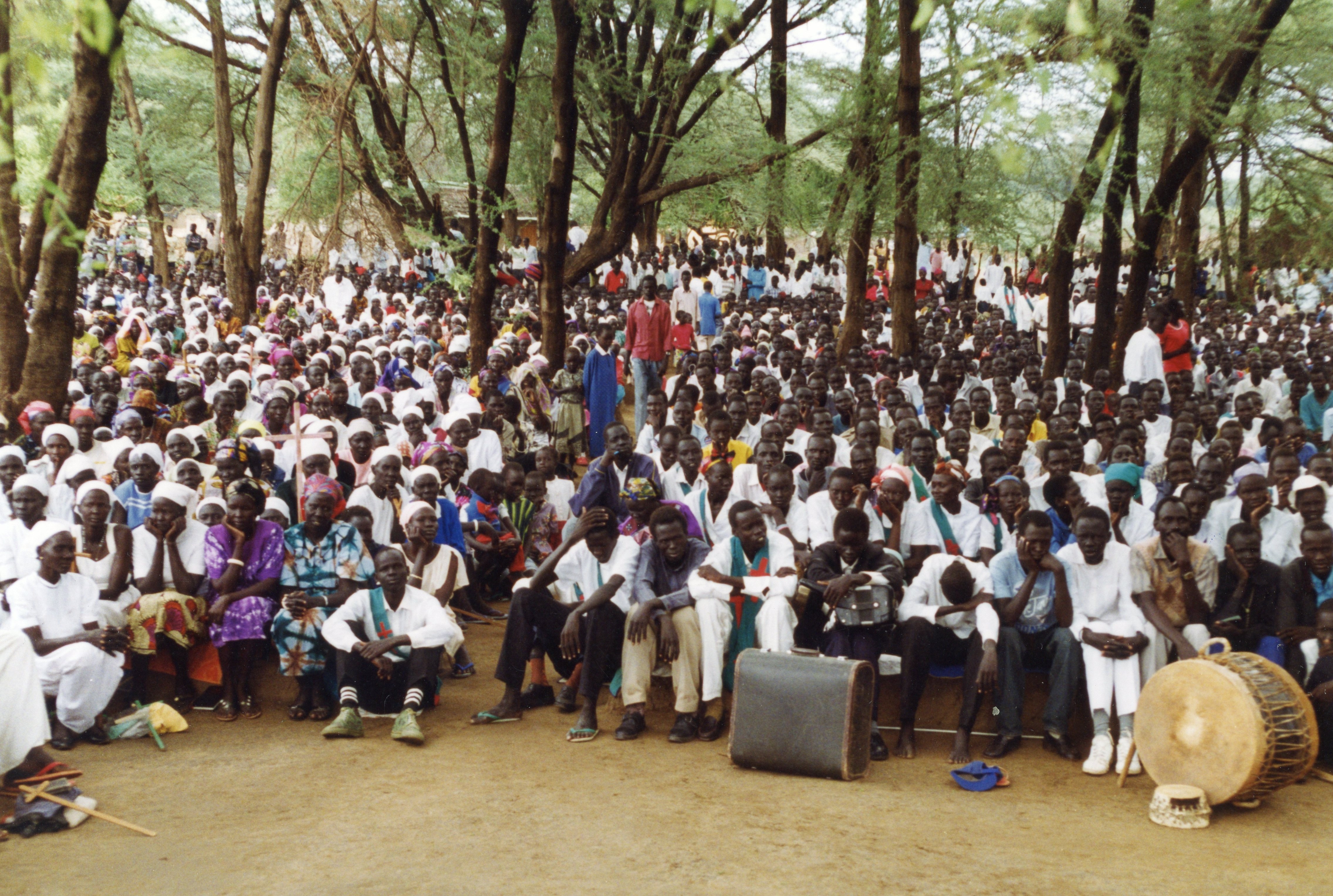
Sudan’s second civil war, from 1983 to 2005, similarly displaced hundreds of thousands of people, though many were from the middle band of the country, places like Jonglei, Lakes, and Bahr el Ghazal. Again, whether displaced in refugee camps in Ethiopia, Kenya, or Uganda, or within Sudan, these people re-created the church where they were. In the Ethiopian refugee camps in the late 1980s, there were multi-day services where thousands of people were baptized. In Kenya in the 1990s, one bishop confirmed several thousand over the course of a three-day service. In Ugandan refugee camps, a committee laboured to create a new hymnal to share with others some of the huge number of hymns that were being written by new converts during the war. (I wrote about this in an earlier post as well.)

A church service at Kakuma Refugee Camp, Kenya, c. 1995

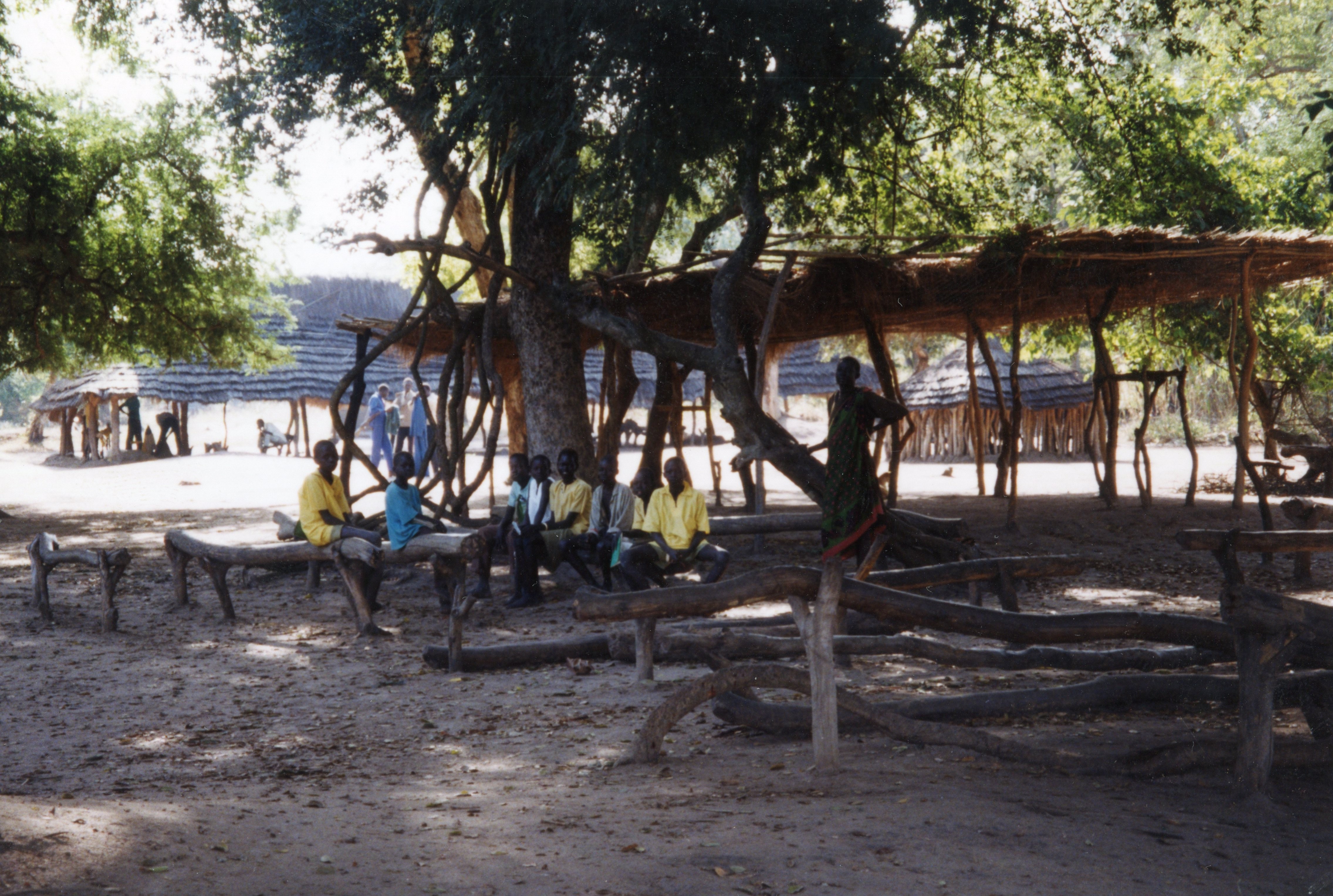
Many people were displaced within the country. In the centre of the country, some Anglicans founded a Bible school at a place deep in the bush called Dhiaukuei. It became a place where Christians came for Bible training, literacy education, and mutual support. Every year between Christmas and New Year’s, thousands of internally-displaced southerners would gather for a giant celebration of the nativity. It was a chance to be strengthened by the bonds they shared as one people in Christ before returning to their villages and the uncertain future that awaited them.

A quiet moment at Dhiaukuei Bible School, c. 1995

I know this because this is the area of research for my doctoral dissertation. These are stories that I have been privileged to hear in the course of my oral history interviews. But there’s also another theme I have heard repeatedly: when displaced, these church members felt like the rest of the church around the world had forgotten about them. Time and time again I have seen in the letters that survive from this period the theme, “We are all members of the body of Christ. But how come you Christians around the world are ignoring us?” For instance, between 1983 and 1991 over 400,000 southern Sudanese sought refuge in camps in Ethiopia. In that time, a single British pastor—a man named Tim Biles—came to visit Anglicans there. In April, I interviewed the southern Sudanese pastor in charge of one of the camps. Out of the blue, he asked me if I knew Tim Biles. I said I did. The Sudanese pastor looked straight at me: “You tell Tim Biles we still remember him. Of all the world, he was the only one who remembered us when we were suffering in Ethiopia.” Tim Biles visited the camp for one day twenty-five years ago. By embodying the reality of the body of Christ, he had an incredible impact on the church.

When he was archbishop of Canterbury, George Carey visited Dhiaukuei. I have spoken to many people who remember that visit. It is clear the memory of it has not dimmed one bit in the intervening twenty years. One woman told me that when he came, “We thought, ‘OK, if part of our body from a different part of the world came to visit us, then the message of Jesus Christ which said, “We are all parts of the same body,” is true.'”

As I have read the news in the last week from South Sudan (not to mention in the last month from the Central African Republic), I have been struck—and disturbed—by how similar it is to reports from Sudan’s two previous civil wars. This week, I have been trying to contact Daniel, the priest who translated for me on a recent visit to South Sudan, but have learned only that he is one of many people who have fled into the bush. Those of us who rely on computers for communication know little about what is going on. But if past experience is any guide, we can be sure of one thing: the church is there, interpreting the experience for its members and, in turn, being shaped by the experience.

To use the Biblical term, the church in South Sudan is an exilic church. It is a church whose members know both what it is like to wander in the wilderness and what it is like to have been driven from their Jerusalem and into foreign lands. I wish it weren’t so. I wish that Sudan had known more peace in the last fifty years. But exile is part of life in our fallen world, though its burden falls more heavily on some than on others. For those of us who do not share the experience of exile, the question is: how do we embody the reality of our relations as one body in Jesus Christ and help bear the burden of exile?

(Some of the photos in this post have been collected from private individuals in the course of my doctoral research. Please do not use them without first contacting me. The themes in this post are adapted from my chapter in the forthcoming Oxford History of Anglicanism and from my new book, Backpacking through the Anglican Communion.)

South Sudan church leaders respond to recent violence

Readers of this blog will know I have more than a passing interest in the goings-on in South Sudan. So it is with some alarm that I have been hearing of the violence in Juba and elsewhere this week.

Church leaders in South Sudan have issued two statements recently in response to the violence—both models of Christ-like reconciliation at a deeply uncertain and precarious time.

The first is from several senior clerics:

MESSAGE OF PEACE AND RECONCILIATION

FROM CHURCH LEADERS IN JUBA, 17th DECEMBER 2013

So the king said, ‘Bring me a sword’, and they brought a sword before the king. The king said, ‘Divide the living boy in two; then give half to one, and half to the other.’ But the woman whose son was alive said to the king—because compassion for her son burned within her—‘Please, my lord, give her the living boy; certainly do not kill him!’ The other said, ‘It shall be neither mine nor yours; divide it.’Then the king responded: ‘Give the first woman the living boy; do not kill him. She is his mother.’All Israel heard of the judgement that the king had rendered; and they stood in awe of the king, because they perceived that the wisdom of God was in him, to execute justice. (1 Kings 3:24-28)

Whatever has happened in Juba over the last few days, we are concerned about the consequences.

There is a political problem between leaders within the SPLM. This should not be turned into an ethnic problem. Sadly, on the ground it is developing into tribalism. This must be defused urgently before it spreads.

Reconciliation is needed between the political leaders. Violence is not an acceptable way of resolving disputes. This must be done in a peaceful and civilised manner. Reconciliation is at the heart of the Church’s ministry, a key Gospel value, and so we offer ourselves as mediators.

The way this incident is handled will have an effect on the future of our nation, whether positive or negative, both internally and in terms of international relations.

We are concerned about ongoing insecurity. Today was supposed to be a normal business day, but that was not the case. Fighting, killing and looting continued. The army must be controlled. We appeal to the security forces, who are our brothers, our sons and our parishioners, to exercise restraint and responsibility and to respect civilians.

We urge the civilians to remain calm and to stay somewhere safe. The government should give information to civilians when there are security operations and direct them where to go for safety.

We wish to see assurances for the safety of our international friends, including those from neighbouring countries, who are here to help us.

We urge the government, UN and NGOs to provide humanitarian assistance to the displaced civilians in Juba, and to ensure that water and food are available for the population.

We are in the season leading up to Christmas. This year’s Christmas may not be what we expected, but it is what we have been given and we must accept it as it is. As we celebrate the birth of the Christ-child, let us remember that God is with us, and pray for the strength and courage to bring peace, reconciliation and healing to our new nation.

Text of message given to TV and radio media on 17th December 2013 by Archbishop Paulino Lukudu Loro on behalf of the following Church leaders:

Archbishop Paulino Lukudu Loro, Catholic Church
Archbishop Daniel Deng Bul, ECSSS
Bishop Arkangelo Wani Lemi, AIC
Moderator Rev Tut Kony Nyang, SSPEC
Rev John Yor Nyiker, Secretary General PCOSS
Bishop Emeritus Paride Taban, Catholic Church
Bishop Michael Taban Toro, Chair SSCC
Rev Mark Akec Cien, Acting Secretary General SSCC

As these leaders make clear, the violence is first and foremost the result of a political conflict—though media representations tend to highlight the ethnic elements.

In response to that, Dinka and Nuer church leaders have issued this statement, showing that reconciliation is not only possible, but happening even now.

December 18, 2013

We, the Archbishop, Moderators, Overseer, and clergy from various denominations of the churches in South Sudan, and native members from the Dinka and Nuer Communities:

Identify ourselves not as representatives of tribes or denominations but as leaders and representatives of one church and one body of Christ.

We are gathered, united and speaking in one voice that peace and reconciliation must prevail in our country.

We are saddened of the conflict which has happened in Juba and ongoing in other areas like Bor in Jonglei State. We are concerned about the consequences. It is unfortunate many lives have been lost, many more wounded while many others displaced in their own country. We condole with the families who have lost their loved ones and those separated from their families by the conflict in Juba, Bor and other areas

We condemn the clash and acts of violence which have happened within the barracks of the Republic of South Sudan.

We condemn and correct the media statements and reports that refer to the violence as conflict between the Dinka and Nuer tribes. Whatever has happened should not be referred to as ethnic conflict and not between the Dinka and Nuer communities. These are political differences among the Sudan People’s Liberation Movement (SPLM) Party, political leaders of the Republic of South Sudan.

Therefore, we appeal to the two communities of Dinka and Nuer not to accept that the conflict is between the two tribes.

We appeal to the army and security organs of our Government of South Sudan to take control of the situation and protect its citizens. Our citizens are running for refuge in UN Compounds because they do not feel safe from their own security forces.

We are concerned about the reports of abuse, harassment and killing of individual citizens based on their ethnic affiliation. These are happening and witnessed for the last three days. Soldiers are asking civilians to identify themselves by tribes and we cannot accept to be identified by our tribes as we are all South Sudanese. We condemn such acts of abuse and hope that no more human lives should be lost.

We appeal to our Government to ensure safety of leaders under arrest and ensure speedy justice for any criminal act but most importantly reconciliation for political differences.

We appeal to our political leaders to refrain from hate speeches that may incite and escalate the violence. We urge to initiate dialogues and resolve issues amicably.

We appeal to the international community to respond fast and positively to the humanitarian crisis which has developed in the last three days particularly in Juba and Bor.

We appeal to our President of the Republic of South Sudan, His Excellency Salva Kiir Mayardit to continue to calm and ensure safety for our nation.

Most Reverend Daniel Deng Bul, Archbishop of Episcopal Church of South
Sudan and Sudan (ECSS)
Rev. Tut Kony Nyang, Moderator of the South Sudan Presbyterian
Evangelical Church
Bishop Dr. Isaiah Majok Dau, Overseer, Sudan Pentecostal Church
Rt. Rev. David Akau Kuol, Bishop of Diocese of Awerial, ECSS
Bishop Michael Taban, Chairperson of South Sudan Council of Churches
Rev. Mark Akech Cien, Acting General Secretary of South Sudan Council
of Churches
Rev. James Yout Chuol, ECSS, Diocese of Akobo
Rev. Daniel Deng Anhiany, ECSS, Diocese of Malakal
Rev. Samuel Galuak Marial, ECSS Diocese of Twich East
Rev. Peter Adum Deng, ECSS, Diocese of Twich East
Rev. William Mou Deng, ECSS, Diocese of Wau and Aweil
Rev. Philip Aduong Thiong, ECSS Diocese of Juba
Rev. John Chol Daau, ECSS Diocese of Bor
Rev. Yat Michael Ruot, South Sudan Presbyterian Evangelical Church
Rev. Gatkuoth Chuol Bul, South Sudan Presbyterian Evangelical Church

The list of signers includes Samuel Marial, principal of Bishop Gwynne College.

For me, the key unknown at this point is the situation in Jonglei, one of South Sudan’s states and a key site of inter-ethnic violence during the civil war. I hope to hear more from there soon.

With prayers for peace in South Sudan!

BE-Renk

There’s a lovely article in Glencoe News about Noah Hillerbrand, a young, lay Episcopalian, who has just begun working with the Diocese of Renk in South Sudan:

After the family joined Christ Episcopal, Hillerbrand became even more deeply involved in that community. It was his dad Eric who first suggested he meet with Bishop Joseph last fall, when he made one of his many trips to Chicago.

“My first thought was that it sounded really cool, but I thought I’d probably find something else to do,” Hillerbrand said. “But when I asked Bishop Joseph what I could do there, right away he said, ‘Teach English.’ There was no hesitation, and he said he could find plenty for me to do. That was when I felt this was something important.”

I’m particularly delighted that he found my book, Grace at the Garbage Dump, so helpful as he prepared for his time in Renk:

Hillerbrand finds inspiration from a book by Episcopal priest Jesse Zink, who served for two years in a South Africa slum neighborhood’s medical clinic.

The book Zink wrote about his experience ”really spoke to me,” Hillerbrand explained. “When he first arrived, he didn’t know the language, he wasn’t trained to do anything at the clinic. He had to be content with being with these people. He called it a ministry of presence. Realizing the ministry of presence is something that I’ve kind of trained my trip around.”

You can follow Noah’s work on the Facebook page he has set up for his trip, facebook.com/BERenkSSudan.

When we shift our focus in the Anglican Communion away from bishops, it’s amazing what kind of stories we find.