Keeping up with the Pentecostals

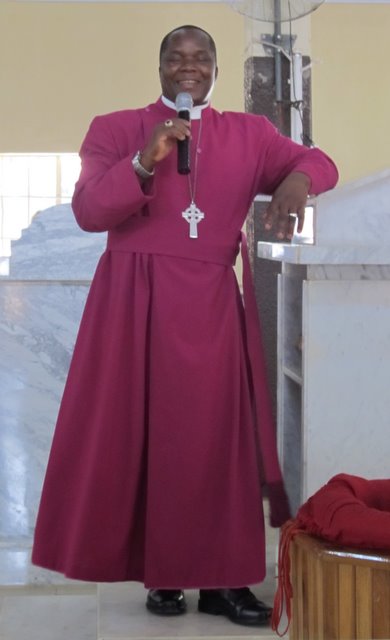
Bishop Marcus of Yola was explaining to me the other day all the work he had done on the cathedral in the last five years – new roof, new generator, new flooring. His next project, he said, is adding air conditioning, which will require a larger generator. I was a little curious why he would be so obsessed with making his cathedral so nice when he has a number of other projects on in the diocese – schools, clinics, farm – that could use the money.

We were driving past a new pentecostal church under construction as I asked. “See that church?” he said. “I’m sure when it is finished that it will have a big generator and air conditioning. If we don’t have air conditioning, people will go to that church instead.”

The competition between churches for members is intense in Nigeria. Anglicans have long had a position of prominence. The “big men” in a community have often been Anglican. (We can talk about the mixed blessings of this legacy in another post.) When they tithe, that makes the churches rich and enables them to run good schools and offer good programs. But now there’s a fear – and I’ve heard it from many people – that those people are aging and that the new generation of business people is going to the “new generation churches” – the catch-all term for the pentecostal/charismatic churches that are flourishing here.

So it is a perpetual competition for nicest church, best pastor (defined as the one who visits you at home the most and brings you the nicest gifts in the hospital), choicest location, largest sign, etc. I visited one church that has laid the foundation for a bigger building. But they don’t have money to complete the project. So they’re in a Catch-22. They need more members to raise the money to finish the church. But no one will come to their church until it is complete because they know they’ll be asked to contribute to its construction. So they go to the church across the street.
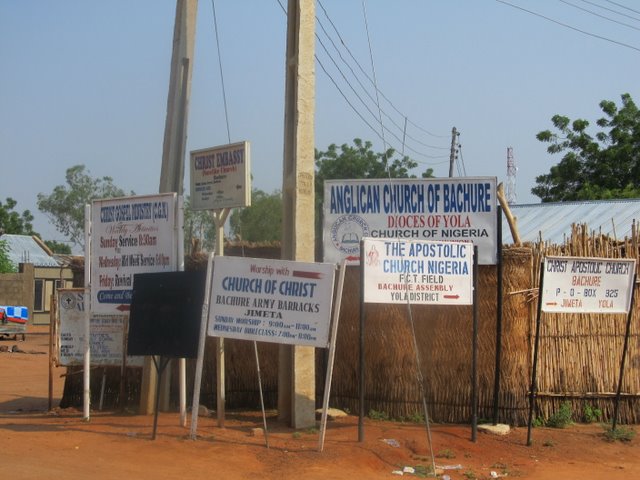
(Competing church signs at entrance to a neighbourhood in Yola.)

This competition helps explain the influence of the prosperity gospel in the Anglican church (we’ll tell you what you want to hear so you come to our church), the changing worship styles (we can out-pentecostal the pentecostals), the rapid growth of the church (so many pastors entreating people to come to church that they eventually do), and even the fierce opposition to homosexuality (if the Anglican church is “tarred” as being unfaithful to the Bible, everyone will go somewhere else).

For me, this raises all kinds of interesting questions. What does it mean to be an Anglican (or Lutheran or Methodist) if one’s church choice is determined by what one gets out of it? This is clearly not true for all people but it is for some. What can the Anglican church uniquely offer in this context?

But what I have been thinking about most of all is what weakness as power would mean in this environment. What if the Anglican church, in keeping with its heritage of incarnational theology, “emptied itself” (Phil. 2) and stopped caring about this competition and focused on its faithful witness to the Gospel, regardless of its size? Is that even possible? What impact would it have?
When Anglican unity looks like a press release

A few posts back, I said Anglican unity “looks” like a pineapple. But it looks like other things too.

Hopefully, you’ve been reading about the devastation in South Kordofan, Sudan, especially in the Nuba Mountain region, that has been going on for the last several weeks. What has struck me about the coverage is just how critical the church has been in publicizing what has been going on. The bishop of the region, Andudu Elnail, has given many interviews to the media. But all this is to be expected when disaster strikes a region. Of course the bishop would be speaking out for justice and peace.

But there was one development early on – when most of the world was ignoring the killing – that I think is significant. Rowan Williams, the archbishop of Canterbury, issued a press release calling attention to the violence. (This is just one small part of Archbishop Williams’ work for peace in Sudan. I attended a press conference at Lambeth Palace last semester at which he spoke in great detail and showed a deep knowledge of the ins and outs of the conflicts in Sudan.) Because he has a much bigger megaphone than a bishop in Sudan, that press release garnered the attention of – and was quoted in – the news coverage of the event that finally began to emerge more than a week after the violence began.

I don’t want to overstate this – there were lots of people calling attention to the violence – but I think this is one more instance of Anglican unity. The relations between members of a church family that span the globe are being used to call attention to the need for peace. Sometimes Anglican unity is as simple as a press release.

Throughout the north-south conflict in Sudan, church members around the world have played an important role in ending the conflict. The Bush administration envoy who negotiated the Comprehensive Peace Agreement that ended the war was John Danforth, an Episcopal priest. (And former senator and ambassador to the U.N….)

I’ve been thinking about this in Nigeria, where people are in a tense mood – kidnappings and random violence in the East, Islamic terrorism in the North. It’s not nearly at the level of the Nuba Mountains. But it is significant. How could Anglicans around the world contribute to the church’s witness for peace here?

Of course, Anglican unity isn’t a panacea for the world’s problems, as the ongoing violence shows. Let’s not overstate what it can do. But let’s recognize these moments of unity in the cause of peace as they occur and pray that there will be many more.

It is worth emphasizing how many of the news stories about the violence have quoted church representatives. When the going gets tough – and it is very tough in South Kordofan right now – it is the church that remains in place when there is no one else left.

Who says the church is irrelevant in the 21st century?

Gleaming Moon School

One theme that emerges again and again as I travel Nigeria is just how talented, hard-working, and smart so many Nigerians are. I met a Cameroonian woman in the airport last week and she was lamenting how “lazy” her people seemed next to Nigerians. Unfortunately, the Nigerian government is not worthy of its people. I have repeatedly seen the ways in which an ineffective and corrupt government holds back the country’s development.

A primary way this happens is in education, where government-run schools are abysmally bad. As a result, there are a huge number of private, independent, or religious schools. (Many of these call themselves “Montessori” not because they have anything to do with that movement but because they know that Montessori is supposed to be good and they want to associate themselves with that.)

It is in this context that I visited Gleaming Moon School in Umuahia. This school was founded by a husband-and-wife team, who were educated in England and have returned to Nigeria. Oliver, the husband, teaches at the local seminary. In his “spare time” (ha!), he makes sure the school keeps ticking.

But it is really his wife, Edith, who is the driving force behind Gleaming Moon. She did an education degree in the U.K. and is now determined to put those lessons into practice in a Nigerian context. But the resources in Nigeria are clearly not the same as in the U.K. So Edith writes all the textbooks and resources for the students and then has them published in Umuahia. (She was in England when I visited doing more training so I sadly was not able to meet her.)

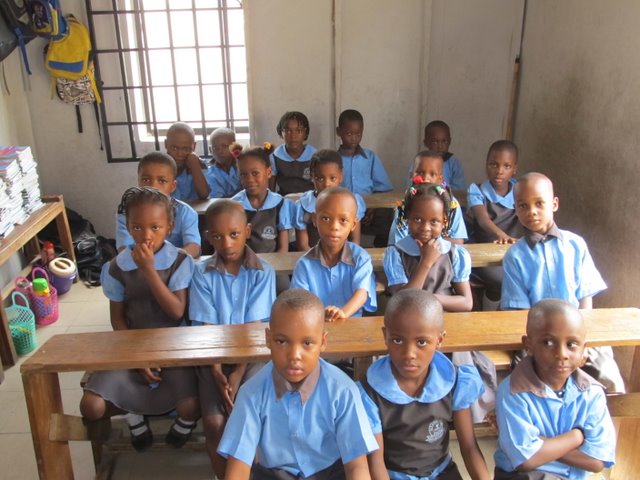
(Small class sizes at Gleaming Moon – an average of 15, compared to 40 to 50 in government schools)

Both of them are motivated by the desire to give back some of what they’ve been given in life. Oliver had to work through high school to pay his fees. (All schools in Nigeria, like much of Africa, require students to pay fees. People marvel when I tell them how I graduated from high school without paying a penny in fees.) He was then supported by his church in his university degree. He did so well in those studies that he was able to study in the U.K. Now he wants to build up some of the next leaders of Nigeria. A handful of the students at Gleaming Moon come from quite poor backgrounds and are supported by donations from overseas. There could be more of these students if there was more funding.

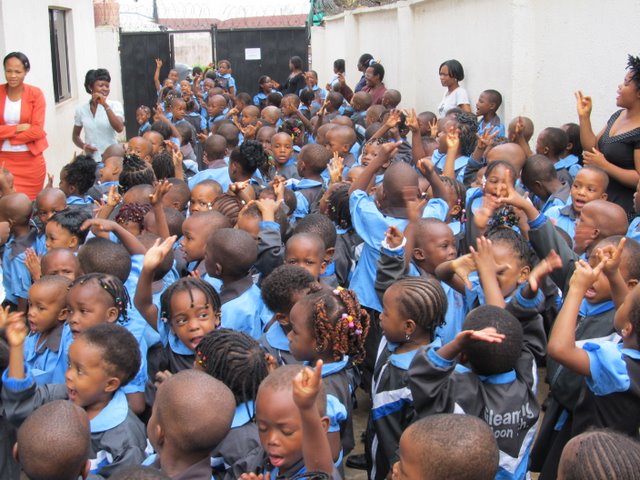
(Students at morning assembly – ranging in age from 2 to 12 years)

I visited the school on two different days and was very impressed by both the students and teachers. One interesting fact is that many officials in the Department of Education send their children to Gleaming Moon. They have to make the rounds of schools to ensure they’re meeting the standards and they clearly know which is best.

(With Oliver and some of the school’s senior administrators)

It is unimaginable the amount of dedication and work it takes to start and keep a school running. How wonderful that people like Oliver and Edith can dedicate themselves to this project. But how sad that the state of the country requires this.

“The stone that the builders rejected…”

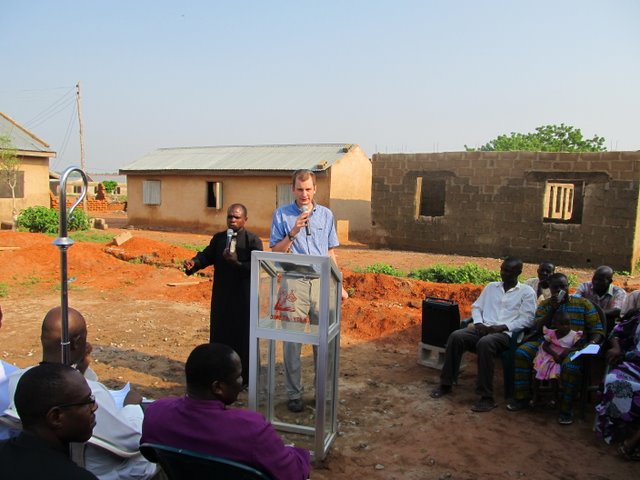
I preached this morning at the service laying the foundation for a new church in the Diocese of Yola. The text was Zechariah 4:1-10 with a little Matthew 16:13ff. and Psalm 118:22 thrown in for good measure. What does the Bible tell us about why we build churches, how we build churches, and who builds churches were my questions.

Bishop Marcus got not a speck of cement on his cassock.

“When you give…”

There’s a practice I’ve observed in the Nigerian church several times. I’ve asked around and it seems like it is pretty common. At some point in an event, there is a time for the “appreciation.” For instance, after the bishop gave his keynote address at the fathers’ conference in Owerri, envelopes were distributed, a big bucket was placed in the chancel, and men came up and put their envelopes of money in the bucket.

Here’s the thing: as they did so, each person took the microphone, said their name, gave a little speech thanking the bishop, and announced how much they were giving. (The money goes to the fathers’ organization by the way, not the bishop.) There was applause based on how much money it was. At one point, the MC said, “No more speeches, please, we don’t have time. Just tell us how much and put it in the bucket.”

As I watched this and other similar events, I couldn’t help but think of Jesus’ instruction in the Sermon on the Mount: “When you give alms, do not let your left hand know what your right hand is doing so that your alms may be done in secret; and your father who sees in secret will reward you.” (Matthew 6:3-4, NRSV)

This practice of appreciation is clearly in direct contravention of an important teaching of Jesus Christ himself. Yet when I’ve brought this up with several Nigerians, I’ve gotten a shrug and the comment – repeatedly – “It’s our culture. That’s how we give.”

I don’t think there is anything necessarily wrong with this public giving. Maybe it encourages people to give more. Maybe it is necessary in a culture where corruption is rampant and the church tries to be as transparent as possible. But then I go and read something like the Jerusalem Declaration, the rather portentous statement that came out of the Global Anglican Futures Conference (GAFCON) in 2008. (It is printed in the Nigerian prayer book.) The second point says, “The Bible is to be translated, read, preached, taught and obeyed in its plain and canonical sense, respectful of the Church’s historic and consensual teaching.” At the 2008 all-Nigeria clergy conference, there was a session on human sexuality where the presenter said that in regards to Biblical interpretation, “our position is the position of the child who is literal and very objective.”

Given that, I cannot possibly see how Matthew 6 can be reconciled with the practices of the Nigerian church. Perhaps, however, the Jerusalem Declaration is wrong and that there are more factors at work in Biblical interpretation. I’m open to the idea that one could make an exception to this teaching based on Nigerian culture and the way the practice of giving has evolved in the church here.

Of course, you’ll see where I’m headed on this one. The American church finds itself, arguably, in a similar position as regards same-sex relationships. But, of course, there is not a similar leniency shown on that issue.

I bring this up when I talk to Nigerians about the practice of public giving. One person just shrugged and said he didn’t know why Nigerian church leaders couldn’t be similarly lenient on interpreting the sexuality passages. “But,” he said, “being opposed to homosexuality has become a test of whether you believe the Bible or not.”

“Why that issue,” I asked, “instead of public giving?”

He shrugged. “That’s just the way it is.”

What this shows, I think, is that the opposition to same-sex relationships is not based on fidelity to the Bible. That is merely a nice cover for something deeper.

What is that something deeper?

I have an idea but I’ll wait to roll it out until a later post.

Alleged Anglican Disunity Blocks the Mission of God

I spent Saturday at the diocesan council meeting of the Diocese of Yola. Yola is the capital of Adamawa state – “the Sunshine State” – and is in north-east Nigeria, not far from the border with Cameroon. Northern Nigeria is more Muslim, poorer, and less populated than the rest of the country so I knew that Yola would give me a different perspective on the church than I’ve had in my first weeks in the East. This meeting confirmed it.

A major topic of conversation was the purchase of a second car for the diocese. Right now, they only have the bishop’s car and it is used for everything, from travels around the diocese (the farthest church is five hours away on bad roads) to errands in town. They need another vehicle not only for back-up but also because there is just too much demand for the one vehicle.

The trouble is that they can’t afford it. The car they want – a 2002 Camry or a 2001 Peugeot 406 – costs about $11,000 and so far the diocese has saved about two-thirds of that. There was a lengthy discussion on whether to keep saving or buy something cheaper. That turned into a conversation about maintenance and which mechanics could care for which brands of car. It is clear that the diocese is taking this quite seriously, as I could tell by the way the conversation reached mind-numbing levels of detail. (Again, for those of you who think this is a vacation, remember me in this four-hour meeting.)

The next topic after the car was completing construction on the new site for the diocesan secondary school. (I haven’t written about this yet but the government in Nigeria has essentially abdicated responsibility for education so the church plays a huge role in this.) They need 400 bags of cement to finish the next phase of construction. Each bag costs about $15. Again, they just don’t have the money so they brainstormed about how to raise that money – ask each deanery to contribute? approach richer members of congregations?

I had two thoughts on listening to these conversations. The first is how different it is to Owerri, where the diocese has about four cars, many parishes own vans, and 400 bags of cement would be nothing.

(Bishop Marcus as he introduces me to the cathedral congregation this morning.)

The second was how clear a need there is for international partnerships in a place like Yola. They have hard-working clergy here, who speak good English and manage their finances transparently. Bishop Marcus Ibrahim is young, smart, energetic, and educated in the U.S (and on Facebook). Yet not a penny of the money the diocese has spent in his six years as bishop has come from abroad. (Some of it comes from other Nigerian dioceses, including Owerri, however.) He has looked and looked for partnerships and had no luck. The reason? The divisions in the Anglican Communion. Mainline Americans (and others) are conditioned to think that Nigeria is closed territory to them. (It’s not, as my presence here demonstrates.)

But surely, you say, those conservative Episcopal/Anglicans in the U.S. and elsewhere that have made such a big deal of their support and concern for the “orthodox” church in places like Nigeria are helping out? Nope. GAFCON folks are nowhere to be found in Yola or any of these other dioceses that have serious needs. It seems like they confine themselves to the big cities, where the rich dioceses and senior bishops are.

The way in which artificial divisions among leaders are causing serious headaches – and creating serious obstacles to the mission of God – in a place like Yola infuriates me. Nigerian after Nigerian is telling me that while they disagree with me on some issues, there is no reason we cannot still work together. Yet that is not the narrative that is propagated at the highest levels of Anglicanism – and to which most people, unfortunately, seem to be listening.

Yola’s annual budget is approximately equal to that of a mid-sized Episcopal Church in the U.S. Yola – and other similar dioceses – present a terrific opportunity for mission-minded congregations throughout the Anglican Communion to form path-breaking new partnerships that would not only do important work in an important area of the world but also helpfully shake up the rather-stale discourse on alleged Anglican disunity.

“I am a true Nigerian!”

Apparently, the state of New York has approved same-sex marriage legislation.

Even if I had missed the news online, I would have heard about it this morning when I attended church at the chapel in the governor’s office. (It’s just down from the mosque.) The bulletin contained a message from the chaplain thanking the congregation for their support at his daughter’s wedding yesterday. It added that the “perversion of the world has distorted God’s concept of marriage,” citing New York as an example. “This is a sign of the last days and as Christians we need to be cautious of these times.”

I was at the government chapel because Bishop Marcus was preaching. New York was on his mind as well. He was especially concerned with what it would make the congregation – the movers and shakers of state government – think of him. They all know about the issues in the Anglican Communion. He reassured the congregation that he thought homosexuality was wrong and that they could be sure he would not allow same-sex marriages in his church. He wasn’t polemical or offensive about it. He just said he thought it was wrong. He concluded with an emphatic, “I am a true Nigerian!” as if opposition to homosexuality is part and parcel of Nigerian identity. (It may well be.)

Later, I was introduced as a visitor from America who was “brave” enough to come to Nigeria when bishops and priests refused to. The chaplain thanked me for coming and prayed for me, making some serious assumptions along the way. “We send you as a missionary to your country to quench this fountain of sin that has welled up in your society, this menace that threatens your country. We pray for righteousness to spring up in your land and for true followers to gather around you.” I was left feeling more than a little uncomfortable but there was no chance for me to speak, nor, if there had been, was I sure what I would have said.

Lest Americans forget (and we often do), the rest of the world is watching us all the time. Our actions have impacts around the world. I saw this in Sudan last year with priests who told me how people accuse them of belonging to the “gay church.” That doesn’t change the rightness or wrongness of our actions. But I hope we spare a thought for how our actions affect our brothers and sisters around the world, who have to spend lengthy sermon minutes defending themselves.

At the same time, I regret the assumption by the chaplain that only certain kinds of Americans would bother to visit Nigeria. Why does he think that only people who toe the line on one narrow issue are worthy of visiting? The answer is clearly that this issue has become a short-hand test for fidelity to a certain Biblical “orthodoxy.” Why is that? I think that’s a question for another post.

Uzuakoli Archdeaconery

So I’ve left Owerri – not without some pangs of regret at leaving behind great people and good friends – and am now (though by the time I post this will probably be gone) in Umuahia. The difference in dioceses is pronounced. Owerri is older, better established, and richer. These two regions, though only an hour drive away from one another, were evangelized by different Anglican missionaries and those differences still have an impact today.

Umuahia’s relative youth and poverty don’t prevent it from doing some great things, however. There are still large churches, impressive diocesan institutions, and capable clergy. The most interesting part of the visit for me, though, was the time I spent in the most rural of Umuahia’s archdeaconeries, centred on the small town of Uzuakoli.

During the missionary era, the different denominations split up territory. Uzuakoli was Methodist territory so there are some large Methodist churches around here. The Anglican presence was started by Yorubas (from western Nigeria) who worked on Nigeria’s once-thriving rail system. So Anglicanism has always been an outsider religion in Uzuakoli.

The archdeacon is a man named Simple (on the left in this picture – more than a passing resemblance to James Franco, I think). He is devoted to rural ministry and has spent a huge part of his career out in Uzuakoli, even though it’s not a great place to work if you’re interested in advancing your career.

His main church gets 30 people on Sunday. He has 11 other mission stations scattered around a huge territory. None of them are in church buildings. Mostly, they are just rented rooms with a few benches and a small altar, led by lay people. In a few instances, they actually meet in people’s homes. This is a far cry from the stories of overflowing thousand-member congregations I heard in Owerri.

I pressed Simple on why there had to be an Anglican presence in this area. Why not just let the Methodists (and Catholics) take care of things? They are Christian after all. Simple said that their real concern is the growth of what are called “new generation churches” – the charismatic, pentecostal, independent churches run by spirit-ordained pastors. He said many of them blur the lines between Christianity and sorcery, witchcraft, and whatnot and so he sees it as his job to teach the “raw Gospel” so that the truth will set people free. “Although there are many churches here already,” he said, “there is still need for those that preach only the Gospel.”

The most touching moment for me was in the last church we visited. There were the three archdeacons who were touring me around, a lay pastoral worker, a seminary student, and four, older members of the congregation – two-thirds of their Sunday attendance. As is my wont, I started asking questions about Anglican identity, the structure of the church, and so on. The conversation was in danger of turning into a seminar, especially since one of the archdeacons is a seminary professor.

Here we are as we are leaving.

But then one of the old men stood up. He had something to say. “Sometimes,” he said, “we are ashamed to be Anglicans in this village. Other churches are much bigger and we are ashamed of our little room.

“But today you have come here. It is evangelism for you to come here. People in our village will be talking, “The white man went to that little Anglican church!’ It will be the talk of the town.”

I told him that we were both members of the Anglican Communion and that there are millions of us around the world and there is nothing to be ashamed of in being Anglican. On the way out, I made sure to smile and talk with as many people in the village as possible. One of the women in the Anglican church gave me a pineapple as thanks.

Everyone is always asking what Anglican unity “looks” like. The answer? A lot like a pineapple.

Sudan: Bishop Calls for Churchwide Day of Prayer, Fasting for an End to Violence

21 June 2011

From the office of the Bishop of the Episcopal Diocese of Kadugli, Sudan:

A Call To Prayer and Fasting to End the Nuba Genocide, and for the Peace of all Sudan! – Sunday June 26, 2011

To all my brothers and sisters in Christ,

On behalf of my people in the Nuba Mountains of Sudan we are asking all Sudanese Christians wherever they are, and the Church throughout the world to join with us in a day of prayer and fasting on June 26, 2011.

Once again we are facing the nightmare of genocide of our people in a final attempt to erase our culture and society from the face of the earth. It is not a war between armies that is being fought in our land, but the utter destruction of our way of life and our history, as demonstrated by the genocide of our neighbors and relatives in Darfur. This is a war of domination and eradication, at it?s core it is a war of terror by the government of Sudan against their people.

As we approach the July 9 day of independence for the New South Sudan, President Bashir has declared for all the world to hear that Sharia will be the law of the land for the North, refusing to recognize the legitimate presence of the Christian minority. It is a declaration of their determination to also end the remembrance of our Christian heritage that dates back two thousand years to the story of the Ethiopian eunuch (who was from modern day Sudan).

At this moment, there is a meeting in Ethiopia with the different parties of Sudan, the African Union and other international parties seeking to find a true path of peace that recognizes our right to survive and thrive as a people, both Muslim and Christian alike, with equality and justice for all. Please pray and fast with us as you are able for a solution to this crisis.

Please forward to everyone.

Rt. Revd Andudu Adam Elnail

Bishop of the Episcopal Diocese of Kadugli, Sudan

Prosperity Gospel in Nigeria

I heard a sermon the other day – on Joshua 1:1-4 – which contained the following lines.

“Somebody’s business shall increase!” “Somebody’s property shall increase!” “Today heaven is laying a hand on you to do wonders in your life and family!” “As from today, anywhere you put the sole of your feet, he will give it to you!”

Each of these statements was followed by lots of “Amens” and “Hallelujahs.” The people were clearly excited at the prospect of – in the preacher’s words – being “little Joshuas.”

But I was thinking about how this sermon shows the influence of the prosperity gospel on the Anglican church in Nigeria. One bishop here told me that many of the independent pentecostal churches preach an “American-style gospel of prosperity.” I asked him if it had spread to the Anglican Church as well. “It’s a virus that is taking us over,” he replied.

The prosperity gospel basically emphasizes that by believing in God, good things will come your way. Often – in one stereotyped view – it is tied to donations to the church. If you give greatly to the pastor, God will greatly bless you (while he rides off in his new car…).

It’s not surprising that the prosperity gospel should be prevalent. Lots of people here watch Christian television stations like TBN that preach what I think is not exactly the most robust or accurate theology.

But the Anglican church is working against this. Last week, I attended an expository preaching conference put on by the Langham Institute of Nigeria. (Langham Place is the location of a famous evangelical Anglican church in London that John Stott once pastored. Its influence has spread far and wide.) It was a four-day conference for 120 clergy from Owerri and surrounding dioceses. I was very impressed. The presenters – all Nigerians – focused on helping clergy understand the context of a passage before preaching on it. The repeated line was, “You must know what it meant to them then before you can understand what it means to us now.”

Emeka, the leader of the conference, told me that “the root of the prosperity gospel is to say the Bible is all about me, me, me. We want to say the Bible is about God, God, God.” Later, he mocked (very effectively) a prosperity gospel-style sermon and had everybody laughing. But, he said, “we have turned the Bible into entertainment and that is why we have so many Christians who are not deep in the faith.”

Christian, another staff member, told me, “It is not that we are against prosperity. But I don’t think the reason Jesus Christ came to earth was to bring prosperity. He came to save mankind from sin.” The secret, Christian thought, was to preach “the way of the cross.” This is not very popular, of course, and the prosperity gospel has an inherent appeal: everyone wants to think that God will increase our territory. The Gospel will always be “foolishness to those who are perishing but to us who are being saved it is eternal life” (I Cor. 1:18).

I should say about that sermon I heard in church that the Joshua part was only one-third of the sermon. He also talked about the importance of forgiveness and unity. Two out of three ain’t bad, I guess.