“What we have here is a failure to communicate!”

Here is a story that should come as no surprise to anyone:

The Anglican Communion faces a shortage of qualified communicators, according to an international Working Group on communications. The group—consisting of communications professionals from five continents—concluded that the Communion life was at risk of being detrimentally affected by some Provinces’ inability to source and share their news and stories widely.

In my travels around the world church, I routinely encounter fascinating, inspiring, and transformative work that is going on—and realize almost no one else knows about it. I’m convinced that communications is part of the church’s missional witness to the world but we’re not doing a great job of it.

Here are at least some of the reasons why I think this is happening:

  • English is the de facto language of the Communion. If you are among the majority of Anglicans who do not speak English as a first language, you might not want to write down your story and share it. Many Anglicans, I’ve learned, are eager to talk in person about what they are doing but reluctant to commit those same thoughts to paper, at least in part, I think, because they think they lack the ability to do so.
  • Folks engaged in the most fascinating ministry around the world often spend so much of their time in ministry that they don’t make the time to tell their story. This is a perfectly understandable impulse but it is one that drives me crazy. We want to hear your story! We want to be able to pray for you and support you and we can’t do that unless you tell us what is going on.
  • People are humble. This is wonderful. Lots of people I’ve met engaged in transformative ministry around the world just don’t think that what they’re doing is all that important and can’t see why anyone else would want to know about what they’re doing. Humility is a great Christian virtue—but a little well deserved tooting of one’s own horn wouldn’t be the worst thing in the world.

And so we get stuck in the position we are in now: no one really knows what else is going on around the world church. The loudest, shrillest, and most destructive voices dominate the conversation. And everyone thinks we’re falling apart. But we’re not. I’m really convinced of that. We just need to tell the story better.

Part of the reason I wrote my book, Grace at the Garbage Dump, is to counter exactly this tendency towards miscommunication. It tells the story of work in one diocese in one particular province. But books like it could be written of the work in countless dioceses around the world.

How do we argue in the church?

I once met an Orthodox woman who was flabbergasted to hear that in some parts of the Episcopal Church, Mary is not venerated. “I know there can be different practices on the Eucharist and other things,” she said, “but I just don’t see how you can be a Christian and not venerate the Virgin Mary!”

I thought of that woman the other night when I had a conversation with a very good friend of mine about communion with the unbaptized. This is the practice of sharing communion with all who come to the rail, regardless of whether they are baptized or not.

My friend, who opposes changing the practice, said, “I can’t see the point of having a conversation with someone who disagrees with me on this subject. It just seems so obvious what the answer is.”

My friend also supports the full inclusion of gays and lesbians in the church. I pointed out to him that his comment is more or less what has been said by those who oppose changing the church’s teachings on homosexuality.

Everyone draws the line in a different place. Mary. Homosexuality. Communion. We all (and I include myself here) have issues on which we are unyielding and absolutely convinced of our own rightness.

We’ve had a decade or more of trench warfare in the Episcopal Church on sexuality (which continues). It has conditioned us to think of a major liberal / conservative divide in the church. What is interesting about the communion debate is the way in which it complicates this divide, as my friend demonstrates. This actually fills me with hope.

I hope that in this conversation about communion we will learn again how to disagree with one another. I hope we learn that the liberal / conservative understanding of the church is not set in stone and, in fact, doesn’t do a very good job of capturing its full diversity. I hope we can learn that Christian unity is not about ensuring that everyone believes and does the same thing. Rather, Christian unity is about recognizing a pattern of faithful living in another person, a pattern of living that shows that one’s life has been transformed by Christ.

It is very easy in any debate—sexuality, communion, Mary—for the stakes to escalate quickly and for anathemas to start being thrown around with reckless abandon. (It has always been so in church history.) What if, in this conversation about communion, we could start by focusing on our patterns of faithful living and pursue ways of building these ties? What would it be like for people who disagree on communion to come together for prayer, instead of debate? As much as I am filled with hope, I fear that Tom Ferguson is right and the communion question will quickly become one which “will just become another flashpoint as we organize ourselves into our little mini-communities, desperately trying to find the people who are like us, and, hence, the true Episcopalians.”

I’m not saying that conversation on this topic, and many others, is not necessary. But it’s striking how quickly we think debate can be the only thing we need to do in the church when, in fact, it’s a small part of what it means to be a Christian wrestling with a difficult topic.

The way in which the church argues can be a key part of our counter-cultural witness to the world. Maybe on the communion question we can begin to get it right.

More than leading worship

I mentioned that Yale’s favourite son, Mark Miller, would be involved in the worship at the ongoing United Methodist General Conference this week and next. It turns out he’s doing more than that.

You can read about Mark’s point of personal privilege last night or watch the whole thing here: Mark begins at 51:24 and goes for about three minutes. It’s well worth watching.

I know that Robert’s Rules must be followed but it is interesting that the General Conference will give Mark a microphone all he wants, so long as he is singing or leading music, but when he wants to actually talk about something, especially something this important, he’s asked to stop.

I’ve sung under Mark’s direction in the Gospel Choir these last few years and deeply admire, respect, and like him. What I am reminded of in listening to him speak is a) the deep difficulty in holding honest conversations across lines of difference and b) the deep importance of doing so nonetheless. These conversations don’t get easier but that doesn’t mean we shouldn’t keep trying to have them—in a way that is loving and truthful and opens a space for all voices to be heard in a safe place.

Lessons from our Methodist Siblings

I’m no expert on the United Methodist Church but I do know the UMC’s General Conference is happening in Tampa this week and next so I spent some time on its web site this morning learning about what is going on. Given that we share an interim ecumenical agreement with the UMC and we’re both mainline denominations in the United States, I figure Episcopalians have something to learn from what is going on.

As I understand it—and my advance apologies for being a neophyte on much of this—some of the following issues are under discussion:

  • There’s a proposal to make the head of the UMC Council of Bishops a full-time position, much like (it seems to me) the Episcopal Presiding Bishop gives up her previous jurisdiction to take the role. The bishops just approved that idea. It’s unclear what the Conference will do. At least some Episcopalians are, I’ve read recently, urging a return to our old model, in which our Presiding Bishop kept a local jurisdiction in addition to the larger responsibilities. Meanwhile, the Council of Bishops has agreed it will only be meeting once a year. Some Episcopalians have suggested something similar for our own House of Bishops.
  • Bishops have a much different role in UMC governance than in The Episcopal Church (as the name of our church alone should tell us). I love this line from an article about a speech by the outgoing president of the bishops: “Bishops do not get a vote at General Conference, and they cannot address the assembly on legislative matters without special permission. Goodpaster acknowledged the bishops’ common lament that they often have nothing to do at General Conference ‘but sit around like wilting potted plants.'” Can you imagine that being said at a General Convention? Me neither.
  • Meanwhile, there are “huge” proposals for restructuring on the table. We Episcopalians have been doing restructuring by emergency budget for the last several years, cutting programs left and right because there’s no money to fund them. The UMC, it seems, has taken a more systematic approach to the topic and will be voting on those proposals at this General Conference. (You can read about the original proposal from this article from 18-months ago. The recent letter from the UMC bishops is also helpful.)
  • The UMC is looking at how it trains its future clergy, including doing away with the promise of job for all ordained clergy. I get the sense that many Episcopal dioceses around the country are having significant conversations about the future of ordained ministry. This doesn’t seem to have risen to the national level, however.
  • And, of course, issues related to homosexuality in church are on the agenda, attracting some of the most attention outside the church.

Any other issues you see as being significant and relevant to Episcopalians that Methodists will be considering at this conference?

One interesting note is the global nature of the UMC and the way jurisdictions in other parts of the world are equal members of the church. This is a conversation for another time but it’s a contrast to our Anglican practice of raising up autocephalous churches.

Also, the General Conference web site is much better than that of General Convention. They’ve got podcasts and everything! If you tune into the live stream at the right time, you just might get to see Yale’s favourite Methodist musician, Mark Miller, leading worship.

UPDATE: Mark is doing more than leading worship.

Who teaches us?

My time at Yale Divinity School is coming to an end. As I’ve been thinking back over it these past few days, I decided to do a little math. The results may only be of interest to me but here’s what I came up with.

In my time at YDS, I’ve taken 22 courses. (You need 24 to graduate. I did a semester abroad, which I’m not counting here.)

Of those 22, 18 were taught or co-taught by male faculty. Seven were taught or co-taught by female faculty. That means only four courses I took were taught solely by a woman.

Nine were taught by ordained faculty members (and one has been ordained since), though I’ve learned that different faculty wear their ordination differently. For some, it barely seems to register in their consciousness.

Four of those 22 courses were taught by non-white faculty, all of whom were male. (And three of those courses, oddly, were taken in the same semester.)

I can’t figure the age breakdown, though I’d guess my faculty have ranged in age from a few years older than me to close to or past retirement.

So what to make of these figures? I don’t think I steered deliberately in any one direction. Many of the courses I’ve taken were required and many of those are taught by white, male faculty.

One thing for sure is that whom we are taught by shapes who we become. The faculty I’ve had courses with are the ones to whom I turn most readily for advice and input on my life and career. How should I feel about the fact that the majority of courses I took were taught by people who are like me? And how will that shape what I do in the future?

Do you think this breakdown is reflective of something specific to Yale or is it generalizable across seminaries?

In any event, interesting questions to reflect on as I prepare to leave this place. Maybe at some point—when I’m really procrastinating—I’ll look back through old syllabi and figure out the breakdown of the books I was assigned to read.

WHMP Interview: “Moving, funny, and edifying”

My interview on WHMP yesterday is now a podcast. The link is here. The interview starts at about 18:00 and ends about 15 minutes later. They call it “moving, funny, and edifying.” I have my doubts but listen and see what you think.

One of my answers surprised me. It was the one on the big lesson I take away from my time in South Africa. I said it was learning about my own helplessness. It just sort of came out but I think it’s right. There’s something to be said for confronting—again and again—one’s own inability to change the world on one’s own. It teaches us something about who we are and our inherent limitations. But it doesn’t end there. It’s only once you’ve realized your own helplessness that you can truly realize God’s never-ending and abundant grace.

Read the book if you want to hear more: it’s called Grace at the Garbage Dump for a reason.

“Episcopal” worship

Every Wednesday night this year, I’ve been involved in the team at Berkeley Divinity School at Yale that has put together the weekly Eucharist for the community. We’ve done all kinds of stuff—historic prayer books, no prayer books, prayer books from around the world, Eucharistic prayers where we—gasp!—change the words (and, for instance, replace all male imagery with female imagery). Each service, we believe, is authentically Anglican or Episcopal and yet there has been wide variety between them.

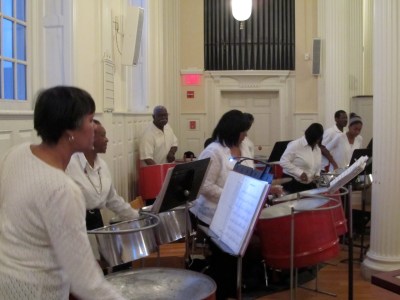
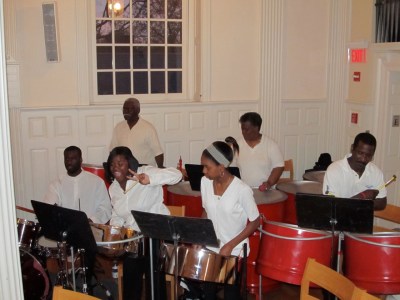
Last night was our mega-mondo, supa-spectacular, everything-AND-the-kitchen-sink, blow-em-out, LAST and FINAL community Eucharist of the year. (I’m working on patenting that phrase, by the way.) It lived up to its billing. We had Anglican chant, a beautiful choral anthem, a major organ prelude, a french horn, and—to top it all off—the steel band from St. Luke’s Episcopal Church in New Haven.

All I can say about their performance is that it is a really good thing the chapel doors have good hinges. Otherwise, they would have been totally blown off by the sheer quality of the music. (You can hear some sample clips here but nothing compares to the real thing, especially in a place with acoustics as good as our chapel’s.)

And it all raises a really interesting question: worship is supposed to be a unifying feature for Anglicans. But what makes worship Anglican or Episcopal? And how can we tell when we see it?

(And another question: how much does the music used in a service have to have a certain “unity” to it? Based on last night, hardly any at all!)

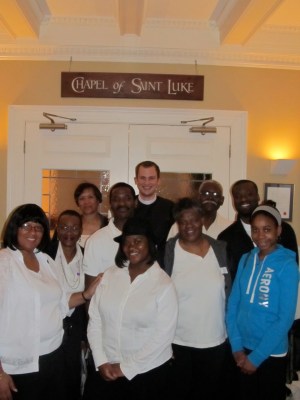
St. Luke’s is the wonderful church I’ve been a part of during my time in New Haven and it was wonderful to have them at Berkeley where we have our own chapel dedicated to Luke.

Isn’t it great…

…when you have a book signing and it’s standing room only?

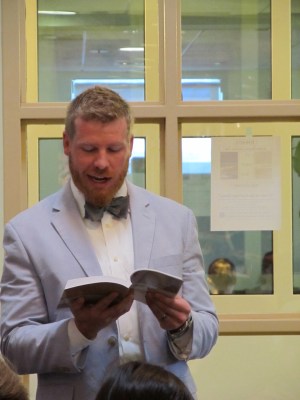
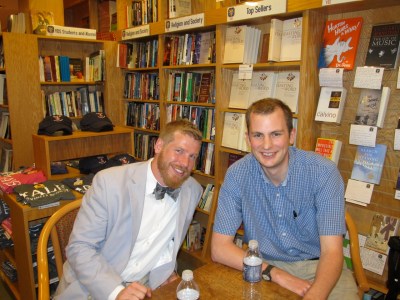
That’s what Stephen Register and I had today at the Student Book Supply at Yale Divinity School. Each of us read from our books—his is Meantime: The Aesthetics of Soldiering, mine is Grace at the Garbage Dump: Making Sense of Mission in the Twenty-First Century—and then started signing… and just kept on going. We sold out the stock the store had on hand (fortunately I had some extra copies handy, which had sold out by the end of the day. They will be re-stocked in the morning if you still haven’t got your copy.). I was especially grateful so many people came out at such a busy time of the semester.

It was a particularly sweet moment since both Stephen and I were in the same spiritual writing course last spring. Now, here we were signing books together. (That’s Stephen on the left; I wish I looked that good in seersucker.) That course, incidentally, was taught by Lauren Winner, who also has a new book out this spring: Still: Notes on a Mid-Faith Crisis. (We read it in draft form in class and it is excellent.)

And the really encouraging thing is that there were ten other people in that class, all of whom are exceptional writers working on fascinating projects. I hope that today’s is not the last book signing to come out of that class!

I’ll next be signing and selling books at the Global Episcopal Mission Network’s annual conference in Ivoryton, Connecticut on Friday, May 4. I’ll also be selling books in Hendersonville, North Carolina as part of African Medical Mission’s fundraising weekend, May 5 and 6. (Details of events beyond that weekend are here.)

Want to set up an event? Let’s talk: jessezink [at] gmail [dot] com.

A Spirituality of Mission

Tell me if this sounds familiar.

You’re off “helping the poor” somewhere—soup kitchen, homeless shelter, outdoor church ministry, wherever. This is great. You’re participating in “mission,” which has become the buzziest buzzword in the church in recent years.

But the focus has become the actual task at hand: making the sandwiches to feed the people at the outdoor church, cutting the carrots to make the soup. Somehow, the focus on the people you were supposed to be working with has been lost, subsumed beneath the never-ending mountain of need you’re encountering.

I know this feeling well—extremely well, as a matter of fact. When I was a missionary in South Africa, it was easy to let the tasks at hand overwhelm the reality that what mattered was building relationships with the people in the community where I worked. Since I’ve been back in the U.S., I’ve seen these same dynamics at play, like the time I helped a group make sandwiches for an outdoor church and then, when we arrived, watched as our group, myself included, handed out the sandwiches with utmost efficiency—and nary a word spoken to any of the people attending the church. Watching the situation I thought to myself, “Hmmm… something’s missing here.”

Mission is not a cost-free enterprise. It’s not something that we can fit into a little box—Sunday afternoon, 2 to 4, mission—and then go on with the rest of our life. It’s about an approach to life, one that demands that we engage with those who are different than us, whether they are just down the street or halfway across the world. It’s what Jesus did when he chatted with the woman at the well. It is, ultimately, what God in Christ did in the moment of the Incarnation, coming to we who were “far off” and engaging with us. Difference exists in this world (and we are ever more aware of it as our world is drawn closer and closer together). Mission is what happens when we encounter it in a Christ-like way.

And it’s all kind of scary and unsettling. It’s much nicer to have all the answers—to know exactly how many sandwiches we need or how many gallons of soup—than to have none but strike up a conversation and see where it leads. But if we want the Gospel to unsettle the world, it must first unsettle us.

One thing that is missing, then, from the church’s conversation about mission is what might be called a “spirituality of mission.” I owe this phrase to the work of Gustavo Gutierrez, who has written of the need for a “spirituality of liberation” to go along with his theology of liberation. His question is how to get people who are poor and oppressed to see that liberation can begin with them, in spite of the years of oppression.

How do we become the people who can overcome our fear and reach out to those who are different than us? We do that by cultivating our relationship with God in Christ, the one whose most frequent teaching was “fear not,” and who modeled exactly what the fearlessness looks like and exactly where it can lead.

What gives you the spiritual resources to continue to engage in God’s mission in the world?

Two Great Books, One Great Place

I’ll be reading from and signing copies of my new book, Grace at the Garbage Dump, at the Yale Divinity School bookstore on Tuesday, April 17, at 12:30pm.

What makes this a particularly special event is that it is a joint event with my friend and fellow author, Stephen Register. Stephen’s new book is Meantime: The Aesthetics of Soldiering, and is about his journey from military service in Iraq to Yale Divinity School. Stephen and I were in the same writing group and have read each other’s work in draft form. So it’s a delight to see his work published—his writing is vivid and honest, and gives those of us who haven’t served an honest window into the life of a soldier. It is well worth the read, particularly as the country begins to grapple with the sheer number of returning veterans in our midst.

Tuesday, April 17, 12:30pm, Yale Divinity School bookstore, 409 Prospect St. Free pizza while it lasts!