The Religion News Service has an article that tries to crunch some numbers to figure out the differences between “Anglicans” and “Episcopalians” in the United States. They’ve asked that the graph not be reproduced so you’ll have to click this link to view it yourself.
There are lots of problems with this data: it is dated and it is not clear that everyone means the same thing when they say “Anglican” or “Episcopalian.”
But if we take the data as it is, two things grab my attention.
First, over half of “Anglicans” think homosexuality should be accepted in society. (No clues as to what “accepted” means.) This is less than the Episcopal number but still substantial. More significantly, it is much, much different than the usual pronouncements we hear from the leaders of the Anglican Church of North America (ACNA) and its affiliated organizations.
Second, more than a quarter of Episcopalians identify as conservative. Historically, given the membership patterns in the Episcopal Church, this is not surprising. But it might come as a surprise for those who believe in the too-often presented image of the church as gone-off-the-rails-liberal.
So three conclusions:
First—and perhaps such an obvious point it doesn’t need to be said—membership in organizations is far more complex than the pronouncements of its leaders.
Second, there is an apparent disjuncture in both Anglican and Episcopal churches between the rhetoric at the highest levels and the reality of the membership. If it is genuinely true that over half of ACNA members think homosexuality should be accepted, then the disjuncture is particularly acute. ACNA leaders have pegged their flag to opposing homosexuality in part because they derive their legitimacy from international links to some other Anglicans, the first condition of which is opposition to homosexuality. What happens when their membership no longer supports such a position?
And third, wouldn’t it be great if we had similar data about other provinces of the Anglican Communion? I bet that if we did, we would find that our beliefs about each other would shift dramatically. Certainly when I have traveled in the allegedly conservative provinces of the Anglican Communion, it has been my experience—time and time again—that the people I meet hold views that are substantially different than what their leaders are saying. People sometimes find that surprising. But based on this data, the same could be said for the Anglican/Episcopal presence in the United States.
So… religious identity is a complex phenomenon whether in the church down the street or the one across the world.
It’s no secret that the Episcopal Church has historically been associated with a particular stratum of society—white, educated, socially connected, middle- to upper-class. The Presiding Bishop used to live in Greenwich, Connecticut—and now lives (or could live) in a Manhattan penthouse. We are a church that can count the number of presidents who have been members and can cite the large number of elected officials who belong. There has always been a number of African-Americans in the Episcopal Church but by and large in majority-black congregations. Power—thanks to the church’s abysmal history of race relations—has remained with the church’s white (and usually male) members.
In recent years and decades, this has begun to change. There are now several African-American bishops, including two of dioceses south of the Mason-Dixon line. There is a growing interest in Spanish-language ministry. We ordain priests from immigrant and Native American communities. Above all, there is the recognition that simply being the church of the white elite is no longer an option—not if we are serious about thriving in the wonderful hetereogeneity of 21st-century America nor, for that matter, if we are serious about being the body of Christ.
At the same time, the church has come to be dominated by a theology that centres on the “mission of God.” There is much to admire about this emphasis—indeed, I wrote a book about it. But I want to highlight one aspect of this emphasis. In the current theology of the church, the word mission is, as I have written at length elsewhere, often associated with a constellation of other words: task, job, do, work, labour, obligation. I once called this the Nike theology of mission: just do it. Get out there and do the work of God.
It is a truism that all theology is contextual and emerges from a particular community. Martin Luther King, Jr. and other civil rights leaders found a powerful parallel in Exodus and God’s deliverance from oppression. During a catastrophic civil war in southern Sudan, it is not surprising that people were drawn to Christianity in part because of the promise of eternal life. When your friends are dying, you begin to think about what comes after life.
The current emphasis on mission in the Episcopal Church can be seen in a similar way. It may not always feel like this but Episcopalians are, by and large, people who tend to have disposable time and disposable income. When we hear calls to volunteer at soup kitchens, start homeless shelters, donate to food banks, or whatever, it is not unreasonable for us to think about responding. In my experience of the Episcopal Church, Episcopalians are people who come from an action-oriented stratum of society that is used to exercising its own agency. When we hear calls to “mend the world,” we might think it’s a tall order but we might also think it’s not unreasonable to start making plans.
Spotted from time to time in an Episcopal church
All of this came to mind while reading a lengthy investigation in the New York Timesrecently about modern labour practices. The article focused on a young, single-mother who has no certainty in her work schedule from Starbucks and so ends up living a life of constant chaos, torn between child care, work, transit between the two, and with barely any time for any of her major life goals, like education or a driver’s license.
The article doesn’t say but I’d guess that this young woman is not a member of the Episcopal church. She may not be a member of any church, in fact. But let’s imagine she walks into her local Episcopal church on a Sunday morning and hears a sermon exhorting her to join in the mission of God, to get out there and build the kingdom, to do, to labour, to work. It’s not unreasonable to think that her response might be, “I can barely keep my head above water as it is. Why would I want to join a church that tells me I need to do more work?”
There’s a picture I once took on a weekday afternoon in a Nigerian church. There was a young woman, praying with her head bowed in a side pew. Over her was a sign that read, “The steadfastness of the Lord never ceaseth.” I was reminded in that moment of the deep well that is Christian theology with its themes of mercy, reconciliation, peace, redemption, truth, and so much more. This woman (I’m guessing) found her faith expressed at a moment of Christian consolation. You don’t have to do anything—just dwell in the love of God.
(As I write this, I am recalling a sermon I once preached on Matthew 11.28-30—”come to me, all you that are weary…”—and focused on how we were being called to take up the yoke of mission. All work, little consolation.)
The truth is, I can only tell you about what draws me to Christianity and to the Episcopal Church in particular. I can’t see inside the head of a Starbucks barista or a Nigerian church-goer. It is decidedly not the case that people from a lower socioeconomic background cannot mend the world or that they don’t want to try. Mission theology is not inherently misguided. But mission theology is, as all theologies are, particular to a particular community.
As Episcopalians think about our future as a church, one common theme seems to be that the main problem we face is that our message is not being heard broadly enough. We need to be better at evangelism, at church planting, and at communicating in the fractured media world of this era. All true. (And all steps that are action-oriented.) But I wonder if we might not stop and question not just how we communicate but what we communicate as well.
As Episcopalians look to transcend our historic membership patterns, we need also to think about the theology—or, more likely, theologies—that will be at the root of our new, broader community.
IN HER book Travelling In, Monica Furlong wrote: “Priests are justified only by their powers of being and seeing.”…
Thank God, then, for a priest such as Jesse Zink, who transparently understands this, and who can communicate William Blake’s “minute particulars” with an eye to their global significance, and with love and intelligence.
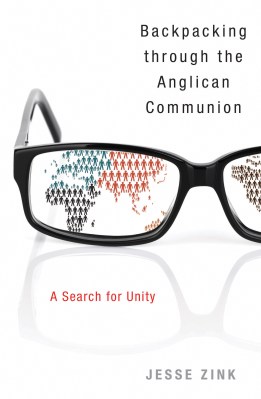
Backpacking through the Anglican Communion: A search for unity is a marvellous book, at turns prayerful, thoughtful, challenging, and moving. Above all, it glows with a luminosity that gives its readers space for real engagement with the material before them.
Being and seeing are increasingly rare qualities that Zink possesses in spades. In a way that is convincing, he invites and encourages his readers to embrace them, too. His book is a working out of that powerful injunction from Henri Nouwen: “Don’t just do something – stand there!”…
In truth, his book is much needed…
Zink wants us to embrace the truth that unity is mission. It is an argument that he advances in the best traditions of Anglican apologetic, with beauty, clarity, and insight. His book is a must-read for those who truly believe that belonging to the worldwide body of Christ – where there is difference, and should be charity and love – is what discipleship means.
Some people—including the archbishop of Canterbury—said yesterday that the vote in the General Synod of the Church of England to allow women to be bishops is “the completion of what was begun over 20 years ago with the ordination of women as priests.”
In fact, the journey began long before that—and many women in the church have lived every moment of it.
Take, for instance, the biography of Vivienne Faull, the current dean of York Minister. As a young women, she worked overseas as a missionary. She returned from that experience to train for ordination. Then she was “ordained”—but as a deaconness, which at the time was as far as women could go. When women could become actual deacons in 1987, she was so ordained. Then in 1994, when women could become priests, she was priested. And now she is tipped to be one of the first women bishops. Along the way, she held some great positions—Cambridge college chaplain and fellow, cathedral canon, and now dean.
What strikes me about her story is the parallels with mine a generation later—worked overseas, came back to study for ordination, Cambridge college life. But there is one crucial difference: no one ever questioned that I should be anything other than a priest. I didn’t have to spend years labouring in orders created especially for my gender. My call to sacramental ministry didn’t have to feel daily frustrated by the fact that I couldn’t celebrate the sacraments. When women were ordained priests, many were told not to make a big deal out of it for fear of offending others. When I was ordained, the church threw a big party and I went on a local radio station to talk a bit about vocation and ministry.
Nor, as a priest, have I ever had to deal with the daily questioning of my vocation by people who don’t think I should be doing what I am doing. Maggi Dawn has written powerfully about what the challenges of training for ministry as a woman in 1994. Vivienne Faull, for a time, had a priest colleague at York Minster who would not receive communion from a woman. No one has ever turned down the host I offered them.
I remember talking with a women priest in the Church of England who was ordained as a deaconness in 1987. She did the customary two curacies as a deacon but it wasn’t clear what the next step was going to be: “It’s a good thing they allowed women to be priests so I could be ordained in 1994 and move to be an incumbent.” At the time, the statement struck me as so odd—why was there a bar that was going to prevent her from doing what all her male peers ordained in 1987 would be doing as a matter of course?
As it is, the journey is not yet over. I don’t understand the ins and outs of canon law but the legislation passed yesterday does make space for people who object to women as bishops, which can be seen to detract from women as bishops.
This is not the post of a naive young male priest all of a sudden discovering that gender discrimination exists in—of all places!—the church. Nor does it say anything that isn’t already well known. This post is simply to say—in a church whose historical memory is often weak—that the church is abundantly blessed with many, many women who have for so long borne the burden of the church’s conflict over gender—and they have borne it with consistently good grace, charity, and love. And as I read the news of the Synod vote, that is what I am most grateful for.
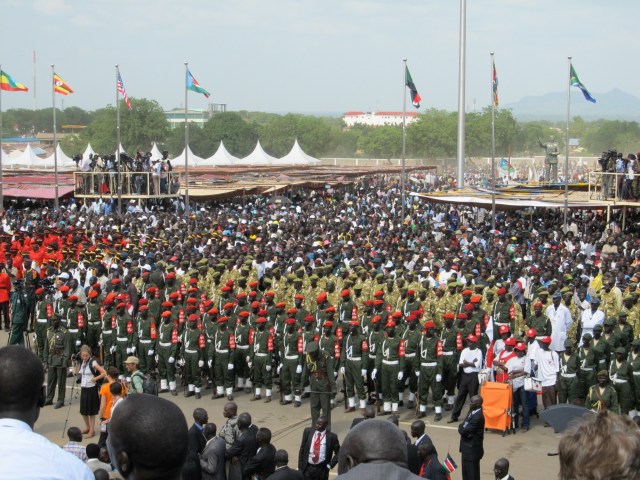
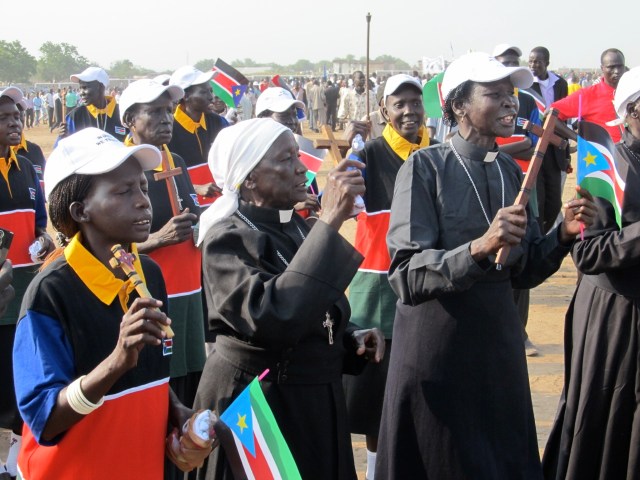
Three years ago today, I was in Juba, South Sudan for the birth of the world’s newest nation. After decades of civil war, South Sudan broke away from Sudan under the terms of a negotiated peace settlement.
It was an overwhelming day. I remember walking out to the site of the celebrations around 6.30 in the morning. The streets were full of people with an eager energy. At the site itself, there were crowds and crowds of people dancing and singing and celebrating—including some Anglican priests.
There was this powerful sense of hope for the future, that at last, after so much war, South Sudanese would be able to set their own course. I remember speaking to one bishop who was near tears as he told me, “I know so many people who did not live to see this day.” Every word he met in a profoundly literal sense. There was a sense of obligation to those who had died to craft this new future together.
As I recall, the actual events surrounding independence were rather banal. They began late, the speeches lasted too long, the sound system didn’t work so well, the crowds began to get impatient, and the jaded foreign correspondents started smoking. It was hot, of course, and for those of us out in the cheap seats, it was not always terrible comfortable.
As I walked away that afternoon to write a story about the event, I remember holding these two contrasting emotions together: on the one hand, the sheer joy and expectation; on the other, the banality and mundanity of any major event. Independence was something special and unique, of course, but it was also something that took place fully within the context of daily life and was shaped by that context of lateness and verbosity.
In the three years since independence, the news from South Sudan has not often been good. A dispute between South Sudan and Sudan led to a shut-down of oil production. The health and welfare indicators in the country continue to be among the worst in the world. Most significantly, since December of last year parts of the country have been embroiled in a metastasising civil war.
It is hard, in reading about South Sudan, to think back to that sense of hope and expectation which was so strong three years ago. And I wonder if that’s not because we haven’t also lost sight of that second emotion, the sheer banality of everyday life. In all of the big plans for the future and big discussions about the political future of the country, it is easy to lose sight of the daily existence of so many South Sudanese.
So I am grateful on this third anniversary of South Sudan’s independence for the continued work of the church—in its work for peace and reconciliation at a local, grassroots level; in its commitment to delivering aid and assistance to the displaced across the country; and in the hope it embodies for a new future for the country. The work of building a new country is long and arduous. It is when the focus is placed on the concrete, day-to-day lives of the millions of South Sudanese who yearn for peace and opportunity that the country begins to move forward.
For Anglicans and non-Anglicans alike who have become inured to the seemingly endless debates and strife—mostly recently focused on sexuality—between various members of the leadership of the Anglican Communion, Zink’s anecdotes offer the reader a series of refreshing glimpses into a church that is vital and growing in some places but faces tremendous social, political and developmental challenges in others.
Canadian readers have reported difficulties ordering Backpacking through Cokesbury and other American outlets. May I suggest trying Crux Books in Toronto, which ships within Canada?
Daniel Deng Bul, the Archbishop of the Episcopal Church of South Sudan and Sudan, and leader of South Sudan’s National Platform for Peace and Reconciliation, has written an important letter outlining the efforts of so many to bring about peace in South Sudan.
I have uploaded the letter here so that you can read it in its full, but here are a few excerpts that struck me.
Why is it so important at this point to raise an independent voice for peace and reconciliation? The war is dividing and polarising the people and communities of our country. The middle ground is eroded. When you listen to one side you are criticized as biased towards one or the other. Each side wants you to be with them. And if you are not with them you are against them. Tribal allegiance is expected and people labeled accordingly. This makes it very difficult for people and leaders to stand in the middle and reach out to both sides equally. Motives are questioned, actions are doubted and words are twisted. Reaching out to both sides requires courage and commitment to the ideal of a healed nation. This is why being independent and united is so important. Standing in the middle is necessary to reach both sides and to bridge the divide between people and political leaders, between divided communities. We serve the people and we serve our leaders. We are inspired by the courage of our people and guided by our belief in the Word of God. Independence does not mean you are against the government or the Opposition, against one or the other community. Independence for the [Reconciliation] Platform means we can listen to everyone equally, openly and inclusively to bring the voices of all the people together to advance peace and reconciliation.
To be a reconciler is to be stuck in the middle of deeply conflicted situations. I am reminded of the Latin word for priest, “pontifex,” which means bridge-builder. The trouble with being a bridge, however, is that you get walked all over. It is that holy work of bridge-building to which Archbishop Daniel and others are dedicated.
Reconciliation is not just about a cessation of hostilities between warring parties but involves actors from across society.
To start the journey for our healing, we have to come together and speak with one voice against this war that is tearing our nation and our people apart. The Platform is reaching out to all constituencies and groups. The role of women, youth, religious communities, traditional leaders, government and opposition and many more are recognized as equally essential if we want to build a broad coalition of people to stand up against the war and urge our leaders to find and implement solutions that stop the war and begin the healing and development we all need. The Scriptures have countless calls for us to be of the same mind and consider others better than ourselves.
Be of the same mind toward one another… And let us consider one another to provoke to love and to good works (Romans 12.16; Hebrews 10.24, NKJV)
In all that is happening in the world—you can read about the work of an Anglican priest in Iraq here—it is easy to lose sight of South Sudan, particularly as the onset of the wet season leads to a necessary diminution of violence (though not of suffering). But the need for reconciliation remains acute and we can continue to pray and support the work of Christians there.
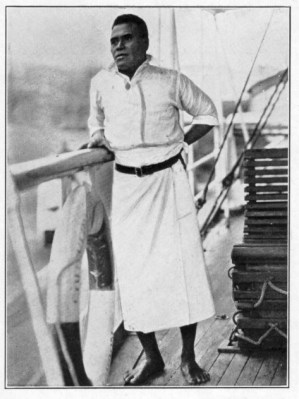
It was only this morning that I realized that the anniversary of D-Day coincides with the church’s commemoration of Ini Kopuria, founder of the Melanesian Brotherhood. It is, I think, an apt coincidence. The Melanesian Brotherhood is a religious order in the South Pacific—you can read more on Wikipedia—that entered Anglican consciousness perhaps most forcefully in 2003 when seven of their members were killed in violence related to civil turmoil in the Solomon Islands. At the time, the attention of many Anglican leaders was focused on the consecration of a new bishop in New Hampshire but the witness of these men was so powerful it demanded attention. I have just finished reading Richard Carter’s In Search of the Lost, a moving account of the months before and after the martyrdom of these seven Brothers. By 2003, the turmoil in the Solomon Islands had moderated and the Brothers had been asked to take the lead on a disarmament campaign. At a time when the police were suspect and international forces were only just establishing themselves, it was only the Brothers who could make a credible claim that weapons needed to be collected and destroyed if peace was to be reestablished. Their trustworthiness was rooted in the life they lived as a community—prayerful, open, honest, mutual. By living the values of the Gospel, they held up a vision of a different kind of community. People saw that and responded. The Gospel is powerful stuff. The death of the seven Brothers came about when one went to meet with a rebel leader and work towards peace. When he didn’t come back, six others went to look for them. For several agonizing months, it was unclear what had come of them. Finally, it was confirmed that they had been tortured and killed. (As a taste of the book, you can listen to this interview that Richard Carter gave last year to Vatican Radio on the 10th anniversary of the martyrdoms.) Ini Kopuria, whom the church commemorates today, died long before the 2003 martyrdoms. But the vision of a community that in its way of living challenges the ethos of the world around it remains strong. I have incredible admiration and respect for all who participated in D-Day and for those who fought in the World War II. But I also want Christians to be able, at the same time, to hold up a vision of a different kind of community that is not based on violence, submission, and force. Christians do this best when they are living those values in their own lives. One of the stated priorities of Justin Welby is a revival of the religious life in the church. It is not only in religious orders that Christians are able to show forth this alternate religious community, but given their nature it is a particular charism of such orders. We pray for the success of the archbishop’s efforts so that we can all be enriched by the example of orders like the Melanesian Brothers. Then, together, as the body of Christ, we pray that we may model the other world that is brought about in the life, death, and resurrection of Jesus Christ.
The threat which many young women face as they seek education in northern Nigeria has been forcefully brought home in recent weeks by the abduction of several hundred young students.
Not long ago, I visited an Anglican diocese not far from where the students were recently abducted. On that visit, I learned from Bishop Marcus Ibrahim and others in the Diocese of Yola about the church’s outsize role in education and the vital importance of English-language education for all students, regardless of gender.
A major focus of the diocese’s work was education. The weakness of the government in Nigeria means it has essentially abdicated any role in schools. When he became bishop, Marcus started the Anglican Junior Seminary Yola, a secondary school. When I visited, there were about sixty students at AJSY, and they met in an old house that had been donated by a family in the diocese. The language of instruction is English, unlike many of the Islamic-run schools in the area, and the school admits boys and girls equally, making AJSY one of the few institutions in the state that educates girls in English. I was asked to speak to an assembly, and was impressed by how articulate and interesting the students were. They had very good and challenging questions for me and were promising young Nigerians. It was clear, however, that the house was too small. The assembly met while crammed into what I imagined was the main living space, with students standing against walls or sitting on the ground with their knees scrunched up against their chests to make space for the people around them.
Marcus took me out to see the spacious piece of land the diocese purchased on the edge of Yola to build a new school. Progress was coming, but it was slow. In the two years prior to my visit, the diocese raised the funds necessary for three classroom blocks, which have enough space for double the number of students currently enrolled. But delays in building the dormitory meant the school was not yet able to open. The builders had completed the dorm’s foundation, but then the money ran out. Marcus and I walked across the foundation, and he pointed to where the individual rooms and communal spaces would be. He was bubbling over with excitement about the possibilities of the school, sketching in the dirt possibilities for expansion once this initial site was up and running.
All the money for the construction had come from Nigerians, some from donors who lived outside the diocese, but much from members of the diocese. At a diocesan council meeting I attended, the conversation centered on raising funds for the four hundred bags of cement necessary to finish the dorm. Each bag cost about fifteen dollars. Council members brainstormed ways to raise the money: Ask each deanery to contribute a set amount? Approach the richer members of congregations? Eventually, they settled on assigning each congregation a specific number of bags of cement to provide based on the congregation’s size and average offering in the past year….
“Have you looked for any international support?” I asked Marcus when we were at the school site. Off the top of my head, I could think of several organizations that were interested in funding projects exactly like this one.
“We have,” Marcus said, in a tone that combined disappointment, frustration, and regret. “But no one will help us. They think because of the problems in the Anglican Communion that they can’t work with us in Nigeria.”…
“Look,” Marcus said. “I want to build this school. Children need to be educated. Girls need to be educated. That’s not happening in Yola. Anglicans can work together on this.” We let the words hang in the air. We both knew that. But how could other people come to know?…
The sun was setting. We stood on the foundation and looked back at the future AJSY together. The empty classroom blocks and the dormitory foundation, as well as the students crammed into classrooms in an old house, represented the real-life lost opportunities that result from the narrative of disunity in the Anglican Communion, a narrative that has been propagated by some of its most senior members. Marcus and I were testament to the utter wrongness of that narrative. But our story would never seize headlines or lead to special meetings of Anglican leaders. As we headed back to the car, my steps were heavy with deep, profound sorrow.
As we pray for the return of these kidnapped students, we also pray for the grace to act to ensure an educated future for all in the region who want to learn.
When I initially visited the school, I wrote about it in two differentposts. You can also read more about how the Nigerian government has abdicated its role in education in this post, about a visit to a different school in southeastern Nigeria.
He writes beautifully. His descriptions of people and places and the accounts of conversations are crafted with skill and sensitivity. Even if Jesse has not covered the entire Communion, he’s managed to get to places where few white Anglicans have penetrated. I suspect if the project could be financially supported, we could in future be reading about many more backpacker journeys. Anglicans today know next to nothing about fellow Anglicans living beyond their particular provinces and this makes it a valuable project.
To the point about such future backpacking journeys, the answer can only be, “Of course!”

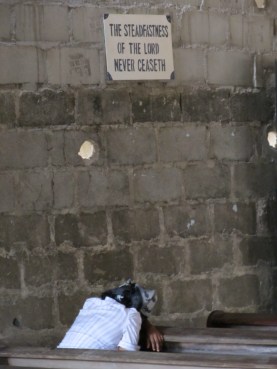 There’s a picture I once took on a weekday afternoon in a Nigerian church. There was a young woman, praying with her head bowed in a side pew. Over her was a sign that read, “The steadfastness of the Lord never ceaseth.” I was reminded in that moment of the deep well that is Christian theology with its themes of mercy, reconciliation, peace, redemption, truth, and so much more. This woman (I’m guessing) found her faith expressed at a moment of Christian consolation. You don’t have to do anything—just dwell in the love of God.
 The
The 
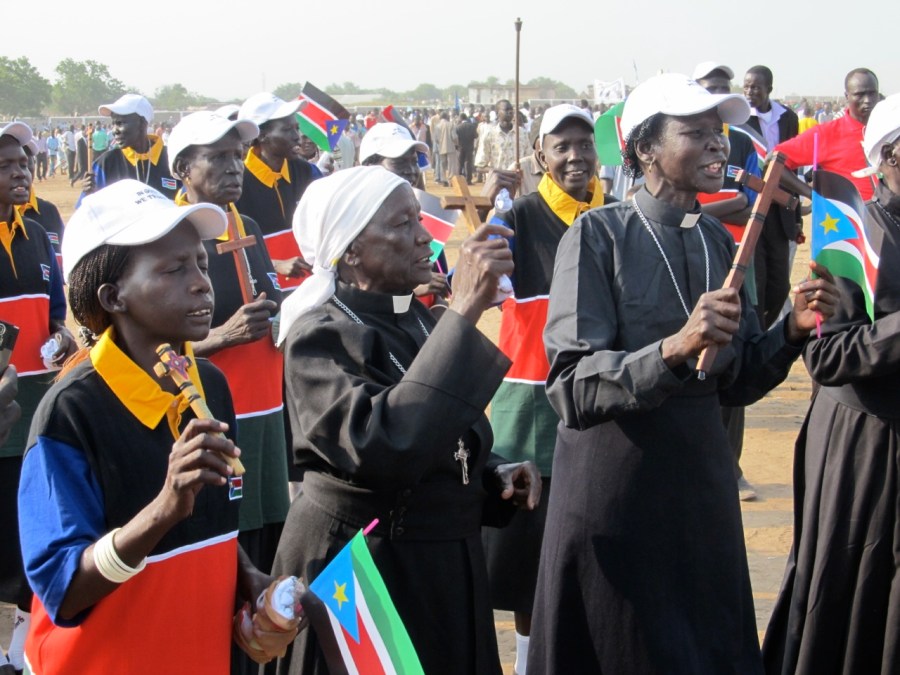

 Daniel Deng Bul, the Archbishop of the Episcopal Church of South Sudan and Sudan, and leader of South Sudan’s National Platform for Peace and Reconciliation, has written an important letter outlining the efforts of so many to bring about peace in South Sudan.


 Jesse Zink
