South Sudan, one year on

One year ago today, I was in Juba, South Sudan for the independence celebrations of the world’s newest country. It was a huge event, and I shall not soon forget it, even if my friend here was holding his flag in the wrong spot.

It’s been a hard first year for South Sudan. Not only are there serious unresolved issues in its relationship with what remains of Sudan, it has been beset by inter-tribal violence, plagued by corruption, and unable to address the many pressing social needs of its people.

But when people ask me, as they often do, what I think about South Sudan, my reply always includes the lines, “I have a lot of hope for the future.” And I do. My visits to Sudan have convinced me that the potential in that country is huge.

I am particularly convinced of this because of the continued and powerful witness of the church in Sudan for peace and reconciliation. When Jonglei state was plagued by inter-tribal violence earlier this year, the government turned to Archbishop Daniel Deng Bul of the Episcopal Church of Sudan. He negotiated a peace deal that has held and has created the space necessary for long-term peace-building to get underway. Archbishop Daniel and his Catholic counterpart Paulino Lukudu Loro have issued a statement on their continued hopes for the future of South Sudan.

So when you read the truly horrific news that the continued violence along the border is producing another “Lost Boys”-type situation or the awful conditions in some new refugee camps, I hope that a gasp of horror won’t be your only response. On this July 9—and every other day—I hope you’ll join in prayers for this new nation, read the letter from the archbishops, and think about ways in which you and your church can support our sisters and brothers in Christ in South Sudan.

Together, perhaps, the enthusiasm displayed by this young man can soon become a reality shared by all.

Turning mission rhetoric into reality: preview of this afternoon’s study guide launch

Just in time for today’s launch of the Grace at the Garbage Dump study guide at the Episcopal Church’s General Convention, there’s a great article in Center Aisle about the book, its genesis, and what we talk about when we talk about mission in the Episcopal Church.

“I have always loved stories,” he says. “Hearing them, telling them, sharing them. I returned from Itipini with the conviction that the stories of people like those who live in Itipini are not being told. I was also convinced that if we are going to move forward in addressing the problems of global poverty, we need to actually know about one another around the world, how we live and the challenges we face.”…

After publishing his book, Zink created a study guide “as a tool for groups to use as they think about how they can be involved in God’s mission.” The study guide can be downloaded for free at www.jessezink.com. “God is calling everyone to a role in God’s mission,” he says. “Discerning just what that role is is a holy and important task.”

Read the rest of the article here.

In Indianapolis? Stop by for two minutes or twenty tomorrow to pick up a copy of the book, learn about the study guide, or chat about what mission means to you. We’ll be at the Global Episcopal Mission Network booth (#629—you’ve got to go past the food booths). At previous signings, we’ve run out of books pretty quickly so we’ve got extra on hand for tomorrow. But we’re selling them for the special Convention-only price of $15 (30% below what Amazon will sell it you for) so they might go quickly.

See you there!

The harvest is plentiful…

Students of history will know that the Episcopal Church (and other Anglican churches) used to have missionary areas overseen by missionary bishops. In places where the church did not yet exist, the church consecrated men to serve as bishops who had the sacramental authority needed to build the church in that area. Over time, the missionary areas grew into full dioceses capable of supporting themselves.

(For the record, one of the reasons the Anglican Church in North America is so purple-heavy is that they’ve adopted a similar strategy. Todd Hunter’s Accidental Anglican has more on this. Evaluating that decision is for another post.)

A lot of great missionary bishops are in the commemoration calendar of the church, people like Jackson Kemper and Philander Chase. (The latter of Kenyon College fame: “The first of Kenyon’s goodly race / Was that great man Philander Chase; / He climbed the Hill and said a prayer, / And founded Kenyon College there.”) But they are no longer. While some dioceses of the Episcopal Church receive financial support from the central church, they are all self-governing. Missionary areas and bishops are a thing of the past.

Or are they?

News comes from the Anglican Church of Canada that one of its dioceses, the Diocese of Moosonee, will become a mission area of the province of Ontario.

The plan evolved after almost a year of discussions and consultations on the fate of the diocese, which has been burdened by extreme financial difficulties….

Under the plan, the Ontario metropolitan will exercise the authority, jurisdiction and powers presently held by the diocesan bishop. The metropolitan may authorize other bishops to perform episcopal duties including the ordination of deacons and priests, confirmations and consecration of churches, chapels and churchyards.

Is Moosonee the canary in the coal mine for dioceses in the Episcopal Church? There are many dioceses that face similar financial difficulties. (Just look at this list of diocesan giving and see how small some of the budgets of dioceses are. How do they survive?) There’s been talk of combining dioceses. (In at least one case, it was tried and the vote failed.) What would it mean if, instead of combining, dioceses reverted to mission areas?

I happen to know something about the diocese of Moosonee and the part of the country it’s in as it’s where my grandparents lived. (In fact, the current bishop of Moosonee presided at my grandfather’s funeral.) It’s rural. It’s relatively poor. There’s a large native population. It is The North (capital T, capital N), rich in natural resources, plagued by chronic illness, shut out of political power. It is a place dear to my heart, though the years I spent in the northern latitudes were to the west. It’s an area (like every other) that needs to hear the good news of Jesus Christ.

Moreover, many Christians recognize this. If you drive through some of these hard-up towns in northern Canada, you’ll see quite a few pentecostal-style churches in old malls and storefronts. The spread prosperity gospel churches on First Nation reservations is one of the great unreported trends of North American Christianity. Evangelism is happening here. I just happen to think the Anglican/Episcopal interpretation of the Christian faith has a lot to offer. That, sadly, is not happening.

I was reading about the Moosonee at the same time I was reading about news from the ongoing General Convention of the Episcopal Church. There’s all kinds of talk about how the church needs to change, take risks, be bold, make sacrifices, etc., etc. Love it. It’s great rhetoric. But as more than a few have noted, where’s the action to back up the talk?

There’s no doubt in my mind that there is a lot of energy and enthusiasm in the church, especially among its younger generation. What would it mean for some of this energy and enthusiasm to be translated into some of the great missionary areas of this continent, places like Moosonee, that so need to hear the good news of Jesus Christ? What would it mean to consecrate missionaries—bishops or not—who don’t expect any perks of status or rewards of income but are so fired to share the teachings of the kingdom of God that it doesn’t matter to them? What would it mean to take this great well of energy and enthusiasm that is—let’s face it—concentrated in the urban areas of the country and spread it wider across the land? It’d be risky. It’d be bold. It’d be sacrificial.

I’m not sure what the result would be. But I do know that if we don’t try, we’re going to end up with a few American dioceses going the way of Moosonee.

Memo to bishops-elect

The General Convention of the Episcopal Church will vote in the next day or two to confirm  several new bishops who have been elected in the last four months. No doubt, these bishops will take office full of plans for their tenure and ready to implement them. As they do, I— presumptuously—have a thought for them.

The definition of the ministry of a bishop in the Episcopal catechism includes, “to act in Christ’s name for the reconciliation of the world and the building up of the Church.” Bishops are symbols of unity in the worldwide church, representing the universal to the local and the local to the universal.

My thought for the new bishops is that they be sure to use their time as bishop to establish solid companion diocese relationships. This is not, in itself, that surprising an idea. Many dioceses already have such relationships.

What I want to urge the new bishops to do, however, is to build relationships in unlikely places. As I found out in my travels last summer at this time, there are several dioceses in the church in Nigeria that are eager for American companions. (See my posts here and here for more on this.) I heard time and again how interested people in those dioceses were in establishing relationships that moved the Anglican Communion beyond the divisive rhetoric of the last decade or more. Without ignoring the differences of opinion, these people still wanted to establish companion relationships. And yet, no matter how hard they tried, the Nigerians I met were turned away. “Sorry,” they were told. “Our churches can’t be in relationship.”

These bishops-elect have an incredible opportunity to change the discourse in the Anglican Communion from one of fracture to one of unity. (I’ve written before about the importance of companion diocese relationships.) Just imagine what a companion relationship between an American diocese and a Nigerian one could mean for the Anglican Communion.

I imagine that being a bishop can be pretty overwhelming. I imagine it can be pretty easy to end up focused solely on the pressing concerns of the diocese. My hope for the new bishops—and all bishops—is that they’ll remember to work for the reconciliation of the world.

The church—and the world—needs it.

Turning Mission Rhetoric into Congregational Reality: New Study Guide

“Mission” is the buzzword of this year’s Episcopal General Convention. It’s already a buzzword in mainline Protestant denominations.

But how can churches across the country put that mission rhetoric into reality? What does it mean for a congregation to discern its role in God’s mission?

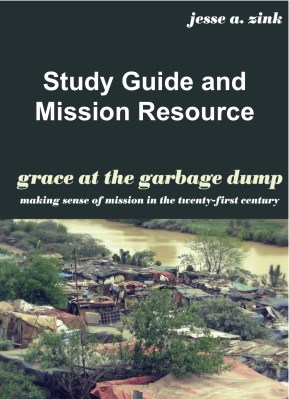
The new Study Guide and Mission Resource for Grace at the Garbage Dump: Making Sense of Mission in the Twenty-First Century is designed to help Christians put the rhetoric of mission into reality. Designed to be used with youth groups, mission/outreach committees, book study groups, and adult education forums, the Study Guide features overviews and summaries of each section of the book, questions for conversation and discussion, links to further resources, and much, more more. And it’s entirely free.

Download the Study Guide for free at www.jessezink.com/guide. Copy it, distribute it, and use it as a resource to help your congregation find out what God is calling you to… whether just down the street or halfway around the world.

If you’re in Indianapolis for General Convention, stop by the official launch of the study guide. Hosted by the Global Episcopal Mission Network (Booth #629) on Sunday, July 8 from 2pm to 3pm, come by for two or twenty minutes to buy a copy of the book (at a special Convention only rate), ask questions about the guide, and learn more about how to involve your congregation with mission. More information is in this press release.

Read all about what people are saying about the book—and how they are commending it as a resource for congregational study—by clicking over to the reviews page.

Questions? Comments? Contact the author directly. jessezink [at] gmail [dot] com or on Twitter @jazink.

Again, you can download the study guide for free at www.jessezink.com/guide.

The reviews just keep on coming

The reviews of Grace at the Garbage Dump are coming quickly now.

There’s a new one in Pastoral Staff, the newspaper of the Diocese of Western Massachusetts:

Jesse tells his story beautifully in Grace. As he used his ingenuity with the schoolchildren, he used it as well to learn Xhosa, to reach out to women dying of HIV and serve as their advocate. He learned, even, to talk to teenagers and women about safe sex, about avoiding pregnancy and sexually transmitted disease, about keeping their options for education open.

(Pastoral Staff is published online as a pdf document. The full review is on p. 14. For kicks, you can read the interview with me that follows the review.)

Have you bought your copy of Grace at the Garbage Dump yet? You can find all the information on doing so here.

And if you’re not ready to buy, remember you can always read the first chapter for free on Amazon.

If you’re planning to be at the General Convention of the Episcopal Church, I’ll be selling and signing books (at a special Convention-only price!) on Sunday, July 8. Details are here.

“Puts real flesh and real blood on what mission looks like”

There’s a new review of my book Grace at the Garbage Dump from Episcopal Digital Network. You can read the whole thing, or read the extracts here:

The struggles [Zink] has as he lives and learns and serves in a situation of desperate poverty and horrible disease make Grace at the Garbage Dump a highly valuable tool for exploring a new sense of mission….

Zink is an engaging writer who tells stories well, and stories are the heart and soul of the book…. Zink excels at both drawing you in compassionately to the individuals and analyzing the social and political structures that contribute to an unjust world that leaves some living short lives on a garbage heap.

The book is a primer on the two-thirds world, the world of the vast majority of the global population…. His description of the ravages of AIDS – which affects directly or indirectly everyone he serves – is particularly instructing to those of us for whom this disease can be (though should not be) regarded as less prevalent…. The book would make an excellent study in a Christian Education program, if only to help people from the one-third world understand the desperate needs of the rest of the world.

Making sense of mission is our important new challenge as disciples of Christ. This book’s greatest strength is that it puts real flesh and real blood on what the missio dei looks like on the ground today.

Read the whole thing.

Have you bought your copy of Grace at the Garbage Dump yet? You can find all the information on doing so here.

And if you’re not ready to buy, remember you can always read the first chapter for free on Amazon.

If you’re planning to be at the General Convention of the Episcopal Church, I’ll be selling and signing books (at a special Convention-only price!) on Sunday, July 8. Stay tuned for details.

Why would a young person be ordained?

I was asked on the radio last week to answer the question, “Why would a young person chose to be ordained in this day and age?”

The conversation was lengthy—I got almost 30 minutes of airtime—and pretty good. I felt like I managed to provide a pretty fair accounting of what vocation is all about and why the good news of Jesus Christ needs to be proclaimed as much in this generation as in any other.

The interview has now been posted online. You can listen to it here. It begins around 10:30.

How would you have answered? If you’re not ordained and not planning to be, what do you say when people ask you why you’re in the church?

Mission and marriage, they go together like a…?

Complete the sentence and win a prize. I’m stuck.

Episcopal News Service has a commentary I wrote on my recent wedding and young marriage.

The unity of our relationship, and every other marriage relationship, is a testament to the hope-though not always the reality-that fractured relationship can be restored. (I interpret the current debate about same-sex marriages in the church to be, in large part, about whether that same hope can be found in such relationships.) Our marriage, then, is not simply about the love we have for one another or our desire to spend our lives together. Our marriage is part of our role in God’s reconciling mission. Marriage is missional.

You can read the rest of it here.

There are some good comments on the piece at the article itself. Or you can leave them here, on the article or speculation on what it might mean to follow the article’s logic through to the upcoming General Convention.

Bring back the Church Congress Movement!

Proposals are flying around to restructure the Episcopal Church and it’s clear that the make-up of the church’s governing body, General Convention, is on the table. The bishop of Long Island wants to combine its houses. The bishop of Arizona wants to shrink it substantially. It has already, due to budgetary constraints, been shortened in recent years, though with no apparent reduction in workload. That, in turn, has led to calls for certain items—like resolutions calling for the government to do (or not do) something—to be jettisoned from Convention’s agenda. Across the board, there are calls for more collaboration across the church with more “sharing of resources.”

So here’s an idea—building on that same proposal from the bishop of Arizona: what if we brought back the Church Congress Movement?

The Church Congress Movement (about which there is no Wikipedia article so you know it’s really obscure; you get a whopping eight Google entries when you search for it) flourished in the Episcopal Church in the late nineteenth and early twentieth centuries. It was back when the Episcopal Church had pretensions to grandeur and thought it had something to say to the world around it (and that people were listening). Folks came together to debate the issues of the day in the world and in the church.

Why might this be a good thing to consider reviving?

  • General Convention is awfully focused on doing stuff: passing a budget, authorizing liturgies, etc. The Church Congress can be focused on exactly the kind of consensus-building and resource-sharing we need in the church—without getting distracted by the pressure of having to take care of the business of the church.
  • The Church Congress was an early example of what we now take for granted: networking. This is what makes the world go ’round (however you may feel about it) and a lot of it seems to happen at Convention. Why not de-emphasize Convention, though, where the focus is on the folks who happened to get elected as deputies, and open the door to a broader-based conversation with less hierarchy and more open participation.
  • The Church Congress separates the important business of governing our church from the equally important (but I think slightly different) business of figuring out where the church is going and what it should be. Let’s be clear about what’s important for governance and what’s important for the church as a whole.
  • The Church Congress is open to all comers, not just the kind of people who stand for and get elected as deputies to General Convention. As a result, there’s a wider slice of the church represented.

There are already plenty of signs of movement in the direction of a Church Congress-like organization. Gathering 2013 or the Gathering of Leaders are both groups that do similar sorts of things to what I’m describing here (with the important distinction that both are clergy-only affairs). But I think there’s something to be said for scale and regularity. The Church Congress was an event in a way that neither of these two Gatherings are.

The major obstacle, of course, is financial. We can barely fund General Convention. How can we fund another big meeting? In the twentieth century there were three Anglican Congresses that brought together Anglicans from all over the world. (Once we’ve brought back Church Congress, let’s bring back the Anglican Congress!) The Lambeth 2008 design team wanted to have an Anglican Congress but scrapped it for lack of money. I’m not sure I have an easy answer to the financial question, though a much-reduced Convention should help, nor am I going to let that stand in the way of an idea.

There’s one thing I’m not telling you about the Church Congresses: they actually represented a church faction (the broad church types) and so were not truly an equal meeting ground for all. Moreover, the movement foundered when consensus (in this case, over the creeds) began to break down in the church. The meetings were an expression of a consensus in the church rather than a tool for creating consensus. I’m not sure how that would translate to today’s church.

Still, the idea remains. De-emphasize the governing of the church and emphasize the being of the church. A movement like the Church Congress could be egalitarian, broader-based, and feature the kind of networking that leads to change.

Sounds a lot like the world around us that the church is so often encouraged to learn from and emulate.