New book interview on KNOM

My old friends at KNOM in Nome, Alaska wanted to hear all about my new book, Grace at the Garbage Dump. So I told them all about it. An interview we did recently is now posted online.

You can listen to it at this link. It’s about 7:30 long.

Don’t have your copy yet? All the ordering information for Grace at the Garbage Dump is here.

Not sure you want to buy it yet? Read the first two chapters for free on Amazon.

I used to work in radio. Even won some awards. But you might not guess it from this picture.

More Itipini news

Karen in Mthatha has two new posts about what life is like now that Itipini has been demolished.

She writes about how increased government attention to Itipini in recent months has had a tragic downside:

It seems that finally having the attention of the municipality, though, has come with a price. However, being on the radar meant that when the incident in Waterfall happened, the police and municipality pounced. Itipini, to the municipal government, was always the problem that they just never dealt with. Now they’re dealing with it, but in way that completely disregards the humanity of people at Itipini. The way they’re handing it is dehumanizing, destructive, and utterly reckless.

She also has pictures of where people have resettled and how difficult life is there.

Forming and choosing new priests

I sit on the Board of Trustees of Berkeley Divinity School at Yale and we’ve devoted considerable time in recent meetings to the question of what kind of priests the church needs in this era of its life. This is of more than a little interest to me as, God willing, I may one day be one of those priests.

So I found the resolutions submitted to this summer’s General Convention of the Episcopal Church interesting in this regard. By my count, there are two that propose changing what candidates for the priesthood should be trained in. (You can see the text of these on this page.)

  • A071 changes the language regarding inter-cultural training. I’m not sure I see the force of this resolution other than to specify what groups priests should know about. (The resolution does seem to leave in place the implicit assumption that priests will be white Americans and they need to know about these “other” groups.) The explanatory text says seminarians aren’t receiving enough training in this area (which is likely true) but the solution to that is more money for seminaries, I think, not changed wording. Berkeley sends lots of people overseas and into other inter-cultural settings. The school needs more money to make sure everyone has that opportunity.
  • A072 adds a requirement that new priests be trained in “the practice of ministry development and evangelism.” The resolution makes no reference to the existing (and, in my experience, neglected) canon that requires training in “missiology and mission theology” (III.5.g.3), which seems to be of at least overlapping interest. The resolution also crams in as many popular buzzwords as possible—”storytelling” “building capacity” “engaging God’s mission”—and, in its list of resources for evangelism fails to mention the Bible.
If the Episcopal Church—and mainline Protestantism in general—is, as we continually hear, truly at a point in which everything needs to be re-considered as we build the church of the future, surely that includes the priesthood as well. Just as we are (hopefully) considering church structure from the bottom up, I think we should be considering the formation of new priests in the same way.

This seems to be what resolution A148 accomplishes when it calls for establishing “a committee to initiate and coordinate a Churchwide conversation regarding what essential learnings (knowledge and skills) The Episcopal Church expects its candidates for priest and deacon to have at the time of ordination.” Although I have a default suspicion of committees and commissions, I find this to be a pretty good idea, particularly if it succeedes in initiating a truly churchwide conversation.

But I think A148 doesn’t go far enough. When we talk about the future priests of the church, I hope we talk about how they are chosen as well, not just how they are trained. The current system of picking priests begins when people decide they are called to be a priest. There is then a lengthy process of testing that call within the church. One result of this is that since the 1970s, when the current ordination process really came into being, the number of priests ordained each year has stayed steady even as the number of Episcopalians has declined precipitously.

What if we began the process of choosing priests not by letting applicants initiate the process but by actively recruiting those we thought had the gifts the church needed? To some extent this is true already: I wouldn’t be a deacon were it not for people who actively encouraged me to go to seminary and enter a diocesan discernment process. But I think we can go farther in this direction. Rather than making priests of people who say, simply, “I feel called to be a priest,” I hope we can shift the conversation in the direction of “The church is need of these particular talents/gifts/experiences and I believe I can provide them because close friends/mentors/advisers have told me so.”

It is clear that the choosing and training of the church’s ordained leadership is as much in need of review as the church’s structure. I hope A148 passes and I look forward to the fruits of its labours.

Necessary qualification for the next Archbishop of Canterbury

A willingness to sit on the grass and have tea with visitors.

Here’s a picture from last year’s annual review from Westcott House in Cambridge, England. You wouldn’t notice it if you didn’t know what you were looking for but there’s the current occupant of St. Augustine’s chair, getting his trousers grassy and having tea with visitors.

I hope the next Archbishop of Canterbury is like that.

Update from Itipini

Karen in South Africa has an update on how life carries on in Itipini, despite its demolition last week.

A normal number of people came to the clinic, we had prayers on the veranda, people came for food, and there were people hanging out on the bench outside the clinic all day, chattering and laughing.

For more background on Itipini, you can read the first two chapters of my book about the community for free on Amazon.

When the only tool you have is a hammer… (Part II)

…every problem begins to look like a nail.

This is the second of two posts looking at why the Itipini community—the shantytown community where I worked for two years—was bulldozed last week. Read the first post if you haven’t already.

There’s one aspect of life in Itipini I left out of the earlier post and that has to do with young men. For a variety of reasons (all of which I discuss at length in my book), young men are problematic actors in society: unemployed, uneducated, and prone to violence and crime. (Those are some harsh generalizations, I know: read the book to learn more.) In fact, when I worked in Itipini it sometimes seemed like young men existed to father children (but not rear them), get drunk, and commit crimes. One of the roles of community leaders in Itipini was to keep a lid on the young men: send them back to the rural areas, try to find them work, or whatever would keep them out of trouble.

That’s some background to the news that in recent weeks and months, tension in Itipini has increased. It’s hard to know exactly why this was happening. Perhaps one or two of the community leaders had moved out and the precarious balance that kept the community on an even keel was disrupted. Perhaps too many new people had moved into the community who didn’t understand the mores of the place. Perhaps young men were proving unable to control. I don’t have any special insight here. You can read Karen’s posts for more on what has been happening.

One result of this is that the municipal government actually made an effort to respond to the needs of people in Itipini. I almost didn’t believe it when I heard it. They came in and registered people for the government housing. It’s hard to see just what this would do, of course, given that many of these people already were on the wait list and there doesn’t seem to be any plans to build new homes. But at least Itipini was on the map.

Despite this intervention, the even keel of the community was so disrupted that people in Waterfall began to get upset and accused people (read: young men) in Itipini of stealing from them. Not long ago, some young men from Itipini killed a woman who lives near Waterfall. The police got involved, though in South Africa this is not always a great thing. (That meant the newspaper covered it.) In any event, it was all too much for folks in Waterfall. They began agitating even more and pretty soon there were notices posted in Itipini that the city was going to clear the squatters and they had to move out. Where? That hardly seemed to matter. The line of thinking seemed to be that if Itipini was gone, the problem would be no more. There’s no thought taken for the number of problems it would create, like where everyone in Itipini would live.

(Here it is time for a little aside: if I were a reporter in Mthatha interested in the demolition of Itipini, I’d be asking this question: who ordered the demolition? This clearly became a feud between Waterfall and Itipini. Since Waterfall is an actual neighbourhood of Mthatha, it has political representation in municipal government, something that Itipini, for all intents and purposes, lacks. [Remember: everyone wishes Itipini wasn’t there.] When it comes down to it, Waterfall is more powerful than Itipini. Its [justifiable] complaints about safety trump any considerations about what will happen now that Itipini has been destroyed. I imagine there is someone higher up the political food chain in Mthatha who took this opportunity to get rid of Itipini, something the city didn’t want anyway, and satisfy folks in Waterfall. In any community, the folks who drive bulldozers are always taking orders from someone else.)

Back to those posters in Itipini. People felt free to ignore them because similar threats have been made in the past but nothing ever happened. But not this time. On Thursday morning, the bulldozers showed up. Apparently, people were not given time to remove their possessions from their homes. They simply had to do their best from the crumpled remains, even as (so I have been told) the tin that made up their walls was bundled up to be sold for scrap.

Now, lots of people are living in a Rotary Hall in another nearby neighbourhood. Many others are, I imagine, living with friends and relatives in other parts of Mthatha, swelling the capacity of already overwhelmed homes. There’s word that the government just wants to send all these folks back “home,” i.e. to their rural village. But many have not been there in years and have little connection there, yet alone a place to live.

And that brings me to the title of this series of posts. There are a lot of difficult, complex factors that combine to produce the urban poverty that results in a place like Itipini. Resolving these problems is not simply a matter of demolishing Itipini and declaring the problem solved. (It is not at all clear, for instance, that demolishing Itipini will reduce crime in Waterfall. Young men will still be young men.) Doing away with places like Itipini—which we all long for—means a better school system, jobs for people who are educated, and so on and so forth. None of those things are easy of course. But it seems like folks in Mthatha’s government got the idea that demolition was all that was needed. So they took blunt instruments—the bulldozer—to complex issues. The result? Devastation.

The people who lived in Itipini are, well, people. True, in Mthatha and the rest of the world they are often essentially invisible; everyone does their best to forget they exist. But they are people, with hopes and dreams and imperfections and foibles just like the rest of us. The basic premise of my book about Itipini is that these are people whose story deserves to be told, just like anyone else. What they definitely do not deserve is to have their homes destroyed as if they are meaningless, forgotten people. Yet that is exactly what has happened.


When the only tool you have is a hammer… (Part I)

…every problem begins to look like a nail.

That saying has been rolling around my head these past few days as I process the news that Itipini—the shantytown community on a garbage dump in South Africa where I worked for two years—has been bulldozed. Why did this happen? In this post and the next, I’m going to offer my best answer to that question. But, first, some background.

First of all, no one wants to live on a garbage dump. That should be an indisputable fact. People live in a place like Itipini because there is no other option: there are no opportunities in their rural village so they move to an urban area like Mthatha to look for some kind of work in the informal economy: fruit stand, pushing grocery carts, etc. Some seem to be doing well enough—a dollar or two a day seems not bad in comparison to rural poverty—that they “put down roots,” improving their shacks enough that it begins to feel something like a home. They have children here. The children may know the name of the village their parents came from and say that they too are “from” that village but for all intents and purposes the family is now resident in Mthatha. It isn’t a great life by any means but it is one that has some predictability to it.

The thing is, the city government doesn’t like a community like Itipini very much. It makes city leaders look bad when the first thing you see driving into Mthatha is a tumble-down cluster of shacks on a hill. So the city leaders adopt an age-old approach: ignore Itipini. When I worked in Itipini, it was all but impossible to get a social worker, a police officer, or a municipal politician to care about Itipini. I remember a woman who had her shack burned down by a drunk young man who accused her of being a witch: neither the fire department nor the police department ever did a single thing about it.

They’re helped in this by the social opprobrium attached to residents of Itipini. Remember, when you say, “I live in Itipini,” you’re saying, “I live at the dump.” Because Itipini is ignored, it’s a place where crime can flourish: the only time the police ever came to Itipini is when they were hunting for an escaped prisoner. So folks in Itipini compensate by a de facto community governance system that keeps a lid on violence and lets people live as best they can. In my limited understanding, it’s not unlike what happens in housing projects in the U.S.: informal governance for an informal community.

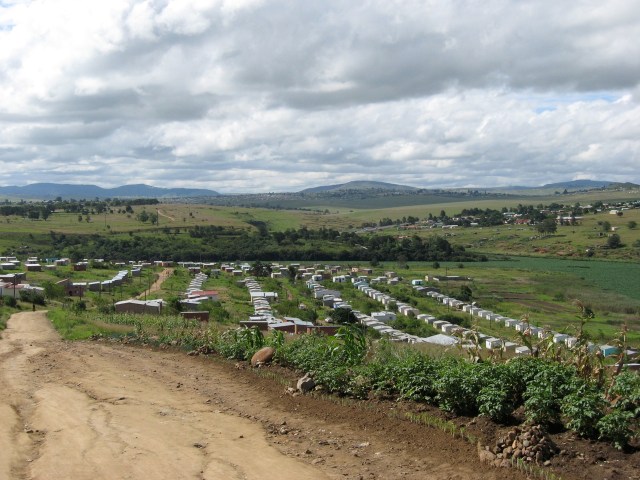
Meanwhile, the post-apartheid government has made strides toward building housing for people who live in places like Itipini. These are the neighbourhoods of what I have heard called “Mandela mansions”—what we in the U.S. would call “the projects.” There are three such neighbourhoods in Mthatha and one is often called “Waterfall” because it is close to a dam on the Mthatha River. The housing is often quite good—cinder block, running water nearby, a patch of ground that can support a garden. It looks like this.

But there are numerous problems with these neighbourhoods. First, there simply aren’t enough. Many people who once lived in Itipini have been moved to these new neighbourhoods but many people remain on never-ending waiting lists. Second, these neighbourhoods are on the edge of town (that’s where the open land is). But to work in Mthatha’s informal economy you have to be in the city centre. That can mean a bus fare of a dollar or two each way into town just to keep making that dollar or two a day you were making before. In that situation, it can seem sensible to stay in a place like Itipini, within walking distance of town. Third, the growth of these new neighbourhoods has not been accompanied by a similar expansion of government services. If you need a clinic, a school, a police station, whatever, you have to trek a very long way. The Itipini clinic made the decision to continue to treat people who had once lived in Itipini but had since been moved away. That includes people from Waterfall.

All of this is some context for the events of recent weeks. It helps explain why Itipini is called an “informal settlement”: the government has an “informal” relationship with the people and would prefer they didn’t exist. Itipini detracts from the idea that the government is making progress with its neighbourhoods of Mandela mansions. Technically, the people of Itipini are squatters on municipal land. But since there is really no other place for them to go, the government looks the other way and lets them alone.

The existence of a place like Itipini is a testament to the fact that South Africa’s socio-economic problems are complicated and not easily soluble. For every person that is moved out of Itipini, another person from the rural areas comes to Mthatha looking for work and winds up in Itipini. People in Itipini can’t simply be “sent home” to their rural village because Mthatha is their home. Unless there is economic opportunity in these new neighbourhoods—or jobs in the formal economy—people will continue to want to live close to where the action is.

The situation as I’ve described it is not unique to Itipini, of course. There are one or two other informal settlements in Mthatha (none built on garbage dumps and none quite as large) and there are hundreds more around the country, all created by similar dynamics that cannot simply be solved by building lots of new housing—though lots of new housing would definitely help.

So that’s the context… in the next post, I’ll think about how this context informs the events of the past few weeks and months.

UPDATE: The second post in this series has been posted.

Itipini BULLDOZED

Last Thursday, the shantytown community in South Africa in which I used to work—the place I wrote a book about—was demolished.

You can read an account from one of my successors, Karen.

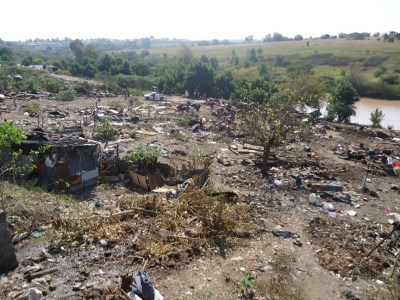
There are many factors at work here, many complicated, and I’m still trying to untangle all of them. For now, though, consider this picture I took in 2007.

Now consider this picture of the same place Karen took the other day.

Have a look at this image of a woman I knew well when I worked in Itipini.

Look at this one taken by Karen of the same woman with all her belongings.

Whatever the reasons, whatever the intent, whatever the plan, the impact of this move is absolutely devastating. It is a man-made disaster.

Please pray for the residents of Itipini. Details to follow as I track them down.

UPDATE: My two part (part one and part two) account of some of the background to this is now online. For more background on Itipini, you can read the first two chapters of my book on Itipini for free on Amazon.

“I don’t understand what happens!”

I once heard a story about an older woman who reprimanded her priest for giving communion to young children. “Father,” she said, “you can’t give them communion. They don’t understand what happens!”

To which the priest replied: “Mrs. McGuillecudy, I don’t understand what happens!”

I think of that story often as I read about—and participate in—the conversation in the Episcopal Church about the relationship between communion and baptism.

Brand new review of Grace at the Garbage Dump

Pastor Julia at RevGalBlogPals has a new review of my book Grace at the Garbage Dump:

I highly recommend Grace at the Garbage Dump for your personal reading, if not for your church book club or any Christian education class from high school and up. In particular, if you are in a denomination that talks about the conservatism of the churches in Africa, this book is for you and yours. What does it mean to be the body of Christ with limbs across the world? A body with limbs that are dying from AIDS, TB, and malnutrition? A body that is schizophrenic about social issues and divides against itself? We cannot undo that we have been made one in Christ because it was not our doing. Thus, we are God’s mission- a mission of relationship and reconciliation. The goal of that mission for us, according to Zink, is to learn to spot grace. Everywhere. Even at the dump.

Read the whole thing.

Have you bought your copy yet? If you’re looking for multiple copies for your book discussion group at church or elsewhere, contact the publisher directly for discounts on larger orders. They’re very helpful and friendly!

Don’t forget: if you want to read the first two chapters for free, you can do so on Amazon. Also, if you want a complimentary review copy for your electronic or media publication, contact James Stock at the publisher—james [at] wipfandstock [dot] com. Or, let me know, and I can set you up.