Is the ground shifting under ACNA?

Change is afoot in the Anglican world—and already its effects are beginning to be felt.

There’s a new archbishop of Canterbury, of course, who will be formally seated in his new cathedral on Thursday. Rowan Williams was a convenient whipping boy for breakaway American Anglicans. (This is the group that has left the Episcopal Church and affiliated with various overseas provinces. Many are now grouped under the Anglican Church in North America [ACNA].) They bemoaned his alleged liberalism and chastised him for not going after “apostate” liberals more forcefully and chucking them out of the Communion.

But Justin Welby is not so easy to pigeonhole. For one thing, he’s no liberal. His public statements on sexuality-related issues, for instance, have been entirely in keeping with what ACNA Anglicans say they’ve wanted to hear from Lambeth. He comes from the centre of contemporary Anglican evangelicalism, Holy Trinity Brompton.

Yet already he’s causing ACNA Anglicans to have fits. Welby’s early statements have been all about reconciliation, a profoundly Biblical concept—and ACNA Anglicans have busily set about redefining reconciliation and downplaying its significance. A less Biblical move I cannot think of. Welby gave a major stage to the deeply holy relationship between Tory Baucum and Shannon Johnston—and GAFCON Anglicans apparently put tremendous pressure on Baucum that he had to contort his own rhetoric to end the relationship. No matter the surface justifications, this is not the move of a strong organization.

But the potentially more significant change is taking place in Rome. Anglicans don’t always like to admit it but Rome has always had huge influence on Anglicanism—things we adopt usually start there first. The stature of the pope is such that we can’t avoid the effects of what he does. ACNA Anglicans relied on Pope Benedict as a handy backstop. In his opposition to same-sex marriage, say, and his theological acumen, these Anglicans could—and did—say, “See, there’s the kind of leader we need to have—bold and orthodox.” They trumpeted their meetings with him.

Francis has only been pope for a few days but already things seem different. He talks about the poor, for one thing—a lot. There’s a hint that he was once open to blessing same sex relationships. Most significantly—and the thing I have found most appealing about him—he takes himself with a kind of holy lightness, one thing that has been in short supply in the church (of any communion) in recent years. He looks like he’s having fun.

It is way too early to say anything with any certainty but two of the verities that ACNA Anglicans have relied on in recent years—a “weak”, “liberal” leader at Lambeth and a backstop in Rome—are quickly changing. These breakaway Anglican groups have lots of money and lots of time to come up with new ways to make their case and I have no doubt they will. But the fact that they are scrambling is significant.

I don’t wish ACNA ill and I make these comments with no value judgment. But I do wish for a new narrative in Anglican relations, one that is a little more accurate, interesting, and fruitful. Change is coming. Let us hope it move us closer to reality.

“Ambassadors for Christ”

Reconciliation is at the core of the good news of Jesus Christ:

“So if anyone is in Christ, there is a new creation: everything old has passed away; see, everything has become new! All this is from God, who reconciled us to himself through Christ, and has given us the ministry of reconciliation; that is, in Christ God was reconciling the world to himself, not counting their trespasses against them, and entrusting the message of reconciliation to us.” (2 Cor. 5:17-19)

The Old Testament tells the story, in part, of the estrangement of God’s people from God. Instead of dusting his hands of them, God instead commits to God’s people in a whole new way in the Incarnation of Christ. The life, death, and resurrection of Christ reconciles the divide between God and God’s people and entrusts that message to the community of the baptized, to share it as widely as we can.

To that end, it’s encouraging to see that the Archbishop of Canterbury, Justin Welby, has appointed David Porter as his Director of Reconciliation. David Porter comes from Coventry Cathedral, a place that has made itself a centre for the ministry of reconciliation.

Coventry Cathedral was destroyed by an air raid during World War II.IMG_5208

On the morning after the bombing, the then-dean had a cross made out of the burned timbers and inscribed “Father Forgive” on the altar.IMG_5202

This, in turn, led to the creation of the Community of the Cross of Nails and the cathedral’s reconciliation work. Justin Welby knows about this, because he used to work there.

I had a chance to meet David Porter on my visit to Coventry and he is an inspiring person: direct, funny, honest, forthright, holy, and deeply committed to spanning seemingly unbridgeable gulfs. His background is in the peace process in Northern Ireland but since going to work at Coventry he’s been involved in a number of places around the world.

Creating this position is a no-brainer, really, and David Porter is an excellent person to fill the role.

UPDATE: David Porter has written a reflection on his new position on his personal blog.

Thomas Bray’s unfinished project

About eighteen months ago, I spent some time at a seminary in Nigeria. Shortly after having a contentious conversation with a group of students’ wives about homosexuality, I peeked into the library. This is what I saw:IMG_1774

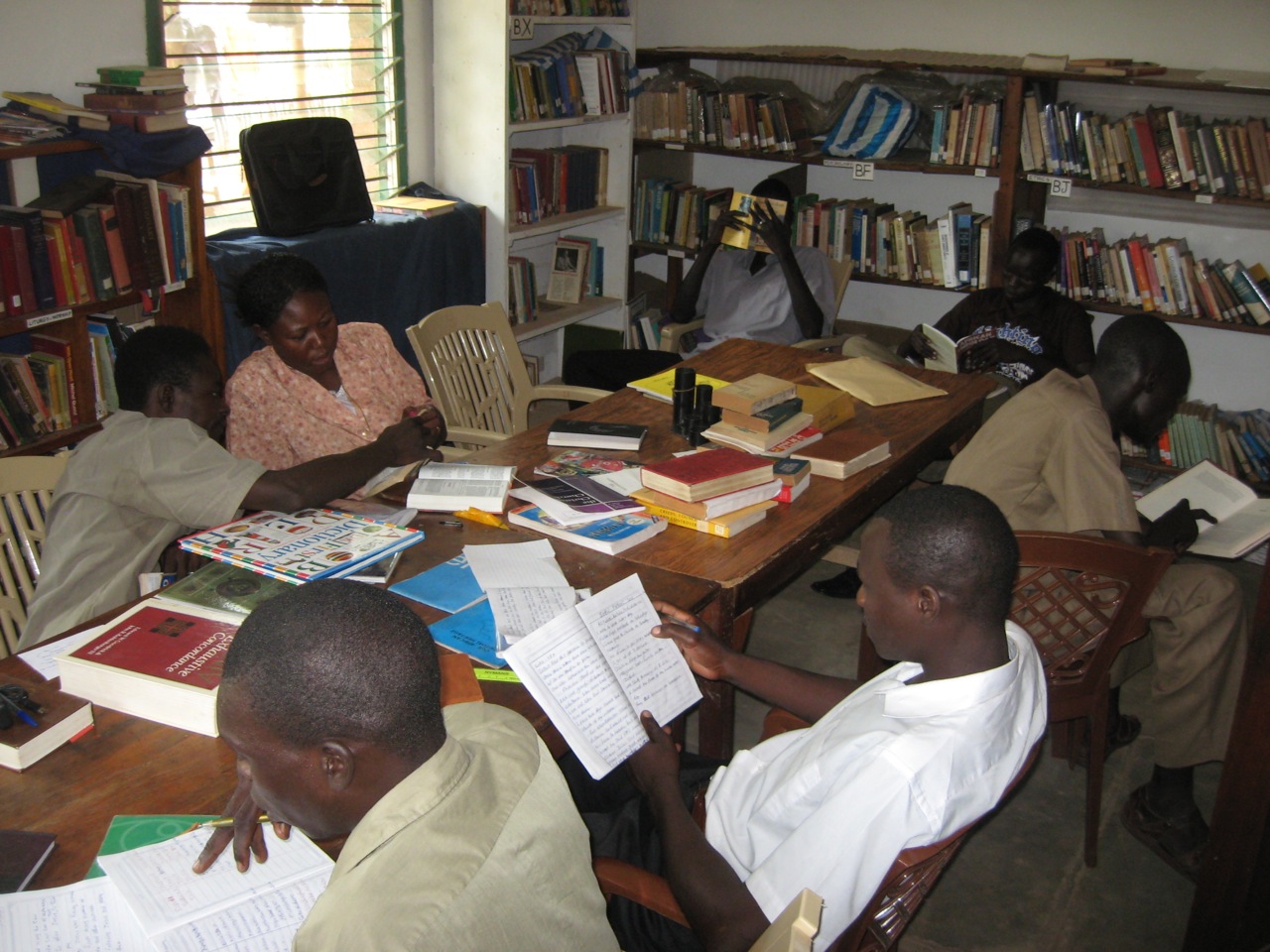
I’ve also spent time at a seminary in South Sudan. There, I also found a lot of people who found homosexuality to be difficult to reconcile with Christianity. Their library looked like this:IMG_2652

At Yale, where I went to school, I had access—literally—to millions of volumes and all the latest scholarship. At both these seminaries, the books are relatively few and are overwhelmingly old: there were few that were less than thirty years old. Yet at both places, I found students who were eager to read whatever they could get their hands on.

Think about where theology and the church were thirty years ago on the question of homosexuality. In that context, is it any wonder that we have such sharp disagreements on these issues?

The church commemorated last week Thomas Bray, a seventeenth century priest, who was instrumental in founding the Society for Promoting Christian Knowledge (SPCK.) (He was also involved in founding the Society for the Propagation of the Gospel, which was instrumental in bringing the church to the American colonies.)

Bray’s idea in founding SPCK was that Christians should have access to Christian scholarship and literature. He envisioned libraries in churches and an educated clergy. SPCK helped start some of the first libraries in the American colonies that focused on church-related material.

When we look at these libraries in places like Nigeria and South Sudan, we are reminded that Bray’s work is not yet done. There are really important insights of the last generation that have not been shared yet with our sisters and brothers around the world, and not just on questions of sexuality. (The Anglican Theological Review’s Seminaries Abroad Gift program is one very small way in which this work is being done.)

The commemoration of Thomas Bray is an opportunity to reflect on a visionary Anglican. But more importantly, it’s a chance to reflect on the vital need to continue his important work.

A Carbon Fast for Lent

Received in e-mail from the Anglican Communion Environmental Network

Thursday, January 31, 2013

JUST IN TIME FOR LENT: CARBON FAST BRINGS ENVIRONMENTAL REALITIES TO LIFE

Lent is a time of repentance and fasting, of turning away from all that is counter to God’s will and purposes for his world and all who live in it. This year, Anglicans and all local faith communities are invited to focus on Lenten ‘acts of love and sacrifice’ (of which our Ash Wednesday speaks) on our contribution to climate change, and those most impacted by it.

To each of the “forty days” a specific action is prescribed which educates the participant and provides a significant action affecting creation positively. Originally developed by Tearfund, the programme has been re-configured by Rachel Mash of the Province of Southern Africa and is distributed through the ACEN and ACSA.

The fast builds on traditional Lenten practices where we give something up, such as chocolate or alcohol. The Carbon Fast asks participants to focus on giving up (or making changes to your lifestyle), to reduce your ‘carbon footprint’ – your total impact of environmentally damaging greenhouse gas emissions, usually measured in carbon dioxide equivalent, hence the name.

A traditional Lenten observance is ‘Fish on Fridays’. Why not also have a ‘Meat-free Monday’ – or some other day, if on Mondays you usually eat Sunday’s leftovers? Did you know that ‘a kilogram of steak could be responsible for as many greenhouse gases as driving a car for three hours while leaving all the lights on at home’ (D Fanelli, New Scientist, 2007, 2613:15)?

Participants can record experiences at a blog www.carbonfast2013.wordpress.com which will be available from Ash Wednesday through to Easter Sunday.

For more information contact:
Rachel Mash at mashr@ctdiocese.org.za.
Ken Gray rector@colwoodanglican.ca

Resource materials for the fast, suitable for posting in your parish or sharing with the congregation, are posted here.

What about when we don’t “do justice, love kindness, and walk humbly with your God”?

A particular verse from the prophet Micah—chapter 6, verse 8—has long been a favourite of many Christians. “What does the Lord require of you but to do justice, and to love kindness, and to walk humbly with your God?” It even got a shout-out from Episcopal priest Luis Leon in his benediction at President Obama’s inauguration. It seems to summarize what many people believe about the life of faith.

The trouble is, of course, that there are many parts of the world where justice, kindness, and humility—along with a lot of other wonderful virtues—are not in great abundance.

One of these places is Sri Lanka. Since the end of its civil war in 2009, a single family of brothers has managed to consolidate its grasp on the levers of state power. Recently, the chief justice was impeached and removed from office. So much for justice, when it’s clear that the courts are firmly under the thumb of the president. A friend of mine involved in the church in Sri Lanka e-mailed to say, “Our situation is quite tense just now as people live in fear and anger and the Regime grows more suspicious and unpredictable. We need the prayers of all.” The church has been actively involved in this situation, in part by opposing the impeachment.

But I was struck by the recent pastoral letter of the Bishop of Colombo. In it, he denounces the current situation and writes, “We no longer appear to be a constitutional democracy.” But the action he calls for is not what you might expect. He calls for the church to repent:

This is a time for us as a Church to take an honest look at ourselves, where we have shamelessly compromised our loyalty to God. We need to repent of ways in which we, as individuals as well as collectively, have;

  • been silent when we should have spoken
  • allowed ourselves (thoughtlessly or out of fear) to be used by those in authority to speak lies or commit wrong and unjust acts
  • consciously received benefits for ourselves through acts of injustice committed against others

I as your Bishop, call the Church to a period of lament together for the terrible state of our nation today, and repentance for our failing as a Church to “love mercy, to seek justice and to walk humbly with the Lord” (Micah 6:8).

While reading this letter, I was reminded how Jesus’ ministry began with the call to repentance. It is very easy to long for change in the world and to demand that other people change. But that is not what Jesus begins with. Jesus begins with our own transformation. The message of the Gospel seems to be, “Change is going to come. Let it begin with me.”

I’m all for doing justice, loving kindness, and walking humbly with God. But I also know that simply stating that again and again won’t make it happen. What will make it happen, though, is turning again (the meaning of the word “repent”) in our weakness and imperfection to the overflowing love of God in Christ and allowing ourselves to be transformed in that encounter to be agents of the new reality God longs for us to live in.

The Bishop of Colombo has called for this Sunday, 3 February, to be a Day of Lament in the churches of the diocese. Perhaps we can join our sisters and brothers in Sri Lanka in prayer that day, as we pray for transformation in that country, but most of all within ourselves.

The “threat” of the “new churches”

The Anglican province of West Africa has recently reorganized itself, and has a new archbishop and primate, Solomon Tilewa Johnson. In an interview, he identified two challenges for the church: poverty and “new churches.”

The Archbishop was referring to the fact that traditional Churches on the continent of Africa have been increasingly concerned about losing particularly younger worshippers to newer, more charismatic Churches, or losing them from church altogether.

The author of the article in the Anglican Communion News Service subtly opined that this latter threat was “surprising.” But if you’ve been reading this blog, you’ll know it’s not.

After a trip to Nigeria 18 months ago, I asked, “What is Peter Akinola afraid of?” I saw, in my travels, the incredible growth of neo-Pentecostal churches and the way in which the growth of those churches threatened established denominations (Anglicanism chief among them) and made Anglicans become more like Pentecostals in theology, worship practice, approach to Scripture, and much else.

I returned from that trip, thought some more about it, and wrote a paper in which I argued that the Pentecostal explosion and its influence on Anglicans was one of the most under-reported stories in the Anglican Communion. That paper (which is a lot longer than a blog post) was published in the Journal of Anglican Studies, but is available for free online.

So I appreciate the frankness and honesty with which Archbishop Johnson raises the issue. It is clearly one that needs thoughtful reflection and consideration—what does it mean to be Anglican? Is the church designed to give people what they want or challenge them with a new way of living?—and it is encouraging to see a leader addressing the issue so openly.

UPDATE, 27 March 2013: This post is attracting quite a lot of attention lately, which is great. If you’re interested in reading my article in the Journal of Anglican Studies about “Anglocostalism,” you can find it by clicking here.

Facing your failure and living with difference: why I give thanks for Rowan Williams’ tenure as archbishop of Canterbury

Two years before he was appointed archbishop of Canterbury, Rowan Williams wrote

I long for the Church to be more truly itself…. Yet I must also learn to live in and attend to the reality of the Church as it is, to do the prosaic things that can and must be done now and to work at my relations now with the people who will not listen to me or those like me—because what God asks of me is not to live in the ideal future but to live with honesty and attentiveness in the present. (Christ on Trial, pp. 85-86)

As of today, Williams is no longer archbishop. For many in the church (including Williams himself, I imagine), this is a cause for relief. His tenure is viewed as a disappointment by liberals, who think he betrayed them and his own views by his actions in office, and by conservatives, who think he didn’t go far enough in using the powers of his office. The general public sees him as a figure who made (apparently) impolitic remarks on sharia and failed to get General Synod to pass legislation allowing for women to be bishops.

But before he fades much further into the past, I think it’s worth taking the time to give thanks for Williams’ tenure in Canterbury. And the place to start is with this quotation, which could serve as a programmatic statement for his tenure. On the one hand, Williams is saying, there is a vision of the church he aspires to and which he longs to see realized. On the other hand, he recognizes that the reality of the church is such that any one person’s understanding of it is insufficient. Elsewhere, he was written

Believing in the Church is really believing in the unique gift of the other that God has given you to live with. (Tokens of Trust, p. 106)

The fact that—try as we might—we cannot create a church of people who think like we do is central to Williams’ understanding of what the church is to be and do. As a leader in that church, Williams’ tenure has been about reminding us of that reality. Given the divisiveness and polarization that so mark and mar our politics (ecclesial and otherwise) these days, that reminder is both prophetic and timely.

In his closing address at the 2009 Anglican Consultative Council meeting, Williams told delegates:

the Gospel seems to be saying to us: first face your failure; your failure, not your neighbour’s; your failure, your turning away; not theirs, not his, not hers; then ask how can it be made glorious? ….But perhaps, just perhaps, thinking about those potentially glorious failures, opens us out onto the prayer that turns us back to Christ-like self-giving that lets the glory through. That’s what we hope for in our fellowship, our very fragile, very flawed, very precarious Anglican fellowship.

Repentance has always been a theme of Williams’ theology and it is something he has held up before Anglicans—often to their derision. Who, after all, wants to talk about their failures? There are many reasons why I think this is important to emphasize but I’ll note just one here: Williams reminds us that we are human and that means fallible, imperfect, and incomplete. That sounds obvious but it’s something that is frequently elided in this world of ours that puts so much focus on accomplishment—in the church and otherwise.

Williams’ tenure was not perfect. He made many mistakes. But his deeply-held theological convictions have issued in a profoundly human and profoundly humble leadership—even when it has led to his humiliation, as it has, repeatedly—that I have found refreshing and honest in this day and age, and which I shall miss.

“The authority of God’s word written over all contexts”?

For a variety of reasons, I’ve been thinking a lot recently about my travels a year ago to visit with Anglicans in Nigeria. Readers of this blog might remember I encountered a curious practice. At major church events, there was the practice of “appreciation”: members of the congregation stood up, donated money to the church, and said exactly how much they were giving. (You can read my description of that event here.)

As I witnessed this, I thought about Jesus’ instruction on giving in the Sermon on the Mount:  “When you give alms, do not let your left hand know what your right hand is doing so that your alms may be done in secret; and your father who sees in secret will reward you.” (Matthew 6:3-4, NRSV) I mentioned this verse to several people I encountered at this service. They readily admitted the practice did not conform to the teaching but shrugged and said, “It’s our culture.”

We can debate the merits of public giving in another post. For the record, in a culture that has a huge problem with corruption, I’m open to the idea that disregarding Christ’s teaching on this count might be a reasonable accommodation to make to Nigerian culture.

I just wish Nigerian church leaders would cut the rest of us some slack. The Nigerian and Kenyan delegates to the recently-concluded Anglican Consultative Council meeting in New Zealand have released a reflection document titled “What really happened in Auckland NZ at ACC-15.” I think there are some important points in here but I was disappointed to see the strong emphasis on the apparent un-Biblicism of many Anglicans. To wit:

While there were many reports and resolutions at ACC-15, we wish to highlight our concerns over the report and the resolution on “The Bible in the Life of the Church” project…. However, we are seriously concerned that the context in which people interpret the Bible is considered as important as what the Bible actually says.

The Bible stands over context, not the context over the Bible. God’s Word changes us—we do not change God’s Word….

We call upon all Anglicans to pray that our beloved Communion will stand firm in honouring the unique and universal Lordship of Jesus Christ as the Son Of God, and the authority of God’s Word written over all contexts, and in every matter of faith and practice.

I have no doubt of the sincerity behind this statement and the strong belief in the supremacy of the Bible. I just think that a more productive place from which to begin conversations about the life of the Bible in the Anglican Communion is to acknowledge that all of us—whatever our cultural background or context—fall short in allowing ourselves to be transformed by the revelation of Jesus Christ as entrusted to us in the Bible. Surely from that point of common ground, we can begin to make progress in our inter-Anglican conversations?

“This is a time for optimism and faith in the church”

So it’s official. Justin Welby, the Bishop of Durham, will be the next Archbishop of Canterbury.

His first press conference was fascinating and, I thought, quite impressive. He expressed his hope for the future of the church—as I’ve quoted in the title of this post—and answered questions (at least the ones I saw before the BBC cut away) with skill. The friends I have in the Diocese of Durham speak very highly of him.

Three things I appreciated about what I saw of his introduction:

  • He wants the church “to be a place where we can disagree in love.” I so strongly share this view and it was so encouraging to hear him highlight it.
  • He is “always averse to the language of exclusion when what we are called is to love in the way Jesus love us.” He challenged himself to listen to the experiences of those he does not know about, referring especially to the LGBT community here. Just wait until the conservative Anglican polemicists jump on him for this. I hope he ignores them.
  • His pectoral cross is (and I believe I’m correct about this) the Cross of Nails from Coventry Cathedral. This is a symbol of the powerful reconciliation work that has emerged from that cathedral since it was destroyed in World War II and which Welby was involved with before becoming Dean of Liverpool. Reconciliation is at the heart of the Gospel and I’m encouraged he has been so involved with this work in its many forms.

As I’ve written, I think Welby’s appointment could be a moment when Anglicans begin to move beyond (but not resolve) the battles of the last decade or more, given his apparent credibility with evangelicals and the church in Nigeria.

The response to his appointment so far seems to have been fairly positive. I take that as good news and as a hopeful sign for Anglicans around the world.

For now, however, Welby goes back to Durham until the end of the year and the fevered speculation can come to a rest. We’ll have to wait until March 21 and his installation to see how all this unfolds.

A Nixon goes to China moment for Anglicans

Sometimes in life, to really make progress, you need to have someone do the unexpected. Richard Nixon’s visit to China was one such moment. A man with an uncompromising stance towards communism was the one who changed the nature of relations between the United States and China. It took a Democratic president, Bill Clinton, to sign welfare reform into law. In order for change to happen and for it to really “stick”, you need someone who comes from the opposing view but has been brought around to a new view. It is these moments that mark the change as permanent.

The conflict over sexuality in the Anglican Communion has thus far pitted two (at least) sides firmly against one another, with each trying to gain the upper hand. On one level, this is fine; it’s how democracy, ecclesial or otherwise, works.

But I’ve been thinking lately that for true progress to really stick—and for Anglicans to move forward—it’s going to take something more. In that regard, Rowan Williams was never the right person to make progress on this issue. Whatever his merits as archbishop and as a theologian—and I believe they are many—he was always too identified with the “liberal” group to be trusted on this issue.

There are hints that Williams’ successor will be Justin Welby, the Bishop of Durham, and a man who, from what I can gather, was heavily influenced by Holy Trinity Brompton, a church at the heart of Anglican evangelicalism, and who has worked closely with the Nigerian Anglican Church. Yet there are tantalizing hints that his views on sexuality questions are more nuanced and complex than that traditionally associated with conservative evangelicals or Nigerian Anglicanism.

Perhaps Welby is the person who will be able to move Anglicans beyond the trauma of the last many years. I don’t know quite what it will look like but I am coming to believe that it is only a person with “conservative” bona fides who will be able to help Anglicans move past this issue and onto the many other pressing issues we face.

I can dream, can’t I?