How is Yale different to South Africa?

In the ongoing question I pose yet again in the title of this post, I have two new answers.

First, there is much more routine at Yale. I have a datebook now; I definitely did not have one in South Africa. There were no dates to keep there; everything just sort of… happened. I go to a lot more meetings of committees here. There were no committees in Itipini, praise be.

One result of this is that the time line of life here seems really strange to me. In South Africa, we knew we would never see the Kingdom of God on earth but we kept working away each day at different variations of the same problems – alcoholism, neglect, illness, etc. – knowing we would never solve everything but finding joy in what we could do and learning from when we failed. If we didn’t finish a task today, there was always tomorrow that would be largely the same as today.

At Yale, there are deadlines. Everyone works really hard preparing for midterms or papers and then when they are past, they can be completely forgotten. Each task looms large in the mind as it approaches; when it passes, it is as if it never happened and you can lose sight of how it fits into the larger picture. Life is a lot more segmented here.

(Regular readers of my blog in South Africa will know I once had a less laudatory take on the lack of routine in South Africa.)

In South Africa, when I was struggling through the Xhosa language barrier, I thought many times, “I wish we could speak English – that would be so much easier and I would understand so much more!” And that’s been true. It has been easier and I do understand so much more.

BUT… it’s not always clear that understanding more is really worth it. Sometimes – and I say this with advance apologies to my new New Haven friends who read this blog – our conversations are kind of, well, you know, boring. (I’m as much at fault for this as anyone else.) In South Africa, when I did manage to communicate with someone, it often felt pretty meaningful because we didn’t waste energy on boring stuff. Here, there’s no filter for quality control. Sometimes I wish there was.

If the wistful tone of this post doesn’t make it clear, I miss my life in South Africa.
It turns out YouTube is a great pedagogical resource at Yale Divinity School

A while back I posted a video we watched in my liturgics class. (I ended up dropping that class but whatever.)

Today, in my Patristics class (formally titled “History of Christian Theology to 451”), we watched snippets of these two videos about the Toronto Blessing, something I had never heard of before.

It was a lead-in to our discussion about Montanism, a heresy that began in the second century, and involved prophetic figures who believed the Holy Spirit spoke directly through them.

The parallels are fascinating. One reason the church at the time rejected Montanism was because it undercut the church’s claim on authority (Apostolic succession? Who cares!) and emphasized the role of the Holy Spirit perhaps a bit too much for a church that was still struggling to figure out just what it thought about God the Father and God the Son.

It turns out the Toronto Blessing types got too much for their Vineyard leaders. Wikipedia tells us: “In 1995, the Airport church was released from affiliation with the Vineyard movement. The reasons for the disaffiliation were for growing tension over the church’s emphasis on extraordinary manifestations of the Holy Spirit and the Vineyard leadership’s inability to exercise oversight over the revival.”

I take two lessons from this: the established church never likes letting the Holy Spirit get out of hand and it turns out Patristics is relevant after all!

What do you leave behind?

There’s a short piece in Sunday’s New York Times Magazine that captures the feeling I get in the pit of my stomach when I look back over my time in South Africa:

Patrick began coming to class. Like a matchmaker, I helped him find books he might like. When he read, he laughed out loud. And reading made him want to write. It was painful, at times, to watch Patrick write, because half of what he wrote he erased. Every word that let him down he viewed as a personal failure — he wrote like a writer. I took away his pencil and gave him a pen.

His progress made me happy. By the spring, Patrick’s reading had jumped two levels. At a school ceremony, he won the award for “Most Improved.” He looked surprised. Sheepishly, he walked up to the stage. He turned to the students, who were still clapping, and then, suddenly, he raised both arms up in the air: a victory pose. Everybody laughed.

It was some two and a half years later, when I was at law school in the Northeast, that I learned Patrick was arrested for stabbing and killing someone….

I haven’t been able to resist guilty feelings over Patrick. What if I’d stayed? And I’ve wondered if my sense of Patrick was faulty; whether I saw only the parts I wanted to see. But isn’t any teacher who tries to bring out the best in her students inclined to see them in the warmest light?

What happens when you leave and can’t give the kind of close support and attention that may have been the only thing responsible for any kind of “success” you had? What happens when you just pick up and leave?

Something else I miss…

…adrenalin.

My life in New Haven has taken on a distinctly plodding style – chapel at the same time every day; classes in the same place every week; meals at the same time.

It’s a far cry from the free-flowing lifestyle that defied planning ahead in South Africa. That uncertainty and unknowingness, I realize, now was a big reason I loved daily life in South Africa and looked forward to it so much. (It’s also a big reason I got so frustrated by it.)

Life in New Haven is also a far cry from the life I lived in Alaska, where each day brought new news stories and new ambulance calls, all springing up out of my control.

So this new life comes as a bit of a shock. I have a date book! That means I can plan far enough into the future to make plans with people to do things. I could never do that in South Africa.

About the only adrenalin I get these days comes from dodging traffic on my bike.

Sailing the ocean blue

During the orientation in August, I won a karaoke contest. (“Bohemian Rhapsody” and “Ice Ice Baby” since I know you’ll want to know). The prize was a sailing trip with the dean of the divinity school and I cashed that in on Sunday.

Here’s the good news: it was a gorgeous late summer day – not a cloud in sight, warm, smooth seas.

Here’s the bad news: there was no wind!

But that didn’t matter. We motored around Long Island Sound, discussing the finer points of New Testament exegesis…or something like that. It was a literal three-hour tour. That’s a lot of exegesis!

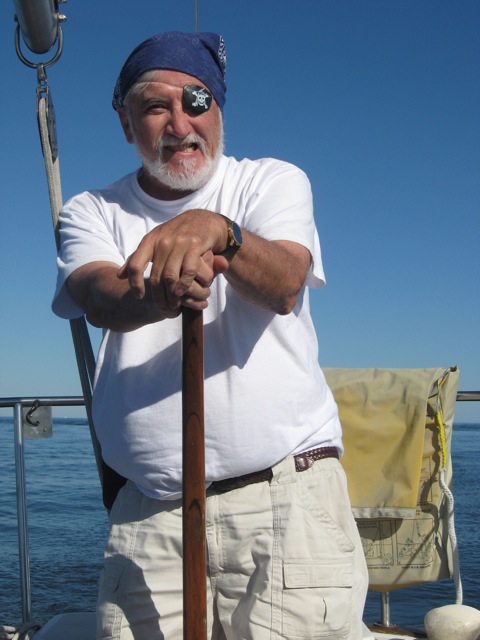
I had hunted the night before for the perfect attire to complement the trip. I even convinced the dean to wear it out on the water, resulting in what I believe is one of the finest pictures I have ever taken.IMG_1561(By the way, I am intentionally not using his name in this post so that this picture won’t eventually show up on Google Images attached to him. I’m not sure what the Society of Biblical Literature would think.)

IMG_1562(“Ahoy, me matey – there’s the Big Apple”… or something. Actually, we sailed east not west.)

Our dean edited the HarperCollins Study Bible we use in class. My classmate who had also been triumphant at karaoke decided it would be a good idea to have him autograph the book. (After all, who else would you get to autograph your Bible?) So I take away not only the memories and the pictures but a Bible inscribed by its author, er, editor.

The Super Bowl of Church Services

On Saturday, I drove down to Long Island for the consecration of the new bishop of that diocese. This alone was fantastic. For so many years in Alaska and South Africa, I’ve heard about events – weddings, primarily – that have gone on and I haven’t been able to attend because I’ve been so far away. Now, when something big happens, I can actually be a part of it.

The new bishop is Larry Provenzano, formerly of the Diocese of Western Massachusetts. I worked with his children at summer camp and he was frequently a chaplain there. I like the idea of Bishop Larry. I think he looks good in purple.

The consecration of a bishop is kind of like the Super Bowl of church services for Episcopalians, I decided. There were about 2500 people in the concert hall – that’s a lot for us Episcopalians – and there was a clear buzz of excitement. There were at least 20 bishops on hand, including the Presiding Bishop herself. What most impressed me was the diversity of the congregation – African-American, Asian, Latino, white, and probably others I missed. That’s not always true of the Episcopal churches I’m familiar with.

The service was about two and a half hours long. That’s nothing for my South African trained self. The initial procession took about 20 minutes and four hymns.IMG_1518The presentation before the other bishops.

IMG_1530The magic moment. That’s a lot of bishops!
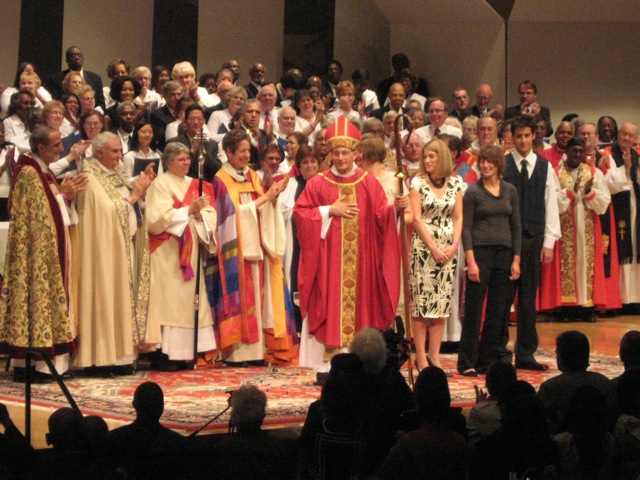
IMG_1537The new bishop gets a long ovation from his new diocese.

IMG_1545Larry has for a long time been a fire chaplain.
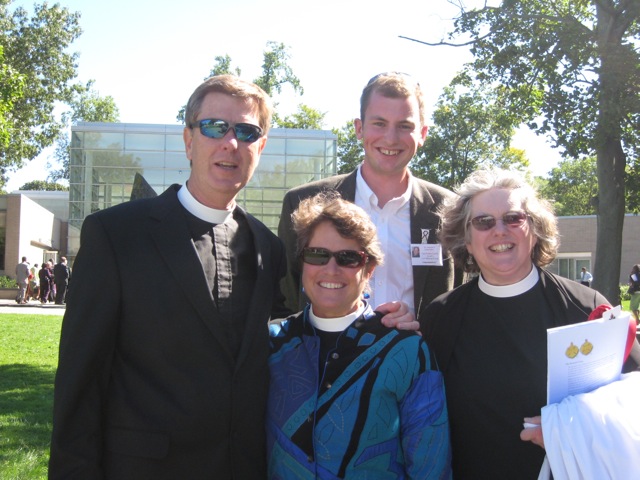
IMG_1548With some other former camp chaplains on hand for the occasion.
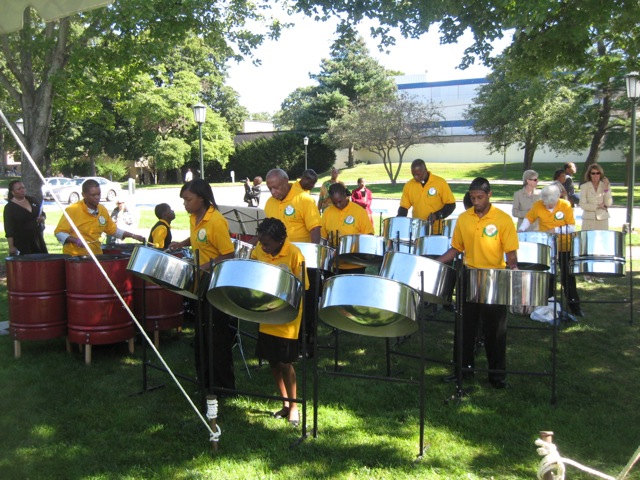
IMG_1550There need to be more steel bands at Episcopal events, especially ones with priests playing in them. Note the white-haired woman in the last row. She was my favourite.

I like it when I get excited when I go to church. Wouldn’t it be great if it happened more often?

In the news

There’s a lengthy article on the front page of the New York Times today about how the education system in South Africa is failing:

Thousands of schools across South Africa are bursting with students who dream of being the accountants, engineers and doctors this country desperately needs, but the education system is often failing the very children depending on it most to escape poverty.

Post-apartheid South Africa is at grave risk of producing what one veteran commentator has called another lost generation, entrenching the racial and class divide rather than bridging it. Half the students never make it to 12th grade. Many who finish at rural and township schools are so ill educated that they qualify for little but menial labor or the ranks of the jobless, fueling the nation’s daunting rates of unemployment and crime.

I was pleased to see such an important topic receive such attention. There really are students who do dream big dreams and want to change their world. I know some of them. And then you look at their school and wonder how the dream will ever become a reality.

But, based on my experience interacting with the South African education system, the article omits at least two important considerations.

The first is the school fees that students still have to pay – especially at the secondary level – that make it impossible for many students even to access the education, no matter its quality. This continues to be true despite the government’s putative commitment to “fee-free” education.

The second is the language barrier. South Africa has 11 official languages but most of the resources and exams are in English. That is a substantial obstacle to students who are raised in, say, a household where Xhosa is the first language and whose parents know so little English they are unable to reinforce the education at home, even if they wanted to. You may know all the math skills you need to pass the test but if you’re incapable of demonstrating that knowledge on an English-language test you fail.

Back in the land of the doing

Regular readings of my former blog will know well my obsession with the distinction between being and doing. A central insight I gained while in South Africa is that who I am will always matter far more than what I can do. That was immensely helpful when I was struggling with the language and culture barriers in Itipini.

Indeed, I find I have internalized this message so much that I have almost a visceral reaction when I hear the word “do” and its cognates – deed, did, done, work, task, etc. I am immediately suspicious when people talk about “doing the work of the Lord.”

But it’s true that I am firmly back in the land of the doing. People at Yale measure themselves by what they have done, can do, or will do. “Did you do all that reading last night?” is a common first question when you see someone in the morning.

I am struggling with how to respond. Obviously, I want and need to do all that stuff as well. I am here to read and do all the learning. But I don’t want to lose hold of that insight I gained in South Africa.

Additionally, I want to be able to share what I’ve learned about being and doing with my classmates here, especially since I think it has a good deal to say to those who are planning on entering the ministry. But how do you bring it up? “Ummm… excuse me, but I think you’re focused a bit too much on doing.”

One way I have tried is to bring the topic up in conversation and in questions. At a session last week on securing funding for overseas mission trips, I asked, “How much do you have to do while you’re overseas to earn the money?” I acknowledged these organizations probably wouldn’t want to fund tourists but I also said how I thought the most effective mission work could be done simply by choosing to share an existence – being – with someone else. I got a reasonably good answer to the question.

Afterwords, someone came up to me and said, in what he thought was a jocular and jovial way, “Oh, I see, you just want to see how little work you can get away with and have a vacation somewhere nice.”

I guess there’s a long way still to go.

What do you miss?

When people ask me about South Africa, they occasionally ask something like, “What do you miss about South Africa?”

Here’s my partial list:

  • the people, obviously
  • in South Africa, I felt like I was closer to the centre of things, not in the sense that I was the centre of the attention (though my skin colour assured me of that) but in a broader sense that it was in places like Itipini that the truly important questions of faith, mission, and reconciliation are most profound.
  • I realize this now only in retrospect but I probably felt closer to Christ than at any other time in the past. If Jesus was alive today, I have a feeling he wouldn’t be spending his time at Yale Divinity School.
  • Despite all the many obstacles and frustrations, when everything “worked” in just the right way and something happened at least sort of as I wanted it to, the transcendent feeling of satisfaction I had was and is like nothing else I’ve ever experienced.
  • This last one was added yesterday morning when I went to a church in New Haven known for its high liturgy. It reminded me so much of the congregation I was a part of in South Africa that I felt a sort of “liturgical homesickness.” But I also like being able to understand the sermon.

There’s also a list of things I don’t miss – driving everywhere is one of them – but I’ll save that for another time.

“The four walls of my new freedom”

One thing Yale does not lack in is course offerings. There are scores of classes to pick from at the Divinity School and then scores more to pick from at the various schools and departments elsewhere in the university.

It can be easily overwhelming. There can be too much choice. Except for some broad distribution requirements, there are very few paths that a M.Div student must trod before graduation. He or she can feel like a kid in a candy store, limited only by the four or five courses we can take each term. I know this because I’ve heard it expressed by several of my fellow students.

For me, the story is a little different. Because I am doing both an M.Div and a Diploma in Anglican Studies and am also – simultaneously and confusingly – a student at Berkeley Divinity School, I have a fair bit more guidance. In fact, on the first day of orientation, we were given an advising customary that strongly recommended the four courses to take in our first term so that we can meet prerequisites for later courses and distribution requirements. My schedule isn’t quite set yet but it looks like I’ll be taking at least three of those four courses.

Usually, I resist such efforts to “meddle” in my choices. (Yes, I know it’s just the accumulated wisdom and advice of years of previous students, not meddling.) But this time I found it so liberating. While everyone else was obsessing about what courses to take, I was not. It was one possible stress-inducing factor that was happily lifted from my shoulders.

Thomas Merton in The Seven Storey Mountain writes about how when he arrived at his monastery for the first time, he found “the four walls of my new freedom.” I never understood what that meant – freedom? in a Trappist monastery? Now, thanks to this experience of choosing classes, I do.