In Abyei

So I made it to Abyei and back in one piece. But I’ve been delayed in writing about it by a combination of a lack of Internet access, lack of electricity, and blogger’s block. (But not writer’s block. An article I wrote about the visit is on Episcopal News Service.) Hopefully, you are a close follower of the situation in Sudan and know exactly why Abyei is significant. If not, here is a very brief summary.

Abyei is to Sudan like Kashmir is to India and Pakistan: a contested region that both sides want. You often see Abyei described as “oil rich” but this is not as true as it once was. The oil is mostly gone. But it is an incredibly fertile area that southerners and northerners want to graze their cattle and grow crops. In January, people in Abyei were supposed to vote to decide if they wanted to be with the south or north. That referendum never happened because no one could agree who was allowed to vote. In May of this year, northern troops and militias seized Abyei town, the major town in northern Abyei. That displaced a huge number of people, many of whom are now in Agok, the major town in southern Abyei. (Others are further south, including in Wau, creating more need there. The church with its limited resources has decided to focus on people actually in Abyei.)

There’s a river that divides Abyei region into two. We stayed on the south side of the river, where the refugees are and the northern army isn’t. But we had a Sudan People’s Liberation Army escort on our way into Agok because the road we were traveling on is closely watched by the south.

Ecclesiastically speaking, this is all part of the Episcopal Diocese of Aweil and is Bishop Abraham Nhial’s territory. Even had he wanted to go to Abyei town, he can’t. The bridge over the river was bombed by the northern army.

There are seven priests and three deacons (or nine priests and one deacon – I heard both) to serve the thirty-odd congregations in Abyei. I was driving in with two priests and occasionally one would point and say, “We have a church there.” He was pointing at large trees. The congregation meets underneath.

We also passed many burned out homes.

The villages we drove through felt eerily (a cliché adjective, I know, but true) empty. Everyone is seeking safety in the towns. Significantly, very few of the fields we passed have been planted. Too many people have fled, which means this planting season (there are two per year in South Sudan) has been missed, increasing the demand for food aid. The other notable part of the drive in was that we passed not a single cow. The Dinka people are pastoralists and cows play a major role in their culture. Around Wau, herds of cows are everywhere. But in Abyei, they were all seized and driven north during the violence in May.

We spent a few nights in the church compound in Agok. The church itself is a long, mud-walled, thatch- and tarp-roofed building. There are many refugees living here, mainly in the classrooms of the church-run school here. I talked with many of them and heard their stories of fleeing the sudden attacks and walking through the bush to get here. The UN has had a presence in Abyei for several years but no one trusts them anymore. During the attacks – both those in May and similar ones in 2008 – some people sought refuge in UN compounds, were denied, and were killed as a result. Under an agreement reached in June, Ethiopian peacekeepers will deploy to the region. But everyone is waiting to see if they’ll do any better. No one has much hope that they will.

Although it is estimated that tens of thousands of people were displaced in the attacks, Agok didn’t seem that unusual as a town. In part, I couldn’t see what was in front of my eyes. Some huts meant for one family now have four families living in them as people seek shelter with their relations. But also, the human capacity to cope is remarkable. People have lost everything but are already working on rebuilding their lives. There’s not enough food, shelter, or medicine in Agok and that is causing huge problems but people just keep going. That’s not to say they don’t need help. But I never fail to be impressed by the resourcefulness of people in difficult situations.

The roads to Abyei are in horrendous shape. Our four-wheel drive truck got stuck in the mud at least three times, once for nearly two hours. The trucks carrying the relief material also got stuck and broke down. (The Wau-to-Agok drive is supposed to be eight hours. It took one truck 60 hours to make it.) As a result, we all arrived at different times. Unfortunately, the bishop and I had to leave before the church distributed any food so I don’t have any pictures of that. But I am still grateful for the few days I had in Agok, visiting with church members and learning about their experiences.
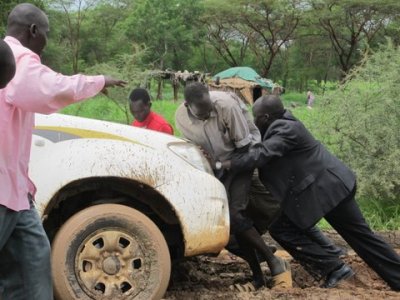
The bishop pushing his car out of the mud. No dry cleaners in Agok.

Hopefully, people will begin to trust the peacekeepers soon and return in time for the second planting season. Maybe then, students can return to their classrooms – right now, they are meeting under trees – and life can return to “normal.” But in such a sharply-divided area, it’s hard to see what “normal” might look like.

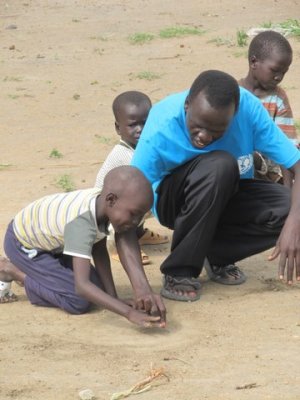
What could possibly go wrong?

So this was the plan:

  • fly to Wau
  • spend ~$50,000 on food and other relief items
  • load that stuff on truck
  • drive truck to Agok, where there are lots of internally displaced people fleeing violence in Abyei town to the north
  • distribute

Simple. Piece of cake. No problemo – right?

Ha!

Logistics in sub-Saharan Africa – especially in a place like South Sudan and especially in a peripheral place of South Sudan like Wau – are not easy. Here are some of the problems – and this is by no means an exhaustive list – we ran into along the way.

Plane – Our team of four – for reasons that are too complicated to explain – took two different airlines to Wau. One plane had engine trouble and had to turn back to Juba, causing a delay of several hours.

Prices – The donor agencies require three price quotations for all the material we buy. Local church people in Wau had done this before we arrived. But it’s not like that’s a binding RFP. Prices fluctuate so we had to go around and re-confirm all the prices. Then, based on those prices, we had to recalculate the budget. Then, having recalculated the budget, we had to go back and buy the stuff. In those few hours, prices have continued to fluctuate. More recalculation. What did we ever do before cell phone calculators?

Quantity – We were buying 400 bags of maize flour. One merchant doesn’t have all that on hand so he has to go check with his neighbours to see if they can help him out. Same for the lentils, cooking oil, salt, mosquito nets, plastic tarps, etc.

Weight – Four hundred 50-kg bags of maize flour are not light. In fact, they weigh 20 metric tonnes. Add on the weight of the lentils, cooking oil, salt – more calculations, more cell phone use – and we had to find a truck capable of carrying approximately 27 tonnes.


Road – It’s the beginning of the wet season in South Sudan, which means the quality of the road has deteriorated substantially. As a result, truckers have raised their rates and are less willing to take a full load. In fact, the most we could get was someone willing to take 20 tonnes. So that means two trucks. That means more recalculation. Have you ever hired a truck before? Do you know how to pick the one that won’t break down half-way to Agok? Or the driver who has a license that is not expired? Do you know how big a truck you need to hold 400 50-kg bags on maize flour? Me neither.

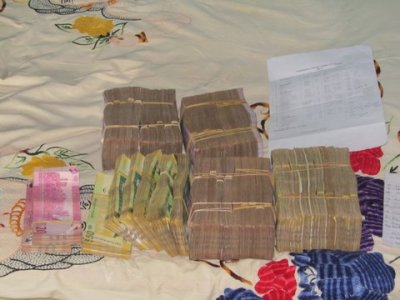
MoneyI’ve already indicated that the money – because of financial sanctions on Sudan – took a long time to reach Juba. But getting it to Wau is another matter altogether. Banks in Juba only allow people to withdraw $5000 in cash per day because of currency shortages. Since this is for the church, they bump that up to $10,000. But that still means it takes a week to get the money, convert it to Sudanese pounds, and fly with it to Wau. That’s a lot of money to be carrying around. I’m glad I didn’t have responsibility for it.

Purchasing – Merchants in Wau, like everywhere else in Sudan, work on a cash-only basis. So when you buy 400 bags of maize flour (at a price of over $60/bag), you have to hand over more than 50,000 Sudanese pounds. This poses several problems. That much money weighs a lot so is a pain to carry around. But it also has to be counted – twice – by the merchant and his partner to make sure they’re not being ripped off. Oh, for the ease of a credit card to swipe!

Loading – It takes a while to load 400 bags of maize flour (and other stuff) on to the trucks we finally managed to procure. Even with a team of four hard-working young men we hired, it still took nearly two hours. Oh, for a forklift! Then there was another issue. We were loading the goods on Friday. Most of the merchants are Muslim and they want to close at noon so they can go pray. Quick, load faster!

Seats – There were six of us who needed to go to Agok to distribute the material – one bishop, three priests, one SUDRA representative, and me. But in the two trucks, there were only two empty seats. So that meant hiring another car, one good enough for the bad roads. Just head down to Avis Wau and find one right? Nope. More negotiation, more calculation. (It would be great if one of the dioceses around here had a car we could have used. But none of the dioceses in this part of the country – Wau or Aweil – are rich enough to own vehicles. The bishop of Wau had just returned from visiting a far-flung part of his gigantic diocese on public transport.)

Communication – Our team was beginning to scatter around Wau, renting vehicles, supervising loading, etc. But many of our cell phones had died. Their calculators had been used too much and there was no electricity at the diocesan office where we staying to charge them. Those of us that did have working phones confronted network issues – calls dropped, didn’t go through, etc. Wau is a far-flung town and we were buying goods from two markets. More delay, more hassle.

(I should say that though I’ve been using “we” throughout, my role was minimal. My presence and help is welcome but I don’t speak Arabic or Dinka so am kind of useless, beyond tracking the receipts for each of our purchases. I’m paying my own way on this trip and the impetus for it is entirely from the Sudanese church members.)

In this context, I found it almost incredible when we did finally pull out of Wau on Friday afternoon, only about seven hours later than we had intended. All these difficulties we encountered made me wonder if the church is really the right organization to be doing this kind of work. More on that in another post, however.

I write this in Agok, where the trucks have not yet arrived, and after a difficult, rough, and bouncy journey that showed us just how bad the roads were. More on that in another post, however

(This post was written on Saturday but is now being posted on Monday now that I am back in Wau with Internet access. More on the remarkable trip to Abyei is coming. Here’s a small taste.)


“We are the church. We are always on the ground!”

Here’s a meeting I was a part of this afternoon in Wau, Sudan. The participants are all church members and residents of the contested Abyei border region between Sudan and South Sudan, who were displaced in the recent attacks there in May.

The Sudan Development and Relief Agency (SUDRA, the Episcopal Church of Sudan’s development and relief arm) is taking emergency supplies into Abyei this weekend. The meeting was to arrange the logistics for the trip.

You might be asking yourself, “But those attacks were in May – what good is emergency relief now?” Indeed, there was some dissatisfaction expressed in the meeting at the very slow pace of the church. The reason for that slow pace? The money for the supplies comes from international partners – in this case, Episcopal Relief and Development – and getting that money into a country under financial sanctions (as Sudan is) is not easy.

Actually, though, the delay turns out to be something of a blessing. Many of the international NGOs that initially responded are winding down their relief efforts. The church can now target its efforts better and draw them out over a longer period of time when they will still be needed. As one participant in the meeting said today, “The UN is there for three months. We are the church. We are always on the ground!”

The trip is being led by Bishop Abraham Nhial, bishop of the Diocese of Aweil, which also includes Abyei. The relief portion has been coordinated by John Sebit, head of SUDRA. But the real on-the-ground knowledge is coming from the priests and Mothers’ Union leaders who were at the meeting this afternoon and know which families are suffering the worst and – most importantly – where all the refugees have scattered to. Throughout the meeting, I was hugely impressed by the thoughtfulness, diligence, and care with which everyone made decisions about how to spend the money we have.

The head priest in Abyei is Zechariah, a student I studied with at Bishop Gwynne College last September and whom I’ve written about in an earlier post. Last year, I know him as a quiet, hard-working guy. He is the same way now – and also deadly serious and to-the-point about everything. I hadn’t expected to be able to see him on this trip. I’m glad we’ve reconnected, though I wish it were under different circumstances. (His family, by the way, for you readers of the earlier post, is alive and accounted for, though all have been displaced.)

To answer your question, yes, I’m going on this trip. I have checked and re-checked on safety and am as assured as I can be that this is a good idea. More importantly, I know how powerful a message it can send to have even one international visitor show up in a situation like this as a concrete example of what international partnership means. (I don’t represent ERD or any of the donors, of course; it’s more the idea of international partnership I represent than the actual fact.)

I doubt I’ll have solar-powered Internet access in Abyei like I do now – I’m typing this under a mango tree as the sun sets over Wau – so look for more picture and updates on the trip early next week.

Testifying to what we have seen and heard

I am reading Rowan William’s address to the Church of England General Synod in Wau, Sudan – connected to the Internet on the solar-powered satellite connection in the church yard, in the heart of a region that was devastated during the civil war, surrounded by hundreds of school children at the diocesan school who have no other place to attend, and not far from the contested border region of Abyei, where the church is ministering to refugees from recent violence.

His words rang true for me.

Two weeks ago in Eastern Congo, listening to the experiences of young men and women who had been forced into service with the militias in the civil wars, forced therefore into atrocities done and suffered that don’t bear thinking about, I discovered all over again why the Church mattered. One after another, they kept saying, ‘The Church didn’t abandon us.’ Members of the Church went into the forests to look for them, risked their lives in making contacts, risked their reputations by bringing them back and working to reintegrate them into local communities.

And I thought, listening to them, ‘If it wasn’t for the Church, no-one, absolutely no-one, would have cared, and they would be lost still.’ It was almost a fierce sense, almost an angry feeling, this knowledge that the Church mattered so intensely. It put into perspective the fashionable sneers that the Church here lives with, the various excuses people make for not taking seriously the idea that God’s incalculable love for every person is the only solid foundation for a human dignity that is beyond question. And it put into a harsh light the self-indulgence of so much of our church life which provides people with just the excuses they need for not taking God seriously. It left me wanting to be a Christian. It left me thinking that there is nothing on earth so transforming as a Church in love.

Congo isn’t unique. I’d just had a week in Kenya, where I saw ample evidence of how the Church stays at the forefront both of national reconciliation and of practical regeneration, and how its teaching programmes blend seamlessly together the new and grateful confidence that the gospel brings with the prosaic business of releasing skills and assets in a community so that food security is improved, soil replenished by better, simpler and more responsible farming techniques, co-operative schemes established and so on – always with the Scripture-reading congregation at the centre, learning what the new humanity means in practice, always with an unquestioning hospitality to the entire community. No, Congo isn’t unique. And today especially we will have particularly in our hearts another of our sister churches that has once again been the carrier of hope and endurance for a whole people in times of terrible suffering, as the new republic of Southern Sudan begins its independent life. But what is special in places like Congo and Sudan is a Church with negligible administrative structures and no historic resources working with such prolific energy. ‘Silver and gold have I none…’ But what they have is, somehow, the strength not to abandon, not to stigmatise, not to reject, but always to seek to rebuild even the most devastated lives. What they have is the strength not to abandon.

It’s possible to see this as a “romanticized” view of the church. People are people after all, whether in Congo or the United States. Try as we might, no branch of the church is free from stigma, abandonment, and rejection. But there’s essential truth in his words that is all too often overlooked in our insatiable desire to cut down and de-legitimize our brothers and sisters in Christ around the world.

What Williams is getting at is something we often miss in the West because our media are incapable of reporting on the church. While there are NGOs – religious and not – that do important work that is similar to the church, in my experience, it is only the church that can marshal the authority that comes from its size and the fact that it is led by locals, not expatriates.

I also read the latest update from the American Anglican Council, where I learned that “two stories are ‘burning up the wires’ at the moment in Anglican Church circles.” You can read for yourself what the stories are but I can assure you that neither of those stories is on the radar screen of any Anglican I’ve met in either Nigeria or Sudan – two of the largest provinces of the Anglican Communion, which surely deserve to be counted as part of “Anglican Church circles.” No, people in Nigeria were talking about the faltering security situation in that country when I was leaving. In South Sudan, people are talking about their new country, specifically, what the roll-out of a new currency will mean.

The AAC e-mail struck me as a prime example of what the Archbishop of Canterbury calls “the self-indulgence of so much of our church life which provides people with just the excuses they need for not taking God seriously.”

I wish more people had the opportunity to have the experiences that I have and to learn that the body of Christ is not a metaphor but an actual reality. So I do my best to put into words what I experience, though it is here that Rowan’s words ring most true:

I wish I had the words to express more clearly to you what that strength looks and feels like, but I can only give thanks for seeing it.

On a trip like this, gratitude is the only possible response.

The Joyousness – and Banality – of Independence


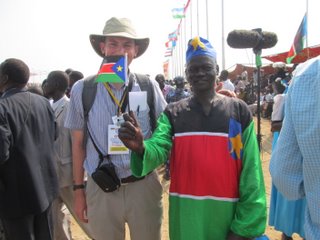
(Um, you’re holding the flag in the wrong place.)

So here I am in Juba, now capital of the world’s newest country, South Sudan.

I’ve held off on writing anything about the independence celebrations on Saturday because, well, what is there to write? How does one put into words the realization of a people’s dream?

I did try to put the events into words for Episcopal News Service. You can read the two stories if you like.

Here are a few moments that didn’t make the articles that are worth remembering.

I started walking to the site of the celebrations at 6:45am on Saturday, bringing with me four granola bars, three sandwiches, two liter and a half bottles of water, and one Cliff Bar for the day. (Could have used more water.) It was a two-mile walk – no taxis were allowed on the roads that day, just VIP SUVs – and it was really great to be in this stream of people all walking in the same direction. “Joy comes in the morning,” sings the psalmist and that was what I was thinking about on that walk. On Friday night, there was loud honking and yelling all over town at midnight. On Saturday morning, it was subdued and people looked determined but it was still joyous.

The actual event was long, hot, and attended by a crushing number of people. I have never felt so claustrophobic in a crowd before. But it was also safe and everyone was friendly and enthusiastic. After a while, I couldn’t handle the crowds anymore and so watched from the distance.

I was struck as I was doing so that an independence celebration is just like any other event – speeches that were too long, more than modest disorganization by the security and protocol people that rendered what had seemed to be a very impressive pass system completely ineffective, a sound system that was kind of weak, and lots of trash left behind, including the new South Sudanese flags that had been handed out. I don’t mean to be uncharitable here because it was a great time all around but the banality and sheer ordinariness of the event struck me, perhaps because there was so much build-up to this once-in-a-lifetime event.

Because I was thinking about the story I was going to write and because I was concerned about not wilting in the heat, I didn’t feel the emotion of the day on Saturday. But on Sunday, I attended a thanksgiving service at the Episcopal cathedral. During the singing of the new national anthem – they had to project the words on the screen because so few people know them – the emotion of the congregation was just amazing and overwhelming. I finally felt – in a really deep way – just what this moment meant to so many people who had waited so long for it.

More photos of the big day on Facebook, which you can access even if you’re not a member.

The pursuit of peace and mutual upbuilding

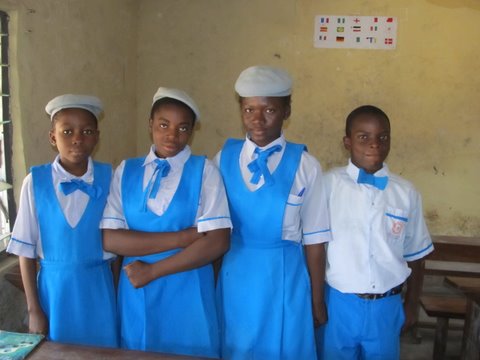
These girls – and boy – are students at Anglican Junior Seminary in Yola, Nigeria. (The name is confusing but in American terms it is a combination middle- and high-school.)

Here is Bishop Marcus of Yola, with one of his priests, standing on the foundation of the dormitory at AJS’s new site.

When the dormitory is complete, the students will be able to move from their current temporary, cramped accommodations in a run-down building in town to this new, spacious, quiet site on the edge of town. AJS will be able to enroll more students than the current 60 it has room for. I spoke to an assembly at their school when I was in Yola and was impressed by how articulate and interesting the students were. They had very good – and challenging – questions for me and are promising young Nigerians.

I’ve written before about how the Nigerian government has essentially abdicated responsibility for education, especially secondary education. That is why church-run schools like AJS are so important to Nigeria’s future.

I’ve also written before about how alleged Anglican disunity is blocking really important projects like AJS. Bishop Marcus would love international partners to help him complete construction of AJS. As it is, the diocese is building the site building by building as it has the money to do so. It is hoping to raise enough money from its members to complete the dormitory by September to coincide with the beginning of the new school year. But progress has been slow lately.

My earlier post got some tetchy comments from both sides. Those in the broadly liberal camp said that Nigerian church leaders have said they don’t want American money so we shouldn’t give them any. Those in the conservative camp said I’m peddling “deviant theology” and undermining the “wall of orthodoxy” in a “poor, rural diocese.” (Yola is a state capital, not a rural backwater. Also, isn’t Jesus the one who breaks down barriers – read “walls”? But whatever.)

It’s hard for me to see the logic of any of these comments. To the conservatives, I’d say that my visit was at the enthusiastic invitation of my hosts. I’d also ask how many “poor, rural” Nigerian dioceses they’ve visited that make them such experts on what Nigerians are looking for. To the liberals, I’d ask if money is to be used as a weapon to punish people. Just because one leader says something we should inflict his sins on the rest of his church? I well remember what it was like to travel abroad when George Bush was president and foreigners visited his sins on me because of the passport I was carrying. To both, I’d say that the logic of punishing students because of alleged divisions seems more than a little twisted.

If there’s one thing I learned in a month in Nigeria, it is that paying attention to the most senior Anglican leaders may not be the best way to understand what is going on in the Anglican Communion right now. The lay people, priests, and bishops I met – in far-flung and off-the-beaten-path dioceses – are actually quite committed to Anglican unity and looking for international partnerships to build that unity and make it real.

One interesting factoid I learned in Nigeria concerns Bishop Josiah Idowu-Fearon of Kaduna. His diocese has one of the longest-standing international relationships in the Nigerian church. Over several decades, a church outside Hartford and the diocese of Kaduna have been able to work together on some really interesting projects. People have traveled both ways and the exchange has been about more than money.

Bishop Josiah is the one Nigerian bishop who has consistently called for dialogue and reconciliation within the global Anglican Communion – and he has paid the price for it. He was demoted from archbishop of a province back to bishop of Kaduna. Nigerian Anglican mucky-mucks have insisted Bishop Josiah is an outlier and doesn’t represent Nigerian Anglicanism.

But here’s what I’ve learned: there are many more bishops like Bishop Josiah out there. They may have some theological disagreements with other Anglicans around the world but they don’t see those disagreements as prohibiting dialogue. I don’t know of any other international partnerships like the one Bishop Josiah has with the church in Hartford. It is a fascinating thing that the one bishop with a relationship with a mainstream Episcopal congregation is the one bishop who has – without selling out his theological convictions – been most outspoken about the need for dialogue. Correlation is not the same as causation but…

One priest, in the midst of a deep conversation about things that divide Anglicans, said to me, “What really matters is Romans 14:19.” I had to look that up. “Let us then pursue what makes for peace and for mutual upbuilding.”

Sounds about right to me. Are there Anglicans in the rest of the world willing to challenge the dominant narrative of fissure in the Communion and form international relationships? The students at AJS – and countless other similar places around the country – are asking that question.

Farewell

So here I am in the Lagos airport – and the only thing on TV is the Casey Anthony murder trial; honestly CNN, is this the most important thing going on in the world right now? – getting ready to leave Nigeria. My visa expires tomorrow. I have to go.

This brings to the end phase II of my summer trip travels, investigating what Jesus’ prayer for unity means when the body of Christ spans the globe. God willing and Kenya Airways consenting, phase III begins in South Sudan later this week. My aim there is to visit some of the seminary students I met in Juba last September and learn about what ministry is like in their home dioceses.

I’m excited about the next phase of this trip but disappointed to be leaving Nigeria. My month here has flown past and I leave with scores of new friends, hundreds of pictures, and pages and pages of notes. I was convinced when I arrived that Nigerian Anglicans had something of value to teach the world church. I now know that’s true. I hope you’ve been able to read about some of that in posts here over the past few weeks.

I have one or two ideas for posts so there might be a bit more about Nigeria popping up from time to time. But for now, it’s farewell – with the hope that someday I’ll be able to return.

Pietistic Arminianism

Here am I with A.C., a priest in the diocese of Owerri. He was the first person here to give me one of his books and it’s the one that has provoked the most thought for me. In The War Within, he asks the question, “How come Christians still sin after they have been born again?”

In the west – especially in the liberal denominations where sin is hardly discussed – this might not seem like a pressing issue. But in Nigeria, it is. Being a Christian in Nigeria means you are supposed to subscribe to a particular set of behaviours and norms – no drinking, no smoking, no lying, no stealing, etc. A Christian may have no trouble not smoking, say, but can be just as corrupt as everyone else. (One priest wondered aloud to me what percentage of his Sunday collection plate is ill-gotten gains.) This causes no end of consternation to priests and bishops, who want to improve the nation by applying “Biblical principles” and practicing “Biblical leadership.”

For me, it is all very reminiscent of the early church. The Donatist heresy began (early 4th century, I think?) when some Christian leaders, facing persecution, recanted their belief so as to avoid death. The Donatists said this was not right and that these leaders were suspect. Even the baptisms they had performed before wilting were suspect. This led to lots of confusion about who was properly in the church and who wasn’t. After Christianity became legal in the Roman empire, the debate evolved into how many times a Christian could sin after being baptized. If memory serves, the answer was once. This got tied in with Pelagianism as well, the belief that a person’s works got them into heaven. Augustine of Hippo was the major orthodox figure in all these debates and wrote some great material against them that did much to draw out a theology of grace. This all happened in Africa, by the way.

(The Donatists are not to be confused with the Donutists, another debate in the early church between people who wanted to serve donuts at coffee hour and those who wanted a healthier option. But I digress.)

I see A.C.’s book as another entry in this debate. I haven’t read the whole thing yet but he basically talks about grace and how ultimately what we do and don’t do is secondary to how we are saved.

This is an important message here. I’m no theologian – as my recap of the Donatists no doubt proves – but the theology I’ve heard preached here – when it’s not prosperity gospel – combines the worst parts of pietism and arminianism. The first says – more or less – that how you behave matters. That’s the no drinking, no smoking bit. The second says that one’s works and deeds contribute to whether or not one is saved. I heard a preacher discuss how hard it had been to get a visa for a trip to the U.S. “But,” he said, “you have to work even harder to get to heaven.” The combination means that people are being told that you have to act a certain way to get to heaven. This is not my theology.

The issue is particularly pressing because of one fact that Chinua Achebe observed nearly 30 years ago in his famous little book, The Trouble with Nigeria:

Whenever two Nigerians meet, their conversations will sooner or later slide into a litany of our national deficiencies. The trouble with Nigeria has become the subject of our small talk in much the same way the weather is for the English. But there is a great danger in consigning a life-and-death issue to the daily routine of small talk. No one can do much about the weather: we must accept it and live with it or under it. But national bad habits are a different matter; we resign ourselves to them at our peril.

People here are always talking about the government, politics, and the state of the nation. Security, economic growth, political accountability, corruption, and many other issues are all wrapped up into one bundle that is on everyone’s mind. On the TV news the other night, there was a story about a major Anglican church in Lagos that held a conference on “the future of Nigeria” (or some similar topic) that was attended by government figures. Can you imagine an Episcopal church in the U.S. doing that and having it make the national news?

The answer the church is providing right now is pietistic Arminianism. I’m sorry, but this is never going to work. Somehow, you have to take account of Romans 7:18: “For I have the desire to do what is good, but I cannot carry it out.” That’s why grace is so important. I see A.C.’s book as one more entry in a long-running debate in the church that has spanned centuries.

St. Luke’s, Waciri

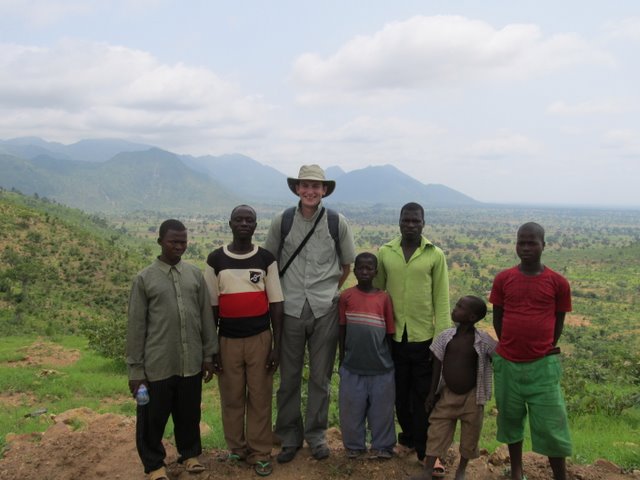
Here’s how you get from Yola to St. Luke’s, Waciri. (In this picture, I’m with some of the members of St. Luke’s.)

Take the paved road south from Yola that leads to Cameroon. After 15 minutes, turn right onto a dirt road that is not all that bad. You’ll have to dodge the huge herds of cows and goats that meander across the road but it’s a fairly smooth ride. Follow this road for an hour.

At a junction, veer left. You know it’s your road because it is just awful. Pitted, rutted, eroded, it barely qualifies as a road. In fact, it’s mostly just a motorcycle track. After 45 minutes bouncing on this road, across rivers, through gullies, up steep hills, you’ll find yourself in the village of Mari. The road ends here. You can see why, too. All around are steep, forested hills.

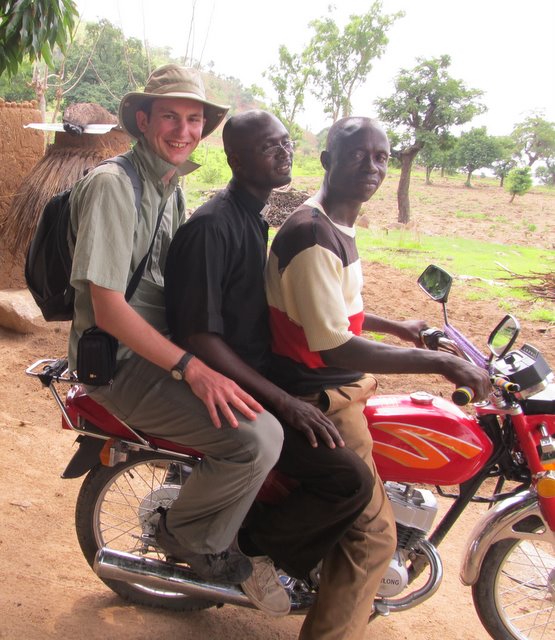
Hop onto the waiting motorcycle of the local canon and ride for 15 minutes into the foothills – more gullies, more hills. He’ll make you get off and walk from time to time because his little bike can’t handle the weight. Eventually, that track ends. Now you’re on foot. It’s 30 minutes (if you’re in decent shape) straight up hill. Of course, since you left Yola later than you planned, it is now the middle of the day, the sun is shining brightly, and pretty soon you’re rationing all that water you brought with you.

But if you can make it this far, you’ll find the views in the village of Waciri to be gorgeous. It’s the rainy season so everything is green and you can look out over the valley floor that you bounced across not too long before. Waciri itself is a village of mud huts, thatch roofs, and fields everywhere – maize and groundnuts, primarily. There is no thinking this is an easy life. In the fields are men and women bent over hoeing acres and acres by hand. The huts are crumbling in places. Water is hard to find. There is no school or clinic up here. Children have large bellies from the lack of protein and more than a few older people have large goiters at their throat from a lack of iron. (I think?)

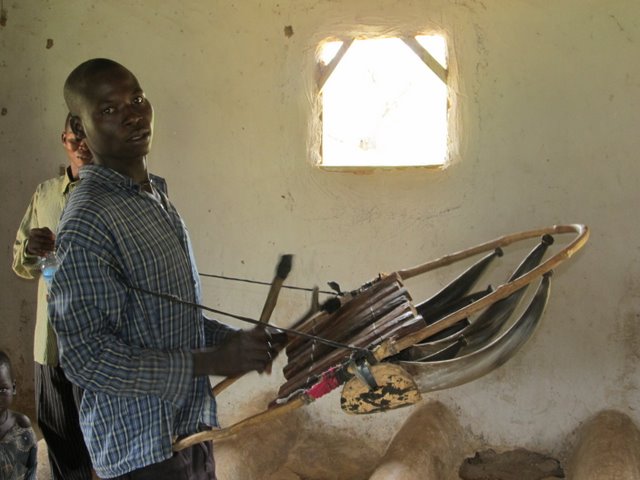
St. Luke’s Anglican is the only church in Waciri. It gets about 50 adults on Sunday, overseen by a lay worker of the diocese, who also lives in Waciri. The pews are rounded mud benches. There are a few drums and some traditional instruments, including a xylophone-type thing made of cow horns and mahogeny.

Almost no one at St. Luke’s owns a Bible. It hasn’t been translated into Koma, their language. Many speak at least a little Hausa, the main language around here, but not all can read so a Bible would be beside the point. They are the first Christians I’ve met in Nigeria who do not know who Jesse is in the Bible.

The Koma people in this region were “discovered” in the mid-1980s when – as the story goes – the governor was passing over in his helicopter and noticed people living in the mountains. When others went to investigate, they found whole communities of people who practiced subsistence agriculture, hunted with bows and arrows, and wore clothing made of leaves – if they wore anything at all.

It is this last point, no doubt, that is responsible for the Christian presence in the area. In the 25 years since their “discovery,” several churches and Christian organizations have arrived in Koma, determined to – using a word I heard several times today – “civilize” the Koma. Many Koma have come down from the hills and live in places like Mari, where there is a (church-run) school. Everyone wears some kind of clothing now but it is not uncommon to see topless women around. This Christian mission effort – spread among many denominations – has been entirely led by Nigerians. I talked with the principal of the school and she is a woman from Lagos, who with her husband, came to Mari 15 years ago because they felt called by the Lord to teach the Koma about Jesus (and other stuff). I thought again about how the Gospel is out of “our” control.

(There are nine churches in Mari. Only the Lutherans and the Anglicans have churches in the little villages in the hills like Waciri.)

Because of the length of the journey and the fact that I’m leaving tomorrow, our visit to the Koma Hills was too short. (We were supposed to come on Saturday but were rained out.) Waciri isn’t even the end of the path. There’s another village two hours more up the mountain that has a church.

I didn’t have any great Anglican unity moments like I did a few weeks back with a pineapple. Indeed, almost none of the people at St. Luke’s knows what an Anglican is. They just go to church. They asked me what kind of food we eat in the United States and I showed them a Nature’s Harvest granola bar. They sampled it and were not too impressed.

I also told them who Jesse was in the Bible. I said he had a son named David, who was the youngest and was almost forgotten by his father. But God specifically selected David and made him king. This is part of God’s pattern of taking people who the rest of the world has forgotten and making them important in God’s eyes. God built a whole church out of apostles who were not exactly the leading lights in society.

St. Luke’s may not be the largest or richest church in the diocese or have the nicest building. But it is exactly the far-flung places like this where, I believe, God is present and at work. Out of such as these is the kingdom of God made.

A free market of religion

I’ve written before about the competition in Nigeria for church members. This morning, I experienced it for myself.

I visited a new church plant in Bachure, a small neighbourhood of Yola. The congregation is led by a seminary student, Joe, and his wife. (Since he is often away at school, she does most of the teaching, preaching, and leading. But women can’t be ordained in Nigeria. Go figure.)

The service began at 9 and we arrived at 8:30. We drove past these two churches on our way in.

The first one is only a few months old. The second one is one of the established churches in the neighbourhood.

This is the Anglican church – the same church that we laid the foundation for on Thursday.

The established church we drove past has a band and a loud sound system so we could hear every single word of their service throughout ours. (And the echo in their sound system: pray-pray-pray-se-se-se the-the-the Lor-Lor-Lord-d-d-d.)

At 9am, we had seven people in church: me, Joe, his wife, and their four children. We began anyway. Slowly, over the next hour, people began to trickle in. The congregation peaked at 14. I preached and the service was fine all around – some nice bits of Anglican liturgy and some nice free-flowing bits as well.

It’s hard to convey, though, what it is like to preach with another church less than 100 feet away. (Kind of like going to a funeral with three others going on simultaneously, actually.) If people don’t like what they’re hearing here, they can just get up and leave – taking their offering with them. It may not happen in the middle of the service – people are too polite for that – but they might not return next Sunday or show up for the mid-week service. Where does that leave the pastor? This close connection between the quality of the pastoral leadership and the success of the congregation is something that I am not familiar with in the U.S. It’s a free market of religion and if you can’t perform, you’re done.

The city of Yola is growing quickly and there are lots of new neighbourhoods like Bachure springing up. Bishop Marcus would love to plant Anglican churches in all of them – the Pentecostals are so he needs to as well – but he lacks enough talented clergy and the money necessary for the task.

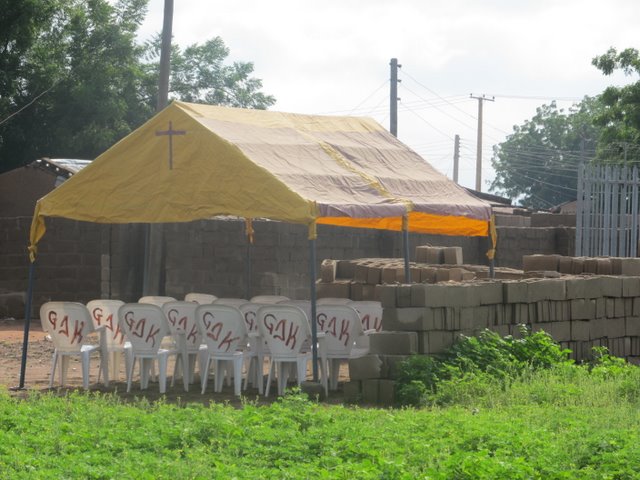
The Anglican church – as well as that new one in the tent – are operating under a significant burden. People see those bricks outside and know that the congregation is trying to erect a building. That takes money. And being in a tent or a grass-walled structure means you don’t have electricity, which means no band, which means bad worship (so goes the equation here). Prospective members will wait until after the church has built the building and then join. But the congregation struggles to put up the building with such a small number of people.

But this little Anglican church has made good progress. They began in a person’s living room before getting together the money for the land and their current structure, none of which came from the diocese. Joe and his wife have already planted one church outside of town. That one began under a tree and now has 60 to 80 people on Sunday and a really solid building.

So it’s possible. But it sure seems like a long row to hoe.

(Is this the direction the American church is headed? The decline of endowments and collection receipts could be leading us in this direction. Our problem is that we have gigantic buildings that take so much money to support. We’ll collapse under the weight of our infrastructure before we learn how to live off the effectiveness of our pastoral leadership.)

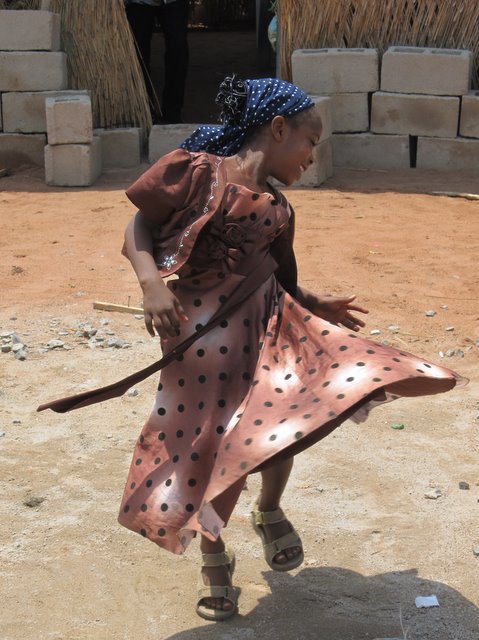
Joe’s daughter Deborah danced around the church while her parents and the church treasurer counted the collection receipts.
This is possibly my favourite picture I’ve ever taken.