Life as a Nigerian Bishop

I’ve really been enjoying the chance to visit with Bishop Cyril Okorocha of Owerri. He is my host these first few weeks in Nigeria and a fascinating person. Leaving aside his personality, though, here are some things he’s told me about his job that might help bring flesh to the idea of what it means to be a bishop in Nigeria.
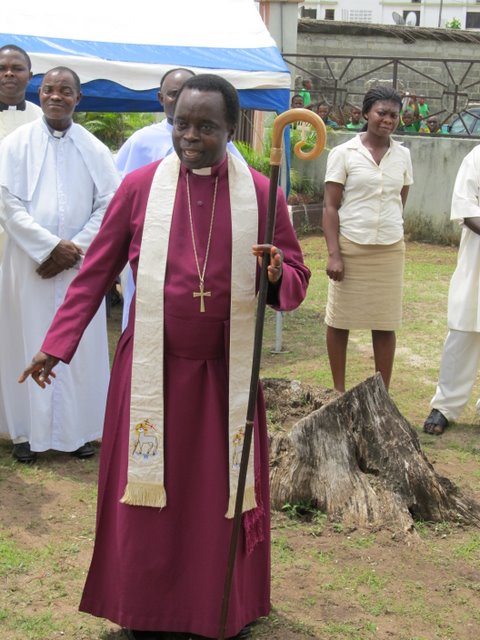
Bishops in Nigeria – as in England – are referred to as “my Lord.” His title is the Rt. Rev. Dr. Cyril C. Okorocha, the Lord Bishop of Owerri. (He did his Ph.D at Aberdeen with Andrew Walls, the premier mission scholar of the 20th century.) People stand when he walks into a room, no matter what else they are doing. He and I talked about this and the challenges it poses to ministry. For instance, when he began as bishop, he drove himself places. But people were shocked at that and said a bishop can’t drive. “Alright,” he said. “I’ll walk.” “No,” they said. “Bishops can’t walk.” So he got a car and driver – the current car is a Toyota Corolla sedan.

His diocese is now much smaller geographically than it was when he began serving as bishop in 1999. That’s because the growth of the church has led to the creation of about ten new dioceses out of his one diocese in the last decade, including four in the last three years. It now takes him only an hour to drive to the farthest away church.

The largest number of confirmations he’s ever done in one service is – wait for it – 700. The service ended at 1 am. Now, he “limits” the confirmands to 200 per service. Confirmation here is a big deal and often involves the young people renouncing – often in very public ways – gangs and non-Christian cults they may have been involved in.

He has about 120 clergy and probably 25 or so more at some point in the preparation process. The parishes and clergy are divided into 18 archdeaconeries. The archdeacons are a super capable bunch of people and do most of the administration of the local needs but it is still a lot of people to keep track of, especially since some people become priests for the social standing that comes with it. Bishop Okorocha has to put out the fires caused by people who don’t behave quite as is expected of priests. (This is something bishops all over the world do, I guess.)

Bishop Okorocha lives in the Bishop’s Bourne – another nice hold-over from England – which is a fairly large compound. His house has three large sitting rooms and a large dining room, all to entertain the groups of people who come to see him. The grounds of the Bourne have several different fruit trees, a well, a generator, and a fish pond (for eating, not looking at). It’s all part of the bishop’s drive for self-sufficiency in the face of the weakness of the Nigerian state, which is a post for another time.

There is a weekly chapel service in the bishop’s chapel, open to anyone who wants to come. The service was a mere three hours this past Wednesday. Afterwards, several people hung around to get a word in with the bishop, asking him to help solve a problem of some sort, no doubt. It’s a lot like a medieval lord holding a weekly audience, I thought. Because everyone is always wanting to talk with him, it takes forever to get anywhere.

There are lots of great questions to ask about the episcopacy in Africa and how it interacts with pre-existing traditions of chiefdom and how those traditions help or hurt the idea of servant leadership. I won’t say that all those questions are answered in Owerri. But they are being asked.
Wives

On Thursday, I visited a seminary in a neighbouring state about an hour drive away. In a small church connection, a friend of one of my Yale professors teaches there and he happily welcomed me.

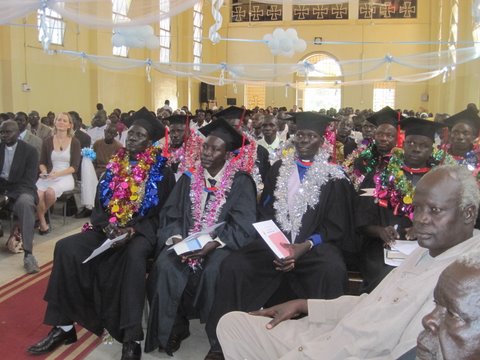
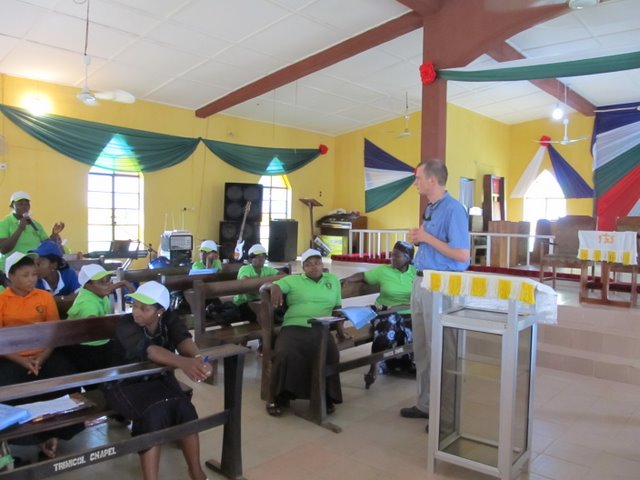
He was particularly intent on having me hold a “forum” with the students. But as it was the day before graduation, they proved difficult to round up. Their wives, however, who had come to the seminary for a week-long, pre-graduation training on how to be a clergy wife, were happy to see me. (The church of Nigeria ordains woman as permanent deacons but not priests, though several people I’ve spoken with expect that to change in the not-too-distant future.) I got handed a microphone in front of a chapel-full of women and told to start talking.

I asked about them and about what sort of challenges they expect to face when their husbands go into ministry. At first, everyone was quiet, likely because they are not used to having guest speakers who ask them questions. But once one person broke the ice, everyone had something to say. Challenges included not having enough money, interacting with older women in the church (many of the women are quite young), dealing with syncretistic faiths and cults, and many others.
(Usually, they looked a little more interested than this.)

I gave a bit of my spiel on unity and everyone seemed to agree unity was important. Then I noted that, in fact, we Anglicans are having trouble with unity. Everyone knew about the “gay issue” but I asked them if they knew anything else about the American church. “Some of your priests smoke!” “Your women do not wear anything on their heads and they can wear trousers!”

I talked about how at my seminary I have classmates who are gay and that they tell me – and I believe them – that God has created them to be this way. As I was saying this, I heard a few voices say, “Not true” or “Not possible” or “No, no, no.” I had clearly opened a can of worms and everyone wanted to say something. Basically, they wanted to tell me – over and over again – that homosexuality was condemned by the Bible. One woman wanted to know if I was gay. (Later, my professor’s friend told me that there are two sides to the issue in Nigeria – you are either opposed to homosexuality or you are homosexual yourself. The idea that someone could defend homosexuality without being gay himself does not seem to be known.)

I won’t say that the conversation was hostile because it wasn’t but it also wasn’t exactly fun and friendly, in the way that similar conversations I had last summer in Sudan were. I immediately realized why – I had no relationship with these women. They didn’t know me and I didn’t know them. I had just dropped in and started talking and the conversation had turned to serious topics pretty quickly. Not a good way to broach difficult subjects. Relationships matter.

As it was, we were soon out of time. I wrapped up the conversation by insisting I wasn’t trying to change anyone’s mind on whether homosexuality is acceptable but I did want to say that I thought we could disagree on this question and still have unity. After all, Christians disagree on plenty of other questions. There were some definitely negative looks when I said this, like it wouldn’t be possible but others that seemed more welcoming of the idea.

And it didn’t prevent them all from gathering for a picture, at their instigation, not mine.

The library at the seminary probably has 1500 or 2000 books, which is not all that bad. But almost all of them are more than 25 years old. Given where theology was 25 years ago, is it any wonder that we are having such severe disagreements over sexuality-related (and other) issues?

My “stump speech”

As I have been traveling, I often find that as a guest I am invited to introduce myself or give a “testimony” as to why I am here and what I am doing. In the last week, I’ve addressed a group of clergy, the diocesan ordinands, a group of students at a seminary, and some clergy wives. I don’t always say the same thing but here are the thoughts I draw from.

I say something about the importance of unity, which is not, I stress, the same thing as uniformity. Jesus prays for unity in John 17 and I am interested in finding out what that unity looks like when there are followers of Jesus around the world. Unity is important, I say, because Jesus connects it to our mission and witness – “that they all may be one…so that the world may believe.”

Unity is also important, I say, because it is eschatologically important. At the end, we will all be united (whether we like it or not…). The more we live like that now, the more we pre-figure the eschaton, which is exactly what Christians are called to do.

Unity has ecclesiological significance as well. The church is called to be a counter-cultural witness to the world – Romans 12:2 is one obvious example but there are many others. To live united in a world that so prizes division is a counter-cultural witness.

(I should say, by the way, that all these “big” theological words I am throwing around here are well understood by the people I am talking to.)

I often talk about the body of Christ and how we are part of a body that spans the world. I talk about how that body is called to particular kinds of action, namely those actions which the actual body of Christ endured – weakness, suffering, sacrifice, humility. This is Paul’s message in I Corinthians, I say, pointing to I Cor. 1:18 – “the message about the cross is foolishness to those who are perishing but to us who are being saved it is the power of God.” Maybe, I say, we can find our way towards the unity of the worldwide body if we start embracing some of these values.

The key thing about all this, I’ve realized, is that it is all rooted in the Bible. Christians in Africa know their Bible. Many are virtual concordances. I can say, “What verse is this?” and quote about three words and they can name chapter and verse. If what you say cannot be linked to the Bible, then no one is going to listen to you. I want to show that we are reading the same Bible – I am just choosing to emphasize different portions than some of them are.

The other neat thing about all this is that this “stump speech” flows from work I’ve done in the classroom and library at Yale. My time visiting in the world church creates questions which I then pursue at school which creates new material to share with people on later trips. If that’s not a virtuous circle, I don’t know what is.

First Notes on Nigeria

So here I am in Nigeria, Owerri – “the eastern heartland,” one-time capital of Biafra – to be precise. As you can imagine, there is plenty to write about but Internet access is spotty so I’ll just make a few notes here.

The church here is huge. I mean that in so many ways – lots of people, lots of priests, many dioceses, big buildings. Owerri is a relatively wealthy diocese and has a very active newspaper, a printing press, big health programs, a 60-room conference facility that is quite nice, and a lot more.

I traveled to Umuahia today to visit a seminary there. It is about 50-km away from Owerri and we passed through four dioceses to get there. It gives you a sense of the size of the church. Nowhere in the U.S. would you do that in such a short distance. Now, there are good reasons to argue that Nigeria has too many dioceses and the current focus is on strengthening the existing dioceses (not all are as well put together as Owerri) rather than creating more, but still…

People here do not recoil in horror when they hear I am an American Episcopalian. I didn’t, of course, expect them to do that but the way discourse is in the Anglican Communion these days, that is perhaps what some might expect. I believe I am received as a faithful brother in Christ. At the airport, I received an effusive welcome from the priest sent to pick me up who was just so delighted that an American had taken the time to come to Owerri.

Beyond the Anglican churches here, there are just a ton of churches of all kinds. Many are stand-alone, self-initiated churches, not connected to any denomination. What is interesting is how many churches have some version of “international” or “worldwide” in their title, as in “Charismatic Renewal Ministries International” or “Church of Yahweh around the World.” As the churches look for a competitive advantage against their neighbours, it is thought that claiming to have international connections – though none of these churches do – helps. This matters to Anglicans here, who actually can claim to have international connections and value them. But then when those international connections start to be “embarrassing…”

On that note, Anglicans here care about the Anglican Communion. A group of clergy wives I spoke to today (more on that in another post) could name several things about the American church beyond homosexuality. How many clergy wives (or clergy) in the U.S. could name anything interesting about the Nigerian church? Anglican Communion news features regularly in the diocesan newspaper (I have been reading back issues) and many people can talk about it. Would that it were the same in the U.S.!

More to come. I have barely begun to soak anything in.

Off to Nigeria – here’s why

During Lent, I preached a sermon on John 4 where Jesus encounters the Samaritan woman at the well. In that sermon, I asked, “What would happen if we did what Jesus did: started showing up in places no one expects and listening to people who are different than us?”

That, more or less, is what I have planned for the month of June, starting tomorrow. I’ll be visiting various dioceses, churches, and other institutions of the Anglican Church of Nigeria.

The church in Nigeria is likely the largest province of the Anglican Communion, with something like one in four Anglicans living there (depending on how you count). It has more dioceses than the Episcopal Church in the U.S. It is also, like many churches in the non-western world, growing rapidly. The diocese I plan to visit first recently split itself into four dioceses to keep up with the growth. Nigeria is closely divided between Muslims and Christians and the Anglican Church in Nigeria – as one of the largest Christian bodies in the country – plays a critical role in shaping that tense relationship.

What most western Anglicans likely know about the church in Nigeria is that its leaders have been vociferous in their opposition to the American church’s actions in regard to homosexuality. The former primate of the church of Nigeria, Peter Akinola, was particularly outspoken. At Akinola’s urging, Nigerian bishops stayed away from the 2008 Lambeth Conference.

My plan is to show up, listen, and learn to what is going on in the Nigerian church. I see it as incarnational ministry at its most basic. I have an invitation from a bishop to visit his diocese for the first two weeks of my 30-day visa. I’m hoping to make enough connections during that time to fill the remainder of the month.

The trip to Nigeria is part of a summer-time project, funded in part by the Fund for Theological Education, in which I’m investigating what Jesus’ prayer for unity among his followers means when those followers span the globe and represent a huge variety of cultures. Act One of the project was in China last month, a trip which has been played out in earlier postings and two Facebook albums. Act Three will be in Sudan in July.

I hope you’ll be able to follow along with me here.

Yingjiang Bible School

The town of Yingjiang introduced me to something new in China: the town. Prior to this, I had been in major cities like Beijing, Nanjing, or Shanghai, all with many millions of people that would make them among the largest in the U.S. Even Hoh Hot, the capital of Inner Mongolia, is nearly two million people and I seemed to spend a good deal of my time there in choking traffic.

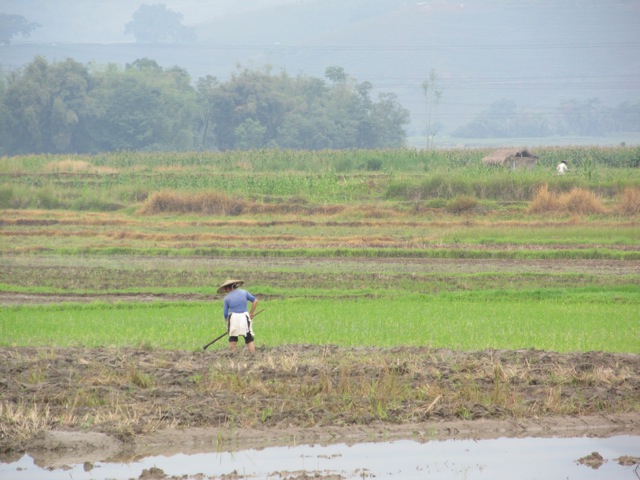
But Yingjiang is different. It has maybe 100,000 people but feels smaller than that. It’s only 30 miles from the border with Burma so there’s a strong Burmese influence. Yunnan Province, where Yingjiang is, has the greatest concentration of ethnic minorities in China so there are a number of different languages, styles of dress, etc. on display in places like Yingjiang. It’s a heavily agricultural region so you pass lots of people working in rice fields, growing watermelon and tomatoes, and planting sugar and coffee for sale.

I was in Yingjiang visiting its Bible training center. As I have learned on this trip, the church in China is growing so quickly that there is a huge shortage of educated leaders to preach, lead services, and generally ensure the church remains the church. In the Yingjiang region, there are 220 village churches and seven ordained pastors. In the last 15 years or so, the church in this region has grown from about 3000 Christians to close to 27,000. Churches make do with leadership from senior lay people most of the time. Some of these lay people are being trained at the Bible school and some may eventually be ordained.
A young lay leader in church.

Why does education matter? I’m sure you can think of several obvious reasons but here are two that emerged as important on my visit. Many people who are becoming Christian come from backgrounds of traditional beliefs so there is a real danger of syncretism. Over and over again I heard Christians in China talk about the need for the true and pure faith to be taught. The other reason education is important is that Yingjiang is a border area and Burmese Christians have been coming across the border. They are often more educated than the Chinese they encounter. Having educated Chinese Christians helps the Christians in the region deal with the Burmese as equals.

Yingjiang Bible school exists to meet these needs. It’s run by Pastor Mi, the senior Protestant pastor in the region, and has several faculty members – trained at other, bigger seminaries in the province and beyond – who teach the students. There is a three-month course during the dry (non-planting) season that about 120 students attend for three or four years. There is a new year-long program with about 20 students, all young and mostly men. The programs cost about $50/month for food. Some students can afford that. Some can’t.

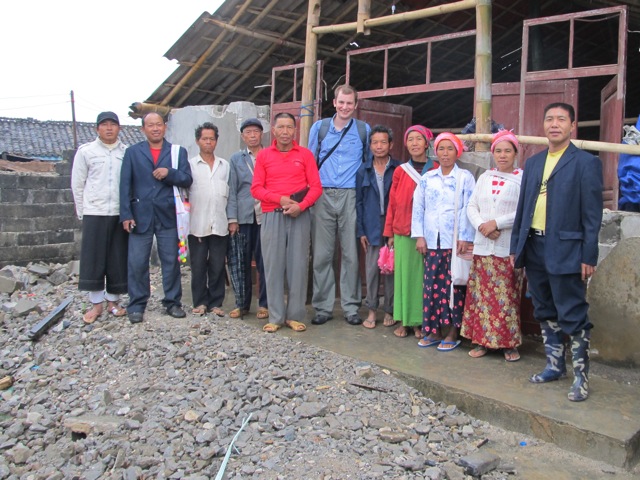
There was an earthquake in Yingjiang in March – it didn’t get as much attention or do as much damage as the earthquake that same month in Japan but it was enough to destroy the main Protestant church in the area. (The training center and the church are part of the same compound on the outskirts of Yingjiang.) Eight other churches in the region were also demolished in the earthquake.
With church-goers on Sunday morning. You can see where the earthquake damaged the wall, which is at our feet in a pile of rubble.

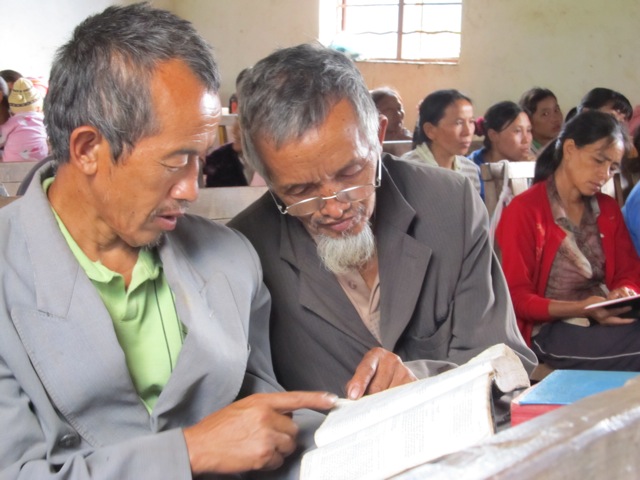
I was in Yingjiang over a weekend and on the Sunday visited two churches in remote villages. Both are in villages of the Lisu people, an ethnic minority known for its colourful clothing, terrific signing, and the fact that many became Christian in the 1920s and ’30s. (I’m sure they’re known for more than that but that’s some of what I learned.) The services were like services in other remote villages around the world I’ve been to – simple, devoted, and attended by faithful, hard-working Christians.

One difference was the basketball court at one church. The young men played after the service.

In the West, we hear a lot about the official and underground churches in China. There’s this implicit understanding, I think, that the underground church is somehow better and more pure. In places like Yingjiang, that distinction matters much less. In such small villages, there aren’t enough Christians for an official and underground church. Yingjiang is such a remote place that the government doesn’t seem much bothered by what the church does. By the same token, however, that means the church has to survive on its own dime and its own wits with no government subsidy. The people at the training center are trying to develop their means of support. It is a steep climb.

A Rising China or a Rejuvenated China?

In the U.S., we hear a lot of talk about a “rising China.” The idea is that China’s rapid growth and development is moving it to a position on the world stage it has not occupied before.

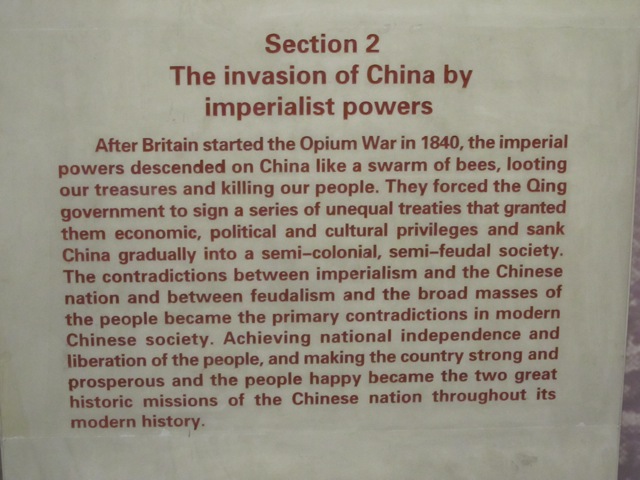
In Beijing, I visited the newly-reopened National Museum of China right on Tiananmen Square. The major exhibit there spans several galleries and is titled “The Road of Rejuvenation.” Most of the exhibit was in Mandarin and I’ll confess I didn’t understand it all. But the basic theme seemed to be that in the Opium Wars of the 1840s, the “imperialist” powers of the west took advantage of China and began to enforce a decades-long period of humiliating foreign rule. But the plucky people of China rose up and first, unsuccessfully, behind Sun Yat Sen and then, successfully, behind Mao, they threw off the foreign rulers, liberated themselves, and so set themselves on a path to grow into a “moderately prosperous” society. Rather than rising to a new place in the world, China is, with this recent growth, returning to its proper place in the world after a rough century or century and a half.

Here’s the opening panel of the exhibit.

I must say that China’s version seems to have more than a kernel of truth to it. Visit places like the Imperial Palace in the Forbidden City or Summer Palace outside Nanjing or the Ming Tombs in Nanjing and you quickly realize they are at least as impressive as any castles, palaces, or cathedrals in Europe. If this is what China could produce in the past, why not believe it when they say they have a bright future ahead of them?

I guess this is why travel is so important – to be able to see things up-close, first-hand, and learn how people present themselves to themselves. You never quite realize how significant the Opium Wars – something we more or less brushed over in my history classes – are until you hear the Chinese perspective on those “unfair treaties.”

In the midst of learning about China’s self-presentation, though, little questions keep popping into my head. The Chinese story strains credulity. How come in the National Museum of China there is no mention of the Cultural Revolution? How come it presents the policies of Deng Xiaoping as more or less a continuation of Mao’s policies when they were closer to a radical break?

If you’ve been reading the western press in the last few months, you might have learned that China is in the middle of the biggest crackdown on dissent since 1989. But I spent three weeks there and saw no signs of this. I once traveled in Ethiopia, at least as authoritarian a state as China, and saw uniformed men with guns riding around in pick-up trucks everywhere. In China, there are uniformed men around but I guess the repression is much more subtle. Or else I don’t know what to look for.

At Tiananmen Square

Instead of seeing repression, I was impressed (and jealous) of the train ride where we surpassed 200mph. I noted the stark contrast between the public works – airports, train stations, etc. – in China’s cities and those I’ve encountered in the U.S. on my way back to New Haven.

I’m finding it hard to get a handle on my time in China and I think this all points to the reason why. China is a gigantic country with incredible complexities which we only scratched the surface of in our time there. There are numerous competing narratives, both those that are actually happening and those that are being told about what is happening. What happens when the West’s policies depend on one narrative – a rising China – and China’s depend on another – a rejuvenated China? And now the narrative of the Christian Gospel is growing in prominence throughout China. What impact will that have?

But here’s one story that has stayed with me since I’ve returned. In Hoh Hot, the capital of the Inner Mongolia Autonomous Region, we visited the very impressive-looking museum. There were exhibits on how important coal and mineral mining was to the region (and implicitly, how everyone in the region thought it was important) and one on the recent history of the region, which said, “Historical experiences show that only the Chinese Communist Party…can issue a policy to meet the needs of Mongols.”

Browsing through the paper the other day, I saw that Hoh Hot came alive with unrest not long after we left, as ethnic Mongolians protested the death of one of their own by a Han-majority coal truck driver. Internet access in the region was cut off and security forces were out on the streets.

“‘Peace, peace,’ they say, when there is no peace.” (Jer. 6:14)

Teetering Sudan

One of the great joys of traveling as I have in recent years is the way it has brought to life the reality of a worldwide body of Christ. I have been fortunate to come to know our brothers and sisters in Christ around the world in a real and meaningful way. With e-mail, I’ve even been able to stay in touch with them from time to time.

But relationships that bring joy can also bring pain, especially when these people begin to suffer. Such is the case in Sudan at the moment.

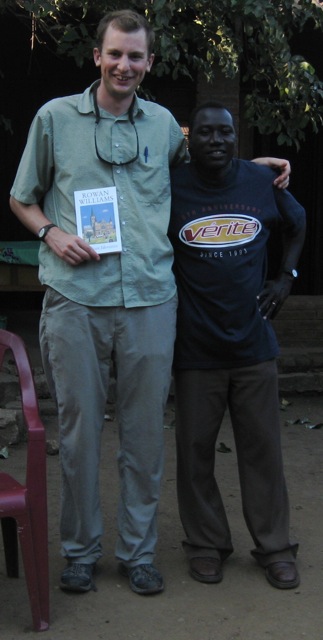
Perhaps you’ve seen the news that the northern army last weekend occupied a contested border town, Abyei, and is now making noises about doing the same to two other contested border regions. Last September, I studied at Bishop Gwynne College, a seminary in Juba, Sudan. One of the students I studied with, Zechariah, learned recently that his family has been displaced into multiple directions at once and he doesn’t know where they all are or if they are still alive.

Zechariah and I (not, admittedly, the world’s greatest photo of either of us)

Another student, Cimbir, is from the Kadugli Mountains, one of the contested areas on the brink. He is hoping to return home to his wife and two small children next week after he graduates. He hasn’t been home since last August. But he doesn’t know if he’ll be able to go home now or if his family will be there when he returns.

Cimbir and I

I’ve also recently received this e-mail from the secretary of the diocese that includes Abyei.

Sudanese forces attacked on Abyei claimed the possession of Abyei town on Saturday at round 8PM. The whole town was completely set on fire, and according to Rev. Nathaniel Maral Mayom, the current senior priest of E.C.S in Abyei, approximately 20,000 people fled Abyei to many different bushes and others ran towards South Sudan towns of Warrap State.

High population has arrived in Agok town in Twic area, and many others ran to small towns in Twic County in Warrap State. The majority of displaced persons are still in the bush including two priests of Episcopal Church of the Sudan, Rev. Santino Akec and Rev. John Manayang. It is still not known where they ran to. Rev. Santino Jok arrived in Agok last night and reported that he was forced to ran to a place called Rum-Ajang-Deng but he hasn’t heard or knows where Rev. Akec and Rev. Manyang have ran to.

The situation on the ground is worse, said Rev. Maral. All the civilians are now down on streets and in bushes, no food, no shelters, no water and no medical assistant. The situation was intensified last night by heavy rain fall in Agok area. Displaced people and children are seriously affected under trees in Agok.

Agok ECS School has accommodated 2,800 displaced people despite the fact that Agok School has very limited space to accommodate such huge number of people; there no option but such deteriorating condition forces us to accept them. Majority are still under the trees with children, sick people and elderly people. Aweil Diocese is left with no choices but raise the voice of voiceless for relief assistance.

Aweil Diocese is calling for urgent support for the civilians who are now lying on the ground without medical attention, shelters, food and water. People with communicable diseases are forced to sleep together with healthy people and this could spread the effect of disease all displaced people if no urgent humanitarian relief intervention reach them before the end of this week

Traveling is great fun and always loads of adventure and excitement. But these are real people with real concerns. The more I travel the more I learn that I need to bear their needs as best I can.

Out of “our” control

I was in a rural village in Yunnan province in southwest China the other Sunday. After the service, my friend Doug and I were talking with a member of the congregation – let’s call him Mr. Jou.

Doug and Mr. Jou

Mr. Jou told us that he is planning to move to a region about twelve hours away – still in Yunnan province – and be a missionary among the Han people there. Mr. Jou is Lisu, one of China’s ethnic minorities and the Han are the dominant ethnicity in China. For Mr. Jou, the Han are an “unreached people” and he is motivated by the Great Commission to go live among them. He is currently figuring out how he’ll support himself there. Whatever he works out, it’ll be a maximum of, say, $4,000 to support him and his family per year.

In mission studies, there is great emphasis on “south-to-south” mission, that is, Christians from the global south who travel to other parts of the global south as missionaries. In Yunnan, there are Malayasians, Signaporaeans, and Taiwanese (not to mention western ex-pats) working as Christian missionaries.

What is so striking to me about Mr. Jou, though, is how much sense it makes. He speaks Mandarin already; he knows the culture; he’s a lot cheaper to support than a western missionary overseas.

The other thing that struck me about Mr. Jou is how it shows that Gospel is out of our hands. By “our,” I mean the white, educated, westerners like me who have, for the last few centuries, thought we controlled the church, the message of the Bible, and maybe even God.

But that’s not how the Gospel works. It has a life of its own.