Nigerian students and the Anglican Communion

The threat which many young women face as they seek education in northern Nigeria has been forcefully brought home in recent weeks by the abduction of several hundred young students.

Not long ago, I visited an Anglican diocese not far from where the students were recently abducted. On that visit, I learned from Bishop Marcus Ibrahim and others in the Diocese of Yola about the church’s outsize role in education and the vital importance of English-language education for all students, regardless of gender.

I wrote about the church’s role in education in my new book, Backpacking through the Anglican Communion. Here’s an excerpt.

A major focus of the diocese’s work was education. The weakness of the government in Nigeria means it has essentially abdicated any role in schools. When he became bishop, Marcus started the Anglican Junior Seminary Yola, a secondary school. When I visited, there were about sixty students at AJSY, and they met in an old house that had been donated by a family in the diocese. The language of instruction is English, unlike many of the Islamic-run schools in the area, and the school admits boys and girls equally, making AJSY one of the few institutions in the state that educates girls in English. I was asked to speak to an assembly, and was impressed by how articulate and interesting the students were. They had very good and challenging questions for me and were promising young Nigerians. It was clear, however, that the house was too small. The assembly met while crammed into what I imagined was the main living space, with students standing against walls or sitting on the ground with their knees scrunched up against their chests to make space for the people around them.IMG_2683

Marcus took me out to see the spacious piece of land the diocese purchased on the edge of Yola to build a new school. Progress was coming, but it was slow. In the two years prior to my visit, the diocese raised the funds necessary for three classroom blocks, which have enough space for double the number of students currently enrolled. But delays in building the dormitory meant the school was not yet able to open. The builders had completed the dorm’s foundation, but then the money ran out. Marcus and I walked across the foundation, and he pointed to where the individual rooms and communal spaces would be. He was bubbling over with excitement about the possibilities of the school, sketching in the dirt possibilities for expansion once this initial site was up and running.

All the money for the construction had come from Nigerians, some from donors who lived outside the diocese, but much from members of the diocese. At a diocesan council meeting I attended, the conversation centered on raising funds for the four hundred bags of cement necessary to finish the dorm. Each bag cost about fifteen dollars. Council members brainstormed ways to raise the money: Ask each deanery to contribute a set amount? Approach the richer members of congregations? Eventually, they settled on assigning each congregation a specific number of bags of cement to provide based on the congregation’s size and average offering in the past year….

“Have you looked for any international support?” I asked Marcus when we were at the school site. Off the top of my head, I could think of several organizations that were interested in funding projects exactly like this one.

“We have,” Marcus said, in a tone that combined disappointment, frustration, and regret. “But no one will help us. They think because of the problems in the Anglican Communion that they can’t work with us in Nigeria.”…

“Look,” Marcus said. “I want to build this school. Children need to be educated. Girls need to be educated. That’s not happening in Yola. Anglicans can work together on this.” We let the words hang in the air. We both knew that. But how could other people come to know?…

The sun was setting. We stood on the foundation and looked back at the future AJSY together. The empty classroom blocks and the dormitory foundation, as well as the students crammed into classrooms in an old house, represented the real-life lost opportunities that result from the narrative of disunity in the Anglican Communion, a narrative that has been propagated by some of its most senior members. Marcus and I were testament to the utter wrongness of that narrative. But our story would never seize headlines or lead to special meetings of Anglican leaders. As we headed back to the car, my steps were heavy with deep, profound sorrow.

As we pray for the return of these kidnapped students, we also pray for the grace to act to ensure an educated future for all in the region who want to learn.

When I initially visited the school, I wrote about it in two different posts. You can also read more about how the Nigerian government has abdicated its role in education in this post, about a visit to a different school in southeastern Nigeria.
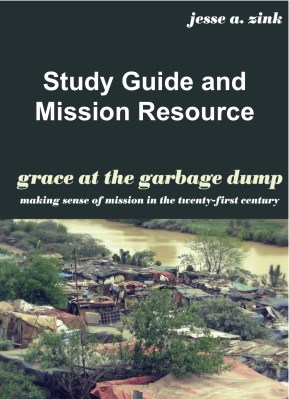
Turning Mission Rhetoric into Congregational Reality: New Study Guide

“Mission” is the buzzword of this year’s Episcopal General Convention. It’s already a buzzword in mainline Protestant denominations.

But how can churches across the country put that mission rhetoric into reality? What does it mean for a congregation to discern its role in God’s mission?

The new Study Guide and Mission Resource for Grace at the Garbage Dump: Making Sense of Mission in the Twenty-First Century is designed to help Christians put the rhetoric of mission into reality. Designed to be used with youth groups, mission/outreach committees, book study groups, and adult education forums, the Study Guide features overviews and summaries of each section of the book, questions for conversation and discussion, links to further resources, and much, more more. And it’s entirely free.

Download the Study Guide for free at www.jessezink.com/guide. Copy it, distribute it, and use it as a resource to help your congregation find out what God is calling you to… whether just down the street or halfway around the world.

If you’re in Indianapolis for General Convention, stop by the official launch of the study guide. Hosted by the Global Episcopal Mission Network (Booth #629) on Sunday, July 8 from 2pm to 3pm, come by for two or twenty minutes to buy a copy of the book (at a special Convention only rate), ask questions about the guide, and learn more about how to involve your congregation with mission. More information is in this press release.

Read all about what people are saying about the book—and how they are commending it as a resource for congregational study—by clicking over to the reviews page.

Questions? Comments? Contact the author directly. jessezink [at] gmail [dot] com or on Twitter @jazink.

Again, you can download the study guide for free at www.jessezink.com/guide.

Learning from the past

This is the first summer in five in which I will not visit some part of Africa and spend time with our sisters and brothers in Christ in that part of the world.

But I’ve found what is, perhaps, the next best thing.

St. Paul’s Sudanese Mission in South Phoenix is an Episcopal church like no other in the country: it’s the only free-standing Sudanese Episcopal church in the country. The congregation is primarily what are often called “Lost Boys”: some of the thousands of children who walked into refugee camps in Ethiopia and Kenya twenty or more years ago and were resettled in the U.S. a decade ago.

On past trips to Sudan, I’ve done a fair amount of teaching: in dioceses, and in seminaries. (I’ve also done much more learning than I’ve done teaching.) St. Paul’s has a Saturday school for lay people that they call the Sudanese American Theological Institute. Thanks to a generous grant from the Evangelical Education Society of the Episcopal Church and building on a course I did at Yale this past spring, I’m teaching a course this summer on Sudanese Church History. Here’s the first class.

Now, at first glance, you might think it a bit odd that an American should be a teaching a bunch of Sudanese about their own church history. In fact, however, many Sudanese, particularly many of the Lost Boys, became Christian after they were forced to leave southern Sudan. Their conversion happened in places like Kakuma Refuge Camp and Khartoum. Church history is not something that is widely known.

So on Saturday we began at the beginning, with the so-called Ethiopian eunuch of Acts 8 (Really, he was from the Meroitic empire in what is now northern Sudan) and the Nubian Christian empire that withstood an Islamic invasion and was a flourishing Christian kingdom for centuries on the Nile River. We talked about what we can learn about the enculturation of the Gospel, missionary strategies, Christian-Muslim relations, and much more.

I had them read extracts from the sixth century writer, John of Ephesus, who documented the work of missionaries to the Nubian kingdoms.

Then we talked about the pros and cons of a missionary strategy that focused on converting kings and nobles and discussed how relations between the Nubian kingdoms changed from enmity to friendship when the kings became Christian.

You get this sense, sometimes, that westerners think Christianity is a relatively recent import to Africa, brought by Euro-Atlantic missionaries in the last century or two. That’s obviously not true. After Pentecost, the Gospel radiated in every direction from Jerusalem—not just to the north-east—and we do well to remember that. Christianity is part and parcel of African history. Studying that history seems like a good idea to me, both for what we learn about what happened and for what it can teach us about our own time.

Next up: the beginning of the European mission era. Why did European missionaries—who had so much success elsewhere in Africa—fall flat on their face when they encountered the Dinka people? And what does that tell us about mission and evangelism in our own time?

Who teaches us?

My time at Yale Divinity School is coming to an end. As I’ve been thinking back over it these past few days, I decided to do a little math. The results may only be of interest to me but here’s what I came up with.

In my time at YDS, I’ve taken 22 courses. (You need 24 to graduate. I did a semester abroad, which I’m not counting here.)

Of those 22, 18 were taught or co-taught by male faculty. Seven were taught or co-taught by female faculty. That means only four courses I took were taught solely by a woman.

Nine were taught by ordained faculty members (and one has been ordained since), though I’ve learned that different faculty wear their ordination differently. For some, it barely seems to register in their consciousness.

Four of those 22 courses were taught by non-white faculty, all of whom were male. (And three of those courses, oddly, were taken in the same semester.)

I can’t figure the age breakdown, though I’d guess my faculty have ranged in age from a few years older than me to close to or past retirement.

So what to make of these figures? I don’t think I steered deliberately in any one direction. Many of the courses I’ve taken were required and many of those are taught by white, male faculty.

One thing for sure is that whom we are taught by shapes who we become. The faculty I’ve had courses with are the ones to whom I turn most readily for advice and input on my life and career. How should I feel about the fact that the majority of courses I took were taught by people who are like me? And how will that shape what I do in the future?

Do you think this breakdown is reflective of something specific to Yale or is it generalizable across seminaries?

In any event, interesting questions to reflect on as I prepare to leave this place. Maybe at some point—when I’m really procrastinating—I’ll look back through old syllabi and figure out the breakdown of the books I was assigned to read.