The long reach of war: from Bor to Nairobi to eviction

As a peace deal in South Sudan appears to take hold, more and more pictures are coming out of the areas most affected by the recent violence. This is the market in Bor, a town I spent time in last year.

1654583_647130938658416_1348427556_o

Most horrifying of all has been the pictures of a mass grave at St. Andrew’s Cathedral in Bor, a church community I wrote about in a recent Christian Century article.

1466036_648052425232934_819014980_n(These photos—and many more—are on the Facebook page of someone I met in Bor last year. He has made them available to anyone to see.)

As I have been reading about the macro-level of the violence—number of people displaced, relief needs, etc.—I have been trying to stay in pretty close contact with a friend of mine in Bor. For the purposes of this post, I’ll call my friend S.

Like many other reasonably-educated Dinka, S.’s wife and children live in Nairobi, Kenya. They are part of the large and persistent Dinka diaspora that was created by the civil war in the 1980s and 1990s. One of the reasons it is so persistent is that people like S. decide that because the schools are better in Kenya, they would rather their children grow up there, even if it means being apart from them. S.’s job with the church meant that he could afford to pay rent for a very small place in Nairobi for his family.

In January, S. wrote to me say that he was “traumatized” by all that had happened. His mother and sisters had fled to the rural areas. His entire diocese had, essentially, been displaced. Significantly for S. and his family, the violence meant that he was no longer drawing an income from the church. He had no idea how he was going to care for his family.

This week, S. was in touch to say that his family’s landlord in Nairobi is threatening to evict them because they have been unable to pay the last three month’s rent. Unless he gets the money—about $650 in total—his family will have to move from Nairobi to Kakuma Refugee Camp. Kakuma is the large camp in arid and remote northwestern Kenya, which was founded in 1992 to care for the so-called “Lost Boys of Sudan,” but now remains as a major community for people of lots of different nationalities. It is far inferior to living in Nairobi, however. It is isolated and cut off from the rest of the country and the schools are not nearly as good. It also means upending the lives of his children and cutting his wife off from her supportive social network.

On one level, S.’s story is familiar: bread-winner loses income, family displacement ensues. This happens as much in England and the United States as east Africa.

But on another level, S.’s story drives me crazy: THIS DIDN’T HAVE TO HAPPEN! The loss of income and the displacement is one microcosmic impact of violence that is the result of a struggle for control among member of the political class. If countries like South Sudan are to move forward, they need people like S.: educated, dependable, committed to their country and its future. In turn, people like S. need the same thing from their leaders. They need to be able to make long-term plans for the futures of their families. But they can’t do this if the very stability of the country is constantly in doubt.

Well, that was fast… or, how Anglican communiques become cudgels

John+Sentamu+Justin+Welby+Annual+Church+England+PakUd_nqZ32lOn Wednesday, the archbishops of Canterbury and York wrote a letter in which they “recalled the common mind” of the Primates of the Anglican Communion to say that it wasn’t right to support anti-gay legislation in places like Nigeria and Uganda.

It’s hard to argue with the message, but it is interesting how they chose to phrase it—pointing back to a communique from a meeting of the leaders of the Anglican Communion in 2005. In the years immediately after the consecration of Gene Robinson, there were a fair number of these communiques. When I read the letter from the archbishops on Wednesday, I wondered on Twitter how long it would be before someone quoted from another one of those communiques or some other “common mind” Anglican document to make a different argument.

Not long, it turns out.

Yesterday, the archbishop of Uganda, Stanley Ntagali, responded to the Wednesday letter by reaching for the granddaddy of them all, Resolution 1.10 from Lambeth 1998:

We would further like to remind them, as they lead their own church through the “facilitated conversations” recommended by the Pilling Report, that the teaching of the Anglican Communion from the 1998 Lambeth Conference, from Resolution 1.10, still stands. It states that “homosexual practice is incompatible with Scripture,” and the conference “cannot advise the legitimising or blessing of same sex unions nor ordaining those involved in same gender unions.”

It was the Episcopal Church USA (TEC) and the Anglican Church of Canada’s violations of Lambeth 1.10 which caused the Church of Uganda to break communion with those Provinces more than ten years ago. We sincerely hope the Archbishops and governing bodies of the Church of England will step back from the path they have set themselves on so the Church of Uganda will be able to maintain communion with our own Mother Church.

Then today, the archbishop of Kenya responded by quoting Lambeth 1.10 and a different Primates’ communique, this one from 2007. You can read his whole text here.

It’s worthwhile looking back at the history here for just a minute. The 1998 Lambeth Conference was a fraught affair—one bishop publicly tried to exorcise a gay activist—and Resolution 1.10 was one result of that atmosphere. The resolution says a number of things, though the phrase that is most commonly quoted is “rejecting homosexual practice as incompatible with Scripture.” (Then again, so is eating a cheeseburger.) Throughout its history, the Anglican Communion has had trouble figuring out what weight to accord to the voice of bishops assembled in Lambeth. So some Anglicans point to 1.10 as the final, definitive answer; others do not.

You might note that Archbishop Ntagali slightly misquotes the resolution. The actual text is “rejecting homosexual practice as” and not “is incompatible.” I point this out because it means that this most-commonly quoted phrase is actually a subordinate clause in a larger sentence. And that larger sentence? I’m so glad you asked:

[This Conference] while rejecting homosexual practice as incompatible with Scripture, calls on all our people to minister pastorally and sensitively to all irrespective of sexual orientation and to condemn irrational fear of homosexuals, violence within marriage and any trivialisation and commercialisation of sex;

The “irrational fear of homosexuals”: does that sound familiar to anyone? Oddly, it is not mentioned in any letter I have yet seen.

We are quickly getting lost in the weeds here. Resolutions and communiques, rather than serving as unifying documents that express a common mind, quickly become cudgels which we start selectively (mis-)quoting to beat our opponents over the head with. Frankly, it’s not very fun.

A couple of conclusions, then:

First, responding by saying, “Yeah, but they did it first” is not very effective.

Second, perhaps it is actually time for Anglicans to think seriously about the weight we accord the voices of our bishops and how we integrate that voice into our life of faith. In this context, it is no surprise that the conversation is between (arch)bishops quoting documents written solely by (arch)bishops.

Third, rather than reaching for the nearest cudgel, maybe in the future we can reach for a slightly more constructive instrument and come back to the verb that is at the centre of Resolution 1.10: listen

We commit ourselves to listen to the experience of homosexual persons and we wish to assure them that they are loved by God and that all baptised, believing and faithful persons, regardless of sexual orientation, are full members of the Body of Christ.

A time for talking and a time for not talking—or do we all just need more time?

imgfullsize

In February of my final year of university, the faculty went on strike. The dispute had been brewing for the entire academic year and provoked plenty of fodder for debate. I have always remembered how discussions seemed to continually circle back to one question: when do you decided that dialogue has failed and opt for other strategies? In other words, when do you walk away from the negotiating table?

I can remember rehearsing the various answers. On the one hand, how can anyone be opposed to something as reasonable as dialogue and negotiation? On the other hand, it is clear that there are ways in which dialogue can be used to perpetuate an unjust status quo and in which at some point one party is justified in declaring that it no longer makes sense to continue in the conversation.

In one way or another, I have had these debates in my head ever since that strike. These issues about the importance of dialogue, conversation, and negotiation have deeply influenced me. Indeed, my reflection on them is a critical part of my new book, Backpacking through the Anglican Communion.

I thought of all these issues again recently when I read two competing essays on the topic. On the one hand, there is Phil Groves, of the Anglican Communion Office, who reflects on the case of Euodia and Syntyche to conclude that

We also need to remember that when disunity appears facilitated conversations are the Biblical way forwards.

For someone who leads the Continuing Indaba project, this is perhaps, not a surprising conclusion.

In response, comes a much lengthier article from Phil Ashey of the American Anglican Council who—never one to shy away from hyperbole—says Ashey “misses the mark by a longshot.” He then proceeds to call reconciliation—a central Biblical concept—some kind of “new religion.” You can read these articles and make up your own mind.

But what neither of these articles addresses is the question of time. “Time all heals all wounds,” it is often (wrongly) said. How does the question of time influence our understanding of conflict transformation?

We might first note that Jesus was not afraid of taking time—it took him thirty years on earth before he began his ministry. So when people start making claims about how much time has elapsed as a reason for determining that dialogue no longer is an option, we can all stop, take a deep breath, and remember that God’s time is not our time.

The other thing is that Jesus invested a lot of his time in people that others thought were hopeless or lost causes. My favourite example of this is Jesus’ encounter with the Samaritan woman at the well in John 4. Jesus takes a break at a well in the middle of the day, meets a woman who has been pretty comprehensively cast out of her society (that’s why she was getting her water in the heat of the day when no one else would be there), and engages her in conversation, even though, as John tells us, “Jews do not share things in common with Samaritans.” (4:9)

I’m not sure if this qualifies as a “facilitated conversation”—there doesn’t seem to be a facilitator at the well—but it does seem to me to be a pretty dramatic example of the fruits of patient engagement with difference. The woman’s life in transformed and she becomes one of the first evangelists, running into town to tell everyone about what she has learned.

When I think about conflicts in the world, whether in the Anglican Communion or beyond, I often think about this story about Jesus and the Samaritan woman. I find myself asking a question. What would happen if we did what Jesus did? Show up where no one expects us to be and taking the time to talk to people who are different than us?

UPDATE: Corrected mistaken reference to Phil Ashey which came out as Phil Groves. A case of too many Phils!

Connection to the outside world

Justin Welby is on a flight to Juba, South Sudan.

(Well not directly. I yearn for the days when you can fly from Heathrow to Juba direct.)

It is easy to underestimate the power of archiepiscopal visits. At least in England, people are used to seeing the archbishop pop up all over the place—preaching at this college, visiting that church, giving an interview to this reporter—that we can get inured to the significance of his presence. Moreover, some people—especially in the media—want action they can report. Think of the headline: “Archbishop brings peace to South Sudan.” But that’s not what the archbishop is going for. In his pre-trip interview with the BBC, he says that the purpose of the trip is, essentially, to be with people.

There is ample precedent for archiepiscopal visitation to what is now South Sudan. George Carey, archbishop in the 1990s, made two visits to Sudan during his tenure. These are vividly remembered by Christians, even today, twenty years later. On one visit, he spent time in Dhiaukuei, a remote community that had become a safe haven for Christians and a centre of learning and evangelism for them. One woman there, remembering his visit, told me that when he came, “We thought, ‘OK, if part of our body from a different part of the world came to visit us, then the message of Jesus Christ which said, “We are all parts of the same body,” is true.’”

Carey’s successor, Rowan Williams, visited South Sudan in 2006. He spent time in Malakal, a town that has been the news recently because it has been one focus of the recent violence. When I was in Malakal in September, people unpromptedly told me about his visit and how everyone—Anglicans and non-Anglicans alike—turned out for his events.

Given all that South Sudan has been through in the last six weeks, I imagine that Archbishop Welby will have a similar welcome—if he allows himself public events—and his visit will have similar significance.

Later in this visit, Archbishop Welby plans to visit the church in the Democratic Republic of Congo. The DRC has its own complex problems of violence and societal fracture. I recently read this from a bishop of the church in the DRC:

The poor infrastructure and lack of communication systems ensure that the church is internally disconnected and lacks sustained contact with the Anglican Communion… [The church] has felt proud to be part of the Anglican Communion but feels unable to fully contribute to the communion or to understand entirely its debates. Many of the problems of poverty, war, hunger, and sickness that are so pressing for the Congolese nation do not appear to be prominent in inter-communion discussions.

(That’s from the chapter by Bishop Titre Ande and Emma Wild-Wood in the new Wiley-Blackwell Companion to the Anglican Communion.)

For many Anglicans, the archbishop of Canterbury is important for what he embodies—connection to and concern from the outside world. This is what many people in conflict zones are yearning for, the assurance that someone, somewhere out there is thinking about them. By simply showing up and listening to the real concerns of real people, the archbishop of Canterbury performs a hugely important ministry.

That’s hard for reporters (and others) to grasp. But the lesson of history is that is hugely significant for the people on the ground. And in the end, that’s probably what matters.

Returning to Itipini

Before ordination, I worked for a couple of years as a young adult missionary of the Episcopal Church in a shantytown community outside Mthatha, South Africa. The community was called Itipini, a word that literally means “at the dump,” which is an appropriate name for a community that grew up on the site of a municipal garbage dump. (Hence the name of my book about this community, Grace at the Garbage Dump.)

Here’s what Itipini looked like in December 2007. (The community stretched a significant distance in both directions.)IMG_3395

In 2012, after a complicated dispute, the municipality razed Itipini to the ground, displacing the scores and scores of families who lived there. (I wrote about that dispute when it happened in a series of two posts.)

I recently returned to Itipini for the first time since its destruction and took a picture from the identical location as the one in 2008.IMG_2043

Unless you knew what you were looking for, you would not have any idea that this was once a place where people were born, lived, and died. You can see the ruins of the pre-school and clinic in which I used to work. Perhaps the most prominent feature in the landscape is the palm tree, which stood next to the playground and which we watered every day with our mop bucket water. It would now tower over the playground—if the playground were still there.

I spent a lot of my time in Mthatha tracking down former residents of Itipini to find out what had happened to them. There is now what could be called an “Itipini diaspora” scattered around town and encountering these old friends in their new lives brought out a complex combination of emotions.

I’ll have more to say about those visits in future posts—as well as more on the series of events that led up to the razing of Itipini—but for now I am struck by how easily and how quickly a whole community can be wiped out—out of the landscape, out of our consciousness, out of our memories. No one wants to live on an old garbage dump. But when people begin to, it becomes a home for them. Destroying that home has not done a single thing to address any of the issues that underlay the decision to live in a place like Itipini. But by wiping it off the map, it has become that much easier to forget that these people even exist.

There is lots of debate in the church about what mission means and how we “do” it. But perhaps the first task of mission is simply to stand with our sisters and brothers when they say, “We exist. We are here. Do not forget us.”

An appeal from the heart

IMG_3731Bishop Abraham Yel Nhial of the Diocese of Aweil, South Sudan has written an open letter to South Sudan’s political leaders. It expresses some of the deep frustration that so many South Sudanese are feeling with their leaders.

A MESSAGE FOR SOUTH SUDAN POLITICAL LEADERS AND CITIZENS

I want to appeal to South Sudanese political leaders, that if you believe in God, you must also believe that killing is a sin. Can you believe in God and not believing that killing is a sin? You all the times go to church to pray, what really do you pray for? What does God means to you and your faith? I thought that you, our leaders in persons of President Salva Kiir and Dr. Riek Machar knew what God’s will is for you in your leadership as leaders of our beloved nation over the last eight years? It is very unfortunate that both of you are forgetting why God gave you this responsibility to lead this nascent and fragile young nation.

Brothers in Christ, our leaders of South Sudan; God’s will for you President Salva Kiir Mayardit and former Vice Dr. Riek Machar is to bring peace, reconciliation and forgiveness among yourselves and to our innocent civil population who are dying because of you. South Sudanese have dangerously broken apart under your leadership. Please turn back and see by yourselves the damages that a month long war has caused this nation. How many people have died? What reasons have they died for? Have they taken part in your political debate in Juba? Give peace a chance!

Juba, Jonglei, Unity and Upper Nile states have lost all citizens that you would want to vote for you tomorrow to unjustified war. What message will you tell the remnant? All the remnants and those who are directly or indirectly affected are left with terrible trauma and or physical damages.

President Salva Kiir and Dr. Riek Machar, if you turn to peace, reconciliation, forgiveness and national healing, both of you will be remembered as great sons of South Sudan in this generation and generations to come. Please think and make your decisions wisely!

All in all, allow God to change your hearts! Scripture says, “Beyond all these things put on love, which is the perfect bond of unity. Let the peace of Christ rule in your hearts to which indeed you were called in one body; and be thankful” (Colossians 3:14-15). We, all Christians of South Sudan have one mission. Our mission in this fighting in our beloved nation is to plant peace, forgiveness, and national healing where hatred and unjust killing had been planted.

I believed all Christians have peace to offer to our politicians who lost the vision and the mission of South Sudan as a nation. It is also our role as Christians to encourage our people who are silently grieving for the killing of their beloved ones to accept reconciliation and forgiveness as the only way forward so that their contrite hearts are inwardly reversed. I appeal to all Christians to stand strong through the storm of conflict with message of peace in our heart knowing that this conflict will come to pass. Blessed are the peacemakers (Matthew 5:9). Be a peacemaker!

Finally, we all are heartbroken because of the wrong direction our nation has taken and continues in it. As a servant of God, my advice to you all is to take charge of your life and take charge of the future of our nation; don’t allow being used by desperate politicians.

Above all, lets continue praying to God to bring divine intervene soon and restore back the South Sudan in just peace; our hope is in Jesus alone. Jesus is the true foundation of our unity without Him we will never be united.

Written by Rt. Rev. Abraham Yel Nhial

The Bishop of Diocese of Aweil

Episcopal Church of South Sudan and Sudan (ECSS &S)

Northern Bahr el Ghazal State

Republic of South Sudan

Bishop Abraham’s ministry in the Diocese of Aweil features in chapter 15 of my new book, Backpacking through the Anglican Communion. Bishop Abraham is also the author of a book of his own, Lost Boy No More.

Reports from South Sudan

I have returned from a time away to read of an apparent peace agreement in South Sudan. The violence may be ending but it is clear that it has done a tremendous amount of damage in a very short time.

Reporters are now making it to Bor, a place I spent some time in last year. One BBC reporter says that on his drive in from the airport he saw, “a scene of absolute devastation… You can see that every home, every hut, every shop has been looted or burned or emptied.” The market is now “a mangled mess of corrugated iron…. It is as though a giant inferno has swept through the entire town of Bor.”

Several reports and appeals for assistance are circulating from church leaders in South Sudan. One is from the Diocese of Malakal, whose bishop, Hilary Garang, I spoke to during the violence. The report from the diocese contains several pictures of the destruction to church property, as well as this report of the violence:

The town was divided into two zones and lawlessness began to overshadow the city and several shops were broke into, looted and burnt afterward. Some Government houses, NGOs offices also Government institutions were broke into, even the house of the State Governor was looted as well. Also the house of the Commissioner of police and many others were done the same. The Governor and most ministers run to Renk for their lives, where they stayed until the day the town was recaptured by the Government forces. All shops full of food items, different types of commodities; goods and everything were looted and later on it was set on fire….

Almost the whole population was affected terribly by this fighting, leaving everybody in critical and difficult position of all kind of needs……especially as the local Market was completely destroyed, and burnt down by the rebels…

Now, we will go without food for almost two months because there will be no safe route to bring us food from Juba since the Nile River passes through the rebels areas.

You can read the whole report from the Diocese of Malakal here.

A second report is from the Diocese of Bor, whose bishop, Ruben Akurdit, I also spoke with during the violence. This report also contains pictures of the damage.

In Bor, the whole population is displaced into different places i.e Awerial County in Lake State, swampy part of Bor County call “Toich” and others in the forest east of Bor town. All are sheltered under the tree, lacking food and clean water, subjected to dangerous insect and snakes as well as diseases. All are sleeping on bar ground because none of them run with the luggage. While those in the swampy area are in danger of the water bone diseases for they spend most of their time hiding from this crisis in water. The only dry places they use are the small Ant-hills in toich and it is also home to some dangerous snake. The condition is very bad. It requires international intervention from God fearing people to provide some basic needs to the victims wherever they are in Awerial, Juba, and Swampy part of Bor County and in the Forest east of Bor County including those who flew to the border town such as Nimule and Yei.

You can read the whole report from the Diocese of Bor here.

It is good news that some sort of peace agreement has apparently been reached—but the damage done by this violence is lasting and far-reaching and South Sudanese continue to need prayers and support as their country again fades from the headlines.

Sharing the suffering on the way to resurrection

Some months ago, the radio show This American Life profiled Meron Estefanos, a journalist who gets drawn into a web of Eritrean hostages in the Sinai peninsula. Beginning with one call, Estefanos eventually ends up devoting a huge portion of her days to talking to hostages who have been captured by people-smugglers and are given mobile phones to call their families and ask them to pay ransom. Along the way, these hostages are left in horrific conditions.

When I heard the program, it was for me an example of Christlike action in the world. One lesson of the Incarnation is that Jesus comes to share our lives with—Emmanuel means “God with us” after all. In the crucifixion, Jesus shares the ultimate moment of suffering and agony—death—with humans. When people are suffering, we can be confident that God in Christ is in their midst because God in Christ has experienced the worst the world has to offer. When Estefanos calls these hostages, she is, in a sense, incarnating herself among them and sharing in their crucifixion.

Christians, therefore, are people who are called to share in the suffering that is present in this world. In the last few weeks, I have been acutely aware of the suffering in South Sudan in part because I’ve been calling various friends there to ask how they are. I want to emphasize that my few phone calls and blog posts are not even close to the total devotion shown by someone like Estefanos, not to mention Christ. But I’ve continued to call and to post out of the conviction that it is important both that we have some clear idea of what is going on in South Sudan—in all its difficulty—and also that people in South Sudan know that we are aware of their challenges. When St. Paul writes, “If one member [of the body] suffers, all suffer together with it,” (I Cor. 12:26), he is not speaking metaphorically. He really means it.

(I am also acutely aware of my own shortcomings in this regard. I know next-to-nothing about the suffering in Syria, for instance, or in the Central African Republic. But I hope that the full body of Christ around the world may hold the full weight of suffering in the world and that I have one small part to play in that.)

I have been reflecting on all this because I am aware that my phone calls will be on hiatus for the next little while. I have a long-planned trip coming up, which will occupy all my time and render the relatively inexpensive way I’ve worked out to call South Sudan inoperable. Does that mean I can just flip off this sharing of suffering? I think not. There are ways in prayer and action and advocacy to continue to share the suffering of our sisters and brothers.

We should finally note that sharing suffering is not the only thing Jesus did. His crucifixion ended in his resurrection. Following Christ, Christians are truly incarnate in the world, sharing the suffering of those who suffer, but all so that we may push and poke and prod and work towards the resurrected life to which Christ is calling us. Glory awaits—in this Christians can trust, even and especially when it seems almost entirely obscured.

In coming days, the Episcopal Church of Sudan and South Sudan will be releasing a proposal for relief, action, and advocacy in response to the violence. I encourage you to keep an eye out for out asa we listen to our sisters and brothers and move towards resurrection.

Dinka Christianity: an exilic faith

It was not planned this way but the Christian Century this week publishes an article of mine about Christianity among the Dinka people of South Sudan, from the stuttering and failed efforts of Anglican missionaries in the first half of the twentieth century through two civil wars (and more recent violence) and into the vibrant faith it is today:

The Dinka church is a church of exile. When the civil war began there were only five Dinka congregations stretched along 150 miles of the Nile’s east bank. They were all that remained of the British Anglican missionary presence among the Dinka in the early and mid-1900s. Today that same 150-mile stretch is home to more than 300 Anglican congregations (and a handful of others in other denominations), not to mention innumerable preaching centers in cattle camps along the Nile. There are two dioceses in the area and plans to create more. Virtually every one of the villages on the roads leading out of Bor has a church—often a mud-and-thatch building.

The Christianity of today’s Dinka emerged out of the sorrow and deprivation of refugee life, a time of despair that led many refugees to turn to the church for support, nurture and growth. It’s no accident that the wooden church pews came back with the refugees. Today the cathedral in Bor is a center of South Sudanese life. On Sunday mornings the building pulses and shakes with the energy of up to 1,500 worshipers. The same is true in the churches scattered throughout the region.

Many of the people in Bor are now displaced, of course, by the violence of the last few weeks. I find myself wondering what role this faith plays in their displacement.

The article tells, in part, the story of Mary Alueel Garang Nongdit, who as a young, uneducated convert to Christianity began composing hymns of great theological depth and profundity.

The Dinka hymnal is a rich repository of theological reflection on many subjects, including the relationship between war and faith. Over a third of the hymns were composed by women, a remarkable achievement in a culture that traditionally has not valued women’s musical contributions. One of them, Mary Alueel Nongdit, began composing hymns shortly after her baptism in 1984. Her hymns are among the longest, most complex and most popular. They have a richness of expression and theological complexity that is unique.

In one hymn Alueel Nongdit writes that “the death that has come is revealing the faith”—an appropriate sentiment for a people who converted to Christianity during a war. She says that the hymn encourages the people to look to God. “When you are crying, instead of crying just divert that crying to prayers. Turn back to God and cry to him. He will see you. He will rescue you. You are not alone.”

Alueel Nongdit also wrote about the love of God and the ways that love can be expressed. In the book of Hosea, she says, God’s love is shown in ways that might not at first seem loving. The Dinka had a similar experience: it was only in the destruction of war that God’s love was revealed to her people. The Dinka were “a stiff-necked people,” she says, but “God cannot get tired. If there is somebody whom he likes, even if the darkness buries you, if God loves you, he can dig you out!”

Although I met Mary Nongdit after I had finished drafting my new book, Backpacking through the Anglican Communion, this article gives you a taste of the kind of stories that are at the heart of that book. Anglicans around the world live some incredible lives of faith. It’s time to learn more about them.

Speaking for oneself

Bishop Ruben Akurdit of Bor continues to make the media rounds via his mobile phone. Today, the British channel ITN spoke to him for a story. There is little that he adds that wasn’t in yesterday’s BBC interview, though this line grabbed me:

There is no supplies, completely. Nobody is giving supplies.

Delivering relief supplies to South Sudan is challenging at the best of times. (I was involved in one such trip once.) But in a war zone, it is even more complicated.

The footage in the story, first from Awerial and then from Bor is disturbing. It shows some of the destruction I was writing about a few days back.

I was struck in the story by the contrast between the rather opulent surroundings of the peace negotiations in Addis and the footage of displaced people in Awerial. Perhaps the peace negotiators could be given the same amount of food as the people in Awerial are getting?

One of the questions I ask in my new book, Backpacking through the Anglican Communion, is how we can create a situation in which the voices of all our sisters and brothers in Christ can be genuinely heard. Ruben is a bishop. He has a better chance than many South Sudanese in having his voice heard. Still, international media coverage of South Sudan (both before this current violence and before) tends to overlook the church, even though the church is the single most important social institution in the country. I’m grateful for interviews like this in which Ruben and others (such as Archbishop Daniel Deng Bul, who spoke to the BBC yesterday) can speak for themselves.

As the coverage continues, however, I hope that interviewers will begin to ask these church leaders questions about topics other than how awful everything is. Archbishop Daniel chairs a national reconciliation commission, the need for which is even more acute now. Church leaders have been consistent in articulating a vision for the future of the whole country that is hopeful and realistic. It’s time for international media to start reporting on that as well.

Still, the frequency with which church leaders keep popping up in news report testifies to the simple fact that when everyone else leaves—including U.S. Embassy staff today—the church remains on the ground. We should not underestimate the importance of that.

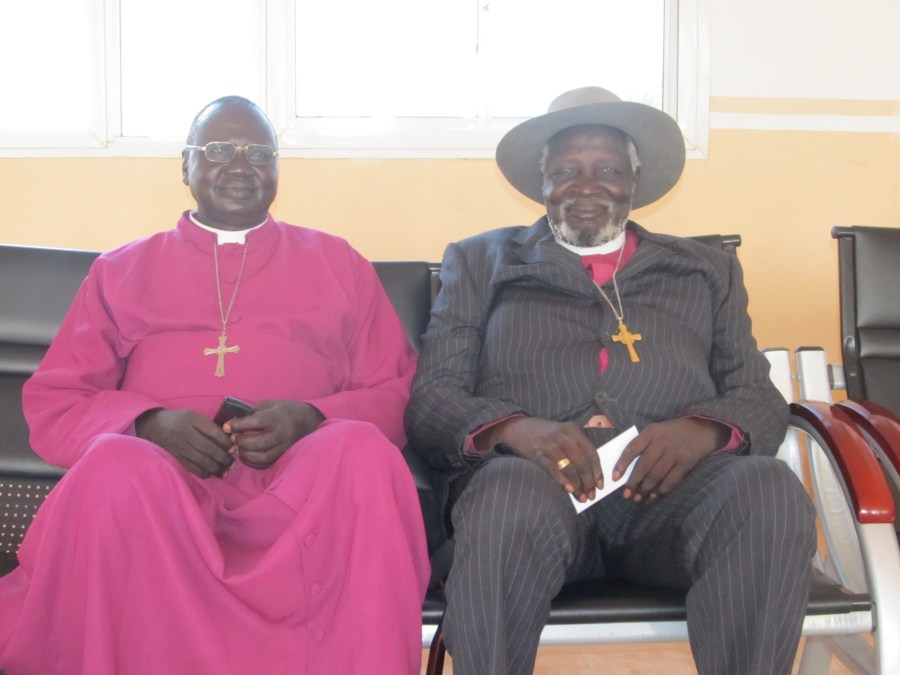
One final note: the ITV report uses my photograph of Bishop Ruben. They didn’t ask permission but I don’t mind. Still, it might be time to trot out a new photo. Here’s Bishop Ruben, with his predecessor Nathaniel Garang at the Bor airport in April 2013.

IMG_7128