Committing to the Anglican Communion

It seems pretty clear that the proposed Anglican Communion Covenant will not be approved by the General Convention of the Episcopal Church this summer. Having been rejected in Scotland, stymied in England, turned down by more conservative provinces, and approved by only a handful of churches around the world, the Covenant has had a tough row to hoe. It’s demise, I think, will be little lamented.

Several of the Convention resolutions concerning the Covenant politely turn it down but then use some sort of language about “committing” to the Anglican Communion. No one, it seems, wants the American church’s rejection of the Covenant to be interpreted as a step back from the Communion.

Actions speak louder than words, however, so here’s the question: what steps can this General Convention take to make it clear that its commitment to the Anglican Communion is more than nice words on a piece of paper?

Here’s a short list of ideas:

Fully fund the Anglican Communion Office. Congregations pay money to support the work of their dioceses because they are committed to work in their region. Dioceses pay money to the national church because they see that it does important work. National churches (or provinces of the Anglican Communion) should pay money to the international body that, on a bare shoestring, provides some sort of organization to the Communion and facilitates important projects like the Continuing Indaba or the Bible in the Life of the Church. The first head of the ACO (though it wasn’t called that at the time) was an American bishop named Stephen Bayne. Full disclosure, he is one of my Anglican heroes (yes I have those) and I think his legacy and his vision deserve all the support we can give them.

The budgets that have been proposed for Convention both slash (yet further) the Episcopal Church’s contribution to the ACO. I’m not sure how Episcopalians can gripe about dioceses that don’t pay the full asking when we don’t pay the full asking to the ACO. Other Episcopalians complain the ACO doesn’t do what we want, much in the way that Republicans in Congress are continually threatening to cut off funding to the UN when it “steps out of line.” Fully fund the organization and let it do its job.

Provide increased funding for the networks of the Anglican Communion. These are organizations, like the Anglican Indigenous Network or the Anglican Health Network, that bring together Anglicans from around the world to work on issues that are not, blessedly, the issues that have consumed the Communion for the last decade and more. Networks are important not only for the work they do but for the way they represent an effort to change the discourse in the Communion. The Episcopal Church used to contribute money to some of these networks as a way of bringing people together from different backgrounds to talk about important issues. That money is now gone. (Disclosure: I’ve been involved with the Anglican Peace and Justice Network.)

Challenge dioceses to be involved in at least one companion relationship. Many American dioceses, happily, have overseas partner dioceses. The companion diocese idea (which came out of work done by the Anglican Communion Office, incidentally, way back when) has been an important tool for building relationships across the Communion and sharing the good news of Jesus Christ. But not all dioceses have companion relationships. Some dioceses have relationships that need to be reinvigourated. We can challenge parishes to have web sites (Resolution A025); why not challenge every diocese to have a companion? (Or two: some of the most exciting companion relationships involve three dioceses.) Companion relationships challenge the dominant Anglican narrative of fissure with one of relationship across reconciled difference.

(Convention has passed resolutions in the past encouraging companion diocese relationships but to the best of my searching has not passed one establishing an expectation that every diocese have a companion.)

Encourage the companion idea to spread to parishes. The budget of many dioceses around the world is equivalent (or smaller than) the budget of a good-sized parish in the U.S. What if, in addition to diocese-to-diocese relationships, there were parish-to-diocese relationships? (We’d have to think about how these relationships might be complementary or competing in a diocese.) There are hundreds of Anglican dioceses around the world, many eager for companions, as I have learned. There’s no reason large, mission-minded parishes can’t take the lead in partnering with them. (The Diocese of Virginia has done some exciting things around this idea.)

Encourage better communications. Communications in the Anglican Communion is abysmal. As I have found in my travels around the Communion, there is exciting work being done in so many parts of the world that few people know about because no one tells anyone else about it. Instead, the dominant communications medium in the church is something like Virtue Online, a polemical, often-false source of “news” that drives a narrative of fracture and decline. This needs to be matched with, well, facts. Solving the communications problem in the Communion is not something Convention alone can do. It can, however, take steps in that direction, like increasing funding for the Episcopal News Service so that the organization can broaden its horizons and get more Anglicans talking to one another. Right now, Anglican Journal, the newspaper of the (smaller and poorer) Canadian church does a better job covering the Communion than ENS does.

Many of these ideas cost money (not much) but, again, actions speak louder than words. If we mean what we say in these resolutions, we need to back it up. These are some of my ideas to do so. Yours?

Learning from the past

This is the first summer in five in which I will not visit some part of Africa and spend time with our sisters and brothers in Christ in that part of the world.

But I’ve found what is, perhaps, the next best thing.

St. Paul’s Sudanese Mission in South Phoenix is an Episcopal church like no other in the country: it’s the only free-standing Sudanese Episcopal church in the country. The congregation is primarily what are often called “Lost Boys”: some of the thousands of children who walked into refugee camps in Ethiopia and Kenya twenty or more years ago and were resettled in the U.S. a decade ago.

On past trips to Sudan, I’ve done a fair amount of teaching: in dioceses, and in seminaries. (I’ve also done much more learning than I’ve done teaching.) St. Paul’s has a Saturday school for lay people that they call the Sudanese American Theological Institute. Thanks to a generous grant from the Evangelical Education Society of the Episcopal Church and building on a course I did at Yale this past spring, I’m teaching a course this summer on Sudanese Church History. Here’s the first class.

Now, at first glance, you might think it a bit odd that an American should be a teaching a bunch of Sudanese about their own church history. In fact, however, many Sudanese, particularly many of the Lost Boys, became Christian after they were forced to leave southern Sudan. Their conversion happened in places like Kakuma Refuge Camp and Khartoum. Church history is not something that is widely known.

So on Saturday we began at the beginning, with the so-called Ethiopian eunuch of Acts 8 (Really, he was from the Meroitic empire in what is now northern Sudan) and the Nubian Christian empire that withstood an Islamic invasion and was a flourishing Christian kingdom for centuries on the Nile River. We talked about what we can learn about the enculturation of the Gospel, missionary strategies, Christian-Muslim relations, and much more.

I had them read extracts from the sixth century writer, John of Ephesus, who documented the work of missionaries to the Nubian kingdoms.

Then we talked about the pros and cons of a missionary strategy that focused on converting kings and nobles and discussed how relations between the Nubian kingdoms changed from enmity to friendship when the kings became Christian.

You get this sense, sometimes, that westerners think Christianity is a relatively recent import to Africa, brought by Euro-Atlantic missionaries in the last century or two. That’s obviously not true. After Pentecost, the Gospel radiated in every direction from Jerusalem—not just to the north-east—and we do well to remember that. Christianity is part and parcel of African history. Studying that history seems like a good idea to me, both for what we learn about what happened and for what it can teach us about our own time.

Next up: the beginning of the European mission era. Why did European missionaries—who had so much success elsewhere in Africa—fall flat on their face when they encountered the Dinka people? And what does that tell us about mission and evangelism in our own time?

Visions for Christian Unity: Roland Allen and the Body of Christ

The Episcopal Church commemorated Roland Allen on June 8. (I’m a day late with this post. Oops.) Allen was an Anglican missionary to China and later Kenya in the first part of the twentieth century. For a variety of reasons—notably what his commemoration generously calls “a gregarious temperament combined with absolute confidence in his ideas”; i.e. he was a real S.O.B.—Allen never rose particularly far in the church hierarchy.

The church commemorates Allen primarily because of one book he wrote, Missionary Methods: St. Paul’s or Ours? This is everything an author could ask for in a book: short, profound, and still in print nearly a century after its publication. (And it’s now on Kindle for less than $2!) Allen argues that St. Paul’s missionary method was to found churches, teach them the gospel, establish a leadership structure, and then leave them to grow on their own. He contrasts that with the decades- and centuries-long hand-holding among mission agencies of his own time. (You may have heard of Allen because Vincent Donovan cites him heavily in Christianity Rediscovered, which, as far as I’m concerned, should be read by every Christian alive.)

Allen (and Donovan) can be criticized on various grounds but I want to remember Allen for something that is rarely mentioned about his writing: the vision he articulated for worldwide Christian unity.

But first, something slightly more recent. For the last quarter century, the Anglican Communion has pursued its efforts toward unity by arguing that the church is something like the Trinity. The loving relations of the three members of the Trinity are what the church is trying to approximate. Just as the Trinity is many but one, so too should the church be.

This is due, in large part, to an Orthodox theologian and bishop named John Zizioulas, who spoke at Lambeth 1988 and whose book, Being as Communion, was hugely influential on Anglicans (and others). The 1997 Virginia Report shows this influence: “Our unity with one another is grounded in the life of love, unity and communion of the Godhead. The eternal, mutual self-giving and receiving love of the three persons of the Trinity is the source and ground of our communion, of our fellowship with God and one another.” (2.9)

These Trinitarian themes have continued in Anglican theology, as, for instance, in the proposed Anglican Communion Covenant, which says, in its first paragraph, “the communion of life in the Church participates in the communion which is the divine life itself, the life of the Trinity.” (The Presiding Bishop’s recent talk to provincial synods is in this vein as well, though she also seems heavily influenced by this more recent book.)

So, with that context in mind, back to Allen.

Allen’s vision for worldwide Christian unity was animated not by the Trinity but by something more Pauline: the body of Christ. Allen rooted his case for unity between churches in countries that sent missionaries (like his own England) with churches that were growing in places where missionaries were being sent (like China, where he wrote Missionary Methods). His insight was that the teaching about the body Paul applied to individuals within the Corinthian, Roman, and other churches could be applied to individual churches within the broader Church catholic.

That is to say, just as individuals in Corinth needed one another to be a fully functioning Christian community, so too did Christians in England need Christians in China (and elsewhere) to be a fully functioning Christian body. Coming at a time when mission reeked of colonialism and noblesse oblige, this was a pretty profound thing to be saying. Moreover, Allen realized, this meant each church was co-equal and had something of value to contribute. (Allen was silent on just what the Chinese church could contribute, an indication, perhaps, of the way in which he was still captive to his own time.)

One of the implications of thinking in this way—and Allen realized it—is that Christian unity is not something that is created by Christians. Rather, it is something that is a gift from God that Christians realize in their relationships. Christians join a body that exists long before they—or anyone else—were around.

Allen was not the first to apply the body of Christ imagery to the world church—John Chrysostom had done so in his sermons—but he is, so far as I can tell, the first to develop it in such great detail. He had a vision for the unity of the world church and that vision was rooted in the idea of the body of Christ. The Church Catholic is one body. Each individual Christian and individual church is a member of it and has gifts to contribute and gifts to receive from it. This body is not created but is joined.

Nor was Allen the only Anglican to rely on this vision to promote Christian unity. Bishops relied on it at the 1930 Lambeth Conference to talk about Anglican unity. The idea reached an apex in 1963 in Mutual Responsibility and Interdependence in the Body of Christ, the manifesto that laid out a new way of understanding the Anglican Communion. (Elsewhere, I’ve written an article about why MRI needs to be remembered in the Anglican Communion.) And it makes sense. Paul’s teaching on the body is intuitive and easily graspable.

In this context, the Trinitarian vision of unity in the past quarter-century seems like something of an outlier. And yet Anglicans have been debating and discussing and arguing about unity as if the Zizioulas-Trinity vision is the only way we have of understanding what it means to be a worldwide church without ever seriously questioning if it is the most helpful vision for Christian unity

It seems likely that the Anglican Covenant is dead. The debate surrounding it has focused primarily on its Section IV, the one that promises unspecified “relational consequences.” As Anglicans figure out a way forward post Covenant, perhaps we might also have a conversation not just about Section IV but also about the implicit assumptions underlying our visions for worldwide unity. What does it mean to say we are a “world church”? How do we understand relations between these various parts of that world church? Are those relations important? If so, why? The body of Christ, I think, gives us the language to begin answering some of these questions.

I’m hoping to publish a paper on this in the not-very-distant future so I’m not going to list all the reasons why I think the Trinitarian consensus of the last quarter-century is lacking and why the body of Christ might be a better answer. But perhaps we might use the commemoration of Roland Allen to reflect on just what vision we have for our world church. Zizioulas, at Lambeth 1988, said, “ecumenism needs a vision.” Substitute “intra-Anglican relations” for “ecumenism” and the point remains sound.

When we start looking for that vision, I think we might find that it’s time to turn away from the Trinity and return to the Body.

The Church in Bukavu, Congo

(This post contains graphic images of victims of violence.)

I’ve written before about how the church around the world is on the front-lines of some very serious, distressing, and appalling conflicts. News comes recently of the Diocese of Bukavu’s response to the ongoing violence—including killings, rapes, and general displacement—in eastern Congo, a place of conflict for much of the past two decades.

Extracts of the report follow. A reminder, as with anything we read from our sisters and brothers around the world, that English is often their third or fourth language.

The diocese of Bukavu serves to South Kivu Province and a great part of North Kivu Province. In both regions, the security situation is becoming worse because of fighting everywhere, massacre of innocents and massive displacement of people….

A large number of the victims are in displacement in Bulambika Centre and Bukavu town. Many of them are vulnerable people such women, children and old people. They are now living in the families of the Christians who hosted them but their situation is anxious because there is nobody to improve their basic needs….

Therefore, with anxious and sadness in hearts, the diocese of Bukavu recognizing the holistic mission of the Church is humbly requesting your prayers for peace and any kind of support YOU so that these vulnerable victims can get relief.

Their report includes a pictures of victims of the violence.

The full report is posted here, with contact details about how you can be in touch with folks in the Diocese of Bukavu. (The report contains pictures of the victims that are more graphic than these.)

If we take our baptism seriously, these pictures are not simply pictures of dead people but of dead sisters and brothers in Christ, whose suffering we, in a very real way, are connected to. And as the Bible tells us, “If one part suffers, all suffer with it.” (I Cor. 12:26)

Is it more than a little infuriating that the Anglican Communion can work itself into a lather about a proposed covenant, taking up years of time and huge swathes of Internet space, but barely notice when events like this take place?

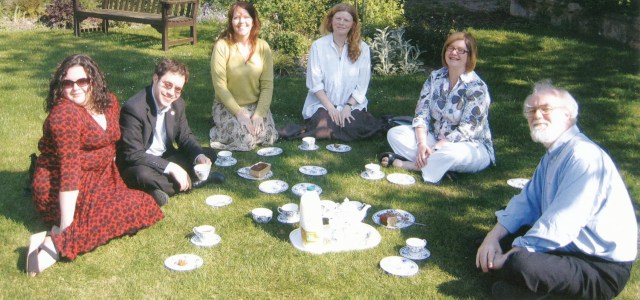
Necessary qualification for the next Archbishop of Canterbury

A willingness to sit on the grass and have tea with visitors.

Here’s a picture from last year’s annual review from Westcott House in Cambridge, England. You wouldn’t notice it if you didn’t know what you were looking for but there’s the current occupant of St. Augustine’s chair, getting his trousers grassy and having tea with visitors.

I hope the next Archbishop of Canterbury is like that.

“What we have here is a failure to communicate!”

Here is a story that should come as no surprise to anyone:

The Anglican Communion faces a shortage of qualified communicators, according to an international Working Group on communications. The group—consisting of communications professionals from five continents—concluded that the Communion life was at risk of being detrimentally affected by some Provinces’ inability to source and share their news and stories widely.

In my travels around the world church, I routinely encounter fascinating, inspiring, and transformative work that is going on—and realize almost no one else knows about it. I’m convinced that communications is part of the church’s missional witness to the world but we’re not doing a great job of it.

Here are at least some of the reasons why I think this is happening:

  • English is the de facto language of the Communion. If you are among the majority of Anglicans who do not speak English as a first language, you might not want to write down your story and share it. Many Anglicans, I’ve learned, are eager to talk in person about what they are doing but reluctant to commit those same thoughts to paper, at least in part, I think, because they think they lack the ability to do so.
  • Folks engaged in the most fascinating ministry around the world often spend so much of their time in ministry that they don’t make the time to tell their story. This is a perfectly understandable impulse but it is one that drives me crazy. We want to hear your story! We want to be able to pray for you and support you and we can’t do that unless you tell us what is going on.
  • People are humble. This is wonderful. Lots of people I’ve met engaged in transformative ministry around the world just don’t think that what they’re doing is all that important and can’t see why anyone else would want to know about what they’re doing. Humility is a great Christian virtue—but a little well deserved tooting of one’s own horn wouldn’t be the worst thing in the world.

And so we get stuck in the position we are in now: no one really knows what else is going on around the world church. The loudest, shrillest, and most destructive voices dominate the conversation. And everyone thinks we’re falling apart. But we’re not. I’m really convinced of that. We just need to tell the story better.

Part of the reason I wrote my book, Grace at the Garbage Dump, is to counter exactly this tendency towards miscommunication. It tells the story of work in one diocese in one particular province. But books like it could be written of the work in countless dioceses around the world.

Episcopal / Anglican Slogans

Last semester in class, we made a list of slogans, phrases, ideas, objects, etc. that we’ve heard in conversation about or relating to the Episcopal Church, Anglicanism, or any part thereof. Here’s a partial list:

  • the three-legged stool (that is, Scripture, Tradition, and Reason)
  • lex orandi, lex credendi—the way we worship shapes/determines/is what we believe
  • a logo that features a shield with obscure heraldry
  • “no outcasts”
  • Via Media, or Middle Way
  • “The Episcopal Church Welcomes You” (to what?)
  • Dispersed Authority
  • The Four-Fold Anglican Shape: formed by Scripture, shaped by worship, ordered for Communion and directed by God’s mission (this is the most recent, I’d say)
We can debate some of these later, especially whether their current interpretations and usages match up with the original usage, whether the authors meant for them to have such defining weight (in the case of dispersed authority, definitely not), and whether they are even consistent. What struck me as we did the list is that you could make a similar list of slogans related to Episcopalians/Anglicans and mission:
  • Mutual Responsibility and Interdependence in the Body of Christ (1963 document from Toronto Anglican Congress)
  • Partners in Mission
  • Decade of Evangelism (the 1990s, as set by bishops at Lambeth 1988)
  • Millennium Development Goals
  • Five Marks of Mission

(Indeed, the word “mission” itself could almost be added to this list, given the reckless abandon with which it has been used in recent years.)

I don’t find many of these particularly helpful. I can never remember the Five Marks of Mission, mainly because they don’t really grab me. I think the Millennium Development Goals promote a shopping-list mentality among churches that prize dollars and cents over relationships. The Decade of Evangelism is very well-remembered in the non-western Anglican Communion (an archdeacon in Nigeria last summer told me, “The Decade of Evangelism saved the Church in Nigeria”) but I rarely hear anyone in the U.S. talk about it.

The thing of it is, despite our wonderful slogans we still seem to have difficulty articulating what the Episcopal Church is and is for (though we seem to have no problem articulating what it is not). And, we lack a clear sense of what mission is, which results in something like the Sauls’ resolution’s very thin idea of mission.

There is much to find depressing in all this but two stand out. First, these slogans replace genuine theological engagement with inconsistent and confusing sound-bites. Second, they betray the assumption that we all know what we’re talking about when we say something so we don’t need to bother figuring out what it means. This is never a good assumption to make.

As far as mission goes, there’s a third disappointment: all of these are focused outward. This is, obviously, quite good. But I’d hope that we remember that in order for us to be a missional church, we need first to be transformed by the love of God in Christ to become missional Christians. Mission is our response to God’s grace—but we need to receive that grace before we can respond.

What are your favourite slogans that I’ve left out?

UPDATE: Welcome to all who are clicking over here from Episcopal Cafe. If you like this post, you might like some others I’ve written about mission lately: the spirituality of mission or how our understanding of mission shapes our budgetary decisions.

Demographics is Destiny – Evangelicalism and Anglicanism

Last night, our community service at Berkeley Divinity School was in the style of Anglican evangelical worship—think Holy Trinity Brompton or Holy Trinity Cambridge: praise band, a Eucharistic prayer I wrote which only quoted the writings of St. Paul, the whole works.

The idea behind the service was to challenge our understandings of what constitutes distinctively “Anglican” worship. Evangelical churches may worship in ways other than those set out by the prayer book but still consider themselves Anglican. (I experienced something of this when I was studying in England a while back.) There was some, predictable, grumbling about the service. Evangelicalism, for a variety of reasons, has historically been weak in the American church so it can seem particularly foreign to us.

By chance—and this is the kind of thing that happens when you go to a place like Yale/Berkeley—we had with us last evening principals of two English theological colleges, Martin Seeley of Westcott House and George Kovoor of Trinity Bristol. (Rev. Kovoor is also the international general secretary of the Evangelical Fellowship of the Anglican Communion, which, I think, raised the stakes for our praise band a bit. They rose to them. Of all the guests to have on all of the nights, this was pretty ironic.)

Westcott is a moderately Anglo-Catholic place where I once spent a term. It has maybe 70 to 80 students training for ordination. I was chatting with Rev. Kovoor after the service and learned Trinity Bristol has 160 students training for ordination in the Church of England. Now, these are not the only training colleges in the Church of England, but these numbers should, I hope, give pause to those of us who sometimes are eager to dismiss evangelicalism as not truly Anglican (as if we can somehow get to decide that). If demographics is destiny, it seems like the evangelical wing of the church is certainly in a good position.

And, if one purpose of our seminary training is about learning about the breadth of the church and preparing for the future church, then a single evening of evangelical worship seems like a very good thing.

Our senior student preacher, Josh, put his sermon on YouTube

The Cross in our Midst in Holy Week

There are many seemingly intractable situations in South Sudan but one that has gotten a fair bit of attention recently is the ongoing violence in Jonglei state. As we sit in this Holy Week, there is an update on the situation, in the form of a report from Daniel Deng Bul, Archbishop of the Episcopal Church of Sudan and a lead negotiator in Jonglei.

The Committee feels that there is a new momentum for peace in Jonglei State at all levels, from the grassroots right up the national government. We appeal to all stakeholders within Jonglei and South Sudan to put aside their differences and take this opportunity to work together for peace, reconciliation and tolerance. Enough is enough.

We appeal to all to speak the language of peace, reconciliation and tolerance, particularly our diaspora and intellectuals. We must all accept responsibility for what we say and what we do, to give peace a chance in Jonglei and the whole of South Sudan.

I highlight this for two reasons. First, it’s a reminder of the way our sisters and brothers in Christ around the world are on the frontlines of some difficult situations. It’s one thing, as I did last night, to sit and look at images of violence in the world and reflect on daily crucifixions in this world. It’s entirely another, as members of Archbishop Daniel’s commission will do tomorrow, to visit devastated villages on Good Friday and see the cross in our midst.

Second, it is always worth highlighting—since it seems it is so easily forgotten—that in many parts of the world, it is the church that is the active agent for peace and reconciliation in society, in part because that is the church’s calling but also because in some cases the church is the most well-established organization in society.

Daniel Deng Bul, incidentally, was recently nominated by a British think-tank for their person of the year award.

“The church speaks the language of reconciliation. Not the government.”

I am a reader of The Economist, the British news magazine that has, to my knowledge, more foreign correspondents than any print news organization in the world. The Economist covers events even after they drop from the headlines in the rest of the world’s media.

But even it can falter. I thought about that while reading about the primate of Canada’s recent visit to the Church in Melanesia. Part of the visit included time in the Solomon Islands with Fr. Sam Ata, an Anglican priest and chair of the Truth and Reconciliation Commission in the Solomons.

Let’s be honest. How many of us are aware of the ongoing process of recovery in the Solomons following the violence between 1998 and 2003? How many of us know that this TRC process has been ongoing for some time? Not even The Economist has been giving much play to it.

And yet—there is the church. When the eyes of the world are turned away, when even sister and brother Anglicans are focused on a proposed covenant, the sex (or sex life) of its bishops, or any of a myriad of other things, the local church in the Solomon Islands remains an instrument of peace and reconciliation.

It reminds me of the church in South Sudan, a place where I’ve spent some time. There, in intensely poor and incredibly remote parts of the country, the government’s remit does not run. But the church is still there, running schools, building clinics, feeding refugees, and much else; “preaching good news of peace” (Acts 10:36) in other words. When society is on the verge of breakdown because of inter-tribal violence, who does the government ask to negotiate peace? The church. No one else has the authority, the stature, or the ability to do so.

So, as at least part of the attention of the church is occupied by a defeated covenant, a proposal for “radical hospitality,” and conversation (dare I call it naval gazing?) about church structure, spare a thought for our sisters and brothers in Christ around the world on the frontlines of some of the most difficult and intractable situations imaginable.

And then ask yourself: how can we support our fellow members in the one body of Jesus Christ?