Nigerian students and the Anglican Communion

The threat which many young women face as they seek education in northern Nigeria has been forcefully brought home in recent weeks by the abduction of several hundred young students.

Not long ago, I visited an Anglican diocese not far from where the students were recently abducted. On that visit, I learned from Bishop Marcus Ibrahim and others in the Diocese of Yola about the church’s outsize role in education and the vital importance of English-language education for all students, regardless of gender.

I wrote about the church’s role in education in my new book, Backpacking through the Anglican Communion. Here’s an excerpt.

A major focus of the diocese’s work was education. The weakness of the government in Nigeria means it has essentially abdicated any role in schools. When he became bishop, Marcus started the Anglican Junior Seminary Yola, a secondary school. When I visited, there were about sixty students at AJSY, and they met in an old house that had been donated by a family in the diocese. The language of instruction is English, unlike many of the Islamic-run schools in the area, and the school admits boys and girls equally, making AJSY one of the few institutions in the state that educates girls in English. I was asked to speak to an assembly, and was impressed by how articulate and interesting the students were. They had very good and challenging questions for me and were promising young Nigerians. It was clear, however, that the house was too small. The assembly met while crammed into what I imagined was the main living space, with students standing against walls or sitting on the ground with their knees scrunched up against their chests to make space for the people around them.IMG_2683

Marcus took me out to see the spacious piece of land the diocese purchased on the edge of Yola to build a new school. Progress was coming, but it was slow. In the two years prior to my visit, the diocese raised the funds necessary for three classroom blocks, which have enough space for double the number of students currently enrolled. But delays in building the dormitory meant the school was not yet able to open. The builders had completed the dorm’s foundation, but then the money ran out. Marcus and I walked across the foundation, and he pointed to where the individual rooms and communal spaces would be. He was bubbling over with excitement about the possibilities of the school, sketching in the dirt possibilities for expansion once this initial site was up and running.

All the money for the construction had come from Nigerians, some from donors who lived outside the diocese, but much from members of the diocese. At a diocesan council meeting I attended, the conversation centered on raising funds for the four hundred bags of cement necessary to finish the dorm. Each bag cost about fifteen dollars. Council members brainstormed ways to raise the money: Ask each deanery to contribute a set amount? Approach the richer members of congregations? Eventually, they settled on assigning each congregation a specific number of bags of cement to provide based on the congregation’s size and average offering in the past year….

“Have you looked for any international support?” I asked Marcus when we were at the school site. Off the top of my head, I could think of several organizations that were interested in funding projects exactly like this one.

“We have,” Marcus said, in a tone that combined disappointment, frustration, and regret. “But no one will help us. They think because of the problems in the Anglican Communion that they can’t work with us in Nigeria.”…

“Look,” Marcus said. “I want to build this school. Children need to be educated. Girls need to be educated. That’s not happening in Yola. Anglicans can work together on this.” We let the words hang in the air. We both knew that. But how could other people come to know?…

The sun was setting. We stood on the foundation and looked back at the future AJSY together. The empty classroom blocks and the dormitory foundation, as well as the students crammed into classrooms in an old house, represented the real-life lost opportunities that result from the narrative of disunity in the Anglican Communion, a narrative that has been propagated by some of its most senior members. Marcus and I were testament to the utter wrongness of that narrative. But our story would never seize headlines or lead to special meetings of Anglican leaders. As we headed back to the car, my steps were heavy with deep, profound sorrow.

As we pray for the return of these kidnapped students, we also pray for the grace to act to ensure an educated future for all in the region who want to learn.

When I initially visited the school, I wrote about it in two different posts. You can also read more about how the Nigerian government has abdicated its role in education in this post, about a visit to a different school in southeastern Nigeria.

Crucifixion in Abuja, Nigeria

On this day, Good Friday, Christians commemorate one moment of crucifixion two thousand years ago—but we also reflect on all the other moments of crucifixion that continue to take place in our world even today.

One moment of crucifixion this week was the bombing of a bus station and market outside Nigeria’s capital, Abuja. It is a moment of crucifixion whenever innocent people are killed, whenever violence tears apart our societies and brings grief and suffering in its wake. When I saw this picture, I thought of the women with Jesus at the cross reacting to his death sentence and execution.

I was in Nigeria in June 2011 when a similar bombing happened at Nigeria’s police headquarters in Abuja. I was well away from Abuja but what I remember so clearly about that time was how on edge everyone was afterwards. It’s understandable. These kinds of killings make us question what we think we know about our safety and security.

I particularly remember all the rumours I heard in church on the Sunday after the 2011 bombing. One rumour in particular was making everyone nervous: Boko Haram, the Islamist group thought to be behind the attacks, had tried but failed to bomb a church in the town of Enugu, not far north from where I was. Not only for me, but for everyone else, this brought the terror home in a deeply personal way: was our church next? Would we be the next victims? And if not us, what about friends and relatives at other churches in the region? I never actually learned if the the rumour of what had happened at Enugu had any truth to it but it had clearly done its job: everyone was on edge.

An environment like this, so shaped by such pervasive insecurity, shapes one’s approach to the gospel and to church. Some months back, when a Nigerian archbishop was kidnapped, I posted an excerpt of my book, Backpacking through the Anglican Communion, that reflects at greater length on how the Nigerian church is shaped by this context. In brief, however, people come to church looking for assurance, constancy, and steadfastness. They want to hear about a God who protects (when it seems no one else will) and who will defeat one’s enemies (when it seems no one else can). The result is a church that is about confidence, steadfastness, and fidelity to a particular interpretation of the Bible.

But what these holy days remind us is that this is not the only approach to crucifixion. Christ’s response to crucifixion was not to return as a vengeful, wrathful victim, seeking to inflict retribution on those who had wronged him. Rather, Christ’s response to crucifixion was to return to life as a forgiving, reconciling presence whose followers sought to create a new community that would include even those who had once put their leader to death.

Although the church makes the journey in a handful of days, it can take a long time to go from the crucifixion of Good Friday to the forgiveness of the risen Christ. Indeed, it is the journey of a lifetime. But it is the journey that all Christians are called to make, a journey that begins not in a place of strength but in a place of weakness and humility.

Crucifixions remain all around us in this world of ours. But Christians know that Good Friday is not the end of the story.

And that is good news.

Backpacking excerpt in the Church Times

The Church Times this week publishes a lengthy excerpt of my new book, Backpacking through the Anglican Communion. In the excerpt, I describe the practice of “appreciation” I witnessed at a Nigerian church conference and wondered how to square it with the church’s Jerusalem Declaration.

With one exception, it was not all that different from what I remembered at the stewardship-ingathering Sunday at my home church in the US. The difference was that, as they approached the bucket, each man took the microphone, said his name, gave a short speech thanking the Bishop, and announced how much he was giving. After each announcement, there was applause, its volume dependent on the size of the gift.

While the appreciation continued, I flipped through the copy of the new Nigerian prayer-book I had been given a few days earlier. At the back is printed the Jerusalem Declaration, the manifesto that came out of the 2008 meeting of GAFCON in Jerusalem, which Nigerian bishops attended instead of the Lambeth Conference.

My eye was drawn to the declaration’s second point: “The Bible is to be translated, read, preached, taught, and obeyed in its plain and canonical sense, respectful of the Church’s historic and consensual teaching.”

As I looked up from the Jerusalem Declaration and watched the men with their envelopes, Jesus’s instruction in the Sermon on the Mount came to mind: “When you give alms, do not let your left hand know what your right hand is doing, so that your alms may be done in secret, and your father who sees in secret will reward you.”

No matter how I tried to square it, the appreciation seemed in direct contravention of Jesus’s teaching. There was nothing secret about this appreciation. It fact, publicity was its purpose. It seemed impossible to reconcile the desire to read and obey the Bible in its “plain” sense with what I was seeing in front of me.

The excerpt has no shortage of pictures, including this one of the appreciation.

IMG_1937

In the excerpt, I describe talking to a wide range of people about the issues before the Anglican Communion, including, of course, homosexuality.

Later, at a separate diocesan conference I attended, I sat next to Eugene, an older priest not far from retirement. He had fought for the Biafran rebel army, and then had a career as a secondary-school teacher.

His ecclesial ambitions were no greater than faithfully pastoring his congregation. We amiably reflected on the divisions in the Communion.

As our conversation came to an end, he said: “These problems have hurt our association in the past few years. But flexing our muscles, left and right, does not solve any of our problems. I don’t think we need to be in a hurry. With the passage of time, we can come to a greater understanding of each other.”

He looked at me: “You need to learn more about Nigeria, and we need to learn more about you. After all,” he said, “we are all Anglicans.”

Read the whole excerpt. Or just go out and buy the book yourself.

“I’m not dead yet.” -The Anglican Communion

I have been staying up late several nights this week finishing the proofs of my new book about the Anglican Communion. It is a book that argues that not only is unity in a world communion possible, it is a vital part of that communion’s witness to the world.

Then I woke up this morning to read that Andrew Brown (“England’s most sanctimonious atheist,” in the words of one Church Times letter to the editor) thinks the Anglican Communion is dead.

Wow. Poor timing on my behalf.

But then I started reading the article and wondered just what grounds Brown had for making his case.

We might notice that his article commits more or less all the errors I outlined in a previous post about writing about the Anglican Communion—he doesn’t travel anywhere, he relies mostly on bishops and men as sources, etc., etc.

He writes, for instance of the Church of Nigeria, that it doesn’t matter how “many Anglicans there are there and however sincerely they seem to hate gay people.” I read that and I think, “Has he ever actually been to Nigeria? Are we talking about the same church?” Were people who write about the Anglican Communion to start moving from behind their computers and instead spend their time and money visiting with Anglicans, I think the story they would find is different. Instead, everyone sits comfortably in their prejudices and certainties and shows little desire to change that situation.

On the other hand, perhaps the Anglican Communion is dead. Perhaps the days when our understanding of the Communion was constituted almost solely by what bishops and other men had to say are coming to an end. Perhaps we can now start listening to the voices of the young, the female, the non-ordained and see that they are hardly in lockstep agreement with what their bishops have to say.

The core of my faith is the belief that death is not the end. Maybe we can pray that the death of our current forms of relationship will lead to a resurrection in newness and fullness of life.

Maybe.

But it’s going to take a willingness to move beyond the same old ways of doing business.

Thomas Bray’s unfinished project

About eighteen months ago, I spent some time at a seminary in Nigeria. Shortly after having a contentious conversation with a group of students’ wives about homosexuality, I peeked into the library. This is what I saw:IMG_1774

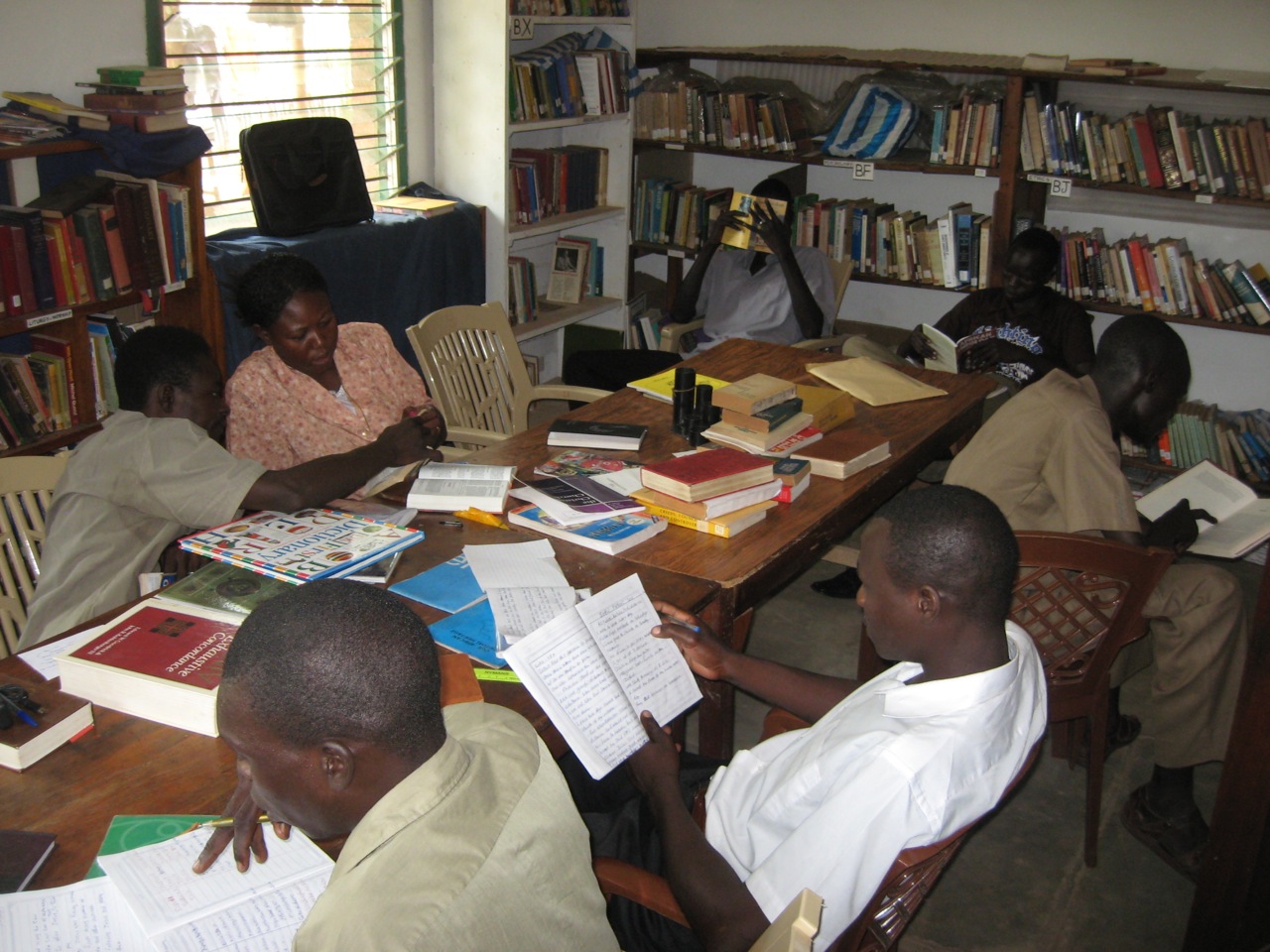
I’ve also spent time at a seminary in South Sudan. There, I also found a lot of people who found homosexuality to be difficult to reconcile with Christianity. Their library looked like this:IMG_2652

At Yale, where I went to school, I had access—literally—to millions of volumes and all the latest scholarship. At both these seminaries, the books are relatively few and are overwhelmingly old: there were few that were less than thirty years old. Yet at both places, I found students who were eager to read whatever they could get their hands on.

Think about where theology and the church were thirty years ago on the question of homosexuality. In that context, is it any wonder that we have such sharp disagreements on these issues?

The church commemorated last week Thomas Bray, a seventeenth century priest, who was instrumental in founding the Society for Promoting Christian Knowledge (SPCK.) (He was also involved in founding the Society for the Propagation of the Gospel, which was instrumental in bringing the church to the American colonies.)

Bray’s idea in founding SPCK was that Christians should have access to Christian scholarship and literature. He envisioned libraries in churches and an educated clergy. SPCK helped start some of the first libraries in the American colonies that focused on church-related material.

When we look at these libraries in places like Nigeria and South Sudan, we are reminded that Bray’s work is not yet done. There are really important insights of the last generation that have not been shared yet with our sisters and brothers around the world, and not just on questions of sexuality. (The Anglican Theological Review’s Seminaries Abroad Gift program is one very small way in which this work is being done.)

The commemoration of Thomas Bray is an opportunity to reflect on a visionary Anglican. But more importantly, it’s a chance to reflect on the vital need to continue his important work.

“The authority of God’s word written over all contexts”?

For a variety of reasons, I’ve been thinking a lot recently about my travels a year ago to visit with Anglicans in Nigeria. Readers of this blog might remember I encountered a curious practice. At major church events, there was the practice of “appreciation”: members of the congregation stood up, donated money to the church, and said exactly how much they were giving. (You can read my description of that event here.)

As I witnessed this, I thought about Jesus’ instruction on giving in the Sermon on the Mount:  “When you give alms, do not let your left hand know what your right hand is doing so that your alms may be done in secret; and your father who sees in secret will reward you.” (Matthew 6:3-4, NRSV) I mentioned this verse to several people I encountered at this service. They readily admitted the practice did not conform to the teaching but shrugged and said, “It’s our culture.”

We can debate the merits of public giving in another post. For the record, in a culture that has a huge problem with corruption, I’m open to the idea that disregarding Christ’s teaching on this count might be a reasonable accommodation to make to Nigerian culture.

I just wish Nigerian church leaders would cut the rest of us some slack. The Nigerian and Kenyan delegates to the recently-concluded Anglican Consultative Council meeting in New Zealand have released a reflection document titled “What really happened in Auckland NZ at ACC-15.” I think there are some important points in here but I was disappointed to see the strong emphasis on the apparent un-Biblicism of many Anglicans. To wit:

While there were many reports and resolutions at ACC-15, we wish to highlight our concerns over the report and the resolution on “The Bible in the Life of the Church” project…. However, we are seriously concerned that the context in which people interpret the Bible is considered as important as what the Bible actually says.

The Bible stands over context, not the context over the Bible. God’s Word changes us—we do not change God’s Word….

We call upon all Anglicans to pray that our beloved Communion will stand firm in honouring the unique and universal Lordship of Jesus Christ as the Son Of God, and the authority of God’s Word written over all contexts, and in every matter of faith and practice.

I have no doubt of the sincerity behind this statement and the strong belief in the supremacy of the Bible. I just think that a more productive place from which to begin conversations about the life of the Bible in the Anglican Communion is to acknowledge that all of us—whatever our cultural background or context—fall short in allowing ourselves to be transformed by the revelation of Jesus Christ as entrusted to us in the Bible. Surely from that point of common ground, we can begin to make progress in our inter-Anglican conversations?

“This is a time for optimism and faith in the church”

So it’s official. Justin Welby, the Bishop of Durham, will be the next Archbishop of Canterbury.

His first press conference was fascinating and, I thought, quite impressive. He expressed his hope for the future of the church—as I’ve quoted in the title of this post—and answered questions (at least the ones I saw before the BBC cut away) with skill. The friends I have in the Diocese of Durham speak very highly of him.

Three things I appreciated about what I saw of his introduction:

  • He wants the church “to be a place where we can disagree in love.” I so strongly share this view and it was so encouraging to hear him highlight it.
  • He is “always averse to the language of exclusion when what we are called is to love in the way Jesus love us.” He challenged himself to listen to the experiences of those he does not know about, referring especially to the LGBT community here. Just wait until the conservative Anglican polemicists jump on him for this. I hope he ignores them.
  • His pectoral cross is (and I believe I’m correct about this) the Cross of Nails from Coventry Cathedral. This is a symbol of the powerful reconciliation work that has emerged from that cathedral since it was destroyed in World War II and which Welby was involved with before becoming Dean of Liverpool. Reconciliation is at the heart of the Gospel and I’m encouraged he has been so involved with this work in its many forms.

As I’ve written, I think Welby’s appointment could be a moment when Anglicans begin to move beyond (but not resolve) the battles of the last decade or more, given his apparent credibility with evangelicals and the church in Nigeria.

The response to his appointment so far seems to have been fairly positive. I take that as good news and as a hopeful sign for Anglicans around the world.

For now, however, Welby goes back to Durham until the end of the year and the fevered speculation can come to a rest. We’ll have to wait until March 21 and his installation to see how all this unfolds.

A Nixon goes to China moment for Anglicans

Sometimes in life, to really make progress, you need to have someone do the unexpected. Richard Nixon’s visit to China was one such moment. A man with an uncompromising stance towards communism was the one who changed the nature of relations between the United States and China. It took a Democratic president, Bill Clinton, to sign welfare reform into law. In order for change to happen and for it to really “stick”, you need someone who comes from the opposing view but has been brought around to a new view. It is these moments that mark the change as permanent.

The conflict over sexuality in the Anglican Communion has thus far pitted two (at least) sides firmly against one another, with each trying to gain the upper hand. On one level, this is fine; it’s how democracy, ecclesial or otherwise, works.

But I’ve been thinking lately that for true progress to really stick—and for Anglicans to move forward—it’s going to take something more. In that regard, Rowan Williams was never the right person to make progress on this issue. Whatever his merits as archbishop and as a theologian—and I believe they are many—he was always too identified with the “liberal” group to be trusted on this issue.

There are hints that Williams’ successor will be Justin Welby, the Bishop of Durham, and a man who, from what I can gather, was heavily influenced by Holy Trinity Brompton, a church at the heart of Anglican evangelicalism, and who has worked closely with the Nigerian Anglican Church. Yet there are tantalizing hints that his views on sexuality questions are more nuanced and complex than that traditionally associated with conservative evangelicals or Nigerian Anglicanism.

Perhaps Welby is the person who will be able to move Anglicans beyond the trauma of the last many years. I don’t know quite what it will look like but I am coming to believe that it is only a person with “conservative” bona fides who will be able to help Anglicans move past this issue and onto the many other pressing issues we face.

I can dream, can’t I?

“Anglocostalism” in Nigeria and Obstacles to Anglican Unity

One of the most important developments in the world church in the last few decades has been the rise of neo-Pentecostalism, sometimes called the “Born Again” church. These denominations, particularly prevalent in Africa, are marked by their concern with spiritual healing, the preaching of the prosperity gospel, fixation on a world of good and evil forces, and much else.

What is perhaps less remarked upon is the way in which these neo-Pentecostal churches have influenced the historic mission denominations, including the various provinces of the Anglican Communion. This is one of the main things I learned on my travels in the church in Nigeria last summer. (The observations prompted the post, “What is Peter Akinola Afraid Of?”)

The Journal of Anglican Studies has just published my article, “‘Anglocostalism’ in Nigeria: Neo-Pentecostalism and Obstacles to Anglican Unity,” which takes a close look at how what it means to be Anglican is changing in Nigeria.

Here’s the article’s abstract:

In the last several decades, the religious landscape in Nigeria has been transformed by the rise of neo-Pentecostal or ‘new generation’ churches. These churches teach a gospel of prosperity, advance an oppositional view of the world, focus on a supernatural arena of spiritual forces, accord a unique weight to the Bible, and practice a charismatic worship style. One result of the presence of these churches has been to change the face of Anglicanism in Nigeria. Concerned about the possibility of diminished influence and prestige, the Church of Nigeria (Anglican Communion) has responded to neo-Pentecostal churches by adopting more of its rivals’ beliefs and practices. This paper argues that this changing environment explains, in part, Nigerian opposition to efforts at global Anglican unity and argues that it is impossible to address the future of the Anglican Communion without first understanding the on-the-ground religious context in Nigeria.

It’s an academic article, which means it’s a bit longer than a regular blog post, but I hope you’ll have a read through. Already, in the few weeks since the article went online, I’ve been pleased with the e-mail conversations this article has generated with people in the Nigerian church. I’d be happy to expand those conversations to folks elsewhere.

As I have travelled in the world church, I’m repeatedly reminded of just how little we know about each other around the world. This article—and others like it, still in the pipeline—are efforts to help increase that sense of mutual understanding.

Anglican Communion awareness increasing?

The Episcopal News Service has a lengthy article today that follows up a lot of the questions raised at General Convention about the Church’s huge cuts to funding for the Anglican Communion Office. It also makes some grand claims about the nature of the Anglican Communion nine years after the election of Gene Robinson as bishop of New Hampshire.

Here’s the article’s lede:

The world’s 80 million Anglicans are much more aware today than they were 10 years ago that they belong to a global communion, a realization that has led to a flourishing of international relationships between the Episcopal Church and other provinces, dioceses and individuals.

Although the article claims to be concerned with Anglicans all over the world, the only evidence it musters is in the Episcopal Church. This is a hallmark of one of the most depressing of all American characteristics, namely the willingness to generalize from quite particular experience. To write an article like this merely reinforces what many people around the world already think: Americans are self-centred, solipsistic, and parochial.

The thing is, our brother and sister Anglicans around the world have known and cared about the Anglican Communion for a lot longer than many Americans have. When I traveled in the church in Nigeria (where 1 in 4 of those 80 million Anglicans live) last summer, one of the aspects of the church that was most noticeable to me was the way Nigerian Anglicans cared about being part of the Communion. The official name of the church is Church of Nigeria (Anglican Communion). When you leaf through a diocesan newsletter, there’s plenty of material about other Anglicans around the world. In a remote diocese in South Sudan a few years back, I was asked what I thought about Rowan Williams’ decision to deny Katharine Jefferts Schori her mitre on a visit to England. In a remote Bible college in a China, I was once asked about the Anglican Communion. It’s the Americans who have woken up and smelled the Anglican Communion coffee in the last decade. The rest of the world, at least, was already aware.

My sense of the last decade is that the American church, particularly its liberal wing, has been rushing to catch up with the rest of the world in terms of understanding itself as part of a global Communion. For a variety of reasons—including prioritizing domestic concerns, feeling unsure about how to relate to newly-independent churches, and so forth—the Episcopal Church began a fairly large retreat from its global commitments in the late 1960s all the way through the 1990s. This, in many ways, set the stage for the “crisis” of the last decade.

In 1963, Anglican lay people, priests, and bishops from around the world got together for an Anglican Congress in Toronto. One of the speakers was a man named Howard Johnson, who, a few years prior, had completed a two-year tour of every province in the Anglican Communion. At the Congress, he had this to say:

We Anglicans stumbled into universality – prodded, I believe, by Providence. But our consciousness of ourselves has not yet caught up with the reality of ourselves. In actuality we are a multiracial, multilingual, multicultural body, but in awareness we are still parochial and provincial.

My sense is that Johnson’s observation is still largely correct. It is true, however, that the election and ordination of Gene Robinson means that Episcopalians now know more than they used to about the Anglican Communion whether they like it or not. But has that had the positive impacts the article claims? On that question, I think, the jury is still out.